My commentary will focus on a specific point in the target article, relating to the formation of conjunctions, either of subjective probabilities or of degrees of category membership.
Consider people's tendency to overestimate conjunctive probabilities in the famous Linda case (Tversky & Kahneman Reference Tversky and Kahneman1983). The QP model (P&B, Fig. 2) explains the conjunction fallacy as follows. By projecting the initial state vector (Linda) first onto the “feminist” vector, the angle with the “bank teller” vector is thus reduced, and, therefore, the projection to “bank teller” via “feminist” is stronger than the direct projection straight to “bank teller.” To explain this effect psychologically, they then offer the following suggestion: “once participants think of Linda in more general terms as a feminist, they are more able to appreciate that feminists can have all sorts of professions, including being bank tellers.” In some way, Linda is more easily imagined – perhaps she seems more real – so that being considered a feminist makes it more likely that she might also be a bank teller.
This is a totally novel explanation for this effect. Remember that the initial story about Linda (that she was a liberal in college) makes it very likely that she is a feminist. It is unclear why consideration of her being a feminist should then increase the subjective likelihood of her having an improbable job for a graduate such as being a bank teller. This explanation bears no relation to the traditional use of representativeness to account for the conjunction fallacy.
The conjunction fallacy bears close resemblance to another phenomenon, also mentioned by P&B: the overextension of category conjunctions (Hampton Reference Hampton1987; Reference Hampton1988b). For example, people are more likely to categorize chess as a “sport that is a game” than as simply a “sport,” in much the same way that they judge Linda as more likely to be a feminist bank teller than simply a bank teller. The effect occurs across a range of different categories (for example a ski-lift is more likely to be considered a “machine that is a vehicle” than it is to be considered a vehicle, or a refrigerator is more likely to be a “household appliance that is furniture” than it is to be simply “furniture.”)
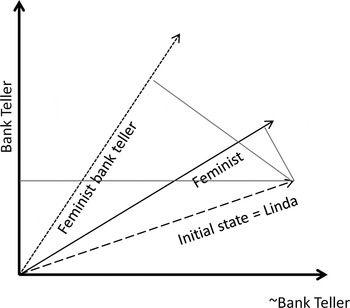
The composite prototype model (Hampton Reference Hampton1987; Reference Hampton1988b) developed to handle such cases proposes that the two conjuncts (for example, feminist and bank teller) are composed into a single composite concept, by merging their intensions (their associated descriptive properties). Therefore, a sport that is a game will have properties inherited from sports (competitive, skilled, and physical) and also from games (rules and scoring). Further elaboration of the representation may then take place to improve the coherence of the new composite (Hampton Reference Hampton, Ward, Smith and Viad1997). In terms of Figure 2 in P&B's article, a new vector would be formed for the conjunction that roughly bisects the “feminist” and “bank teller” vectors, as in Figure 1 here. As a consequence, provided the initial state vector lies outside the angle formed by the two constituent concepts (as here), the projection of the initial state vector onto the composite (conjunction) vector will always lie between the projections on the two other vectors.
Figure 1.
Construction of a new vector for feminist bank teller as intermediate between the two conjuncts.
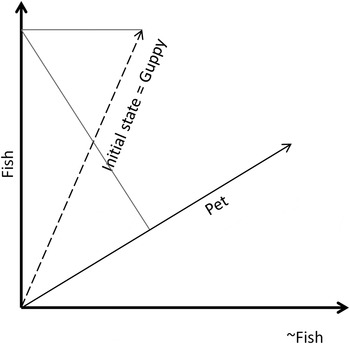
Figure 2.
The P&B projection from guppy to fish, and then to pet. The conjunction can never be greater than both conjuncts.
In psychological terms, Linda has many properties in favour of her being a feminist, and hardly any in favour of her being a bank teller; therefore, she has a moderate number of properties suggesting that she is a feminist bank teller. The two degrees of similarity are averaged. According to the representativeness heuristic, subjective probability is assessed through similarity (number of relevant properties). Although the mechanism proposed by the representativeness heuristic is very different from that proposed by P&B, so far the predictions are similar. In terms of subjective likelihood, Linda should most likely be a feminist, next a feminist bank teller, and least likely a bank teller.
However, the two accounts can be dissociated. A critical test for the QP account concerns the so-called “guppy effect.” In categorization tasks, people will sometimes claim that something is a better example of a conjunction than of either of the conjuncts. In their famous critique of the application of fuzzy logic to conceptual combination, Osherson and Smith (Reference Osherson and Smith1981) pointed out that guppies could be considered better pet fish than they were either pets or fish. The account offered by P&B for conjunctions will have trouble with this result. If the initial state vector must first be projected to one vector and then onto the second, the probability must always be reduced each time (see Fig. 2).
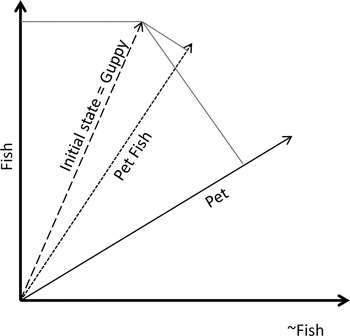
Therefore, it is not possible within this model to obtain this double overextension of conjunctions. In contrast, the intensional account offered by the composite prototype model does allow that an example can be more similar to the composite than to either conjunct. Pet fish lack some key properties of pets (they are not warm and affectionate) and also lack typical properties of fish (they are not caught in nets and fried with breadcrumbs). It is therefore quite feasible for an exemplar such as the guppy, which also lacks exactly these properties, to be a better fit to the conjunction than to either conjunct. Although much rarer than simple overextension of one conjunct, empirical data do in fact support the guppy effect (Storms et al. Reference Storms, De Boeck, van Mechelen and Ruts2005.) A better vector representation would therefore be that shown in Figure 3, where a new vector is created to represent the composite prototype of a pet fish, and the guppy projects more strongly onto this conjunctive vector than it does onto either the pet or the fish vectors.
Figure 3.
Projection from guppy to a new vector representing the combination pet fish allows it to be a better pet fish than it is either a pet or a fish.
In conclusion, as a psychological account of conceptual combination, QP appears to lack sufficient resources to handle the intensional reasoning that can be seen to characterize much of human thought (Hampton Reference Hampton2012). The notion of concepts as regions of subspace makes good sense, as it captures the vagueness and context-dependence of how concepts enter thoughts. However, the simple projection mechanism suggested in Figure 2 is unlikely to provide a rich enough framework to capture the ways in which concepts combine.





My commentary will focus on a specific point in the target article, relating to the formation of conjunctions, either of subjective probabilities or of degrees of category membership.
Consider people's tendency to overestimate conjunctive probabilities in the famous Linda case (Tversky & Kahneman Reference Tversky and Kahneman1983). The QP model (P&B, Fig. 2) explains the conjunction fallacy as follows. By projecting the initial state vector (Linda) first onto the “feminist” vector, the angle with the “bank teller” vector is thus reduced, and, therefore, the projection to “bank teller” via “feminist” is stronger than the direct projection straight to “bank teller.” To explain this effect psychologically, they then offer the following suggestion: “once participants think of Linda in more general terms as a feminist, they are more able to appreciate that feminists can have all sorts of professions, including being bank tellers.” In some way, Linda is more easily imagined – perhaps she seems more real – so that being considered a feminist makes it more likely that she might also be a bank teller.
This is a totally novel explanation for this effect. Remember that the initial story about Linda (that she was a liberal in college) makes it very likely that she is a feminist. It is unclear why consideration of her being a feminist should then increase the subjective likelihood of her having an improbable job for a graduate such as being a bank teller. This explanation bears no relation to the traditional use of representativeness to account for the conjunction fallacy.
The conjunction fallacy bears close resemblance to another phenomenon, also mentioned by P&B: the overextension of category conjunctions (Hampton Reference Hampton1987; Reference Hampton1988b). For example, people are more likely to categorize chess as a “sport that is a game” than as simply a “sport,” in much the same way that they judge Linda as more likely to be a feminist bank teller than simply a bank teller. The effect occurs across a range of different categories (for example a ski-lift is more likely to be considered a “machine that is a vehicle” than it is to be considered a vehicle, or a refrigerator is more likely to be a “household appliance that is furniture” than it is to be simply “furniture.”)
The composite prototype model (Hampton Reference Hampton1987; Reference Hampton1988b) developed to handle such cases proposes that the two conjuncts (for example, feminist and bank teller) are composed into a single composite concept, by merging their intensions (their associated descriptive properties). Therefore, a sport that is a game will have properties inherited from sports (competitive, skilled, and physical) and also from games (rules and scoring). Further elaboration of the representation may then take place to improve the coherence of the new composite (Hampton Reference Hampton, Ward, Smith and Viad1997). In terms of Figure 2 in P&B's article, a new vector would be formed for the conjunction that roughly bisects the “feminist” and “bank teller” vectors, as in Figure 1 here. As a consequence, provided the initial state vector lies outside the angle formed by the two constituent concepts (as here), the projection of the initial state vector onto the composite (conjunction) vector will always lie between the projections on the two other vectors.
Construction of a new vector for feminist bank teller as intermediate between the two conjuncts.
The P&B projection from guppy to fish, and then to pet. The conjunction can never be greater than both conjuncts.
In psychological terms, Linda has many properties in favour of her being a feminist, and hardly any in favour of her being a bank teller; therefore, she has a moderate number of properties suggesting that she is a feminist bank teller. The two degrees of similarity are averaged. According to the representativeness heuristic, subjective probability is assessed through similarity (number of relevant properties). Although the mechanism proposed by the representativeness heuristic is very different from that proposed by P&B, so far the predictions are similar. In terms of subjective likelihood, Linda should most likely be a feminist, next a feminist bank teller, and least likely a bank teller.
However, the two accounts can be dissociated. A critical test for the QP account concerns the so-called “guppy effect.” In categorization tasks, people will sometimes claim that something is a better example of a conjunction than of either of the conjuncts. In their famous critique of the application of fuzzy logic to conceptual combination, Osherson and Smith (Reference Osherson and Smith1981) pointed out that guppies could be considered better pet fish than they were either pets or fish. The account offered by P&B for conjunctions will have trouble with this result. If the initial state vector must first be projected to one vector and then onto the second, the probability must always be reduced each time (see Fig. 2).
Therefore, it is not possible within this model to obtain this double overextension of conjunctions. In contrast, the intensional account offered by the composite prototype model does allow that an example can be more similar to the composite than to either conjunct. Pet fish lack some key properties of pets (they are not warm and affectionate) and also lack typical properties of fish (they are not caught in nets and fried with breadcrumbs). It is therefore quite feasible for an exemplar such as the guppy, which also lacks exactly these properties, to be a better fit to the conjunction than to either conjunct. Although much rarer than simple overextension of one conjunct, empirical data do in fact support the guppy effect (Storms et al. Reference Storms, De Boeck, van Mechelen and Ruts2005.) A better vector representation would therefore be that shown in Figure 3, where a new vector is created to represent the composite prototype of a pet fish, and the guppy projects more strongly onto this conjunctive vector than it does onto either the pet or the fish vectors.
Projection from guppy to a new vector representing the combination pet fish allows it to be a better pet fish than it is either a pet or a fish.
In conclusion, as a psychological account of conceptual combination, QP appears to lack sufficient resources to handle the intensional reasoning that can be seen to characterize much of human thought (Hampton Reference Hampton2012). The notion of concepts as regions of subspace makes good sense, as it captures the vagueness and context-dependence of how concepts enter thoughts. However, the simple projection mechanism suggested in Figure 2 is unlikely to provide a rich enough framework to capture the ways in which concepts combine.