1. Multiple sequential judgments
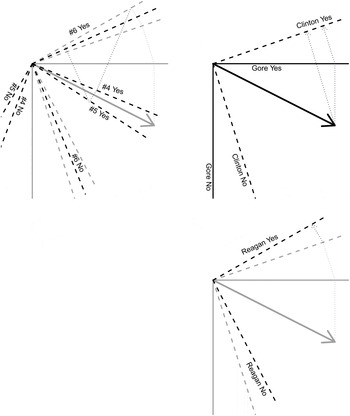
One of the basic tenets of quantum probability (QP) is that the order in which questions are asked of a person will affect how he or she feels about the answer. Pothos & Busemeyer (P&B) illustrate this sequential nature of QP using the Clinton/Gore attitude assimilation effect reported by Moore (Reference Moore2002). The key result is that the percentage of participants endorsing Clinton as honest increases by 7% when Clinton is rated after Gore, but Gore's honesty endorsement decreases by 8% when he is asked about after Clinton. Thus the politicians become more similar (assimilate) when they are asked about second (3% difference in endorsement rates) than when asked about first (18% difference in endorsement rate). This point is illustrated in Figure 3 of P&B, reprinted here as the top-left panel of Figure 1.
Figure 1.
Multiple sequential judgments lead to a belief state that comes ever closer to zero. See text for details.
P&B show that if the initial state vector is projected onto the |Gore yes> basis vector first, followed by the |Clinton yes> basis vector, Clinton will be judged as more honest than if the initial state vector is projected onto |Clinton yes> directly. Thus, the authors explain how asking about the honesty of Gore first, will lead to a subsequently more positive judgment of Clinton's honesty.
An unusual prediction that follows is that as these projections continue, the state vector will gravitate toward the zero point. As an illustration, consider the effect of asking successive questions about the honesty of additional presidents. We assume that subsequent questions have representations as basis vectors in the outcome space. Just as the state vector from |Gore Yes> is projected onto |Clinton Yes>, we assume that subsequent questions cause the state vector to project onto the next appropriate basis vector. As shown in Figure 1, as each state vector projects onto the nearest point of the next basis vector, subsequent state vectors will get shorter (by definition).
Although we agree that asking about the honesty of a number of politicians might put one in a progressively more suspicious frame of mind, it seems unlikely that the believability of any president should necessarily decrease (reaching close to zero in as few as 10 questions) as more questions are asked. Imagine, for example, if the sixth president was Lincoln or Washington.
A possible solution to this problem is to assume that the state vector somehow resets or recalibrates itself, perhaps because of a decay of the effect of initial questions (i.e., forgetting). P&B argue that one of the benefits of QP is that it is based on axiomatic principles, thus avoiding problems of “arbitrariness” common in other explanatory frameworks (e.g., heuristics). Adding a “recalibration” step would appear to be a post-hoc fix outside of the main principles, and as such, something that P&B are at pains to avoid. This example highlights why formal frameworks make such attractive theoretical tools: they make strong, testable predictions.
2. An appropriate benchmark?
Two criteria have been prominent in the search for an appropriate benchmark for probability judgment: correspondence and coherence (e.g., Hammond Reference Hammond1996). These terms, stemming from philosophy, invite different ways of assessing truth: via correspondence with observable facts, and via having a set of internally consistent (coherent) beliefs. Several commentators have argued that both criteria need to be considered for adequate assessment of judgments (e.g., Dunwoody Reference Dunwoody2009; Newell Reference Newell and Reisberg2013).
P&B argue strongly that coherence should be assessed against the axioms of QP not CP – hence allowing Linda to be more likely a feminist bank teller than just a bank teller – but what of correspondence? Consider the correspondence error that homicide is judged the more likely cause of death than suicide (e.g., Lichtenstein et al. 1978). Such a judgment is an error because it does not correspond with the fact that there are more suicides per capita than homicides. Such an “irrational” judgment emerges from the same cognitive system as the Linda judgment and, therefore, should, according to P&B's thesis, be explicable in the QP framework. Our intuition is that QP theory would explain this effect by constructing bases corresponding to representations of death from suicide, death not from suicide, death from homicide, and death not from homicide (in much the same way as bases are constructed for happy and ~happy in P&B's Fig. 1). It might be assumed that people's initial state vector, because of something akin to “availability,” is closer to the homicide basis vector than the suicide vector. This would lead to a larger projection, and, therefore, a judgment of higher probability of homicide than suicide.
Assuming that it is possible to construct such a space, one may ask what predictions QP theory would make were we to ask the participants to sequentially judge the likelihood of both suicide and homicide. To generate such predictions, however, we must first know whether, for example, the two questions are compatible. We must also know whether the initial vector lies between the homicide and suicide basis vectors, or between the homicide and not suicide vectors, for example. Such decisions about the parameters of the model influence the qualitative pattern that QP theory will produce, for example, that compatibility will determine whether we expect the judgments to be invariant to the order of the questions. Similarly, the location of the initial state vector, for incompatible questions, will determine whether the second judgment increases or decreases relative to when it was judged first. Although not relevant to the current example, the principles of entanglement and superposition have similar effects on the qualitative pattern that QP theory predicts.
To call the decisions about such principles in QP theory “arbitrary” may be going too far – P&B provide intuition for when we might expect some of these principles to hold (e.g., compatibility). However, we argue that an understanding of these unique aspects of QP theory, to the point that they are predictable, is a major issue that needs addressing before QP theory can vie to be the framework of choice.





 You have
Access
1. Multiple sequential judgments
One of the basic tenets of quantum probability (QP) is that the order in which questions are asked of a person will affect how he or she feels about the answer. Pothos & Busemeyer (P&B) illustrate this sequential nature of QP using the Clinton/Gore attitude assimilation effect reported by Moore (Reference Moore2002). The key result is that the percentage of participants endorsing Clinton as honest increases by 7% when Clinton is rated after Gore, but Gore's honesty endorsement decreases by 8% when he is asked about after Clinton. Thus the politicians become more similar (assimilate) when they are asked about second (3% difference in endorsement rates) than when asked about first (18% difference in endorsement rate). This point is illustrated in Figure 3 of P&B, reprinted here as the top-left panel of Figure 1.
Multiple sequential judgments lead to a belief state that comes ever closer to zero. See text for details.
P&B show that if the initial state vector is projected onto the |Gore yes> basis vector first, followed by the |Clinton yes> basis vector, Clinton will be judged as more honest than if the initial state vector is projected onto |Clinton yes> directly. Thus, the authors explain how asking about the honesty of Gore first, will lead to a subsequently more positive judgment of Clinton's honesty.
An unusual prediction that follows is that as these projections continue, the state vector will gravitate toward the zero point. As an illustration, consider the effect of asking successive questions about the honesty of additional presidents. We assume that subsequent questions have representations as basis vectors in the outcome space. Just as the state vector from |Gore Yes> is projected onto |Clinton Yes>, we assume that subsequent questions cause the state vector to project onto the next appropriate basis vector. As shown in Figure 1, as each state vector projects onto the nearest point of the next basis vector, subsequent state vectors will get shorter (by definition).
Although we agree that asking about the honesty of a number of politicians might put one in a progressively more suspicious frame of mind, it seems unlikely that the believability of any president should necessarily decrease (reaching close to zero in as few as 10 questions) as more questions are asked. Imagine, for example, if the sixth president was Lincoln or Washington.
A possible solution to this problem is to assume that the state vector somehow resets or recalibrates itself, perhaps because of a decay of the effect of initial questions (i.e., forgetting). P&B argue that one of the benefits of QP is that it is based on axiomatic principles, thus avoiding problems of “arbitrariness” common in other explanatory frameworks (e.g., heuristics). Adding a “recalibration” step would appear to be a post-hoc fix outside of the main principles, and as such, something that P&B are at pains to avoid. This example highlights why formal frameworks make such attractive theoretical tools: they make strong, testable predictions.
2. An appropriate benchmark?
Two criteria have been prominent in the search for an appropriate benchmark for probability judgment: correspondence and coherence (e.g., Hammond Reference Hammond1996). These terms, stemming from philosophy, invite different ways of assessing truth: via correspondence with observable facts, and via having a set of internally consistent (coherent) beliefs. Several commentators have argued that both criteria need to be considered for adequate assessment of judgments (e.g., Dunwoody Reference Dunwoody2009; Newell Reference Newell and Reisberg2013).
P&B argue strongly that coherence should be assessed against the axioms of QP not CP – hence allowing Linda to be more likely a feminist bank teller than just a bank teller – but what of correspondence? Consider the correspondence error that homicide is judged the more likely cause of death than suicide (e.g., Lichtenstein et al. 1978). Such a judgment is an error because it does not correspond with the fact that there are more suicides per capita than homicides. Such an “irrational” judgment emerges from the same cognitive system as the Linda judgment and, therefore, should, according to P&B's thesis, be explicable in the QP framework. Our intuition is that QP theory would explain this effect by constructing bases corresponding to representations of death from suicide, death not from suicide, death from homicide, and death not from homicide (in much the same way as bases are constructed for happy and ~happy in P&B's Fig. 1). It might be assumed that people's initial state vector, because of something akin to “availability,” is closer to the homicide basis vector than the suicide vector. This would lead to a larger projection, and, therefore, a judgment of higher probability of homicide than suicide.
Assuming that it is possible to construct such a space, one may ask what predictions QP theory would make were we to ask the participants to sequentially judge the likelihood of both suicide and homicide. To generate such predictions, however, we must first know whether, for example, the two questions are compatible. We must also know whether the initial vector lies between the homicide and suicide basis vectors, or between the homicide and not suicide vectors, for example. Such decisions about the parameters of the model influence the qualitative pattern that QP theory will produce, for example, that compatibility will determine whether we expect the judgments to be invariant to the order of the questions. Similarly, the location of the initial state vector, for incompatible questions, will determine whether the second judgment increases or decreases relative to when it was judged first. Although not relevant to the current example, the principles of entanglement and superposition have similar effects on the qualitative pattern that QP theory predicts.
To call the decisions about such principles in QP theory “arbitrary” may be going too far – P&B provide intuition for when we might expect some of these principles to hold (e.g., compatibility). However, we argue that an understanding of these unique aspects of QP theory, to the point that they are predictable, is a major issue that needs addressing before QP theory can vie to be the framework of choice.