




No CrossRef data available.
Article contents
Quantum mathematical cognition requires quantum brain biology: The “Orch OR” theory
Published online by Cambridge University Press: 14 May 2013
Abstract
The “Orch OR” theory suggests that quantum computations in brain neuronal dendritic-somatic microtubules regulate axonal firings to control conscious behavior. Within microtubule subunit proteins, collective dipoles in arrays of contiguous amino acid electron clouds enable “quantum channels” suitable for topological dipole “qubits” able to physically represent cognitive values, for example, those portrayed by Pothos & Busemeyer (P&B) as projections in abstract Hilbert space.
Information
- Type
- Open Peer Commentary
- Information
- Copyright
- Copyright © Cambridge University Press 2013
References
Craddock, T. J. A., St George, M., Freedman, H., Barakat, K. H., Damaraju, S., Hameroff, S. & Tuszynski, J. A. (2012a) Computational predictions of volatile anesthetic interactions with the microtubule cytoskeleton: Implications for side effects of general anesthesia. PLoS ONE
7(6):e37251.CrossRefGoogle ScholarPubMed
Craddock, T. J. A., Tuszynski, J. A. & Hameroff, S. (2012b) Cytoskeletal signaling: Is memory encoded in microtubule lattices by CaMKII phosphorylation?
PLoS Computational Biology
8(3):e1002421.Google Scholar
Engel, G. S., Calhoun, T. R., Read, E. L., Ahn, T. K., Mancal, T., Cheng, Y. C., Blankenship, R. E. & Fleming, G. R. (2007) Evidence for wavelike energy transfer through quantum coherence in photosynthetic systems. Nature (London)
446(7137):782–86.CrossRefGoogle ScholarPubMed
Freedman, M. H., Kitaev, A., Larsen, M. J. & Wang, Z. (2002) Topological quantum computation. Bulletin of the American Mathematical Society
40:31–38.Google Scholar
Gauger, E. M., Rieper, E., Morton, J. J. L., Benjamin, S. C. & Vedral, V. (2011) Sustained quantum coherence and entanglement in the avian compass. Physical Review Letters
106:040503.CrossRefGoogle ScholarPubMed
Hagan, S., Hameroff, S. & Tuszynski, J. (2002) Quantum computation in brain microtubules? Decoherence and biological feasibility. Physical Review E
65:061901.Google Scholar
Hameroff, S. (1998) Quantum computation in brain microtubules? The Penrose–Hameroff “Orch OR” model of consciousness. Philosophical Transactions of the Royal Society of London Series A
356:1869–96.Google Scholar
Hameroff, S. (2006a) Consciousness, neurobiology and quantum mechanics: The case for a connection, In: The Emerging Physics of Consciousness, ed. Tuszynski, J., pp. 193–252, Springer.CrossRefGoogle Scholar
Hameroff, S. (2006b) The entwined mysteries of anesthesia and consciousness. Anesthesiology
105:400–12.Google Scholar
Hameroff, S. (2010) The “conscious pilot” – dendritic synchrony moves through the brain to mediate consciousness. Journal of Biological Physics
36:71–93.CrossRefGoogle Scholar
Hameroff, S. (2012) How quantum brain biology can rescue conscious free will. Frontiers in Integrative Neuroscience
6(93):1–17. DOI: 10.3389/fnint.2012.00093.Google Scholar
Hameroff, S., Nip, A., Porter, M. & Tuszynski, J. (2002) Conduction pathways in microtubules, biological quantum computation and microtubules. Biosystems
64(13):149–68.Google Scholar
Hameroff, S. R. (2007) The brain is both neurocomputer and quantum computer. Cognitive Science
31:1035–45.CrossRefGoogle ScholarPubMed
Hameroff, S. R. & Penrose, R. (1996a) Conscious events as orchestrated spacetime selections. Journal of Consciousness Studies
3(1):36–53.Google Scholar
Hameroff, S. R. & Penrose, R. (1996b) Orchestrated reduction of quantum coherence in brain microtubules: A model for consciousness. Mathematics and Computers in Simulation
40:453–80.CrossRefGoogle Scholar
Kitaev, A. Y. (2003) Fault-tolerant quantum computation. Annals of Physics
303(1):2–30; quant-ph/9707021.CrossRefGoogle Scholar
McKemmish, L. K., Reimers, J. R., McKenzie, R. H., Mark, A. E. & Hush, N. S. (2009) Penrose-Hameroff orchestrated objective-reduction proposal for human consciousness is not biologically feasible. Physical Review E. 80:021912.CrossRefGoogle Scholar
Penrose, R. (1994) Shadows of the mind: a search for the missing science of consciousness. Oxford University Press.Google Scholar
Penrose, R. (1996) On gravity's role in quantum state reduction. General Relativity Gravity
28:581–600.CrossRefGoogle Scholar
Penrose, R. (2004) The road to reality: A complete guide to the laws of the universe. Jonathan Cape.Google Scholar
Penrose, R. & Hameroff, S. (2011) Consciousness in the universe: Neuroscience, quantum space-time geometry and Orch OR theory. Journal of Cosmology
14:1–17. Available at: http://journalofcosmology.com/Consciousness160.html.Google Scholar
Penrose, R. & Hameroff, S. R. (1995) What gaps? Reply to Grush and Churchland. Journal of Consciousness Studies
2:98–112.Google Scholar
Sarovar, M., Ishizaki, A., Fleming, G. R. & Whaley, B. K. (2010) Quantum entanglement in photosynthetic light-harvesting complexes. Nature Physics
6(6):462–67.Google Scholar
Scholes, G. S. (2010) Quantum-coherent electronic energy transfer: Did nature think of it first?
Journal of Physics and Chemistry Letters
1:2–8.Google Scholar
Tegmark, M. (2000) The importance of quantum decoherence in brain processes. Physical Review E
61:4194–206.Google Scholar
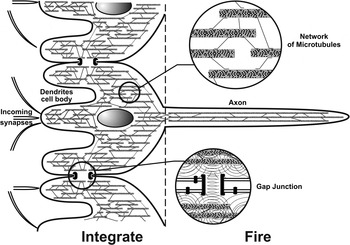
Figure 1. A neuron, and portions of other neurons are shown schematically with internal microtubules. In dendrites and cell body/soma (left), microtubules are interrupted and of mixed polarity, interconnected by microtubule-associated proteins (MAPs) in recursive networks (upper circle, right). Microtubules in axons are unipolar and continuous. Gap junctions synchronize dendritic membranes, and may enable entanglement among microtubules in adjacent neurons (lower circle right). In Orch OR, microtubule quantum computations occur during dendritic/somatic integration, and the selected results regulate axonal firings.
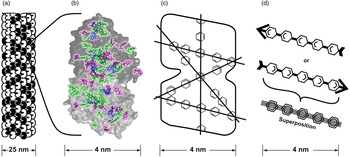
Figure 2. a. A microtubule (A-lattice) is composed of peanut-shaped tubulin proteins. b. Within the microtubule, an individual tubulin shows internal (colored) van der Waals radii of aromatic amino acids tryptophan (blue), phenylalanine (purple), and tyrosine (green) traversing the protein (image provided with permission from Travis Craddock). c. Schematic tubulin illustrates aromatic rings (phenyl shown here, although indole rings are also involved) arrayed through tubulin along “quantum channels.” d. Collective dipoles along such channels may exist in alternative orientations, or quantum superposition of both orientations – that is, quantum bits or “qubits.”
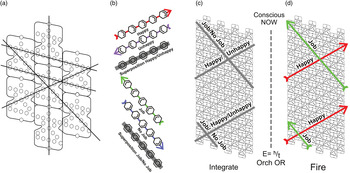
Figure 3. a. Seven tubulins in a microtubule A-lattice neighborhood are shown in which contiguous arrays of aromatic amino acid rings traverse tubulin and align with those in neighboring tubulins, resulting in helical “quantum channel” pathways throughout the microtubule. b. Dipole orientations in two different helical pathways along quantum channels represent alternate cognitive values and their superpositions (as described by P&B, “happy/unhappy,” “job/no job”) – that is, topological dipole qubits. c. Superpositioned qubits in (a larger portion of) a single A-lattice microtubule are shown during the integration phase, prior to reduction/self-collapse by the Orch OR mechanism. d. Post-reduction values selected in the Orch OR process are illustrated, a moment of conscious awareness having occurred.
Pothos & Busemeyer (P&B) suggest that human cognition can follow rules of quantum, rather than classical (Bayesian) probability mathematics. P&B are agnostic on whether such cognition involves actual quantum activity, but quantum mathematical cognition logically requires quantum biology. Could functional quantum biology occur in the brain?
The Penrose–Hameroff “Orch OR” theory suggests that cytoskeletal microtubules inside brain neurons perform quantum computations that mediate conscious perceptions and control conscious behavior (Hameroff Reference Hameroff1998; Reference Hameroff and Tuszynski2006a; Reference Hameroff2007; Reference Hameroff2012; Hameroff & Penrose Reference Hameroff and Penrose1996a; Reference Hameroff and Penrose1996b; Penrose & Hameroff Reference Penrose and Hameroff1995; Reference Penrose and Hameroff2011). In Orch OR, synaptic inputs “orchestrate” quantum superpositioned states (quantum bits, or “qubits,” existing simultaneously in alternative states) in “tubulin” subunit proteins in microtubules in dendrites and soma/cell bodies of “integrate-and-fire” brain neurons (Fig. 1), microtubules in which memory may be encoded (Craddock et al. Reference Craddock, Tuszynski and Hameroff2012b). Dendritic-somatic tubulin qubits entangle, interfere, and compute according to the Schrödinger equation during integration phases, then spontaneously reduce, or collapse to classical tubulin states that influence membrane polarization and regulate axonal firings, controlling behavior. (The Orch OR neuron is the “Hodgkin–Huxley” neuron with finer scale, deeper-order microtubule quantum influences.) At the end of each integration phase, quantum state reduction occurs by an objective threshold (Penrose “objective reduction,” “OR,” hence “orchestrated objective reduction”: “Orch OR”) for example, every 25 ms, coinciding with “40 Hz” gamma synchrony electro-encephalography (“EEG”). Orch OR is testable, feasible, and, although criticized (McKemmish et al. Reference McKemmish, Reimers, McKenzie, Mark and Hush2009; Tegmark Reference Tegmark2000; c.f. Hagan et al. 2001; Penrose & Hameroff Reference Penrose and Hameroff2011), is increasingly supported by experimental evidence from quantum biology (Engel et al. Reference Engel, Calhoun, Read, Ahn, Mancal, Cheng, Blankenship and Fleming2007; Gauger et al. Reference Gauger, Rieper, Morton, Benjamin and Vedral2011; Sarovar et al. Reference Sarovar, Ishizaki, Fleming and Whaley2010; Scholes Reference Scholes2010).
A neuron, and portions of other neurons are shown schematically with internal microtubules. In dendrites and cell body/soma (left), microtubules are interrupted and of mixed polarity, interconnected by microtubule-associated proteins (MAPs) in recursive networks (upper circle, right). Microtubules in axons are unipolar and continuous. Gap junctions synchronize dendritic membranes, and may enable entanglement among microtubules in adjacent neurons (lower circle right). In Orch OR, microtubule quantum computations occur during dendritic/somatic integration, and the selected results regulate axonal firings.
P&B take an extremely important step, but they omit four important features, the first being consciousness. Quantum probability and quantum biology (e.g., Orch OR) may specifically govern conscious cognition, whereas classical (Bayesian) probability and biology govern unconscious cognition (e.g., Hameroff Reference Hameroff2010).
The second omission is information representation in the brain. In a bold and novel assertion, P&B introduce projection rays in abstract Hilbert space to represent cognitive values, for example, feelings, or subjective “qualia,” such as “happy” and “unhappy.” Could abstract quantum projections correlate with actual quantum physical processes in brain biology? Are there qubits in the brain?
According to Orch OR, collective van der Waals London force dipoles among electron clouds of amino acid phenyl and indole rings aligned in non-polar “quantum channels” within each tubulin can orient in one direction or another, and exist in quantum superposition of both directions, acting as bits and qubits (Fig. 2a–d). Intra-tubulin channels appear to link to those in neighboring tubulins to form helical quantum channels extending through microtubules (Fig. 3a). Anesthetic gas molecules that selectively erase consciousness (sparing unconscious brain activity) bind in these channels (Craddock et al. Reference Craddock, St George, Freedman, Barakat, Damaraju, Hameroff and Tuszynski2012a; Hameroff Reference Hameroff2006b). Collective dipole qubits in microtubule quantum channels can represent cognitive values, for example, P&B's “happy/unhappy” and “job/no job” (Fig. 3b).
a. A microtubule (A-lattice) is composed of peanut-shaped tubulin proteins. b. Within the microtubule, an individual tubulin shows internal (colored) van der Waals radii of aromatic amino acids tryptophan (blue), phenylalanine (purple), and tyrosine (green) traversing the protein (image provided with permission from Travis Craddock). c. Schematic tubulin illustrates aromatic rings (phenyl shown here, although indole rings are also involved) arrayed through tubulin along “quantum channels.” d. Collective dipoles along such channels may exist in alternative orientations, or quantum superposition of both orientations – that is, quantum bits or “qubits.”
a. Seven tubulins in a microtubule A-lattice neighborhood are shown in which contiguous arrays of aromatic amino acid rings traverse tubulin and align with those in neighboring tubulins, resulting in helical “quantum channel” pathways throughout the microtubule. b. Dipole orientations in two different helical pathways along quantum channels represent alternate cognitive values and their superpositions (as described by P&B, “happy/unhappy,” “job/no job”) – that is, topological dipole qubits. c. Superpositioned qubits in (a larger portion of) a single A-lattice microtubule are shown during the integration phase, prior to reduction/self-collapse by the Orch OR mechanism. d. Post-reduction values selected in the Orch OR process are illustrated, a moment of conscious awareness having occurred.
Collective dipoles in helical quantum channels appear suitable for qubits, or “braids” in topological quantum computing in which specific pathways, rather than individual subunit states, are fundamental information units, mediated by fractional charge “anyons” (Collins Reference Collins2006; Freedman et al. Reference Freedman, Kitaev, Larsen and Wang2002; Kitaev Reference Kitaev2003). Topological qubits (or comparable “adiabatic” qubits) are inherently stable, resistant to decoherence, and consistent with Orch OR (Hameroff et al. Reference Hameroff, Nip, Porter and Tuszynski2002; Penrose & Hameroff Reference Penrose and Hameroff2011).
P&B's third omission is quantum computation. They cite three quantum features: (1) superposition (co-existing possibilities), (2) entanglement (connectedness of separated states), and (3) non-commutativity (context-dependence, “incompatibility”). The three features together comprise quantum computation in which superpositioned “qubits” interfere and compute by entanglement, and then reduce/collapse to definite output states. In a series of quantum computations, output of each reduction provides input for the next, hence context-dependent incompatibility. P&B's three features add up to cognitive quantum computation, as suggested in Orch OR.
The fourth omission, (and essence of the “measurement problem” in quantum mechanics) is reduction of quantum superpositions to classical output states (“collapse of the wave function”), what P&B refer to as “disambiguating a superposition state.” There are numerous theoretical suggestions as to how and why superpositions reduce to classical states (multiple worlds, decoherence, observer effect), but none address the nature of superposition, and each is unsatisfactory for various reasons (e.g., the von Neumann/Wigner “observer effect” puts conscious observation outside science). Addressing this problem, Penrose (Reference Penrose1989; Reference Penrose1994; Reference Penrose1996; Reference Penrose2004) proposed (1) superpositions were actual separations in underlying spacetime geometry, the fine structure of the universe, (2) such separations were unstable, and reduce to definite states after time t by an objective threshold given by the indeterminacy principle $E=\hbar/t$
(where E is the magnitude of the superposition/separation and
 $\hbar$
is Planck's constant over 2π), and (3) such events result in moments of conscious experience and choice. Orch OR is the neurobiological framework for Penrose OR, and perfect solution for P&B's required “constructive role for the process of disambiguating a superposition state.”
Figure 3c shows two superpositioned dipole pathways acting as topological qubits in a microtubule A-lattice and representing P&B's “happy/unhappy” and “job/no job” (perhaps more properly “job satisfaction” and “job dissatisfaction”). The qubits are coupled; for example, “happy” and “job” are more likely to coincide than “happy” and “no job”. During the integration phase, superpositioned qubits entangle, evolve, and compute (in a microtubule memory bed) by the Schrödinger equation until threshold by $E=\hbar/t$
is met, OR occurs, and classical microtubule states are selected (correlating with “happy” and “job” in the example given). According to Orch OR, consciousness occurs in the end-integration moment of reduction, and microtubule states selected in the OR process govern axonal firing and behavior (Hameroff Reference Hameroff2012).
If cognition (and consciousness) utilize quantum mathematics, entanglement, and non-commutativity, as P&B suggest, the brain is likely to be using quantum computation, such as described in Orch OR. From a well-known example of inductive reasoning: “If the brain swims, looks, and quacks like a (quantum) duck, then it probably is a (quantum) duck.”
ACKNOWLEDGMENTS
I thank Dave Cantrell for artwork, Travis Craddock for Figure 2b, Hartmut Neven and Saatviki Gupta for comments, and Sir Roger Penrose for collaboration.