Pothos & Busemeyer (P&B) must be lauded for providing an alternative way to formalize probabilities in cognitive models in a world where classical probability (CP) theory dominates modeling. The findings that they discuss are indeed a challenge for CP. Existing heuristic explanations are often unsatisfactory, offering few detailed quantitative explanations of the cognitive processes involved. For example, how do heuristics emerge and how do they relate to a formal representation of psychological processes? P&B demonstrate how quantum probability (QP) theory addresses these challenges.
Here, we argue that cognitive architectures, a modeling approach with a long history in the cognitive sciences, may also address the outlined challenges. The main article contained little discussion of cognitive architectures, with the few examples showcasing ones that rely heavily on CP. Whereas cognitive architectures do have a probabilistic aspect with stochastic components to processes such as memory retrieval or action selection, they combine probabilistic processing (i.e., CP) with symbolic knowledge-based representations (e.g., heuristics).
Cognitive architectures are computational implementations of cognitive theories that unify and represent a full range of human cognitive processes from perception to action (Newell Reference Newell1990). Their strengths are derived from a tight integration of their different components, particularly those satisfying the functional constraints to help maintain the “big picture” needed to understand the human mind (Anderson & Lebiere Reference Anderson and Lebiere2003). Performance in any given task is a result of the complex interactions between various modules, their underlying mechanisms, and the resulting information flows. Adaptive Control of Thought—Rational (ACT-R) (Anderson Reference Anderson and Gray2007; Anderson & Lebiere Reference Anderson and Lebiere1998) is one of the most well-known architectures, with hundreds of published models representing a broad range of tasks and phenomena.Footnote
1
Its distinguishing feature is the ability to combine symbolic representations (declarative chunks and procedural rules) with subsymbolic processes tuned by statistical learning. This allows ACT-R to create symbolic representations of heuristics and knowledge in the form of production rules and declarative chunks with probabilistic processes that can capture many mechanics of CP and even QP. In fact, there are researchers who have taken up the task of explaining a portion of the large collection of cognitive biases and heuristics through memory processes. These studies often use ACT-R cognitive models (Marewski & Mehlhorn Reference Marewski and Mehlhorn2011; Marewski & Schooler Reference Marewski and Schooler2011; Schooler & Hertwig Reference Schooler and Hertwig2005).
Although these are commendable efforts, the large variety of cognitive biases cannot be all explained by one single comprehensive model. Rather, these researchers offer multiple models: one for each type of heuristic (Marewski & Mehlhorn Reference Marewski and Mehlhorn2011). We have made a similar observation regarding models of decisions from experience, which are often task-specific and are developed to account for only one variation of a given task (Gonzalez & Dutt Reference Gonzalez and Dutt2011; Lejarraga et al. Reference Lejarraga, Dutt and Gonzalez2012). Therefore, a modeling methodology that provides a unified approach to a variety of tasks by leveraging the same architectural mechanisms is needed. For example, an instance-based learning (IBL) model of repeated binary choice offers a broad and robust unified explanation of human behavior across multiple paradigms and variations of these tasks (Gonzalez Reference Gonzalez, Pammi and Srinivasan2013; Gonzalez & Dutt Reference Gonzalez and Dutt2011; Lejarraga et al. Reference Lejarraga, Dutt and Gonzalez2012).
IBL models are process models that rely on ACT-R learning and memory mechanisms, most notably those involving declarative representations and the activation mechanisms. Activation is a value corresponding to each chunk in memory, learned to reflect its usage statistics. It controls information retrieval from memory and can be interpreted as the log odds of retrieval. The activation mechanisms involve four main processes: base-level learning that accounts for recency and frequency of information, similarity-based partial matching that represents the mismatches between a task's situational attributes and those stored in memory, associative learning that reflects the impact of contextual values and the associations between cues in different contexts, and a stochastic component that makes the retrieval process probabilistic.
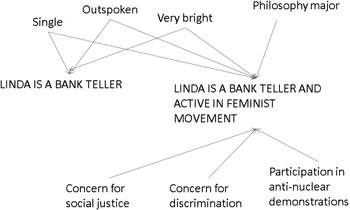
As an example, consider the Linda problem used by P&B. The conjunction fallacy is explained by IBL models as follows. Two main options (i.e., instances) are considered in the decision process: (1) Linda as a bank teller, and (2) Linda as a bank teller and a feminist. Whereas a formal probability theory such as QP and CP represent the latter as a logical conjunction, they are represented as independent instances in memory in a computational theory such as ACT-R. The activation of these two instances is determined by the attributes in the problem's description, and in the memory relationships to “bank teller” and to “feminist,” as is captured by the associative learning mechanism governing the spreading of activation. A scenario of the described attributes and their possible associations to the two options is presented in Figure 1. Without going into detail regarding the activation processes, the figure shows that the number of attributes associated with option 1 (3) is less than the number of associations (7) related to option 2. Therefore, option 2 has a higher probability of retrieval given a higher activation, and it would be selected more often. Although this is an impossibility according to CP, our example illustrates how IBL models and ACT-R more generally account for this effect, and explains it in terms of simple memory processes. When eschewing a formal probabilistic framework in favor of a computational account, apparent impossibilities simply dissolve in light of the cognitive processes used to actually produce the decisions.
Figure 1.
Attributes and associations to the options in the Linda problem.
In general, we believe that the advantages of QP over CP can all be addressed through the mechanisms in ACT-R models. Superposition, for example, can be addressed through the similarity metrics used in the partial matching mechanism in the activation equation, entanglement can be addressed through the contextual effects of associative memory, and incompatibility can be addressed through the recency effects in the base-level learning processes.
In conclusion, although we agree with P&B on the large body of evidence that goes directly against CP principles, we do not believe that an alternative probabilistic theory is essential to understanding the intuition behind human judgment in such conditions. Cognitive architectures are able to address these challenges in a natural way that leverages the characteristics of general cognitive processes such as memory retrieval.





Pothos & Busemeyer (P&B) must be lauded for providing an alternative way to formalize probabilities in cognitive models in a world where classical probability (CP) theory dominates modeling. The findings that they discuss are indeed a challenge for CP. Existing heuristic explanations are often unsatisfactory, offering few detailed quantitative explanations of the cognitive processes involved. For example, how do heuristics emerge and how do they relate to a formal representation of psychological processes? P&B demonstrate how quantum probability (QP) theory addresses these challenges.
Here, we argue that cognitive architectures, a modeling approach with a long history in the cognitive sciences, may also address the outlined challenges. The main article contained little discussion of cognitive architectures, with the few examples showcasing ones that rely heavily on CP. Whereas cognitive architectures do have a probabilistic aspect with stochastic components to processes such as memory retrieval or action selection, they combine probabilistic processing (i.e., CP) with symbolic knowledge-based representations (e.g., heuristics).
Cognitive architectures are computational implementations of cognitive theories that unify and represent a full range of human cognitive processes from perception to action (Newell Reference Newell1990). Their strengths are derived from a tight integration of their different components, particularly those satisfying the functional constraints to help maintain the “big picture” needed to understand the human mind (Anderson & Lebiere Reference Anderson and Lebiere2003). Performance in any given task is a result of the complex interactions between various modules, their underlying mechanisms, and the resulting information flows. Adaptive Control of Thought—Rational (ACT-R) (Anderson Reference Anderson and Gray2007; Anderson & Lebiere Reference Anderson and Lebiere1998) is one of the most well-known architectures, with hundreds of published models representing a broad range of tasks and phenomena.Footnote 1 Its distinguishing feature is the ability to combine symbolic representations (declarative chunks and procedural rules) with subsymbolic processes tuned by statistical learning. This allows ACT-R to create symbolic representations of heuristics and knowledge in the form of production rules and declarative chunks with probabilistic processes that can capture many mechanics of CP and even QP. In fact, there are researchers who have taken up the task of explaining a portion of the large collection of cognitive biases and heuristics through memory processes. These studies often use ACT-R cognitive models (Marewski & Mehlhorn Reference Marewski and Mehlhorn2011; Marewski & Schooler Reference Marewski and Schooler2011; Schooler & Hertwig Reference Schooler and Hertwig2005).
Although these are commendable efforts, the large variety of cognitive biases cannot be all explained by one single comprehensive model. Rather, these researchers offer multiple models: one for each type of heuristic (Marewski & Mehlhorn Reference Marewski and Mehlhorn2011). We have made a similar observation regarding models of decisions from experience, which are often task-specific and are developed to account for only one variation of a given task (Gonzalez & Dutt Reference Gonzalez and Dutt2011; Lejarraga et al. Reference Lejarraga, Dutt and Gonzalez2012). Therefore, a modeling methodology that provides a unified approach to a variety of tasks by leveraging the same architectural mechanisms is needed. For example, an instance-based learning (IBL) model of repeated binary choice offers a broad and robust unified explanation of human behavior across multiple paradigms and variations of these tasks (Gonzalez Reference Gonzalez, Pammi and Srinivasan2013; Gonzalez & Dutt Reference Gonzalez and Dutt2011; Lejarraga et al. Reference Lejarraga, Dutt and Gonzalez2012).
IBL models are process models that rely on ACT-R learning and memory mechanisms, most notably those involving declarative representations and the activation mechanisms. Activation is a value corresponding to each chunk in memory, learned to reflect its usage statistics. It controls information retrieval from memory and can be interpreted as the log odds of retrieval. The activation mechanisms involve four main processes: base-level learning that accounts for recency and frequency of information, similarity-based partial matching that represents the mismatches between a task's situational attributes and those stored in memory, associative learning that reflects the impact of contextual values and the associations between cues in different contexts, and a stochastic component that makes the retrieval process probabilistic.
As an example, consider the Linda problem used by P&B. The conjunction fallacy is explained by IBL models as follows. Two main options (i.e., instances) are considered in the decision process: (1) Linda as a bank teller, and (2) Linda as a bank teller and a feminist. Whereas a formal probability theory such as QP and CP represent the latter as a logical conjunction, they are represented as independent instances in memory in a computational theory such as ACT-R. The activation of these two instances is determined by the attributes in the problem's description, and in the memory relationships to “bank teller” and to “feminist,” as is captured by the associative learning mechanism governing the spreading of activation. A scenario of the described attributes and their possible associations to the two options is presented in Figure 1. Without going into detail regarding the activation processes, the figure shows that the number of attributes associated with option 1 (3) is less than the number of associations (7) related to option 2. Therefore, option 2 has a higher probability of retrieval given a higher activation, and it would be selected more often. Although this is an impossibility according to CP, our example illustrates how IBL models and ACT-R more generally account for this effect, and explains it in terms of simple memory processes. When eschewing a formal probabilistic framework in favor of a computational account, apparent impossibilities simply dissolve in light of the cognitive processes used to actually produce the decisions.
Attributes and associations to the options in the Linda problem.
In general, we believe that the advantages of QP over CP can all be addressed through the mechanisms in ACT-R models. Superposition, for example, can be addressed through the similarity metrics used in the partial matching mechanism in the activation equation, entanglement can be addressed through the contextual effects of associative memory, and incompatibility can be addressed through the recency effects in the base-level learning processes.
In conclusion, although we agree with P&B on the large body of evidence that goes directly against CP principles, we do not believe that an alternative probabilistic theory is essential to understanding the intuition behind human judgment in such conditions. Cognitive architectures are able to address these challenges in a natural way that leverages the characteristics of general cognitive processes such as memory retrieval.