The Hilbert space formalism seems to be a suitable framework to accommodate the experimental richness of cognitive phenomena. The target article by Pothos & Busemeyer (P&B) accomplishes the impressive task of providing, in as simple a way as possible, the theoretical grounds as well as the empirical underpinnings of a probabilistic model capable of grasping many aspects of human cognition. The contribution of this commentary is to point out that important concepts arising from signal detection theory (SDT) can be easily recast into the language of quantum probability. If useful, this addition to P&B's model might be used to describe several phenomena involved in perceptual detectability and discriminability, enlarging the theoretical reach of their proposal and offering new alternatives to verify its empirical content.
SDT is a powerful tool that has been very successful in many areas of psychological research (Green & Swets Reference Green and Swets1966; Macmillan & Creelman Reference Macmillan and Creelman2005). Originally stemming from applications of statistical decision theory to engineering problems, classical SDT has been reframed over the years under many different assumptions and interpretations (Balakrishnan Reference Balakrishnan1998; DeCarlo Reference DeCarlo1998; Parasuraman & Masalonis Reference Parasuraman and Masalonis2000; Pastore et al. Reference Pastore, Crawley, Berens and Skelly2003; Treisman Reference Treisman2002). However, irrespective of their formulation, signal detection theories rely on two fundamental performance measures: sensitivity and bias. Whereas sensitivity refers to the ability of an observer to detect a stimulus or discriminate between two comparable stimuli, response bias implies a decision rule or criterion, which can favor the observer's response in one direction or another.
As in standard SDT and its sequels, in this commentary sensitivity and bias are also derived from the probabilities of hits, p(H), and of false alarms, p(FA), defined as the probability of indicating the presence of a stimulus when it is present or absent. Two other quantities, the probabilities of misses, p(M), and correct rejections, p(CR), are complementary, respectively, to p(H) and p(FA): p(H) + p(M) = 1 = p(FA) + p(CR).
To translate these concepts into the language of Hilbert space, we need to represent a perceptual state by a state vector |Ψ〉. This vector denotes the perceptual state of an observer immediately after a trial wherein either the background noise was presented in isolation (|Ψ
n
〉) or the noisy background was superimposed with the target stimulus (|Ψ
n+s
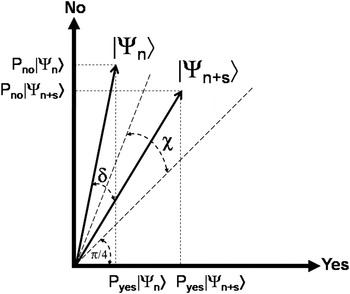
〉). These state vectors are formed by a linear combination of the |yes〉 and |no〉 vectors, an orthogonal vector basis in the present Hilbert space. The components of a state vector along the one-dimensional subspaces that represent the two possible outcomes (either the response “yes” or the response “no” to the question “was the stimulus present?”) are given by the projection of the state vector onto the subspaces for “yes” and “no,” which are spanned by the basis vectors (Fig. 1). Denoting by Pyes and Pno the projection operators (projectors) onto the subspaces spanned by the basis vectors, the components C1 and C2 of a state vector |Ψ〉 = C1|yes〉 + C2|no〉 are given by C1 = ||Pyes|Ψ〉|| and C2 = ||Pno|Ψ〉||.
Figure 1.
A representation of perceptual states in Hilbert space. The state vectors |Ψ
n
〉 and |Ψ
n+s
〉 represent the perceptual state of an observer exposed, respectively, to noise only or to a signal presented on a noisy background. On each condition, the probability of the observer reporting the presence (“yes”) or absence (“no”) of the signal is given by squaring the projection of each vector onto the respective basis vector (see equations 1–4).
As we can see in Figure 1, the probabilities of hits, misses, false alarms, and correct rejections are obtained by the action of the projectors Pyes and Pno on the state vectors |Ψ
n
〉 and |Ψ
n+s
〉. These probabilities can be computed by means of the following “statistical algorithm” (Hughes Reference Hughes1989):
Analogously to SDT, two measures can be extracted from the vector representation of a perceptual state: an angle, δ, which evaluates the separation between the two state vectors, |Ψ
n
〉 and |Ψ
n+s
〉, gives a measure of sensitivity; another angle, χ, which evaluates the location of the state vectors as a whole in relation to the basis vectors, gives a measure of response bias. In two dimensions, these quantities can be calculated from the pair of probabilities p(H) and p(FA):
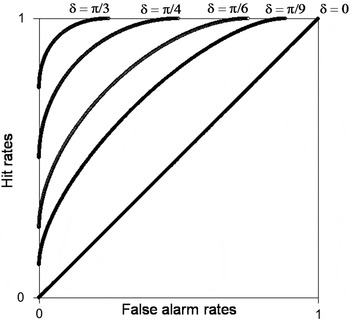
Similarly to SDT, the measures of sensitivity and bias in Hilbert space are also, respectively, the subtraction and addition of terms given by nonlinear transformations of hit and false alarm rates. In Equation 6, the term –π/4 is added only to set χ = 0 for an unbiased observer. Analogously to SDT, χ > 0 means a stricter criterion (a response bias toward lower hit and false alarm rates), whereas χ < 0 means a more lax criterion (a bias toward higher hit and false alarm rates). Figure 2, which resembles a receiver operating characteristic (ROC) representation, shows a family of isosensitivity curves in which the decision criterion χ changes as a function of the hit and false alarm rates along five different magnitudes of the sensitivity measure, from δ = 0 to δ = π/3.
Figure 2.
A ROC curve in Hilbert space. Each line is an iso-sensitivity curve that provides the proportion of hit and false alarm rates along a constant sensitivity measure (δ). In the present model, the sensitivity measure is given by the angle, δ, that separates the two state vectors |Ψ
n
〉 and |Ψ
n+s
〉.
This geometric representation of SDT in Hilbert space can help us visualize many perceptual phenomena. As one example, the modulatory effect of attention could be conceived of as the action of a unitary operator A on the noise-plus-signal state vector, |Ψ
n+s
〉, the noise-only state vector, |Ψ
n
〉, or both, always resulting in a rotation that, without changing their magnitudes, moves them away from each other, thus increasing the sensitivity δ. The physiological interpretation of the attentional operator A would be the enhancement of the signal, the suppression of noise, or both, depending on which vectors the operator's action takes place on. However, a unitary operator that acts on both vectors at the same time, and whose action results in a rotation that preserves their angular separation δ, can be viewed as a change in the decision criterion χ only.
In conclusion, the idea of this commentary is to accommodate in the language of Hilbert spaces some important concepts that are extremely valuable in the experimental exploration of psychophysical and perceptual phenomena. Whether this attempt bears some value, or it turns out to be only a mathematical exercise, is an empirical question.





 You have
Access
The Hilbert space formalism seems to be a suitable framework to accommodate the experimental richness of cognitive phenomena. The target article by Pothos & Busemeyer (P&B) accomplishes the impressive task of providing, in as simple a way as possible, the theoretical grounds as well as the empirical underpinnings of a probabilistic model capable of grasping many aspects of human cognition. The contribution of this commentary is to point out that important concepts arising from signal detection theory (SDT) can be easily recast into the language of quantum probability. If useful, this addition to P&B's model might be used to describe several phenomena involved in perceptual detectability and discriminability, enlarging the theoretical reach of their proposal and offering new alternatives to verify its empirical content.
SDT is a powerful tool that has been very successful in many areas of psychological research (Green & Swets Reference Green and Swets1966; Macmillan & Creelman Reference Macmillan and Creelman2005). Originally stemming from applications of statistical decision theory to engineering problems, classical SDT has been reframed over the years under many different assumptions and interpretations (Balakrishnan Reference Balakrishnan1998; DeCarlo Reference DeCarlo1998; Parasuraman & Masalonis Reference Parasuraman and Masalonis2000; Pastore et al. Reference Pastore, Crawley, Berens and Skelly2003; Treisman Reference Treisman2002). However, irrespective of their formulation, signal detection theories rely on two fundamental performance measures: sensitivity and bias. Whereas sensitivity refers to the ability of an observer to detect a stimulus or discriminate between two comparable stimuli, response bias implies a decision rule or criterion, which can favor the observer's response in one direction or another.
As in standard SDT and its sequels, in this commentary sensitivity and bias are also derived from the probabilities of hits, p(H), and of false alarms, p(FA), defined as the probability of indicating the presence of a stimulus when it is present or absent. Two other quantities, the probabilities of misses, p(M), and correct rejections, p(CR), are complementary, respectively, to p(H) and p(FA): p(H) + p(M) = 1 = p(FA) + p(CR).
To translate these concepts into the language of Hilbert space, we need to represent a perceptual state by a state vector |Ψ〉. This vector denotes the perceptual state of an observer immediately after a trial wherein either the background noise was presented in isolation (|Ψ n 〉) or the noisy background was superimposed with the target stimulus (|Ψ n+s 〉). These state vectors are formed by a linear combination of the |yes〉 and |no〉 vectors, an orthogonal vector basis in the present Hilbert space. The components of a state vector along the one-dimensional subspaces that represent the two possible outcomes (either the response “yes” or the response “no” to the question “was the stimulus present?”) are given by the projection of the state vector onto the subspaces for “yes” and “no,” which are spanned by the basis vectors (Fig. 1). Denoting by Pyes and Pno the projection operators (projectors) onto the subspaces spanned by the basis vectors, the components C1 and C2 of a state vector |Ψ〉 = C1|yes〉 + C2|no〉 are given by C1 = ||Pyes|Ψ〉|| and C2 = ||Pno|Ψ〉||.
A representation of perceptual states in Hilbert space. The state vectors |Ψ n 〉 and |Ψ n+s 〉 represent the perceptual state of an observer exposed, respectively, to noise only or to a signal presented on a noisy background. On each condition, the probability of the observer reporting the presence (“yes”) or absence (“no”) of the signal is given by squaring the projection of each vector onto the respective basis vector (see equations 1–4).
As we can see in Figure 1, the probabilities of hits, misses, false alarms, and correct rejections are obtained by the action of the projectors Pyes and Pno on the state vectors |Ψ n 〉 and |Ψ n+s 〉. These probabilities can be computed by means of the following “statistical algorithm” (Hughes Reference Hughes1989):
Analogously to SDT, two measures can be extracted from the vector representation of a perceptual state: an angle, δ, which evaluates the separation between the two state vectors, |Ψ n 〉 and |Ψ n+s 〉, gives a measure of sensitivity; another angle, χ, which evaluates the location of the state vectors as a whole in relation to the basis vectors, gives a measure of response bias. In two dimensions, these quantities can be calculated from the pair of probabilities p(H) and p(FA):
Similarly to SDT, the measures of sensitivity and bias in Hilbert space are also, respectively, the subtraction and addition of terms given by nonlinear transformations of hit and false alarm rates. In Equation 6, the term –π/4 is added only to set χ = 0 for an unbiased observer. Analogously to SDT, χ > 0 means a stricter criterion (a response bias toward lower hit and false alarm rates), whereas χ < 0 means a more lax criterion (a bias toward higher hit and false alarm rates). Figure 2, which resembles a receiver operating characteristic (ROC) representation, shows a family of isosensitivity curves in which the decision criterion χ changes as a function of the hit and false alarm rates along five different magnitudes of the sensitivity measure, from δ = 0 to δ = π/3.
A ROC curve in Hilbert space. Each line is an iso-sensitivity curve that provides the proportion of hit and false alarm rates along a constant sensitivity measure (δ). In the present model, the sensitivity measure is given by the angle, δ, that separates the two state vectors |Ψ n 〉 and |Ψ n+s 〉.
This geometric representation of SDT in Hilbert space can help us visualize many perceptual phenomena. As one example, the modulatory effect of attention could be conceived of as the action of a unitary operator A on the noise-plus-signal state vector, |Ψ n+s 〉, the noise-only state vector, |Ψ n 〉, or both, always resulting in a rotation that, without changing their magnitudes, moves them away from each other, thus increasing the sensitivity δ. The physiological interpretation of the attentional operator A would be the enhancement of the signal, the suppression of noise, or both, depending on which vectors the operator's action takes place on. However, a unitary operator that acts on both vectors at the same time, and whose action results in a rotation that preserves their angular separation δ, can be viewed as a change in the decision criterion χ only.
In conclusion, the idea of this commentary is to accommodate in the language of Hilbert spaces some important concepts that are extremely valuable in the experimental exploration of psychophysical and perceptual phenomena. Whether this attempt bears some value, or it turns out to be only a mathematical exercise, is an empirical question.
ACKNOWLEDGMENTS
This work was partially supported by the São Paulo Research Foundation and the National Counsel for Scientific and Technological Development (Brazil). I also thank Nestor Caticha for fruitful discussions on this topic.