We partner with a secure submission system to handle manuscript submissions.
Please note:
You will need an account for the submission system, which is separate to your Cambridge Core account. For login and submission support, please visit the
submission and support pages.
Please review this journal's author instructions, particularly the
preparing your materials
page, before submitting your manuscript.
Click Proceed to submission system to continue to our partner's website.
To save this undefined to your undefined account, please select one or more formats and confirm that you agree to abide by our usage policies. If this is the first time you used this feature, you will be asked to authorise Cambridge Core to connect with your undefined account.
Find out more about saving content to .
To send this article to your Kindle, first ensure no-reply@cambridge.org is added to your Approved Personal Document E-mail List under your Personal Document Settings on the Manage Your Content and Devices page of your Amazon account. Then enter the ‘name’ part of your Kindle email address below. Find out more about sending to your Kindle.
Find out more about saving to your Kindle.
Note you can select to save to either the @free.kindle.com or @kindle.com variations. ‘@free.kindle.com’ emails are free but can only be saved to your device when it is connected to wi-fi. ‘@kindle.com’ emails can be delivered even when you are not connected to wi-fi, but note that service fees apply.
The inclusion process allows children with special educational needs to be included in a normative environment. A large group consists of children with intellectual disabilities and behavioral disorders, hey need medical and pedagogical rehabilitation due to their low learning ability, neurotic disorders, and mental distortion.
Objectives
Study of psychophysical characteristics of children with intellectual disability and behavioral disorders.
Methods
140 children with intellectual disabilities who have impairments in the neuro-psychological sphere (2017-2020 г.г.). Methods: medical and pedagogical, observation, examination, assessment.
Results
Variants of the child’s psychophysical development: Option 1. (75%): children with a predominance of violations in behavior, emotional and volitional sphere. There is aggressiveness, inconsistency and impulsiveness of actions, lack of distance with an adult, and difficulties in complying with accepted norms and rules. Option 2 (25%): children with the following manifestations: timidity, tearfulness, distrust, fears, lack of initiative. All children have difficulty sleeping, eating disorders, and frequent psychosomatic illnesses.
Conclusions
Children with intellectual disabilities in an inclusive practice need comprehensive assistance, taking into account different variants of their psychophysical characteristics. The studied children were found to have neurotic and neurosis-like disorders, as well as pathological personality development. All children have: low performance, lability of the nervous system, lack of voluntary regulation, impaired activity, learning difficulties. There are behavioral and mental disorders that require medical, psychological and pedagogical rehabilitation.
Dementia is characterized by a decrease in mental functions, while disorders of balance, coordination of movements and gait are gradually added. In recent years there has been a growing interest in the role of exercise as a therapeutic strategy for people with dementia.
Objectives
The aim of this study was to investigate the effect of different types of exercise and its parameters on cognitive and physical function in patients with dementia after reviewing the relevant literature.
Methods
Review of the literature based on the research of original scientific articles published in the electronic databases PubMed / Medline and Google scholar using as keywords the terms dementia, cognitive function, physical function, functionality, aerobic exercise, resistance exercise.
Results
A review in the literature highlights the beneficial effect of exercise on patients with dementia. Aerobic exercise and mixed interventions have been studied more, while resistance interventions have been less studied. All three types of exercise have shown positive effects. The methodology differences of the studies make it difficult to draw definitive conclusions about the optimal intervention in the cognitive and physical function for the optimal result, the type of exercise, the duration, the frequency and the intensity.
Conclusions
Exercise (physical) may help maintain or improve cognitive function and functionality in patients with dementia but additional study is needed to clarify optimal intervention and establish guidelines.
The provision of mental health care should be promoted at the community level, in order to facilitate their recovery process. Thus, the people who care for these individuals go through a situational transition, as they have to play the role of Family Caregivers (FC).
Objectives
a) to characterize the FC burden of the person with Mental Illness; and b) to correlate FC overload with the variables age, gender, cohabitation, degree of kinship and level of education.
Methods
A cross-sectional correlational study was conducted. The sample consisted of FC who went to consultations and to the inpatient psychiatric unit of a portuguese hospital. Data were collected through a questionnaire which included sociodemographic data, the Lawton-Brody Index and the Zarit Burden Interview (ZBI).
Results
Of the 119 FC, 66.4% were female, with an average age of 53.8 years. 73.1% of FC cohabited with the person they care for, in which the majority was cared for by their child or spouse, 45.2% and 36.1%, respectively. It should also be noted that 71.4% felt the need for more support from health professionals. As for autonomy, 52% of the individuals cared for by FC were moderately dependent. It was verified that about 45% of the FC had an intense overload. Female gender has greater overload and that there are no significant differences between the level of education and cohabitation.
Conclusions
Considering the results, it is understood the importance of valuing FC, as a target and care partners, in order to reduce the burden, they feel when caring for people with MI.
The original Profile of Mood States (McNair et al. 1971) is composed of 65 items to measure six affect dimensions. There is a Portuguese shorter version (POMS-27) for the perinatal period (Bos et al. 2013), which reduced the number of items (adjectives) down to 27. Although briefer, it still covers relevant mood states with good psychometric properties, being considered a good alternative to use during this demanding and busy period.
Objectives
To test if PoMS-27, composed of four dimensions (Depression, Anxiety, Vigour, Fatigue) and one second-order factor (Negative Affect, composed by the former two) is valid and reliable to be used with pregnant women from Brazil.
Methods
After confirming the items semantic equivalence and slightly adapt two adjectives from European to Brazilian Portuguese, 350 pregnant women (Mean age: 30.01±5.452; Mean gestation weeks=25.17±6.55), with uncomplicated pregnancies, completed the PoMS-27 and the Brazilian recently validated versions of Perinatal Depression Screening Scale and Perinatal Anxiety Screening Scale (PDSS; PASS; Barros et al. 2021). SPSS and AMOS software were used.
Results
After deleting two items (20 and 22) and some errors were correlated, CFA indicated that the PoMS-25 four-dimensional model presented an acceptable fit (χ2=3.163; RMSEA=.079, CFI=.868, TLI=.849). The Cronbach alphas of the dimensions were: Depression (.82), Anxiety (.86), Negative Affect (.89), Fatigue (.80) and Vigor (.50).
Conclusions
Within this psychometric study we found useful, valid and reliable measure of negative and positive affect for Brazilian pregnant women. From now on we will denominate it Profile of Mood States-25Br
The PDSS-24 is a Portuguese short version of the Postpartum Depression Screening Scale (Beck and Gable, 2002). Items were selected on the basis of exploratory factor analysis (those with loadings >.60). The PDSS-24 proved to be superior to the 35-items PDSS in reliability, validity and screening ability (Pereira et al. 2013).
Objectives
To analyze the psychometric properties (construct validity using Confirmatory Factor Analysis, discriminant validity and reliability) of the Brazilian preliminary version of PDSS-24
Methods
After confirming the items semantic equivalence and slightly adapt two adjectives from European to Brazilian Portuguese, 350 pregnant women (Mean age: 30.01±5.452; Mean gestation weeks=25.17±6.55), with uncomplicated pregnancies, completed the PDSS-24 and the Brazilian recently validated versions of Profile of Mood States-25 (PoMS; Barros et al. 2021). SPSS and AMOS software were used.
Results
After some errors were correlated the multidimensional second-order model of PDSS-24 presented an aceptable fit (χ2=3.448; RMSEA=.099; CFI=.817, TLI=.886, GFI=.886). The PDSS Cronbach’s alpha for the total was α=.90. Cronbach alpha was .90 for the total and >.75 for the dimensions. Appling the Portuguese validated cut-off score for Major Depression/DSM-5 (>42) to this sample 224 (64.0%) participants presented clinical relevant depressive symptoms.
Conclusions
The Brazilian PDSS-24 has acceptable validity and reliability. The percentage of women with high depressive symptomatology is three times higher than the figures reported in Portuguese Studies. This can be partly explained by the fact that data collection was done during the COVID19 pandemic. It is important to determine the PDSS cut-offs to screen for perinatal depression in Brazil.
The aim of this paper lies in demystifying, historicizing, and de-alienating the relationship between psychiatry and psychoanalysis. Both psychiatry and psychoanalysis inform each other and are informed by each other in various ways which are on one hand similar and on the other hand unique. Medicine can be seen psychoanalytically, and a presenting complaint to a psychoanalytic psychotherapist can be seen in psychiatric terms.
Objectives
This paper theorizes the ‘and’ between psychiatry and psychoanalysis. What is that bridging telling us? There is already an invisible ‘and’ which joins psychiatry and psychoanalysis even before this visible ‘and’ was placed in between them. The effort here is not to undermine the difference. It is to be aware that the thing which separates is also a thing which connects. In other words, each separation is a link. It is to understand how psychiatrists have contributed to the method and practice of psychoanalysis and visa versa. It is about witnessing the continuum that is ever-present between psychiatry, psychology, and psychoanalysis.
Methods
This research used primary sources like books and articles to historicize the psychiatric conceptualization of the medical body.
Results
It shows how psychiatry and psychoanalysis inform each other and are informed by each other. To locate the historical conceptions which are still ever-present in modern psychiatry. How the 18th-century division between normal and abnormal is based on an older division between good and evil.
Conclusions
Good and evil continue to operate in the realm of psychiatry and the confessional becomes a prime source for psychiatry and psychoanalysis.
There is a plenty of literature on providing psychological services for psychiatry inpatients and outpatients. Seeing a psychiatrist for the first time can be stressful.
Objectives
This paper will identify challenges in setting up a clinical psychology service for consultees seen in Reception Department with consultative and primary specialized health care. ‘Clinical psychology service’ is a project in Moscow Research Institute of Psychiatry providing services within the Reception Department setting. A need to address mental ill health issues (getting a diagnosis and treatment plan) within the broader psychosocial needs of consultees has been identified.
Methods
Clinical psychology established a brief intervention ‘service’ for consultees. Issues of establishing trust within this population suggested the need to provide a ‘named’ male or female psychologist. The psychologist accompanied psychiatric consultants’ recommendations to familiarize a consultee of the availability of the service. Evaluation of the service, including uptake, client satisfaction, and outcome, is ongoing using quantitative and qualitative methods. Data is presented on key themes identified in providing psychological services to consultees.
Results
Key themes identified included: 1. Service development: establishing trust, ensuring confidentiality, close between consultants working, flexibility, crisis management, safety, establish links with other agencies; 2. Complex psychological and social needs: mental health issues, trauma, substance misuse, domestic and sexual violence.
Conclusions
Consultees present with a range of complex psychosocial needs. While this population may have reservations about accessing ‘standard’ mental health services, a flexible psychology service working in close liaison with psychiatric consultants may be effective in addressing these needs.
Attention Deficit Hyperactivity Disorder (ADHD) is a common neurodevelopmental disorder often diagnosed between the ages of 7 and 10. The estimated prevalence of ADHD in adults is usually 2-5%, which means that in up to half of people this diagnosis persists into adulthood.
Objectives
The aim of this sub-study was to determine whether there are significant differences in ADHD symptomatology between individuals who have taken or are taking prescription drugs and those who have never taken them.
Methods
Data collection was performed by STEM / MARK in January 2019 through the European National Panel. Respondents completed a demographic questionnaire focusing on the history of ADHD and a standardized ADHD Self-Report Scale (ASRS) questionnaire for the symptomatology of ADHD in adulthood.
Results
Of the 1,518 respondents, 3% reported being diagnosed with ADHD / hyperkinetic disorder during their lifetime. According to the ASRS assessment, 119 respondents were classified as suspected ADHD. Overall, men scored higher symptoms of ADHD. The results also show that the group that states that taking medication has a statistically significantly higher average score in ASRS than unmedicated individuals. 6 individuals are taking medication to this day.
Conclusions
The data collected confirm our main hypothesis that ADHD symptomatology has an impact on the daily functioning of individuals in adulthood. Unlike peers with reduced or no ADHD symptoms, these people are far more likely to have time management issues, need to plan their day carefully, and yet often experience problems such as late arrivals due to a lack of anticipation.
Conflict of interest
Financial support was provided by grants : GA ČR – 18 -112 47 S, Progres Q06 1LF
There is an increasing interest in integrative (mental) health care and a growth in centers offering such services, but a paucity of research on patient characteristics, diagnosis, treatments offered, the effects of those treatments and patient satisfaction.
Objectives
To examine the course of mental health outcomes in the context of the nature and quality of care of outpatients at a center for integrative psychiatry in the Netherlands, as well as relevant sociodemographic, clinical, and treatment-related moderators of this course.
Methods
Baseline patient demographics, clinical and treatment characteristics of 537 patients with a completed care episode between 2012 and 2019 were assessed. Satisfaction and mental health treatment outcomes were examined using routine outcome monitoring and analyzed with multilevel intention-to-treat models.
Results
Two thirds of patients were woman (median age 41 years), predominantly with a primary diagnosis of mood or anxiety disorder. Mean number of treatment sessions was 49 (SD=94) and total clinical time was 54 hours (SD=109). Mean treatment duration was 460 days (SD=407). Ninety percent of the sample filled out one or more assessment(s). Of the individuals with a baseline assessment, 50% completed a follow-up. Significant improvements in symptomatology, social functioning, interpersonal functioning, wellbeing, resilience and quality of life were found. Clinical and scientific interpretation, moderator analyses and patient satisfaction will be presented at the conference.
Conclusions
Although no definite conclusions can be drawn due to the naturalistic design and missing data, especially at follow-up, patients seem to improve on all measured domains, including psychopathology, functioning and wellbeing.
The Therapeutic Engagement Questionnaire (TEQ) has been developed and validated in partnership with service users (SUs), registered mental health nurses (RMHNs) and nurse academics in the UK in accordance with psychometric theory. The TEQ is highly relevant and useful to clinical practice. The TEQ measures therapeutic engagement (TE) in two contexts - 1-1 interactions between SUs and RMHNs, as well as the overall environment and atmosphere of the units - from the perspective of both SUs and RMHNs. The TEQ has been translated into Finnish by two expert panels and was pre-tested and validated in ten adult acute psychiatric in-patient units in two hospitals in Finland.
Objectives
To measure TE in Finnish adult acute in-patient psychiatric settings from the perspectives of both SUs and RMHNs.
Methods
The Finnish version of the TEQ (Hoidollinen yhteistyö) will be completed by RMHNs and SUs in 15 adult acute psychiatric in-patient units. Nine of the units are within the University Hospital and six in a municipal psychiatric hospital. The data will be collected within a 3-month period (October - December 2020). The coordinating nurse of each unit will organise the operational side of the study including obtaining consent from SUs. The nurses will participate in the survey via Webropol which includes nurses’ consent. Sociodemographic information will be collected from the SUs and nurses.
Results
The results of the measurement study will be reported at the 29th European Congress of Psychiatry.
Conclusions
The conclusions of the measurement study will be reported at the 29th European Congress of Psychiatry.
Conflict of interest
This study is supported by the National Institute for Health Research (NIHR) Applied Research Collaboration South London (NIHR ARC South London).
Empathy is considered one of the most relevant characteristics in the interaction between the doctor and the patient, highlighting the need to enhance it from the professional training stage. However, some studies have established that high levels of empathy could generate emotional exhaustion (Boujut, Sultan, Woemer & Zenasni, 2012). However, if a certain type of empathy can lead to burnout, it must also be considered that an optimal empathic posture can, on the contrary, relieve stress and exhaustion.
Objectives
Establish the relationship between the level of emotional exhaustion and empathy in medical students.
Methods
A cross-sectional study of correlational scope was conducted in 182 (n = 90) medical students. The cognitive and affective empathy test (López, et al., 2008) and the adaptation of the MBI instrument for the Colombian population (Barbato, Córdoba, González, Martínez & Tamayo, 2011) were used to assess emotional exhaustion
Results
Statistically significant correlations of positive magnitude were evidenced between the variables emotional exhaustion and cognitive empathy (Table 1)
Conclusions
It was possible to conclude that the higher levels of cognitive empathy (adoption of perspective) in medical students, also resulted in greater emotional exhaustion, revealing an inappropriate consequence of empathy, where professionals can excessively adopt the patient’s feelings, generating wear. It is essential to promote optimal levels of empathy, which are beneficial for both the patient and the doctor.
Sexting is sending / forwarding erotic-sexual content voluntarily through technological devices and / or the internet. (Fleschler-Peskin, 2013). Real Participation (RPS), Active Disposition (ADS) and Emotional Expression (EES) was studied.
Objectives
Compare sexting in two groups of participants: female and male
Methods
Comparison of data means measured by the Cronbach alpha sexting behavior scale α = 0.92, (Chacon-Lopez, et al, 2016). Sample N = 900 (447 female and 453 male)
Results
The ADS and RPS decrease between 18 to 20 years old and increase between 20 to 22 years old. EES decreases when increasing age, except in 20 years old. Applying multiple regression analysis, control variable sex and reference group age 18 old, presents statistically significant difference, excepting 19 years old in EES and 22 years old in RPS. (Figure 1)
Comparing age and gender, ADS men present higher levels than women, excepting 19 years old. EES and RP, no significant differences are observed. Comparing women’s mean show lower AD levels than men with Cohen’s effect size d = 0.62, (Cohen, 1988). Related to PRS averages, women present lower levels than men without statistically significant differences. Comparing means, women show lower ADS levels than men effecting d Cohen d = 0.46, (Cohen, 1988). (Figure 2)
Conclusions
Evidence difference between men and women, in ADS and EES, without pattern associated with age, young men and women sexting
Concerns have been raised about Europe facing a reinstitutionalization process. Thus, research and policy interest in prevalence and determinants of involuntary hospitalizations has recently rekindled. In Greece, heightened rates of compulsory admissions have been partly ascribed to the incomplete psychiatric reform. Psychiatric hospitals remain the mainstay of inpatient care, as opposed to the more community-oriented psychiatric departments of general hospitals.
Objectives
To investigate differences between a psychiatric and a general hospital with respect to rates and determinants of involuntary hospitalizations in Athens.
Methods
All admissions in one psychiatric and one general hospital between May – September 2020 were considered. Information about patients’ socio-demographic characteristics and mental health status was garnered through clinical records and patient and physician interviews. Symptom severity was assessed with the Health of Nations Outcome Scale and diagnosis was assigned in accordance with the ICD-10 criteria.
Results
A total of 600 admissions were analysed. In the general hospital, 52.5% of admissions were involuntary, as opposed to 63.1% in the psychiatric hospital (OR = 0.65, 95%CI = 0.43 – 0.97). In the general hospital, the sole risk factor for compulsory admission was aggression (OR= 3.23, 95%CI = 1.24-8.4). Interestingly, in the psychiatric hospital, sex, age, nationality, education, diagnosis and the severity of symptoms tapped by HoNOS were not found to predict involuntary status.
Conclusions
In psychiatric hospitals, no patient subgroups appear to be at elevated risk of civil detention. Therefore, further research is warranted as to what drives the decision there.
Psychosocial risks (PSR) represent a new scourge of risks at work. The direct links between these risks and occupational accidents (OA) are not well documented, but some work restraints such as time pressure are common factors for both stress and accidents.
Objectives
To establish a relationship between different PSR perceived by health staff and the occurrence of OA.
Methods
Cross-sectional study conducted among staff working at Habib Bourguiba Hospital in Sfax from 1st January to 31 March 2015. The evaluation of mental health was performed by using the validated French version of questionnaire KARASEK.
Results
The study involved 326 care staff (115 men and 211 women). The average age was 36 years old. The participants were mainly nurses (30.6%) and trainee physicians (35.6%). Blood exposure accidents were predominant (66.1% of cases) and were associated with high psychological demands at work with OR = 2.539 (95% CI [1.037 - 6.219]). Health care workers had a high psychological demand in 85.3% and a low latitude in 78.8% of cases. According to the Karasek model, tense employees accounted for 68.7% and assets 16.6%. OAs occurring during care were associated with night work and working in the emergency and resuscitation department (OR = 5,772 (95% CI [1,227-27,146] and OR = 5,778 (95% CI [1,702 -19,619]) respectively).
Conclusions
The prevention of OA goes through the management of PSR, which remains a major concern for health and safety workers at work via the application of preventive strategies based on in-depth analysis of work situations.
Seamless Care-Optimizing Patients Experience-Mental Health (SCOPE-MH) is a hub-based integrative case management and psychiatric care program supporting family physicians (FPs). SCOPE-MH provides patient resource navigation, social support, counselling, psychiatric consults, and short-term follow-up. Due to COVID-19, SCOPE-MH pivoted to serve patients completely online.
Objectives
To assess current utilization and evaluate patients’ and FPs’ experiences using SCOPE-MH as an online service before and during COVID-19.
Methods
This evaluation was developed under the RE-AIM framework (Reach, Adoption, Implementation and Maintenance). Two surveys, one for Patient Reported Experience Measures (PREMS), and one seeking FPs perspective on the service, will complement the evaluation.
Results
Past data showed that 66.4% of referrals to SCOPE-MH were women (ages 14-97), and 33.6% were men (ages 14-91). The most common diagnoses were anxiety and depression, followed by adjustment reaction and PTSD. 72% of referred patients had more than one psychiatric diagnosis. 35.4% of the referrals were resource navigation and brief coordination of care. 39.2% required long term involvement. The main recommendations provided were counselling resources in the community and referral to local community mental health teams. Data on patient and FP experiences using SCOPE-MH, and perspectives on unique needs for psychiatric care in COVID-19, is still being collected. Surveys will be sent within 6 months.
Conclusions
SCOPE-MH is an effective model to support FP’s addressing patients’ psychiatric needs. The information obtained from the evaluation will be used to modify the online service to address unmet needs during COVID-19 and optimize current resources to serve more patients.
Australia has a universal health insurance scheme covering part costs for private mental health care and which supports the public system. The Medical Benefits Schedule (MBS) schedule provides a recommended fee for each service, the amount the Australian Government thinks the service should cost. Many patients still pay a gap fee for the service. Similarly a system for medications, the Pharmaceutical Benefits Scheme (PBS) subsidises the cost of medicines for most medical conditions. As new evidence emerges in the treatment of psychiatric conditions, it is important that the MBS and PBS are updated so patients receive subsidised best practice treatment.
Objectives
To provide an overview of RANZCP efforts to expand treatment availability through evidence and advocacy to government.
Methods
The RANZCP made submissions to the independent Medical Services Advisory Committee (MSAC) requesting an MBS listing for repetitive transcranial magnetic stimulation (rTMS) for treatment of antidepressant medication-resistant major depressive disorder. Submissions were made to the independent Pharmaceutical Benefits Advisory Committee (PBAC) to request ability to prescribe quetiapine in 25mg ranges for maintenance therapy.
Results
Following RANZCP submissions, the MSAC supported public funding for initial treatment with rTMS for adults with major depression who have tried antidepressant medicine or psychological therapy and remain unwell. The PBAC has recommended changes allowing prescription of 25mg quetiapine tablets for maintenance therapy for acute mania, bipolar 1 disorder and in the treatment of schizophrenia following RANZCP submission.
Conclusions
The RANZCP has achieved access to treatments to provide optimal symptom relief for people living with mental illness.
Antipsychotics are the primary treatment for patients with schizophrenia. However, medication non- adherence rate of schizophrenia patients is high. Illness perceptions have been identified as critical indicators to influence patients’ medication adherence and treatment process. Knowledge remains unclear about the effects of illness perceptions on medication attitudes among patients with schizophrenia.
Objectives
This study aimed to investigate the effects of illness perceptions on medication attitudes among patients with schizophrenia.
Methods
This cross-sectional study was conducted in a regional teaching hospital in southern Taiwan with a convenience sample of 200 patients with schizophrenia recruited. Two self-reported scales, Illness Perception Questionnaire-Revised (IPQ - R) and Drug Attitude Index - 10 (DAI - 10), were used to assess patients’ illness perceptions and medication attitudes. Positive illness perceptions mean patients believe their illness acute, noncyclical, fewer consequences and emotional representation. And have more personal control, treatment control, and illness coherence.
Results
Patients’ illness perceptions were negative, with a little illness identity. Most of them believed that illness is more chronic and cyclical, causing negative consequences, lower self-control, and negative emotional expression. However, they thought treatment is moderately helpful for illness control, and the treatment effect is moderate. Multiple regression analysis showed that positive illness perceptions and negatively emotional representation could predict better medication attitudes.
Conclusions
Our findings suggest that psychiatric mental health professionals could assess the illness perceptions of schizophrenia patients to influence their medication attitudes. Moreover, developing evidence-based interventions to improve their positive illness perceptions and decrease negative illness perceptions is needed.
The armed conflict in Colombia manifests and lasts as barbarism in the contemporary world (Zuleta, 2006). Against this background, it is possible to identify among the victims the prevalence of pathologies associated with traumatic events such as forced displacement (Andrade, 2008). Studies indicate a harmony between resentment and other psychosocial effects (Arcos, Muñoz, Uribe, Villamil, Ramos, 2018).
Objectives
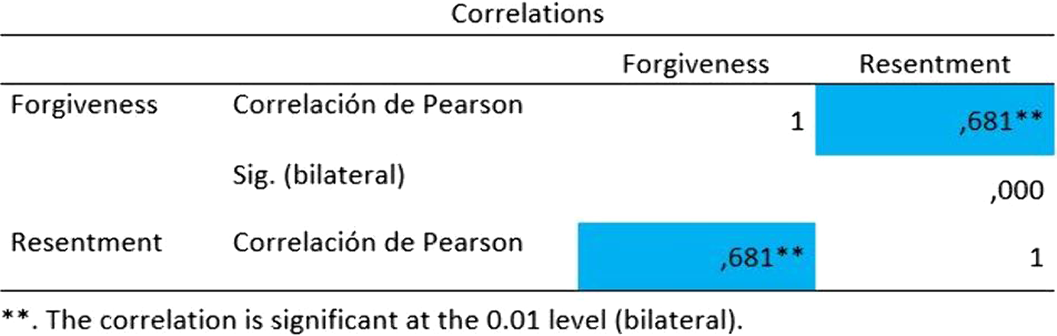
The results of the study are presented, which has aimed to analyze the relationship between resentment and forgiveness with victims of forced displacement in three cities of Colombian.
Methods
A correlational study has been carried out with a sample of 40 (n = 40) subjects of which 52.5% are men and 47.5% women, the mean age is 57.52 (σ = 13.591), all with a history of forced displacement; to the data collection has been used the CAPER instrument of Rosales, Rivera and Garcia (2017) (α = .592).
Results
There is evidence of a positive bilateral correlation between the variables studied (r = .000; p = .681), the greater the personal restoration, the greater the feeling of guilt.
Conclusions
It is important that the intervention processes designed for the victims of forced displacement focused on forgiveness include in their content elements associated with resentment.
Caregiver support groups provide an avenue for interactions among the caregivers of the mentally ill, where they share their fears, hopes and uncertainties about their ill relatives. They are a means to be “heard” by care providers, a platform for psychoeducation as well as an avenue for participation in clinical decision making and formulation of patients’ care plans. In most parts of Africa, such support groups do not exist and where they do, they are poorly structured and poorly funded.
Objectives
This review was aimed at examining the concept of caregiver support groups for the mentally ill globally as revealed in the currently avaliable body of knowledge, as well as raise awareness for the need for such groups in Africa
Methods
A review of related literature was done using appropriate key words and search engines.
Results
This review revealed the presence of well- structured support groups for the caregivers of the mentally ill in many parts of the world. The advantages of such groups and their contributions to the holistic care of these patients in those regions were also discussed, while suggesting a possible structure for their creation, sustainability and focus in Africa.
Conclusions
The support of caregivers for the mentally ill must be given keen attention by both care providers and policy makers, with prime importance given to the creation and funding of more caregiver support groups in the continent in order to achieve quality and holisitic care for the mentally ill.
Few people seek mental health care despite the high prevalence of mental illnesses and their serious consequences. Barriers explaining this lack or absence of help-seeking have been the subject of several studies with stigma being the most prominent barrier.
Objectives
We aimed to assess the relationship between stigma and help-seeking intentions in a sample of Tunisian college students.
Methods
This was a cross-sectional survey. The “Mental Health Knowledge Schedule”, and the “Reported and Intended Behavior Scale” were administered to a total of 714 college students (62.2% female; mean age =20.9).
Results
More than one-third of students (39.6%) felt that it would be “unlikely” or “very unlikely” to seek the help of a health professional for mental health problems. Pearson product moment correlations indicated that help-seeking intentions significantly and positively correlated with behavior (p<0.001, r=0,103) and knowledge (p<0.001, r=0,163). The multiple hierarchical linear regression analysis found that after controlling for demographic variables (gender, age) and other personal-related variables (marital status, family income, living environment, substance use, personal psychiatric history), help-seeking intentions were significant contributors to behaviors and knowledge.
Conclusions
Given that stigma and discrimination against people with mental illness is a real and perceived barrier to seeking help and treatment, psycho-educational campaigns should be put in place to address the negative perceptions and attitudes of the general population about mental health issues, and should be tailored to the needs of specific groups (including students in different disciplines), taking into account their attitudes, fear and concerns about mental illness.