We partner with a secure submission system to handle manuscript submissions.
Please note:
You will need an account for the submission system, which is separate to your Cambridge Core account. For login and submission support, please visit the
submission and support pages.
Please review this journal's author instructions, particularly the
preparing your materials
page, before submitting your manuscript.
Click Proceed to submission system to continue to our partner's website.
To save this undefined to your undefined account, please select one or more formats and confirm that you agree to abide by our usage policies. If this is the first time you used this feature, you will be asked to authorise Cambridge Core to connect with your undefined account.
Find out more about saving content to .
To send this article to your Kindle, first ensure no-reply@cambridge.org is added to your Approved Personal Document E-mail List under your Personal Document Settings on the Manage Your Content and Devices page of your Amazon account. Then enter the ‘name’ part of your Kindle email address below. Find out more about sending to your Kindle.
Find out more about saving to your Kindle.
Note you can select to save to either the @free.kindle.com or @kindle.com variations. ‘@free.kindle.com’ emails are free but can only be saved to your device when it is connected to wi-fi. ‘@kindle.com’ emails can be delivered even when you are not connected to wi-fi, but note that service fees apply.
Working conditions at universities are often considered precarious. Employees complain of fixed-term contracts and extensive unpaid overtime (Dorenkamp et al. 2016). Studies from various fields of work show that occupational groups with a high workload suffer particularly from a conflictual compatibility of work and family.
Objectives
The aim of this study was to assess the WFC in the context of working conditions.
Methods
N=844 university employees (55% women, 41% men) were asked about the burden of work/life balance using Work-family-conflict (WFC) - Family-work-conflict (FWC) -Scales (Netemeyer 1996). The dichotomously formulated question on overtime worked was supplemented by a five-step scaled item on the burden of overtime. The correlation analyses were calculated according to Spearman.
Results
Overtime performed by 83% of the total sample and 64% feel burdened by it. 95% of the scientists and physicians, 68% of the administrative staff, 63% of the service providers work overtime and 90% of the physicians and 72% of the scientists feel burdened by it. Significantly high correlations were found between the burden of overtime and the conflict of compatibility. The higher the burden of overtime, the higher the WFC and FWC. The highest correlation was found among physicians (r=.649), followed by scientists (r=.533), administration (r=.451), services (r= (total sample r=.562).
Conclusions
The additional work and strain caused by this, as well as the connections with the problem of compatibility, show need for action for employers regarding the working conditions of physicians and scientists. Especially with regard to reducing overtime and improving the compatibility of work and family.
Previous studies about relationship between personality factors and stress related processes mainly focus on relation between these factors and application of coping strategies.
Objectives
This study expanded previous research by examining the combined contribution of personality traits (NEO-FFI) and coping strategies (Brief COPE) in the prediction of stress, depressive symptoms, anxiety symptoms (DASS-21), and psychological well-being (WHO-5) among undergraduate nursing students.
Methods
This cross-sectional study was performed in 2017. Participants of this study were 75 nursing students (men=37, women=38) from one Portuguese School of Health Sciences. The students who agreed to participate filled out an informed consent. Then the questionnaires were administered in a random order to avoid order effects in the data.
Results
Regarding personality, women reported higher conscientiousness and agreeableness than men. There were no gender differences in coping. Among men, openness and agreeableness (inversely) and neuroticism predicted stress. In women, neuroticism and venting predicted stress. Regarding depression, conscientiousness and extraversion (inversely) and neuroticism were predictors for men, whereas neuroticism, self-blame, and denial were predictors for women. Conscientiousness and extraversion (inversely) and venting and denial predicted anxiety in men, as did neuroticism and venting in women. For well-being, conscientiousness and extraversion were predictors among men; neuroticism and seeking instrumental support (inversely) and extraversion were predictors among women. Personality traits dominated the prediction of distress and well-being in men, while both personality and coping were predictors in women.
Conclusions
These findings indicate that it is not the degree of each personality trait or coping strategy but the pattern of relationship between these phenomena and psychological outcomes that is of relevance. The results could inform gendered preventive and treatment interventions for college students.
One of the most complex and emotional aspects of nursing is the interaction between the nurse and the dying child. The attitudes of nurses towards death, affect the quality of care.
Objectives
To investigate pediatric nurses’ attitudes towards death.
Methods
Methodology: 170 nurses, working in pediatric hospital departments completed a questionnaire which included sociodemographic characteristics and information related to their previous training and clinical experience regarding death issues in general and dying children’s care in particular.
Results
68.6% reported that the death of a child affects them very much, while 44.7% of the participants didn’t feel well prepared to manage death issues. Pediatric nurses were greatly affected by children’s death, expressing mainly feelings of sadness (44%), compassion (22%), guilt (22%) and anger (22%). 73% of the sample wished the hospitalized child, died when they were not present. 53.5% had been trained regarding the care of dying patients and the management of death and mourning as part of their curriculum and 21.2% had attended a relative seminar / lecture. The importance of proper and adequate education becomes particularly apparent considering that the majority of our sample either did not feel sufficiently prepared in order to deal with death and mourning, even though more than 70% of our participants had been relatively educated.
Conclusions
The incorporation of the notions of death and care at end of life in the theoretical and practical fields of nursing will improve the quality of services offered at the end of life for patients and their families.
Mental illness accounts for about one-third of the world’s disability, a burden that many health systems cannot adequately respond to. Up to 70% of mental health (MH) patients are followed-up in primary health care (PHC) settings. To bridge the treatment gap, the World Health Organization developed mhGAP, a guidance package for integrated management of priority MH disorders in lower-income countries. Other countries have developed their own evidence-based interventions.
Objectives
Overviewing countries’ strategies towards integrating MH services into PHC, their outcomes and challenges.
Methods
Review of literature using PubMed search terms “mental health primary care”, MeSH terms “Primary Health Care”, “Mental Health Care” and “organization and administration”, published in the last 5 years, in English.
Results
25 of 602 articles were selected. The mhGAP programme has seen successful integration in pilot district-level programs, but wider implementation has stalled due to stigma and lack of clinical engagement, resources, MH specialists, and policy support. The Quebec MH reform promoted integrated service networks, improving accessibility and quality of care (QoC). A Norwegian-Russian long-standing collaboration initiative has significantly improved treatment for anxiety and depression (A&D), with 58% reliable recovery rate. A Danish collaborative care intervention provided high-quality treatment of moderate A&D. In Peru, a similar initiative allowed early detection, referral, and treatment of MH patients attending PHC services.
Conclusions
Comprehensive, integrated and responsive collaborative care models are a cost-efficient strategy to improve QoC for many MH conditions across diverse populations. MH-PHC integration initiatives have seen varying degrees of success. However, several barriers impact wider implementation and scale-up.
The Brief Symptom Inventory (BSI-53) was originally developed as a shorter alternative to the Symptom Checklist-90R, which captures a breath of psychopathology. Subsequently, the BSI-53 was further streamlined to an 18-item scale assessing psychological distress in terms of somatization (S), anxiety (A), and depression (D) – also known as the “SAD Triad”. The BSI-18 has been shown to have good validity in the German general population.
Objectives
The objective of the present study was to further improve the ease of use of the BSI as a clinical screening tool by developing a reliable and valid 9-item version of the BSI-18.
Methods
A representative sample of the German general population (N=2,516) was surveyed for demographic information and completed a variety of questionnaires, including the BSI-18. Confirmatory factor analyses, item-level statistics, and correlations were used to select three rather heterogeneous items for each subscale and confirm the model fit.
Results
The proposed 3-factor model of the BSI-9, corresponding to the SAD triad, demonstrated a good model fit. The internal consistency (Cronbach’s alpha) was .87 for the total scale, .72 for the somatisation scale, .79 for the depression scale, and .68 for the anxiety scale. Each of the subscales were significantly related to the Patient Health Questionnaire-4 and Hopkins Symptoms Checklist-25 in the hypothesized direction.
Conclusions
The BSI-9 provides researchers and clinicians with a brief, effective, and valid tool to screen for anxiety, depression, and somatization, thus preventing potential overload for research participants and flagging patients who might need further clinical assessment.
The PSP has been implemented in Catalonia in 2006 in an attempt to improve the Primary Care treatment of the most common mental disorders and addictions. It’s based on a collaborative model, made up between Primary Care and Mental Health professionals.
Objectives
To identify the strengths and limitations of the PSP from the perspective of Primary Care and Mental Health professionals.
Methods
Qualitative, exploratory and interpretive study based on Grounded Theory, made between 2018 and 2019 with Primary Care and Mental Health professionals. Group interviews were conducted with triangulated analysis. The study got the approval from the Research Ethics Committee of the Sant Joan de Deu’s foundation.
Results
11 group interviews were conducted in 6 primary care centers and 5 mental health centers in Barcelona. Intrinsic and extrinsic factors impacting the programme functioning were detected. Within the extrinsic factors, elements related to professionals, patients and public health system have been observed. All the professionals agree that the PCSP has a favorable impact on inter-professional relationships and patients, facilitating the management of cases. In contrast the heterogeneity implementation, the lack of training, and the health care burden in is considered to negatively influence an optimal development of the programme. Professionals suggest communication and inter-professional collaboration would be improved by creating more a horizontal structure that eliminates vertical lines of command and disagreements in clinical judgement, thus facilitating shared decisions.
Conclusions
PrimaryCare and MentalHealth professionals value the PSP positively, but conclude there are communication and organizative barriers that should be addressed in order to improve the overall programme’s efficiency.
Over half of patients with mental disorders are seen by primary care physicians. However, as for patients with somatic problems, referral to psychiatrists seems to be sometimes necessary.
Objectives
The present study aimed to identify reasons and difficulties perceived by general practitioners (GP) in mental health referrals.
Methods
A cross-sectional web-based survey was conducted between August 22 and September 23, 2020, so that 47 responses of GP were included.
Results
The mean age of respondents was 37.3 years. Their seniority as doctors was 8 years on average. Among them, only 17% attended a post-university psychiatric training. The participants reported that they refer on average 32.5% of patients with mental disorders to psychiatrist: 85.1% to psychiatric hospital, 40.4% to liberal psychiatrists and 21.3% to clinical psychologists. Regarding the reasons for referral to mental healthcare structures, 70.2% of doctors justified their doing so by their insufficient training in mental healthcare; 66% by a need for hospitalization, 57.4% by the presence of delusions, while in 27.7 % of cases, the transfer was carried out at the request of the patient or his family. The difficulties mentioned by GP were patient refusal to consult a psychiatrist (70.2%) and difficulties related to the management delay (44.7%).
Conclusions
Patient and health system factors, as well as physicians experience seem to have important influences on mental health referral. Open communication and ease of consultation with psychiatrists can make the care of patients with mental health problems even more rewarding to the primary care physician.
Assessing the attitudes of family medicine residents toward schizophrenia is of greatest concern since family physicians potentially have a key role in identifying the signs and symptoms of schizophrenia at earlier stages and in engaging young people in treatment, especially in low- and middle-income countries.
Objectives
We aimed to investigate attitudes towards schizophrenia in a group of Tunisian family medicine residents, and to examine the link between these attitudes and help-seeking intentions in this group.
Methods
This was a cross-sectional survey. A 18-item questionnaire concerning attitudes toward schizophrenia was used.
Results
A total of 88% participants have reported favorable help-seeking intentions. In total, 48.4% of residents would oppose if one of their relatives would like to marry someone who has schizophrenia, and 37.1% of them would not like to have a neighbor with schizophrenia. Only about a half of residents agreed that “schizophrenia has the chance of recovery”, and 68.8% thought that “schizophrenia can be treated”. Pearson correlations found a significant negative relationship between age and social distance in residents (p<.001). Year of residency was significantly associated with attitudes toward schizophrenia, with more unfavorable attitudes in third-year residents (p=.042). After controlling for potentially confounding sociodemographic variables, help-seeking intentions did not contribute to the prediction of attitudes toward schizophrenia in the residents.
Conclusions
Implementing anti-stigma programs in medical schools may help improve future physicians’ attitudes and prepare them to provide primary mental health care to young help-seekers with psychosis should be given priority attention.
This presentation focuses on two major problems in psychiatric hospital care: patient violence and lack of patient engagement. Interventions already exist for managing patient violence. However, the challenge in using these interventions is poor integration to clinical practice and these methods do not entail elements of patient engagement.
Objectives
The aim of the presentation is to give on overview of a project aiming to develop and test new structured intervention for violence risk management. Intervention aims to increase safety in care environments and engagement of patients.
Methods
Intervention Mapping protocol together with staff and patients will be used in the project. Quasi-experimental design is used to test the intervention in 4 month period in two psychiatric hospital units.
Results
By the end of the year 2020, development of the the new violence risk management intervention is nearly finished. The presentation will give an outline of the developed intervention and how staff and patient engagement in the development phases were ensured.
Conclusions
The project described in this presentation is an example how a feasible violence risk management method can be developed together with staff and patients receiving psychiatric care. By ensuring engagement of the target groups, here staff and patients, it is possible to promote real integration of a new working method to psychiatric inpatient care. This project was funded by the Academy of Finland (316206).
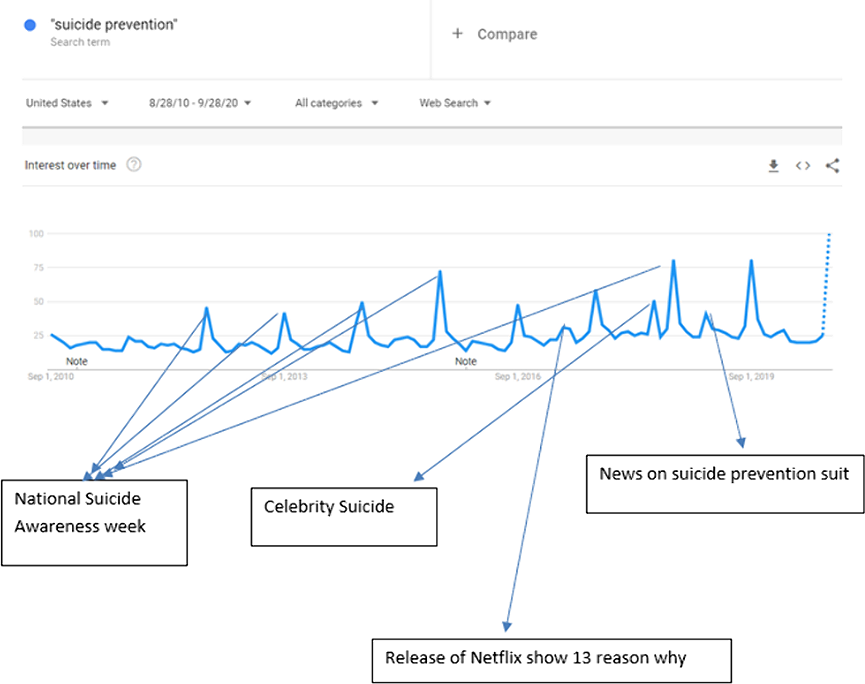
Every year in the month of September, National Suicide Prevention Week is celebrated. The goal of suicide prevention week is to inform the public about suicide prevention, primarily the warning signs of suicide. However, the impact of this month on the general population is unknown. The Google trends show how frequent web searches have been performed for a particular search-term, which provide an approximation of the people’s interest.
Objectives
To evaluate public interest in suicide prevention by analyzing the google trends of “Suicide Prevention” search-term.
Methods
We estimated the interest in such topics by running the google trends data of the last decade by using the filter [Search Term:“Suicide Prevention”, Locations: “United States” and Time Ranges “ 2010 to 2020”].
Results
During this specific interval, people have searched “Suicide Prevention” most frequently during the month of September (month of National Suicide Prevention week). Conversely, in the other months, interest in “suicide prevention” fluctuated between little to none. The only other time people have shown interest in Suicide prevention, other than the month of September, was with suicide news in the media, such as the death of a celebrity by suicide, or suicide-related TV shows. [Figure]
Conclusions
Although it is not definitive, it gives some idea that National Suicide Prevention week has a considerable impact on population interest. Since we did not observe sufficient public interest in other months, there should be frequent and systematic efforts to spread suicide prevention awareness among the general population.
The mental health law is not universal. In Portugal the urgent compulsory regimen is based on the principles of the presence of severe mental anomaly and risk to themselves or others.
Objectives
Characterization of patients admitted in compulsory hospitalization (CH) between 2018 and 2020, in the University Hospital Center of Algarve - Faro Department
Methods
Retrospective study from January/2018 to August/2020. Social, demographic, epidemiological and clinical data were evaluated.
Results
Of 1191 patients who were admitted 36% occurred in CH. There was a predominance in male sex (58%), the average age was 43 years old. For 62% it wasn´t the first hospitalization and 58% had a recent prescription. Admission occurred most frequently because of the presence of psychotic symptoms (figure1) and according to the international classification of disease (ICD10) the most frequent diagnosis was unspecified nonorganic psychosis (figure2). At discharge 59% of the patients remained on compulsory treatment (CT), where the most frequent diagnosis was schizophrenia. Although most of these patients were discharged with oral and long-term injectable antipsychotics, there were higher rates of readmissions when compared to non-CT group, were the most frequent diagnosis was mental and behavioural disorders due to psychoactive substance use and most of the patients were discharged only with oral therapy.
Conclusions
Patients in compulsory regimen have a severe mental illness with higher rates of readmission. We highlight the use of long-term injectable antipsychotics in terms of compliance. These findings corroborate the need for specialized and multidisciplinary approach in terms of psychosocial rehabilitation in these patients.
The reform of the Moscow psychiatric service began in 2011 and was aimed at its optimization, reducing the inpatient level, actively introducing psychosocial rehabilitation, multidisciplinary teams of specialists and developing community-based forms of care. In 2016, the number of beds in day care hospitals in Moscow had doubled to rich 3500.
Objectives
Analyze the dynamics of characteristics of day hospital patients and propose measures to improve the quality of medical rehabilitation care provided.
Methods
Clinical and psychopathological, clinical and statistical, psychological, statistical of 337 schizophrenia patients discharged in 2010 and 2016.
Results
A comparative analysis of the results obtained in 2010 and 2016 indicates a change in the clinical, socio-demographic and psychological characteristics of patients treated in the day hospital. In 2016, the proportion of early stage disease patients with endogenous mental disorders (F20-F29, according to ICD-10) increased; the age of patients and the proportion of patients with disabilities decreased; the proportion of patients with preserved working capacity increased, demonstrating low rates of compliance and motivation for treatment, but higher rates of neuro-cognitive functioning. In 2016, only a fifth of patients received complex psychosocial therapy.
Conclusions
The modernization of the psychiatric service has improved the continuity between its inpatient and out-of-hospital units. To improve the quality of care in the day hospital and to prevent relapses of the disease, it is necessary to combine pharmacotherapy with complex psychosocial treatment followed by a long-term personalized management of patients with the patient’s families involvement.
Some attempts are being made to describe the mental health and well-being of the population in relation with the regional specifics in a particular area of the Russia, however, they are rare and local (limited to one region).
Objectives
The current study aims to identify sociocultural mediation of mental well-being based on its measures in Russia’s regions with different ethno-cultural composition of population.
Methods
The study involved 210 men and 403 women aged 14 to 76 years (M = 26.9; SD = 13.7) from six regions of the Russian Federation: Moscow, St. Petersburg, Udmurtia, Sakha, Sverdlovsk and Kemerovo. The mental well-being of participants was assessed using the Warwick-Edinburgh Mental Wellbeing Scale (Tennant et al., 2006; Tennant et al., 2007).
Results
The measures of mental well-being were different in the regions: Moscow (M=51.04; SD=8.03), St.-Petersburg (M=50.05; SD=5.78), Udmurtia (M=47.57; SD=9.50), Sakha (M=50.99; SD=8.47), Sverdlovsk (M=54.86; SD=8.43), Kemerovo (M=51.84; SD=7.51). Using one-way analysis of variance (ANOVA), it was found that there are significant differences in the assessment of psychological well-being between study participants from different regions (F = 6.692; p <0.001). Residents from the Sverdlovsk evaluate their mental well-being as significantly better than the ones from Moscow (MD=3.821; p=0.012), St.Petersburg (MD=4.812; p=0.023), the Udmurtia (MD=7.284; p <0.001) and the Sakha (MD=3.869; p=0.003).
Conclusions
Residents from Russia’s regions with different ethno-cultural composition of population demonstrate some difference in mental well-being measures that may be caused by sociocultural factors. The reported study was funded by the Russian Foundation for Basic Research, project number 17-29-02506.
Many studies showed an increased incidence of psychotic disorders (PD) among immigrants.
Objectives
Study the characteristics of patients suffering from PD and having immigration experience (IE) by comparing them to patients without IE.
Methods
A retrospective controlled study, involving 58 male patients having IE and suffering from PD (DSM 5) who were followed in the psychiatry department of Hedi Chaker University Hospital in Sfax (Tunisia), between January 2013 and December 2018.They were compared to 60 male patients suffering from PD who lack the IE. Samples were matched on age and socio-economic status. Data was collected from their medical records.
Results
The mean age was 36 years old. The countries of destination were almost European (65.5%). The most common PD were schizophrenia (62%) and schizoaffective disorder (19%). The use of psychoactive substances (PS) was noted in 55% of cases.The average time interval between the onset of the PD and immigration was 4,7 years. The mean age of the onset of PD was 27 years old. The mean age of PD onset was earlier among patients having IE (27 year old vs 28.5 year old, p=0.24).The use of PS was significantly higher in these patients (p=0.04).
Conclusions
Our study identified some of the features associated with PD that occur during an immigration experience such as the use of PS. Further studies should be conducted in collaboration with countries of destination of immigrants to clarify the relationship between immigration and PD.
Understanding suicidal ideation and its association with childhood adversity is crucial for preventing suicide. Although the “healthy immigrant effect”, whereby immigrants are healthier than the native-born population, has been well documented across studies, little research has examined the presence of such effect on lifetime suicidal ideation (LSI) and its association to early adversity.
Objectives
The aim of this study was to compare the prevalence of LSI between the immigrant and native-born population in Chile and explore the association between childhood adversity and suicidal ideation in immigrants.
Methods
Data from two cross-sectional health surveys: the Santiago Immigrant Wellbeing Study (STRING, n=1,091; 2019) and the Chilean National Health Survey (ENS2016, n=3,432) were used. Each study used multistage probability sampling and estimates were weighted to approximate the distribution of demographic variables in each population. Outcomes included LSI measured by WHO-CIDI and an adapted version of the Adverse Childhood Experience Questionnaire. Multivariate logistic regression was employed.
Results
indicated that immigrants were less likely to report LSI compared with the native-born population. Moreover, male and female immigrants had lower risk of having SI than native-born counterparts. After controlling for socioeconomic status, social support, and health conditions, childhood adversities predicted an increased risk of LSI in immigrants. No gender differences were found in the effects of childhood adversity on suicidal thoughts.
Conclusions
Findings confirm the presence of a healthy immigrant effect in LSI and support a life course perspective, highlighting the importance of assessing early life disadvantages to understand suicidal ideation among immigrants.
There are about 1.5 million internally displaced persons (IDPs) in Ukraine, which requires an assessment of their mental health.
Objectives
To develop a psychoeducational program aimed at informing about the clinical manifestations (markers of symptoms) of mental disorders, the possibilities of preventing their formation and options for action in conditions of the formation or exacerbation of a mental state.
Methods
270 IDPs were examined. Methods: clinical-psychopathological, psychometric, statistical.
Results
Evaluation of the mental state of IDPs with symptoms of mental disorders (risk group (31.92%)) indicates the presence of various emotional disorders that formed individual syndromes – asthenic (41.18%), agrypnic (45.59%), somato-vegetative (30.88%), anxiety-depressive (20, 59%). The risk factors for the development of mental disorders in IDPs were identified - the older age is from 50 to 59 and the average age is from 40 to 49 years; lack of a complete family, lack of work, low level of social employment, lack of satisfactory living conditions, a significant decrease in the level of well-being, the preservation of the significance of factors of mental trauma, the presence of certain prenosological syndromes. The proposed psychoeducational program is built on the principle of thematic seminars with elements of social and psychological training.
Conclusions
The implementation of the program provides a comprehensive impact on the cognitive, emotional, psychophysiological, behavioral and social aspects of personality functioning.
Previous migrant population studies have shown that immigrants experience high level of psychological load and difficulties in accessing care. This is especially prevalent in those with refugee background. To tackle this issue, the PALOMA2 project (National support system for refugee mental health work and the knowhow dissemination) establishes a National PALOMA Centre of Expertise (PALOMA COE) for mental health work among refugees.
Objectives
The PALOMA COE consists of all five University Hospital Areas and an NGO representative. The PALOMA COE work is becoming a permanent part of the Finnish health care structure. Each represented region has their own specific strengths and challenges, and the formation of Regional PALOMA COEs is planned accordingly. Together these Regional PALOMA COEs form the National PALOMA COE. Here we dive deeper into the Tampere University Hospital Region’s formation of PALOMA COE.
Methods
Psychiatric Clinic for Refugees (PCR) has been working for over 24 years in the Tampere City area. PCR has a long history of PALOMA COE work in forms of clinical work, consulting and training professionals working with refugee mental health. From the beginning of 2021, PCR is integrating with Tampere University Hospital.
Results
As a part of the integration process, the PALOMA COE work has a possibility to expand to the entire University Hospital area and better fulfill the specific needs of the entire region.
Conclusions
The integration will improve the resources, quality and access to mental health care among people with refugee background.
Emigration is a widespread phenomenon in our country for the last three decades.Various risk factors for mental disorders are related to emigration,like social-economic status,language,cultural shock,racism etc.
Objectives
The objectives of this study is assess how much of a risk factor is emigration in the development of psychiatric disorders.
Methods
This is retrospective study done on 178 patient charts from The Comunity Mental Health Center Nr.3 in Tirana,of patients who durin the last 20 years had their first episode of mental health disorder durin emigration.
Results
Emigrants before year 2004 had more psychotic disoders,whereas those after that year manifested more mood disorders.The mean age for starting MDD is 35 years old,and the mean age for schizophrenia is 25.Females develope more mood disorders,whereas males manifest more schizophrenia.
Conclusions
Emigration affects deeply mental health,and is a risk factor for developing psychiatric disorders,with females being prone to have mood disorders,whereas males schizophrenia.Schizophrenia start in an earlier age compared to depression.
Although a large number of studies have shown brain volumetric differences between men and women, only a few investigations to date have analyzed brain tissue volumes in representative samples of the general elderly population.
Objectives
We investigated differences in gray matter (GM), white matter (WM) and intracranial volumes (ICVs) between sexes in individuals above 66 years old using structural magnetic resonance imaging (MRI).
Methods
Using FreeSurfer version 5.3, we automatically obtained the ICVs, GM and WM volumes from MRI datasets of 84 men and 92 women. To correct for interindividual variations in ICV, GM and WM volumes were adjusted with a method using the residuals of a least-square-derived linear regression between raw volumes and ICVs. We then performed an ANCOVA comparing men and woman including age and years of schooling as confounding factors.
Results
Women had a lower socioeconomic status overall and fewer years of schooling than men. The comparison of unadjusted brain volumes showed larger GM and WM volumes in men. After the ICV correction, the adjusted volumes of GM and WM were larger in women.
Conclusions
After the ICV correction and taking into account differences in socioeconomic status and years of schooling, our results confirm previous findings of proportionally larger GM in women, as well as larger WM volumes. These results in an elderly population indicate that brain volumetric differences between sexes persist throughout the aging process. Additional studies combining MRI and other biomarkers are warranted to identify the hormonal and molecular bases influencing such differences.
Cognitive complaints and psychological distress are common in oncologic patients, in particular many studies have focused on women with breast cancer.Patients presenting the phenomenon of “chemofog” show changes after chemotherapy with regard to memory and emotional regulaiton.
Objectives
To explore brain connectivity prior to chemotherapy that nevertheless,is understudied.
Methods
We used fMRI to investigate the resting state connectivity in 24 patients before chemotherapy and 15 controls.Patients were assessed with self-administered questionnaires,such as the Patient’s Assessment of Own Functioning Inventory (PAOFI) that quantifies the decrease in perceived functioning in memory, language and problem solving (Image 1).We used a preliminary structural analysis in order to choose which neuropsychological test was affected in correlation with a significant anatomical volume alteration,as showed in the p-value table.Therefore, patients were ranked and divided into two group of “Impaired vs Preserved”, measured using the median of the questionnaire results.Higher scores indicate a poor cognitive self-perceived performance.
Results
Connectivity was altered in amygdala and hippocampus, in the subgroup of patients with higher subjective cognitive complaints i.e with a high PAOFI Memory score.More specifically, we found an association between memory impairment and the increase of the resting state connectivity of both right structures, as opposed to a reduction in left amygdala (Image 3).
Conclusions
These findings may suggest a potential effect on brain functional connectivity of the psychological awareness and stress of cancer itself. We found connectivity alterations for both amygdala and hippocampus, two structures belonging to the limbic system, that is involved in the interplay between cognition and emotions, such as anxiety and fear.