Pothos & Busemeyer's (P&B's) argument in favor of a quantum probability (QP) approach to cognitive modeling relies on the following premises:
-
1. A large amount of empirical findings accumulated in the last 40 years shows that human judgment often violates key aspects of classical probability (CP) theory.
-
2. Heuristic-based approaches, although interesting, are often limited in their applicability and explanatory scope.
-
3. It is possible to model probability judgment on the basis of formal tools, and use these to re-express and sharpen popular heuristics.
We agree with P&B on all the mentioned assumptions. However, we depart from P&B in our assessment of the potential of their QP approach for achieving a better understanding of human judgments under uncertainty. We will illustrate our perspective with reference to the conjunction fallacy (CF) (Tversky & Kahneman Reference Tversky, Kahneman, Kahneman, Slovic and Tversky1982; 1983). The CF plays a key role in P&B's argument because P&B claim that this prominent violation of CP laws has a natural and straightforward explanation in their QP approach. In what follows, we will illustrate two main problems that arise with regard to P&B's interpretation of the CF results.
The first problem is that the QP approach is contradicted by empirical data. To begin with, it is unable to accommodate double conjunction fallacies (e.g., the mile run scenario in Tversky & Kahneman 1983, p. 306) – that is, all those situations in which h
1∧h
2 is ranked over each of h
1 and h
2 appearing in isolation (Busemeyer et al. Reference Busemeyer, Pothos, Franco and Trueblood2011, p. 202). Several single conjunction fallacy results are also demonstrably inconsistent with the QP approach. For example, suppose that, given some evidence e, the most likely statement has to be chosen among three, namely, a single hypothesis h
1 and two conjunctions, h
1∧h
2 and h
1∧~h
2, as in the following scenario:
K. is a Russian woman. [e]
Which of the following hypotheses do you think is the most probable?
– K. lives in New York. [h
1]
– K. lives in New York and is an interpreter. [h
1∧h
2]
– K. lives in New York and is not an interpreter. [h
1∧~h
2]
Tentori et al. (Reference Tentori, Crupi and Russo2013) observed that P(h
2|e∧h
1) < P(~h
2 |e∧h
1) for the majority of participants. One can just as safely assume that P(h
2|e) < P(~h
2|e), as clearly only a tiny fraction of Russian women are interpreters. On these assumptions, the QP account of the conjunction fallacy demonstrably predicts that the judged probability of h
1∧h
2 must be lower than that of h
1∧~h
2 (see Fig. 1), and, therefore, that fallacious choices for h
1∧h
2 must be less than those for h
1∧~h
2.
Figure 1.
A QP representation of the Russian woman scenario. To simplify notation, P is taken to already encode the evidence e (Russian). In line with participants' judgment, the basis vectors are displayed as to imply P(h
2|h
1) < P(~h
2|h
1), whereas the position of the state vector implies P(h
2) < P(~h
2), as clearly only a tiny fraction of Russian women are interpreters. Under these conditions, if we assume – as it seems plausible – that P(h
1) ≥ P(h
2), the QP approach does not allow for the conjunctive probability of h
1 and h
2 to rank higher than the single conjunct h
1. However, the QP approach yields the wrong prediction even if we assume P(h
1) < P(h
2). As the figure illustrates, in this case, contrary to the participants' judgment, it is the conjunctive probability of h
1 and ~h
2
, not that of h
1 and h
2, which must rank highest.
However, in contrast to this prediction, a significant majority (70%) of the fallacious responses in the Russian woman scenario concerned h
1∧h
2 rather than h
1∧~h
2. More generally, one can prove that, for the QP account, if P(h
2|e) ≤ P(h
3|e) and P(h
2|e∧h
1) ≤ P(h
3|e∧h
1), the judged probability of the conjunction h
1∧h
2 on the assumption of e cannot be higher than that of h
1∧h
3
. In a series of four experimental studies (which employed different elicitation procedures, experimental designs, classes of problems, and content), Tentori et al. (Reference Tentori, Crupi and Russo2013) documented a robust pattern of results inconsistent with this implication of the QP model, as well as with other recent proposals, such as the averaging (Nilsson et al. Reference Nilsson, Winman, Juslin and Hansson2009) and the random error (Costello Reference Costello2009) hypotheses, which imply that CF rates should rise as the perceived probability of the added conjunct does. The results supported a different explanation of the CF, based on the notion of inductive confirmation (Crupi et al. Reference Crupi, Fitelson and Tentori2008). Much like the QP approach, this explanation relies on a well-defined formalism (Bayesian confirmation theory) while avoiding the limitations (e.g., post-hoc parameters) that P&B (sect. 4.1) ascribe to other Bayesian models.
The second problem is that, even when logically consistent with the empirical data, P&B's treatment nonetheless receives limited support. The QP modeler is typically left with a number of choices that are unconstrained by the model itself. Lacking independent and clearly defined empirical input, the modeling exercise does not achieve explanatory relevance. The Linda scenario serves as an illustration. For their QP approach to account for the reported judgment P(bank teller ∧ feminist) > P(bank teller), P&B need to make various assumptions (sect. 3.1) on the angle between the basis vectors, as well as on the position of the state vector. Some of these assumptions are uncontroversial. Others are quite subtle, however, and have non-trivial consequences. As the left column of Figure 2 shows, keeping basis vectors equal, a small shift in the position of the state vector is enough to reverse the predicted ranking between P(bank teller ∧ feminist) and P(bank teller) even if the perceived probability of the feminist conjunct remains much higher than that of bank teller.
Figure 2.
Two different plausible QP representations of the Linda and Scandinavia scenarios. The positioning of the vectors in the top half is compatible with the observed conjunction fallacy judgment P(h
1∧h
2) > P(h
1), whereas that in the bottom half is not.
A similar situation arises with the Scandinavia scenario (Tentori et al. Reference Tentori, Bonini and Osherson2004):
Suppose we choose at random an individual from the Scandinavian population. [e]
Which do you think is the most probable?
– The individual has blond hair. [h
1]
– The individual has blond hair and blue eyes. [h
1∧h
2]
– The individual has blond hair and does not have blue eyes. [h
1∧~h
2]
Does the QP approach predict the observed prevalence of fallacious choices for h
1∧h
2? This crucially depends on how we determine the vector space.
The right column of Figure 2 shows two different representations of the Scandinavia scenario (the state vector and the h
2 basis vector are simply switched). The QP approach allows for both, and both appear reasonable. However, yet again, in the two cases, opposite orderings of P(h
1∧h
2) and P(h
1) follow from the QP approach. For an observed judgment to be taken as properly supporting the QP explanation of the CF, the corresponding vector space representation needs to be constrained on independently motivated empirical grounds. Otherwise, we can only say that the QP approach can be made compatible with some (and not all) of the CF data. However, for a putatively comprehensive theoretical framework, being able to accommodate some empirical results does not equal predicting and explaining a phenomenon.





Pothos & Busemeyer's (P&B's) argument in favor of a quantum probability (QP) approach to cognitive modeling relies on the following premises:
1. A large amount of empirical findings accumulated in the last 40 years shows that human judgment often violates key aspects of classical probability (CP) theory.
2. Heuristic-based approaches, although interesting, are often limited in their applicability and explanatory scope.
3. It is possible to model probability judgment on the basis of formal tools, and use these to re-express and sharpen popular heuristics.
We agree with P&B on all the mentioned assumptions. However, we depart from P&B in our assessment of the potential of their QP approach for achieving a better understanding of human judgments under uncertainty. We will illustrate our perspective with reference to the conjunction fallacy (CF) (Tversky & Kahneman Reference Tversky, Kahneman, Kahneman, Slovic and Tversky1982; 1983). The CF plays a key role in P&B's argument because P&B claim that this prominent violation of CP laws has a natural and straightforward explanation in their QP approach. In what follows, we will illustrate two main problems that arise with regard to P&B's interpretation of the CF results.
The first problem is that the QP approach is contradicted by empirical data. To begin with, it is unable to accommodate double conjunction fallacies (e.g., the mile run scenario in Tversky & Kahneman 1983, p. 306) – that is, all those situations in which h 1∧h 2 is ranked over each of h 1 and h 2 appearing in isolation (Busemeyer et al. Reference Busemeyer, Pothos, Franco and Trueblood2011, p. 202). Several single conjunction fallacy results are also demonstrably inconsistent with the QP approach. For example, suppose that, given some evidence e, the most likely statement has to be chosen among three, namely, a single hypothesis h 1 and two conjunctions, h 1∧h 2 and h 1∧~h 2, as in the following scenario:
K. is a Russian woman. [e]
Which of the following hypotheses do you think is the most probable?
– K. lives in New York. [h 1]
– K. lives in New York and is an interpreter. [h 1∧h 2]
– K. lives in New York and is not an interpreter. [h 1∧~h 2]
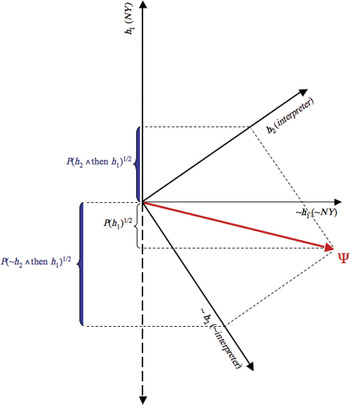
Tentori et al. (Reference Tentori, Crupi and Russo2013) observed that P(h 2|e∧h 1) < P(~h 2 |e∧h 1) for the majority of participants. One can just as safely assume that P(h 2|e) < P(~h 2|e), as clearly only a tiny fraction of Russian women are interpreters. On these assumptions, the QP account of the conjunction fallacy demonstrably predicts that the judged probability of h 1∧h 2 must be lower than that of h 1∧~h 2 (see Fig. 1), and, therefore, that fallacious choices for h 1∧h 2 must be less than those for h 1∧~h 2.
A QP representation of the Russian woman scenario. To simplify notation, P is taken to already encode the evidence e (Russian). In line with participants' judgment, the basis vectors are displayed as to imply P(h 2|h 1) < P(~h 2|h 1), whereas the position of the state vector implies P(h 2) < P(~h 2), as clearly only a tiny fraction of Russian women are interpreters. Under these conditions, if we assume – as it seems plausible – that P(h 1) ≥ P(h 2), the QP approach does not allow for the conjunctive probability of h 1 and h 2 to rank higher than the single conjunct h 1. However, the QP approach yields the wrong prediction even if we assume P(h 1) < P(h 2). As the figure illustrates, in this case, contrary to the participants' judgment, it is the conjunctive probability of h 1 and ~h 2 , not that of h 1 and h 2, which must rank highest.
However, in contrast to this prediction, a significant majority (70%) of the fallacious responses in the Russian woman scenario concerned h 1∧h 2 rather than h 1∧~h 2. More generally, one can prove that, for the QP account, if P(h 2|e) ≤ P(h 3|e) and P(h 2|e∧h 1) ≤ P(h 3|e∧h 1), the judged probability of the conjunction h 1∧h 2 on the assumption of e cannot be higher than that of h 1∧h 3 . In a series of four experimental studies (which employed different elicitation procedures, experimental designs, classes of problems, and content), Tentori et al. (Reference Tentori, Crupi and Russo2013) documented a robust pattern of results inconsistent with this implication of the QP model, as well as with other recent proposals, such as the averaging (Nilsson et al. Reference Nilsson, Winman, Juslin and Hansson2009) and the random error (Costello Reference Costello2009) hypotheses, which imply that CF rates should rise as the perceived probability of the added conjunct does. The results supported a different explanation of the CF, based on the notion of inductive confirmation (Crupi et al. Reference Crupi, Fitelson and Tentori2008). Much like the QP approach, this explanation relies on a well-defined formalism (Bayesian confirmation theory) while avoiding the limitations (e.g., post-hoc parameters) that P&B (sect. 4.1) ascribe to other Bayesian models.
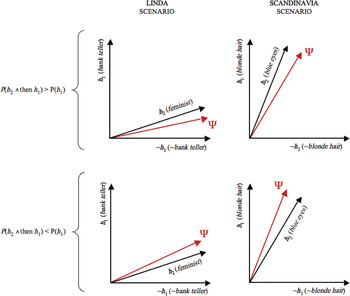
The second problem is that, even when logically consistent with the empirical data, P&B's treatment nonetheless receives limited support. The QP modeler is typically left with a number of choices that are unconstrained by the model itself. Lacking independent and clearly defined empirical input, the modeling exercise does not achieve explanatory relevance. The Linda scenario serves as an illustration. For their QP approach to account for the reported judgment P(bank teller ∧ feminist) > P(bank teller), P&B need to make various assumptions (sect. 3.1) on the angle between the basis vectors, as well as on the position of the state vector. Some of these assumptions are uncontroversial. Others are quite subtle, however, and have non-trivial consequences. As the left column of Figure 2 shows, keeping basis vectors equal, a small shift in the position of the state vector is enough to reverse the predicted ranking between P(bank teller ∧ feminist) and P(bank teller) even if the perceived probability of the feminist conjunct remains much higher than that of bank teller.
Two different plausible QP representations of the Linda and Scandinavia scenarios. The positioning of the vectors in the top half is compatible with the observed conjunction fallacy judgment P(h 1∧h 2) > P(h 1), whereas that in the bottom half is not.
A similar situation arises with the Scandinavia scenario (Tentori et al. Reference Tentori, Bonini and Osherson2004):
Suppose we choose at random an individual from the Scandinavian population. [e]
Which do you think is the most probable?
– The individual has blond hair. [h 1]
– The individual has blond hair and blue eyes. [h 1∧h 2]
– The individual has blond hair and does not have blue eyes. [h 1∧~h 2]
Does the QP approach predict the observed prevalence of fallacious choices for h 1∧h 2? This crucially depends on how we determine the vector space.
The right column of Figure 2 shows two different representations of the Scandinavia scenario (the state vector and the h 2 basis vector are simply switched). The QP approach allows for both, and both appear reasonable. However, yet again, in the two cases, opposite orderings of P(h 1∧h 2) and P(h 1) follow from the QP approach. For an observed judgment to be taken as properly supporting the QP explanation of the CF, the corresponding vector space representation needs to be constrained on independently motivated empirical grounds. Otherwise, we can only say that the QP approach can be made compatible with some (and not all) of the CF data. However, for a putatively comprehensive theoretical framework, being able to accommodate some empirical results does not equal predicting and explaining a phenomenon.
ACKNOWLEDGMENTS
Research relevant to this work has been supported by the MIUR grant “Problem solving and decision making: Logical, psychological and neuroscientific aspects within criminal justice” (PRIN, n.2010RP5RNM_006) and by Grant CR 409/1-1 from the Deutsche Forshungsgemeinshaft (DFG) as part of the prority program New Frameworks of Rationality (SPP 1516).