Hulleman & Olivers (H&O) propose that fixations, rather than items, should serve as the central unit of analysis in theories of visual search. We agree that the fixation-based approach highlights important issues, especially the potential to integrate theories of manual responses and eye fixations. However, we disagree with H&O that their simulation “provides a compelling argument for abandoning” (sect. 6, para. 2) the item-based stance.
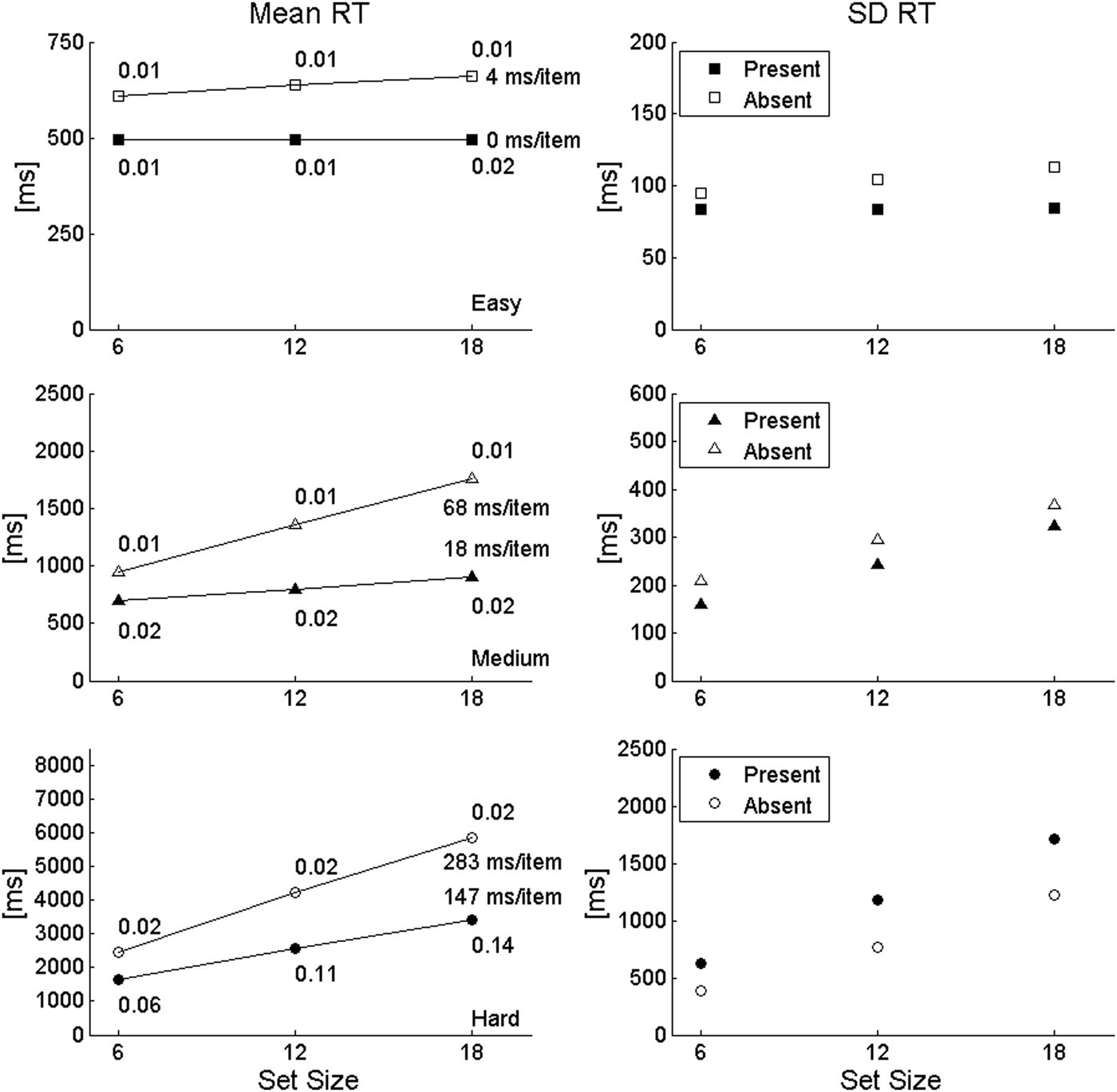
First, H&O emphasize the “difficulties or even the failure of these models to capture the distributional aspects of RTs” (sect. 6.1, para. 2). Recently we developed an (item-based) serial search model, dubbed competitive guided search (CGS; Moran et al. Reference Moran, Zehetleitner, Müller and Usher2013), which successfully accounts for benchmark RT distributions (Wolfe et al. Reference Wolfe, Palmer and Horowitz2010b) and error rates across three classical search tasks (feature, conjunction, and spatial configuration [“2 vs. 5”] searches) and which is superior to a more flexible parallel model (Moran et al. Reference Moran, Zehetleitner, Liesefeld, Müller and Usher2016). Comparing our Figure 1 with H&O's Figures 3 and 4, we see that CGS can account remarkably well for all of the empirical patterns (see our Table 1 for simulation parameters). In fact, whereas H&O's simulation grossly misestimates some aspects of the data (it underestimates RTs in the easy and medium tasks and overestimates the target absent [TA] slope in the hard task and the rate of increase in SD in all tasks), CGS provides accurate predictions.
Figure 1.
Correct RTs from three simulations of the CGS model (Table 1), reflecting hard, medium, and easy search tasks. Left and right panels depict means and SDs, respectively, as functions of set size. In the left panels, error proportions (next to the symbols) and search slopes (on the right) are indicated.
H&O especially highlight “variance inversion” (RT is more variable in TA for easy and medium-difficulty tasks but more variable in target-present [TP] displays for hard tasks) as evidence against item-based models. However, CGS can explain this pattern in that multiple sources contribute to RT variability: (a) variance in how many items are identified before a response is issued (as determined by the tendency to quit the search [for TA] and by the amount of guidance towards the target [for TP]), and (b) variance in item identification time. Because (b) builds up as more items are identified and because, in all three simulations, more items are identified in TA than in TP, (b) contributes to a higher TA variability. However, in the “hard” task, (a) is so much larger for TP that it overrules the influence of (b) and, hence, inverses the variance. Finally, H&O's claim that item-based models encounter the problem that slopes are much lower than expected based on estimates of attentional dwell time from other paradigms (~200–300 ms). A fourth simulation (Table 1, bottom row) with an attentional dwell time of 200 ms (simulated by identification time per item; Table 1, rightmost column) yielded slopes in the range claimed to be problematic for item-based models (25 and 73 ms/item for TP and TA, respectively). These moderate slopes are obtained because adding 1 item to displays increases the mean number of identified items by only ~0.13 (TA) and ~0.36 (TP).
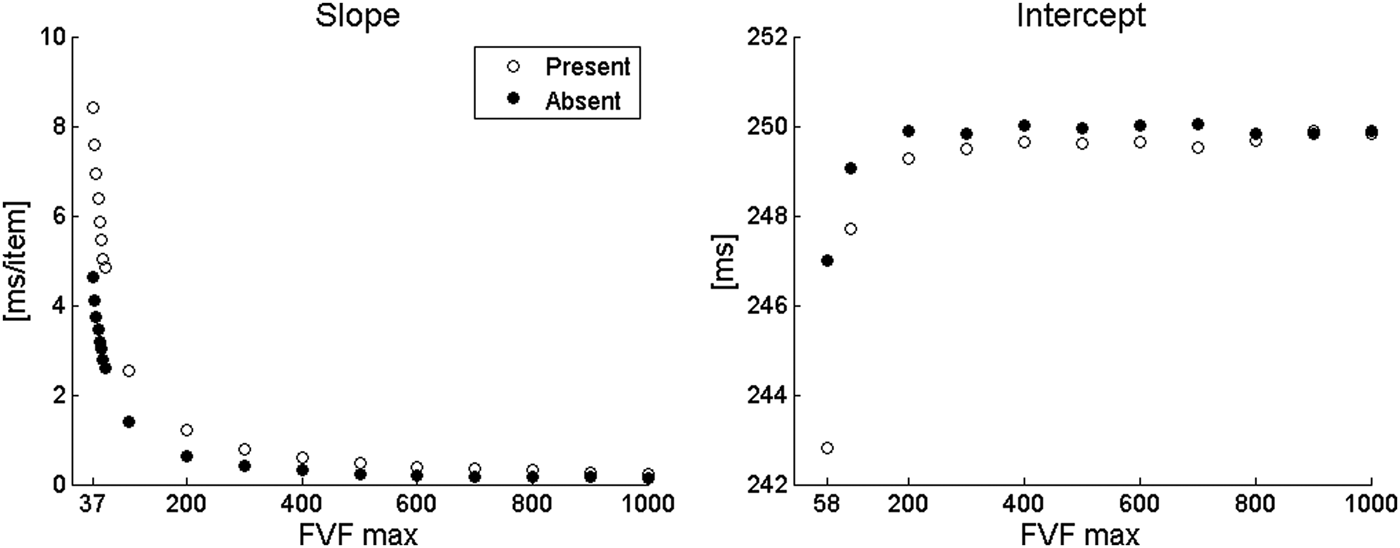
Second, manipulating target discriminability parametrically (via orientation contrast), we recently found several diagnostic data patterns, which we believe successful search theories should explain (Liesefeld et al. Reference Liesefeld, Moran, Usher, Müller and Zehetleitner2016): (a) an intermediate difficulty range (between medium and easy search), where search is efficient (e.g., 1 ms/item) for TP but inefficient (e.g., 15 ms/item) for TA, yielding TA/TP slope ratios much larger than 2; and (b) strong effects of discriminability on search intercepts (decreases >100 ms) in the efficient range. CGS accounts for (a) by large guidance (so the target is always selected first) and a low quit parameters (so the number of inspected items in TA displays increases with set size); and CGS accounts for (b) by a speed-up of item identification. However, these patterns raise challenges to H&O's approach. Indeed, repeating their simulation over a wide range of the maximal Functional Viewing Field (FVF) where search is efficient for TP (<5 ms/item), we found (Fig. 2) that the simulated TA/TP slope ratio is always smaller than 2 (left panel). Furthermore, when search is efficient for both TA and TP displays, the simulated intercepts hardly change (only about 5 ms; right panel).
Figure 2.
Simulated search slopes and intercepts as a function of the maximal Functional Viewing Field (FVF max) plotted in the range where TP (left) or both TA and TP (right) searches are efficient.
Finally, H&O concede that their high-level conceptual simulation provides merely a proof of principle for the viability of the fixation approach, but that there are still details that need to be explicated in a full model. It is tempting to think that the success of a model depends solely on its core functional assumptions and that, therefore, a fully explicated model would account for data better than the current preliminary framework. Alas, a model's success also hinges largely on peripheral assumptions and on their interaction with the central assumptions (e.g., Jones & Dzhafarov Reference Jones and Dzhafarov2014). For example, H&O acknowledge a problem with their stopping rule. This rule is indeed peripheral to the focal items versus fixations debate; however, a stopping rule affects search-RT distributions and error rates substantially and it is therefore unclear how well H&O's framework will perform with a more plausible stopping rule.
In conclusion, we believe that the proposed framework would greatly benefit from developing the details of a full fixation-based model, followed by tests of how well it captures diagnostic empirical data patterns as compared to item-based models (using formal model comparisons). Unless and until this is done, however, we find reports of an “impending demise of the item” somewhat exaggerated.








Hulleman & Olivers (H&O) propose that fixations, rather than items, should serve as the central unit of analysis in theories of visual search. We agree that the fixation-based approach highlights important issues, especially the potential to integrate theories of manual responses and eye fixations. However, we disagree with H&O that their simulation “provides a compelling argument for abandoning” (sect. 6, para. 2) the item-based stance.
First, H&O emphasize the “difficulties or even the failure of these models to capture the distributional aspects of RTs” (sect. 6.1, para. 2). Recently we developed an (item-based) serial search model, dubbed competitive guided search (CGS; Moran et al. Reference Moran, Zehetleitner, Müller and Usher2013), which successfully accounts for benchmark RT distributions (Wolfe et al. Reference Wolfe, Palmer and Horowitz2010b) and error rates across three classical search tasks (feature, conjunction, and spatial configuration [“2 vs. 5”] searches) and which is superior to a more flexible parallel model (Moran et al. Reference Moran, Zehetleitner, Liesefeld, Müller and Usher2016). Comparing our Figure 1 with H&O's Figures 3 and 4, we see that CGS can account remarkably well for all of the empirical patterns (see our Table 1 for simulation parameters). In fact, whereas H&O's simulation grossly misestimates some aspects of the data (it underestimates RTs in the easy and medium tasks and overestimates the target absent [TA] slope in the hard task and the rate of increase in SD in all tasks), CGS provides accurate predictions.
Correct RTs from three simulations of the CGS model (Table 1), reflecting hard, medium, and easy search tasks. Left and right panels depict means and SDs, respectively, as functions of set size. In the left panels, error proportions (next to the symbols) and search slopes (on the right) are indicated.
CGS parameters used in the simulations (see Moran et al. Reference Moran, Zehetleitner, Müller and Usher2013).
H&O especially highlight “variance inversion” (RT is more variable in TA for easy and medium-difficulty tasks but more variable in target-present [TP] displays for hard tasks) as evidence against item-based models. However, CGS can explain this pattern in that multiple sources contribute to RT variability: (a) variance in how many items are identified before a response is issued (as determined by the tendency to quit the search [for TA] and by the amount of guidance towards the target [for TP]), and (b) variance in item identification time. Because (b) builds up as more items are identified and because, in all three simulations, more items are identified in TA than in TP, (b) contributes to a higher TA variability. However, in the “hard” task, (a) is so much larger for TP that it overrules the influence of (b) and, hence, inverses the variance. Finally, H&O's claim that item-based models encounter the problem that slopes are much lower than expected based on estimates of attentional dwell time from other paradigms (~200–300 ms). A fourth simulation (Table 1, bottom row) with an attentional dwell time of 200 ms (simulated by identification time per item; Table 1, rightmost column) yielded slopes in the range claimed to be problematic for item-based models (25 and 73 ms/item for TP and TA, respectively). These moderate slopes are obtained because adding 1 item to displays increases the mean number of identified items by only ~0.13 (TA) and ~0.36 (TP).
Second, manipulating target discriminability parametrically (via orientation contrast), we recently found several diagnostic data patterns, which we believe successful search theories should explain (Liesefeld et al. Reference Liesefeld, Moran, Usher, Müller and Zehetleitner2016): (a) an intermediate difficulty range (between medium and easy search), where search is efficient (e.g., 1 ms/item) for TP but inefficient (e.g., 15 ms/item) for TA, yielding TA/TP slope ratios much larger than 2; and (b) strong effects of discriminability on search intercepts (decreases >100 ms) in the efficient range. CGS accounts for (a) by large guidance (so the target is always selected first) and a low quit parameters (so the number of inspected items in TA displays increases with set size); and CGS accounts for (b) by a speed-up of item identification. However, these patterns raise challenges to H&O's approach. Indeed, repeating their simulation over a wide range of the maximal Functional Viewing Field (FVF) where search is efficient for TP (<5 ms/item), we found (Fig. 2) that the simulated TA/TP slope ratio is always smaller than 2 (left panel). Furthermore, when search is efficient for both TA and TP displays, the simulated intercepts hardly change (only about 5 ms; right panel).
Simulated search slopes and intercepts as a function of the maximal Functional Viewing Field (FVF max) plotted in the range where TP (left) or both TA and TP (right) searches are efficient.
Finally, H&O concede that their high-level conceptual simulation provides merely a proof of principle for the viability of the fixation approach, but that there are still details that need to be explicated in a full model. It is tempting to think that the success of a model depends solely on its core functional assumptions and that, therefore, a fully explicated model would account for data better than the current preliminary framework. Alas, a model's success also hinges largely on peripheral assumptions and on their interaction with the central assumptions (e.g., Jones & Dzhafarov Reference Jones and Dzhafarov2014). For example, H&O acknowledge a problem with their stopping rule. This rule is indeed peripheral to the focal items versus fixations debate; however, a stopping rule affects search-RT distributions and error rates substantially and it is therefore unclear how well H&O's framework will perform with a more plausible stopping rule.
In conclusion, we believe that the proposed framework would greatly benefit from developing the details of a full fixation-based model, followed by tests of how well it captures diagnostic empirical data patterns as compared to item-based models (using formal model comparisons). Unless and until this is done, however, we find reports of an “impending demise of the item” somewhat exaggerated.