





No CrossRef data available.
Article contents
Analysing real-world visual search tasks helps explain what the functional visual field is, and what its neural mechanisms are
Published online by Cambridge University Press: 24 May 2017
Abstract
Rejecting information-processing-based theory permits the merging of a top-down analysis of visual search tasks with a bottom-up analysis of brain structure and function. This reveals the true nature of the functional visual field and its precise role in the conduct of visual search tasks. The merits of such analyses over the traditional methods of the authors are described.
Information
- Type
- Open Peer Commentary
- Information
- Copyright
- Copyright © Cambridge University Press 2017
References
Berti, A. & Rizzolatti, G. (2002) Coding near and far space. In: The cognitive and neural bases of spatial neglect, ed. Karnath, H., Milner, D. & Vallar, G., pp. 119–29. Oxford University Press.Google Scholar
Campion, J. (1987) Apperceptive agnosia: The specification and description of constructs. In: Visual object processing: A cognitive neuropsychological approach, ed. Humphreys, G. W. & Riddoch, M. J., pp. 197–232. Erlbaum.Google Scholar
Campion, J. (1989) Interfacing the laboratory with the real world: A cognitive approach to colour assignment in visual displays.
In: Cognitive ergonomics and human-computer interaction, ed. Long, J. & Whitefield, A., pp. 35–65. Cambridge University Press.Google Scholar
Campion, J. (2009) Consciousness: Paradigm for a science of real minds and brains with special reference to vision. SOTU Press.Google Scholar
Campion, J. (2011) Consciousness as a paradigm for cognitive neuroscience. History and Philosophy of Psychology
13(2):24–31.CrossRefGoogle Scholar
Campion, J. (2014) De-inventing the wheel: How information processing destroyed the science of vision. Paper presented at the History and Philosophy of Psychology Society's Annual Conference, April 15, Guildford, United Kingdom.Google Scholar
Campion, J., Latto, R. & Smith, Y. M. (1983) Is blindsight an effect of scattered light, spared cortex and near threshold vision?
Behavioral and Brain Sciences
6:423–48.CrossRefGoogle Scholar
Crandall, B., Klein, G. & Hoffman, R. (2006) Working minds: A practitioner's guide to cognitive task analysis. MIT Press.Google Scholar
Karnath, H., Milner, D. & Vallar, G. (2002) The cognitive and neural bases of spatial neglect. Oxford University Press.CrossRefGoogle Scholar
Marr, D. (1982) Vision: A computational investigation into the human representation and processing of visual information. W.H. Freeman.Google Scholar
Sirigu, A., Daprati, E., Pradat-Diehl, P., Franck, N. & Jeannerod, M. (1999) Perception of self-generated movement following left parietal lesion. Brain
122:1867–74.Google Scholar
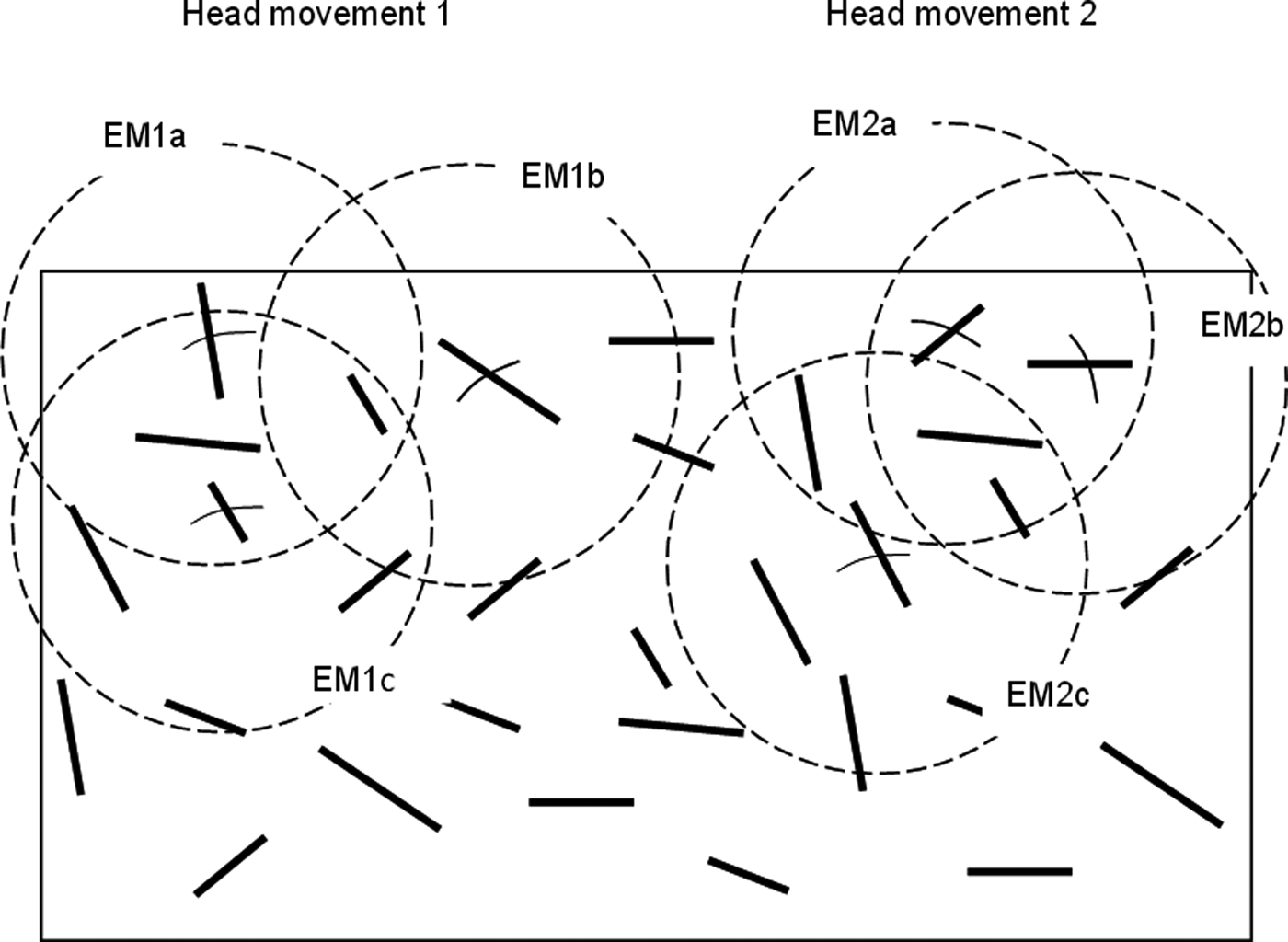
Figure 1. Analysis of the line cancellation task described in the text. The task is to strike through each line on a sheet of paper. Broken lines represent scenes. EM = eye movement. Numbers indicate head movement number. Letters indicate eye movement number within a single head movement.
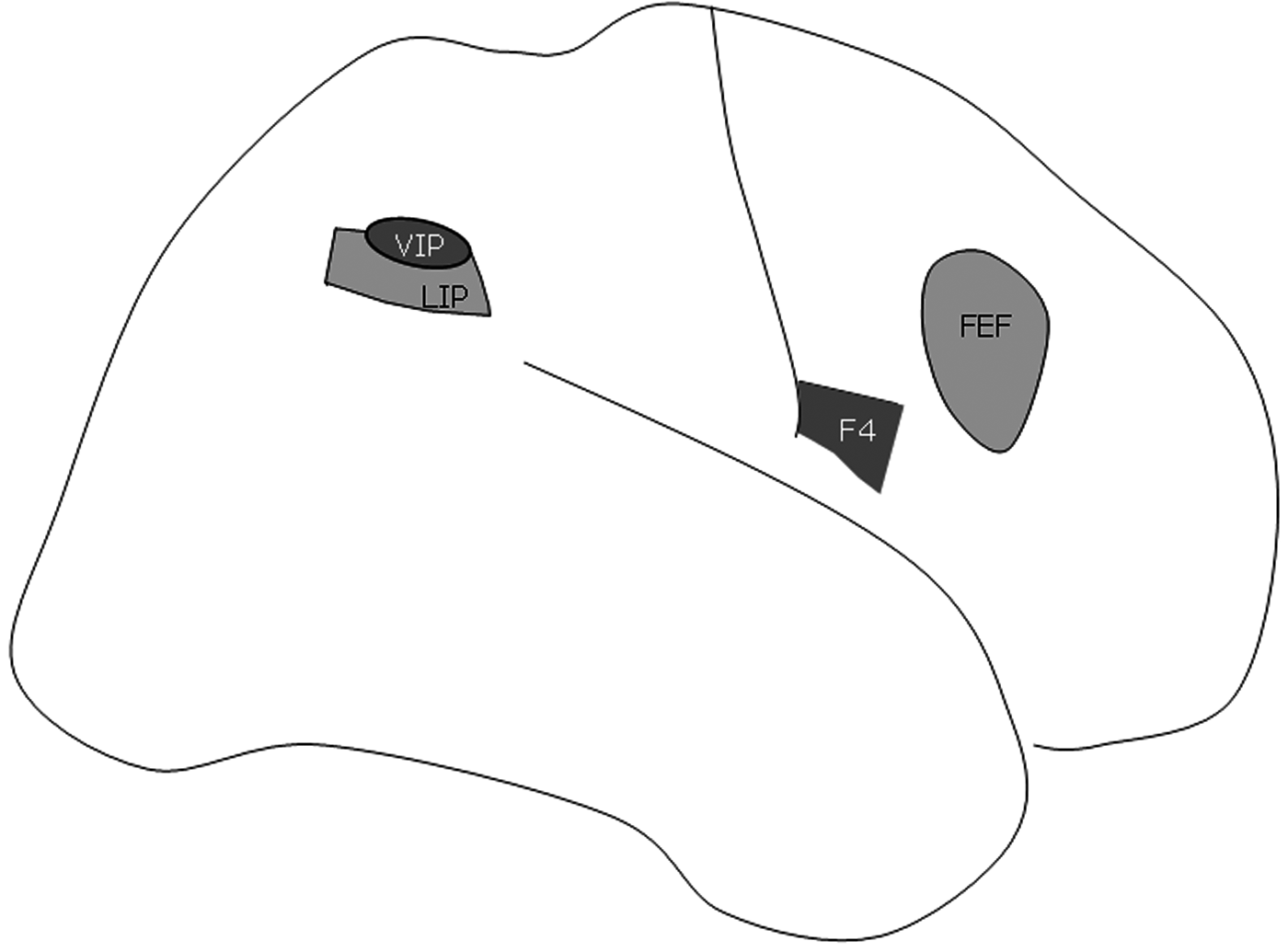
Figure 2. Representation of macaque cerebral hemisphere. The light shaded area indicates the oculomotor circuit, and the dark shaded area the reaching circuit described in the text. LIP = Lateral intraparietal area. FEF = Frontal eye fields. VIP = ventral intraparietal area. F4 = pre-motor area.
 You have
Access
Aims
The authors have served the science well by introducing the important concept of the functional visual field (FVF), but they fail to exploit it fully because of their adherence to conventional ways of working, namely embracing an information processing view of cognition, using data from invented laboratory tasks, and basing explanations of performance on post hoc conjecture rather than strong theory.
I here describe research based on new ways of working that develops a strong theory of the FVF and its role in real-world vision. In doing so it provides answers to three questions posed by the authors: How do covert shifts of attention and eye movements relate to the FVF; what determines the size of the FVF; and how are fixation points selected?
To date the work has been presented only piecemeal for rather niche audiences; more comprehensive mainstream treatments are in preparation.
Methods
Theoretical and methodological challenges encountered in early neuropsychological work (Campion Reference Campion, Humphreys and Riddoch1987; Campion et al. Reference Campion, Latto and Smith1983), and in later applied work (Campion Reference Campion, Long and Whitefield1989), led me to develop a theoretical paradigm that, unlike information processing, was able to encapsulate what the world actually looks like to perceivers, and how this depends on what they are trying to do in it.
This laid the foundations of a general theory of visual perception based on a reworking and integrating of ideas from classical approaches such as Gestaltism (Koffka Reference Koffka1935), Ecological Optics (Gibson Reference Gibson1979), and Constructionism (Neisser Reference Neisser1966) – ideas which information processing had destroyed through assimilation (see Campion Reference Campion2014; Palmer Reference Palmer1999). These reworked ideas were blended with modern conceptions of brain structure and function (Campion Reference Campion2009; Campion Reference Campion2011).
Four core ideas underpin the theory:
1. Perception is not the processing of information but the instantiation of knowledge – the controlled, energy-consuming fusion of a sensory database with learned knowledge.
2. Knowledge is of different types and is constructed and recruited by situation-sensitive learned plans to guide the conduct of tasks.
3. Cognitive and neural processes are not decoupled as information processing doctrine maintains (e.g. Marr Reference Marr1982), but are different levels of description in the reductionist sense.
4. Neural tissue does not perform computations, but has specialised soft-wired circuits that are established and consolidated through experience and are switchable according to task demands.
It follows that the brain can be properly understood only by identifying the various levels of description, and establishing the mappings between them. The case is made here, not by a priori argument, but by demonstrating that it works.
The top level identified is the task. A cognitive task analysis (CTA) of the line cancellation task used to diagnose visual hemi-spatial neglect (Albert Reference Albert1973) was blended with an analysis of literature on brain structure and function. The use of CTA is an important innovation here, but is standard fare in cognitive ergonomics where this work originates (Crandall et al. Reference Crandall, Klein and Hoffman2006).
Results
Research suggests that the configural aspects of the world are handled by two knowledge systems that are distinct but that work together – a locating system subserved by the right parietal region (RPR) of the brain (see Karnath et al. Reference Karnath, Milner and Vallar2002), and a manipulating system subserved by the left parietal region (LPR) – see Sirigu et al. Reference Sirigu, Daprati, Pradat-Diehl, Franck and Jeannerod1999. The former is the focus here.
The RPR does not process information or compute space; it uses a re-sizeable and moveable workspace centred on the fixation point – a scene – equivalent to the authors' FVF, but more precisely defined. It is an area within which every point is specified, by a set of coordinates, in terms of potential eye movements referenced to the fovea rather than physical distance. They become physical distance when the knowledge is instantiated.
The scene is used as follows (see Fig. 1):
1. The eyes fixate the centre of a line. Using the line object coordinates thus generated, a target line is cognitively (covertly) selected. The eyes then move to the target line, followed by the hand. Note, the scene – the set of coordinates – moves with the eyes, so that at each fixation point a new set of coordinates is generated. When the necessary eye movements have become extended to a comfortable maximum, the head is shifted. The process is repeated until all of the lines have been cancelled.
2. The size of the scene is determined by the nature of the task, for example how precise it is, and how quickly it has to be performed. In driving a car a scene might be the entire visual field; in mending a watch, it might be just the fovea.
3. The choice of fixation point is again determined by the nature of the task. In this task, subjects tend to work from left to right and/or clockwise in a systematic fashion because this is natural and practical. In other cases the choice might be determined by colour or position.
Analysis of the line cancellation task described in the text. The task is to strike through each line on a sheet of paper. Broken lines represent scenes. EM = eye movement. Numbers indicate head movement number. Letters indicate eye movement number within a single head movement.
The explanatory power of blending these cognitive data with neural data is illustrated by the work of Berti & Rizzolatti (Reference Berti, Rizzolatti, Karnath, Milner and Vallar2002), who have identified the special and distinct oculomotor and reaching circuits shown in Figure 2. In the oculomotor circuit, neuronal receptive fields are insensitive to distance but are sensitive to stimuli falling only on a specific point on the retina referenced to the fovea, whereas neurons in the reaching circuit prefer three dimensional objects and have receptive fields coded in body part coordinates.
Representation of macaque cerebral hemisphere. The light shaded area indicates the oculomotor circuit, and the dark shaded area the reaching circuit described in the text. LIP = Lateral intraparietal area. FEF = Frontal eye fields. VIP = ventral intraparietal area. F4 = pre-motor area.
This explanation contrasts sharply with unhelpfully vague information processing terms such as parallel and serial processing used by the target article authors, and it does away with the concept of attention as a scientific term altogether. And we should note in passing that it is the strong dependency of cognitive operations on the nature of the task they subserve, coupled with the lack of explicit task analyses in research, that leads to the ambiguity and unresolved debate that characterises much cognitive psychology.
Brief though it is, I hope this illustration is sufficient to demonstrate the merits of the approach; I commend it to the authors and to the science.