Hulleman & Olivers (H&O) account for an impressively diverse array of visual search data with a single free parameter: the “size” of (number of items in) their putative Functional View Field (FVF). Nonetheless, we see two critical shortcomings: (1) FVF is purely descriptive and lacking independent motivation, which is indicative of an ad hoc assumption (Aizawa Reference Aizawa2003); and (2) FVF size is potentially infinite in continuous domains, making it unclear how such cases are supposed to be unified with search in finite settings. In support of the target article, we provide a mathematical (categorical/topological) basis for FVF (size and location), called a fibre (pullback) bundle (Husemoller Reference Husemoller1994), to help resolve these problems.
A category consists of a collection of objects, a collection of morphisms between objects, and an operation for composing morphisms (Mac Lane Reference Mac Lane1998). For example, every topological space is a category whose objects are the subsets constituting the topology, and morphisms are inclusions. Categories can model cognition by interpreting objects as cognitive states or spaces, morphisms as cognitive processes between states/spaces, and the operation as composition of cognitive processes. A universal construction is an arrangement whereby every morphism is composed of a common morphism and a unique morphism. This arrangement generalizes and refines classical/symbolic (Fodor & Pylyshyn Reference Fodor and Pylyshyn1988) and connectionist/functional (van Gelder Reference van Gelder1990) compositionality by providing a necessary and sufficient condition for the indivisibility of certain clusters of cognitive capacities (Phillips & Wilson Reference Phillips and Wilson2010; Reference Phillips and Wilson2011; Reference Phillips and Wilson2012), without the ad hoc assumptions that were problematic in other approaches (Aizawa Reference Aizawa2003). Moreover, every universal construction is optimal in a certain category-theoretical sense. Thus, the preference for aligning relations over features in analogy (Gentner Reference Gentner1983), affording optimal transfer of source knowledge to target domain, derives from a universal construction (Phillips Reference Phillips2014). Visual search also involves compositionality and systematicity, hence our pullback approach to some differences between feature versus conjunctive search (Phillips et al. Reference Phillips, Takeda and Singh2012). Similar considerations motivate our fibre bundle approach to FVFs.
We regard the FVF as a projection of visual information formalized as a fibre bundle (E, B, π, F): a topological space E, called the total space, that is locally a product of base B and fibre F, together with a projection π : E → B that is a continuous surjective map. Projections can be filters, discussed in the target article, in the sense of maps from unfiltered display (total) spaces to filtered view (base) spaces. For example, the projection π1 : C×O → C filters out features in orientation space O so that attention is focused on features in colour space C – total space C × O is the product of base C and fibre O. Likewise, π2 : C × O → O filters out colour features to focus attention on orientation features, as the task demands.
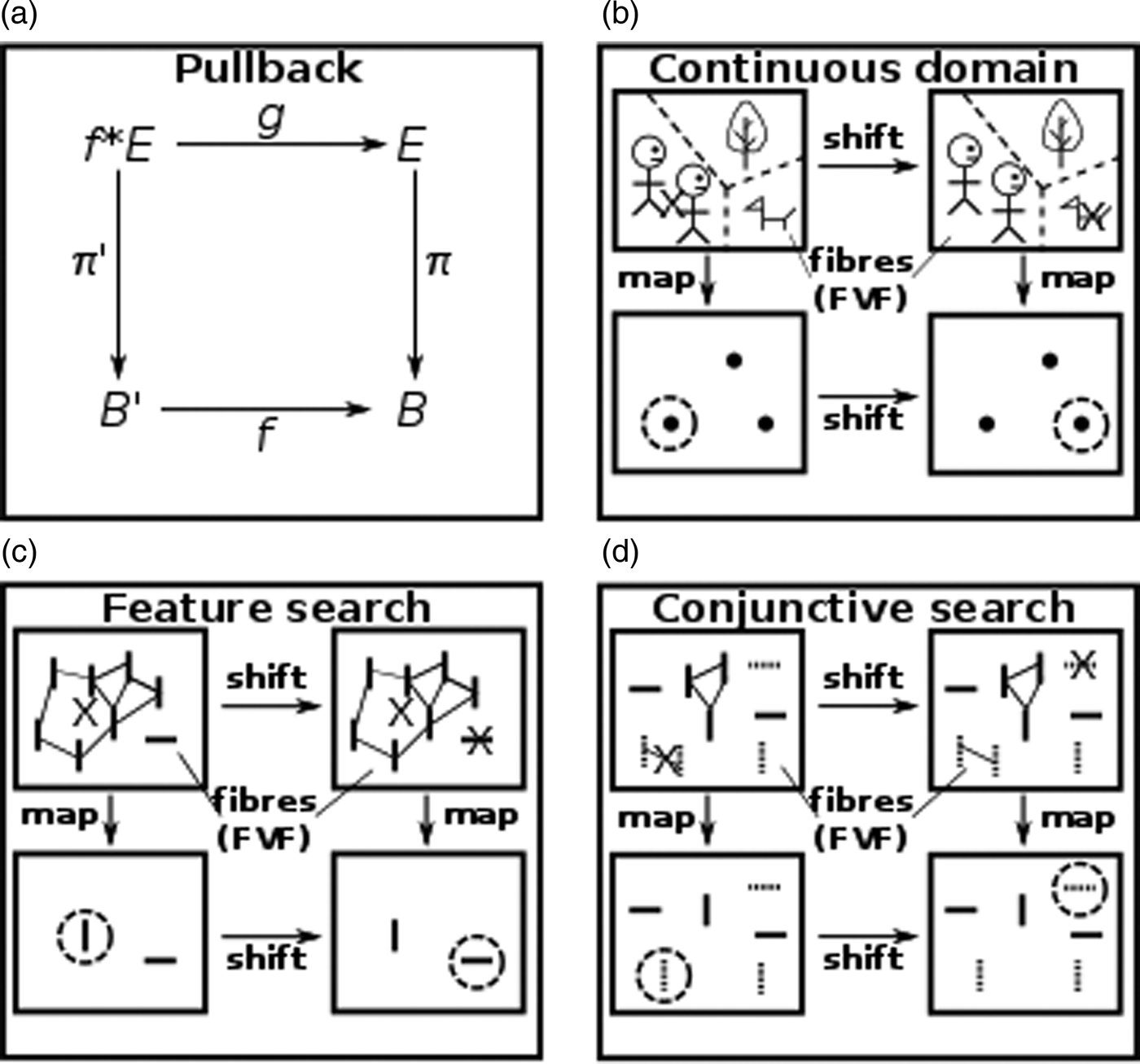
Search involves changes in fixation that are bundle maps. In particular, a pullback bundle is obtained by “pulling back” a fibre bundle along a continuous map f : B′ → B between base spaces, obtaining total space f*B of pairs (b', e), in a way that preserves bundle structure. That is, Figure 1(a) is a commuting (pullback) square: π(g(b′, e))=f(π′(b′, e)). Commute means that fixation change after filtered view is the same as filtered view after fixation change, so search over view space is effectively search over display space. This construction is likened to a database lens, developed for a conceptually similar view update problem (Johnson et al. Reference Johnson, Rosebrugh and Wood2012), hence the expression “cognitive lens.”
Figure 1.
Fibre bundle (a) commuting/pullback square, and corresponding examples for (b) a natural scene, (c) feature search, and (d) conjunctive search.
FVF size and location are determined by the nature of the projection and an inverse. A fibre over a point b∈B, that is, the set of points in E that project to b, denoted π-1[b], corresponds to an FVF. Hence, the size of an FVF is the number of elements in π-1[b]. A section of a fibre bundle is a continuous right inverse of its projection, that is, a function σ : B → E such that π(σ(b)) = b. The location of an FVF associated with point b in view space is the point σ(b) in display space. The pullback condition (Mac Lane Reference Mac Lane1998) restricts bundles to disjoint unions of fibres, an optimal partitioning that prohibits gaps between fibres or overlaps.
Projections based on convex hulls of (topologically) neighbouring elements are one way to realize FVF for search in both natural and laboratory settings. For example, Figure 1(b) depicts a “natural” scene (E). Each convex hull (smallest set) enclosing one of the three scene components, that is, two people, a dog, and a tree, has a centre of mass, hi. The projection (π) sends each point e∈E to the closest centre. The fibre Fi is the region containing hi, with boundaries indicated by dashed lines (cf. Voroni diagram). The base (B) is the (discrete) topological space on the three-centre set H, that is, the set of all subsets of H (cf. Delauney diagram). FVF location is the corresponding centre. An “X” indicates fixation before and after attentional shift, and dashed circles indicate corresponding items in the base. Pullback squares compose (Mac Lane Reference Mac Lane1998). So response time corresponds to the number of composed squares to termination. By commutativity, search need only involve the three items in the base, rather than a very large (potentially infinite) number of locations in the display; greater resolution implies more locations (cf. texture-based search).
An analogous situation applies to feature versus conjunctive search, shown in Figure 1(c, d). Lines connecting bars indicate neighbours in topological space; connected graphs correspond to fibres, which are larger in feature than conjunctive search, hence feature search is generally more efficient. Off-item fixation corresponds to a virtual bar at the “centre of mass” of a multinode graph, so fixation need not coincide with a displayed bar. This situation is akin to perceptual grouping (Duncan & Humphreys Reference Duncan and Humphreys1989). Similar considerations apply to conjunctive search (Wolfe et al. Reference Wolfe, Cave and Franzel1989): Nearby items are less likely to be of the same kind, hence FVFs are smaller and the number of fibres greater, implying the observed steeper search slope. A base can contain non-visual items, for example, categories affording category-guided search (Zelinsky et al. Reference Zelinsky, Adeli, Peng and Samaras2013). The challenge is to develop an FVF model incorporating the mathematical theory.







Hulleman & Olivers (H&O) account for an impressively diverse array of visual search data with a single free parameter: the “size” of (number of items in) their putative Functional View Field (FVF). Nonetheless, we see two critical shortcomings: (1) FVF is purely descriptive and lacking independent motivation, which is indicative of an ad hoc assumption (Aizawa Reference Aizawa2003); and (2) FVF size is potentially infinite in continuous domains, making it unclear how such cases are supposed to be unified with search in finite settings. In support of the target article, we provide a mathematical (categorical/topological) basis for FVF (size and location), called a fibre (pullback) bundle (Husemoller Reference Husemoller1994), to help resolve these problems.
A category consists of a collection of objects, a collection of morphisms between objects, and an operation for composing morphisms (Mac Lane Reference Mac Lane1998). For example, every topological space is a category whose objects are the subsets constituting the topology, and morphisms are inclusions. Categories can model cognition by interpreting objects as cognitive states or spaces, morphisms as cognitive processes between states/spaces, and the operation as composition of cognitive processes. A universal construction is an arrangement whereby every morphism is composed of a common morphism and a unique morphism. This arrangement generalizes and refines classical/symbolic (Fodor & Pylyshyn Reference Fodor and Pylyshyn1988) and connectionist/functional (van Gelder Reference van Gelder1990) compositionality by providing a necessary and sufficient condition for the indivisibility of certain clusters of cognitive capacities (Phillips & Wilson Reference Phillips and Wilson2010; Reference Phillips and Wilson2011; Reference Phillips and Wilson2012), without the ad hoc assumptions that were problematic in other approaches (Aizawa Reference Aizawa2003). Moreover, every universal construction is optimal in a certain category-theoretical sense. Thus, the preference for aligning relations over features in analogy (Gentner Reference Gentner1983), affording optimal transfer of source knowledge to target domain, derives from a universal construction (Phillips Reference Phillips2014). Visual search also involves compositionality and systematicity, hence our pullback approach to some differences between feature versus conjunctive search (Phillips et al. Reference Phillips, Takeda and Singh2012). Similar considerations motivate our fibre bundle approach to FVFs.
We regard the FVF as a projection of visual information formalized as a fibre bundle (E, B, π, F): a topological space E, called the total space, that is locally a product of base B and fibre F, together with a projection π : E → B that is a continuous surjective map. Projections can be filters, discussed in the target article, in the sense of maps from unfiltered display (total) spaces to filtered view (base) spaces. For example, the projection π1 : C×O → C filters out features in orientation space O so that attention is focused on features in colour space C – total space C × O is the product of base C and fibre O. Likewise, π2 : C × O → O filters out colour features to focus attention on orientation features, as the task demands.
Search involves changes in fixation that are bundle maps. In particular, a pullback bundle is obtained by “pulling back” a fibre bundle along a continuous map f : B′ → B between base spaces, obtaining total space f*B of pairs (b', e), in a way that preserves bundle structure. That is, Figure 1(a) is a commuting (pullback) square: π(g(b′, e))=f(π′(b′, e)). Commute means that fixation change after filtered view is the same as filtered view after fixation change, so search over view space is effectively search over display space. This construction is likened to a database lens, developed for a conceptually similar view update problem (Johnson et al. Reference Johnson, Rosebrugh and Wood2012), hence the expression “cognitive lens.”
Fibre bundle (a) commuting/pullback square, and corresponding examples for (b) a natural scene, (c) feature search, and (d) conjunctive search.
FVF size and location are determined by the nature of the projection and an inverse. A fibre over a point b∈B, that is, the set of points in E that project to b, denoted π-1[b], corresponds to an FVF. Hence, the size of an FVF is the number of elements in π-1[b]. A section of a fibre bundle is a continuous right inverse of its projection, that is, a function σ : B → E such that π(σ(b)) = b. The location of an FVF associated with point b in view space is the point σ(b) in display space. The pullback condition (Mac Lane Reference Mac Lane1998) restricts bundles to disjoint unions of fibres, an optimal partitioning that prohibits gaps between fibres or overlaps.
Projections based on convex hulls of (topologically) neighbouring elements are one way to realize FVF for search in both natural and laboratory settings. For example, Figure 1(b) depicts a “natural” scene (E). Each convex hull (smallest set) enclosing one of the three scene components, that is, two people, a dog, and a tree, has a centre of mass, hi. The projection (π) sends each point e∈E to the closest centre. The fibre Fi is the region containing hi, with boundaries indicated by dashed lines (cf. Voroni diagram). The base (B) is the (discrete) topological space on the three-centre set H, that is, the set of all subsets of H (cf. Delauney diagram). FVF location is the corresponding centre. An “X” indicates fixation before and after attentional shift, and dashed circles indicate corresponding items in the base. Pullback squares compose (Mac Lane Reference Mac Lane1998). So response time corresponds to the number of composed squares to termination. By commutativity, search need only involve the three items in the base, rather than a very large (potentially infinite) number of locations in the display; greater resolution implies more locations (cf. texture-based search).
An analogous situation applies to feature versus conjunctive search, shown in Figure 1(c, d). Lines connecting bars indicate neighbours in topological space; connected graphs correspond to fibres, which are larger in feature than conjunctive search, hence feature search is generally more efficient. Off-item fixation corresponds to a virtual bar at the “centre of mass” of a multinode graph, so fixation need not coincide with a displayed bar. This situation is akin to perceptual grouping (Duncan & Humphreys Reference Duncan and Humphreys1989). Similar considerations apply to conjunctive search (Wolfe et al. Reference Wolfe, Cave and Franzel1989): Nearby items are less likely to be of the same kind, hence FVFs are smaller and the number of fibres greater, implying the observed steeper search slope. A base can contain non-visual items, for example, categories affording category-guided search (Zelinsky et al. Reference Zelinsky, Adeli, Peng and Samaras2013). The challenge is to develop an FVF model incorporating the mathematical theory.