Mnemonic techniques have been valued since ancient times but have lost attention dramatically for decades. Llewellyn's target article on a possible role of mnemonic principles (ancient art of memory [AAOM]) acting during rapid eye movement (REM) sleep to aid episodic memory processing is therefore a timely and important endeavor. Here we aim to demonstrate that one promising way to test these ideas is to study users of mnemonic techniques, both novices – that is, naive subjects who have been systematically taught mnemonic strategies – and experts who have trained the use of mnemonics for several years. One group of subjects provides a unique opportunity in this regard: Participants of the annual World Memory Championships regularly demonstrate their mastery in mnemonic techniques by memorizing astonishingly large amounts of information (Maguire et al. Reference Maguire, Valentine, Wilding and Kapur2003). During the last two years, we studied the world's most successful memory athletes, who all credited their performance to deliberate training in mnemonics.
A simple qualitative test of the REM-AAOM hypothesis is the question of whether the application of mnemonics actually feels like dreaming: If REM sleep dreaming implements or is isomorphic to mnemonic principles, the use of mnemonics should feel dreamlike during wakefulness. This should be true in particular for the more experienced users of mnemonics. We asked 34 mnemonic experts (aged 32.1 ± 11.3 years, 12 female) in the top 100 memory-sports-world rankings and 37 mnemonic novices (aged 24.4 ± 4.9 years, 9 female) who participated in an introductory course in mnemonic techniques whether they felt the application of mnemonics to be dreamlike, on scale of 1 (totally dreamlike) to 7 (not dreamlike at all). Neither group felt the application of mnemonics to be very dreamlike, with the mnemonic experts' ratings being even slightly (though nonsignificantly) shifted more to the nondreamlike side of the scale (4.9 ± 1.5 vs. 4.5 ± 1.5, t = 1.1, p > 0.2).
A test on the neurophysiological level is to compare the REM sleep of mnemonic experts and control subjects naive to mnemonics. If an essential function of REM sleep is to apply mnemonics on recent memory traces, then it should differ depending on how much information was learned before sleep and whether this information was already encoded mnemonically or without the use of mnemonics. We investigated 16 mnemonic experts (aged 27.1±9.5 years, 6 female) in the top 50 of the memory-sports-world rankings with polysomnography, both after a day without memory-related activity and after an intense learning session of several hours during which they applied mnemonics on a broad variety of declarative information, and compared them with closely matched controls (aged 27.4 ± 8.5 years, 6 female) without any experience in mnemonic techniques (Dresler et al. Reference Dresler, Konrad, Halimsetiawan, Genzel, Spoormaker, Czisch and Steiger2012).
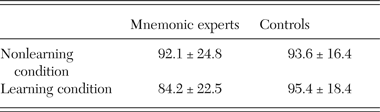
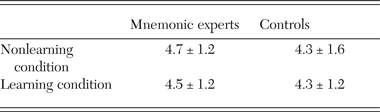
Despite a huge difference in mnemonic expertise and memory load, we did not find a significant difference in REM sleep duration between the groups (F=1.5, p > 0.2) or between the learning conditions (F=0.4, p > 0.5) and no interaction effects (F=0.9, p > 0.3). Since REM density has been proposed to be implicated in memory processing and to provide a marker of learning potential (Smith et al. Reference Smith, Nixon and Nader2004), we also analyzed this variable, but also did not find a differences between the groups (F = 1.0, p > 0.3) or conditions (F = 0.2, p > 0.6) and no interaction effects (F = 0.2, p > 0.6). For details, see Tables 1 and 2.
Table 1.
Time spent in REM sleep, given as mean minutes ± standard deviation
Table 2.
REM density, given as mean count of rapid eye movements per minute of REM sleep ± standard deviation
The results of both tests with mnemonic experts do not support the REM-AAOM hypothesis. In our view, this is no surprise, since despite several intuitively convincing similarities between REM sleep dreaming and mnemonic techniques, the two also manifest essential differences. One important aspect of mnemonics, like the method of loci, is to provide a systematic structure that reliably helps to retrieve the complete set of to-be-remembered information. However, REM sleep dreams, with their frequent discontinuities and indeterminacies, do not provide such systematic structure, but rather consist of a chaotic progression of only loosely related elements.
An essential function of mnemonics is to provide easily accessible retrieval cues that help to recollect less accessible information. Mnemonic retrieval cues associated with new information during REM sleep, however, are hard to access after awakening, because of dream amnesia. According to the REM-AAOM hypothesis, somehow they do their job anyway – just on a nonconscious processing level. The mnemonic mechanism seems to be somehow inverted here: During wakefulness, mnemonics provide easily accessible retrieval cues to activate otherwise inaccessible memories, whereas during sleep the REM-AAOM hypothesis presumes them to provide inaccessible retrieval cues that in most cases do not even reach a conscious level when the corresponding memory traces are successfully retrieved. We find this hardly convincing.
Another problem of the REM-AAOM hypothesis is its focus on episodic memories: Defining properties of episodic memories already include several mnemonic features like representation in the form of visual images, having a personal perspective, being represented in given order, or being recollectively experienced when accessed (Conway Reference Conway2009). Even though some of the mnemonic experts that we studied reported that sometimes they would encode also proper episodes mnemonically (e.g., if completeness of details is important), typical applications of mnemonics are discrete or abstract sets of information without episodic structure – for example, telephone numbers or shopping lists. Roughly speaking, mnemonics transform such unrelated bits of information into episodelike structures – for example, imagined stories or mentally travelled routes.
The REM-AAOM hypothesis hence faces a dilemma: Either it proposes that REM sleep mnemonically reprocesses only information that is already episodically structured – in which case the application of mnemonics loses much of its strength – or it widens its focus on declarative memory in general, including also information without proper episodic structure – although for these kinds of stimuli, several studies were unable to find an essential role for REM sleep in memory processing (e.g., Dresler et al. Reference Dresler, Kluge, Pawlowski, Schüssler, Steiger and Genzel2011; Genzel et al. Reference Genzel, Dresler, Wehrle, Grözinger and Steiger2009; Reference Genzel, Kiefer, Renner, Wehrle, Kluge, Grözinger, Steiger and Dresler2012; Rasch et al. Reference Rasch, Pommer, Diekelmann and Born2009).
In conclusion, both empirical data and theoretical considerations contradict the REM-AAOM hypothesis. The world's leading mnemonics users do not feel the application of mnemonics to be dreamlike, and their REM sleep does not differ from mnemonics-naive controls. The REM-AAOM hypothesis focuses on information that normally does not need to be encoded mnemonically, and that is proposed to be encoded mnemonically in a cognitive environment that is not well suited for the application of mnemonics.





Mnemonic techniques have been valued since ancient times but have lost attention dramatically for decades. Llewellyn's target article on a possible role of mnemonic principles (ancient art of memory [AAOM]) acting during rapid eye movement (REM) sleep to aid episodic memory processing is therefore a timely and important endeavor. Here we aim to demonstrate that one promising way to test these ideas is to study users of mnemonic techniques, both novices – that is, naive subjects who have been systematically taught mnemonic strategies – and experts who have trained the use of mnemonics for several years. One group of subjects provides a unique opportunity in this regard: Participants of the annual World Memory Championships regularly demonstrate their mastery in mnemonic techniques by memorizing astonishingly large amounts of information (Maguire et al. Reference Maguire, Valentine, Wilding and Kapur2003). During the last two years, we studied the world's most successful memory athletes, who all credited their performance to deliberate training in mnemonics.
A simple qualitative test of the REM-AAOM hypothesis is the question of whether the application of mnemonics actually feels like dreaming: If REM sleep dreaming implements or is isomorphic to mnemonic principles, the use of mnemonics should feel dreamlike during wakefulness. This should be true in particular for the more experienced users of mnemonics. We asked 34 mnemonic experts (aged 32.1 ± 11.3 years, 12 female) in the top 100 memory-sports-world rankings and 37 mnemonic novices (aged 24.4 ± 4.9 years, 9 female) who participated in an introductory course in mnemonic techniques whether they felt the application of mnemonics to be dreamlike, on scale of 1 (totally dreamlike) to 7 (not dreamlike at all). Neither group felt the application of mnemonics to be very dreamlike, with the mnemonic experts' ratings being even slightly (though nonsignificantly) shifted more to the nondreamlike side of the scale (4.9 ± 1.5 vs. 4.5 ± 1.5, t = 1.1, p > 0.2).
A test on the neurophysiological level is to compare the REM sleep of mnemonic experts and control subjects naive to mnemonics. If an essential function of REM sleep is to apply mnemonics on recent memory traces, then it should differ depending on how much information was learned before sleep and whether this information was already encoded mnemonically or without the use of mnemonics. We investigated 16 mnemonic experts (aged 27.1±9.5 years, 6 female) in the top 50 of the memory-sports-world rankings with polysomnography, both after a day without memory-related activity and after an intense learning session of several hours during which they applied mnemonics on a broad variety of declarative information, and compared them with closely matched controls (aged 27.4 ± 8.5 years, 6 female) without any experience in mnemonic techniques (Dresler et al. Reference Dresler, Konrad, Halimsetiawan, Genzel, Spoormaker, Czisch and Steiger2012).
Despite a huge difference in mnemonic expertise and memory load, we did not find a significant difference in REM sleep duration between the groups (F=1.5, p > 0.2) or between the learning conditions (F=0.4, p > 0.5) and no interaction effects (F=0.9, p > 0.3). Since REM density has been proposed to be implicated in memory processing and to provide a marker of learning potential (Smith et al. Reference Smith, Nixon and Nader2004), we also analyzed this variable, but also did not find a differences between the groups (F = 1.0, p > 0.3) or conditions (F = 0.2, p > 0.6) and no interaction effects (F = 0.2, p > 0.6). For details, see Tables 1 and 2.
Time spent in REM sleep, given as mean minutes ± standard deviation
REM density, given as mean count of rapid eye movements per minute of REM sleep ± standard deviation
The results of both tests with mnemonic experts do not support the REM-AAOM hypothesis. In our view, this is no surprise, since despite several intuitively convincing similarities between REM sleep dreaming and mnemonic techniques, the two also manifest essential differences. One important aspect of mnemonics, like the method of loci, is to provide a systematic structure that reliably helps to retrieve the complete set of to-be-remembered information. However, REM sleep dreams, with their frequent discontinuities and indeterminacies, do not provide such systematic structure, but rather consist of a chaotic progression of only loosely related elements.
An essential function of mnemonics is to provide easily accessible retrieval cues that help to recollect less accessible information. Mnemonic retrieval cues associated with new information during REM sleep, however, are hard to access after awakening, because of dream amnesia. According to the REM-AAOM hypothesis, somehow they do their job anyway – just on a nonconscious processing level. The mnemonic mechanism seems to be somehow inverted here: During wakefulness, mnemonics provide easily accessible retrieval cues to activate otherwise inaccessible memories, whereas during sleep the REM-AAOM hypothesis presumes them to provide inaccessible retrieval cues that in most cases do not even reach a conscious level when the corresponding memory traces are successfully retrieved. We find this hardly convincing.
Another problem of the REM-AAOM hypothesis is its focus on episodic memories: Defining properties of episodic memories already include several mnemonic features like representation in the form of visual images, having a personal perspective, being represented in given order, or being recollectively experienced when accessed (Conway Reference Conway2009). Even though some of the mnemonic experts that we studied reported that sometimes they would encode also proper episodes mnemonically (e.g., if completeness of details is important), typical applications of mnemonics are discrete or abstract sets of information without episodic structure – for example, telephone numbers or shopping lists. Roughly speaking, mnemonics transform such unrelated bits of information into episodelike structures – for example, imagined stories or mentally travelled routes.
The REM-AAOM hypothesis hence faces a dilemma: Either it proposes that REM sleep mnemonically reprocesses only information that is already episodically structured – in which case the application of mnemonics loses much of its strength – or it widens its focus on declarative memory in general, including also information without proper episodic structure – although for these kinds of stimuli, several studies were unable to find an essential role for REM sleep in memory processing (e.g., Dresler et al. Reference Dresler, Kluge, Pawlowski, Schüssler, Steiger and Genzel2011; Genzel et al. Reference Genzel, Dresler, Wehrle, Grözinger and Steiger2009; Reference Genzel, Kiefer, Renner, Wehrle, Kluge, Grözinger, Steiger and Dresler2012; Rasch et al. Reference Rasch, Pommer, Diekelmann and Born2009).
In conclusion, both empirical data and theoretical considerations contradict the REM-AAOM hypothesis. The world's leading mnemonics users do not feel the application of mnemonics to be dreamlike, and their REM sleep does not differ from mnemonics-naive controls. The REM-AAOM hypothesis focuses on information that normally does not need to be encoded mnemonically, and that is proposed to be encoded mnemonically in a cognitive environment that is not well suited for the application of mnemonics.