




No CrossRef data available.
Article contents
The method of loci (MoL) and memory consolidation: Dreaming is not MoL-like
Published online by Cambridge University Press: 21 November 2013
Abstract
Certain method of loci (MoL) prerequisites – familiar, coherently ordered locations – should appear during dreaming if the latter is, in fact, elaborative memory encoding as hypothesized by Llewellyn. A review of the literature suggests that dreamed locations are neither familiar nor coherently ordered and thus unsuitable for facilitating memory in this sense. This conclusion converges with other evidence that episodic memory is dependent upon non–rapid eye movement (NREM), rather than REM, sleep.
Information
- Type
- Open Peer Commentary
- Information
- Copyright
- Copyright © Cambridge University Press 2013
References
Aly, M. & Moscovitch, M. (2010) The effects of sleep on episodic memory in older and younger adults. Memory
18:327–34.Google Scholar
Bellezza, F. S. & Reddy, B. G. (1978) Mnemonic devices and natural memory. Bulletin of the Psychonomic Society
11:277–80.Google Scholar
Daurat, A., Terrier, P., Foret, J. & Tiberge, M. (2007) Slow wave sleep and recollection in recognition memory. Consciousness and Cognition
16:445–55.Google Scholar
Diekelmann, S. & Born, J. (2010) The memory function of sleep. Nature Reviews Neuroscience
11:114–26.CrossRefGoogle ScholarPubMed
Dorus, E., Dorus, W. & Rechtschaffen, A. (1971) The incidence of novelty in dreams. Archives of General Psychiatry
25:364–68.Google Scholar
Drosopoulos, S., Wagner, U. & Born, J. (2005) Sleep enhances explicit recollection in recognition memory. Learning and Memory
12:44–51.Google Scholar
Fosse, M. J., Fosse, R., Hobson, J. A. & Stickgold, R. J. (2003) Dreaming and episodic memory: A functional dissociation. Journal of Cognitive Neuroscience
15(1):1–9.CrossRefGoogle ScholarPubMed
Griessenberger, H., Hoedlmoser, K., Heib, D. P., Lechinger, J., Klimesch, W. & Schabus, M. (2012) Consolidation of temporal order in episodic memories. Biological Psychology
91:150–55.CrossRefGoogle ScholarPubMed
Hall, C. & van de Castle, R. I. (1966) The content analysis of dreams. Appleton-Century-Crofts.Google Scholar
Hobson, J. A. & McCarley, R. W. (1977) The brain as a dream state generator: An activation-synthesis hypothesis of the dream process. American Journal of Psychiatry
134(12):1335–48.Google Scholar
Inostroza, M., Binder, S. & Born, J. (2013) Sleep-dependency of episodic-like memory consolidation in rats. Behavioural Brain Research
237:15–22.Google Scholar
Legge, E. L., Madan, C. R., Ng, E. T. & Caplan, J. B. (2012) Building a memory palace in minutes: Equivalent memory performance using virtual versus conventional environments with the Method of Loci. Acta Psychologica
141:380–90.Google Scholar
Maguire, E. A., Valentine, E. R., Wilding, J. M. & Kapur, N. (2003) Routes to remembering: The brains behind superior memory. Nature Neuroscience
6(1):90–95.Google Scholar
Massen, C., Vaterrodt-Plünnecke, B., Krings, L. & Hilbig, B. E. (2009) Effects of instruction on learners' ability to generate an effective pathway in the method of loci. Memory
17:724–31.Google Scholar
McCarley, R. W. & Hobson, J. (1977) The neurobiological origins of psychoanalytic dream theory. American Journal of Psychiatry
134(11):1211–21.Google Scholar
Persensky, J. J. & Senter, R. J. (1970) An investigation of “bizarre” imagery as a mnemonic device. Psychological Record
20:145–50.Google Scholar
Rauchs, G., Bertran, F., Guillery-Girard, B., Desgranges, B., Kerrouche, N., Denise, P., Foret, J. & Eustache, F. (2004) Consolidation of strictly episodic memories mainly requires rapid eye movement sleep. Sleep
27:395–401.Google Scholar
Revonsuo, A. & Salmivalli, C. (1995) A content analysis of bizarre elements in dreams. Dreaming
5:169–87.Google Scholar
Rittenhouse, C. D., Stickgold, R. & Hobson, J. A. (1994) Constraint on the transformation of characters, objects, and settings in dream reports. Consciousness and Cognition
3:100–13.Google Scholar
Scullin, M. K. (2012) Sleep, memory, and aging: The link between slow-wave sleep and episodic memory changes from younger to older adults. Psychology and Aging
6:97–108.Google Scholar
Senter, R. J. & Hoffman, R. R. (1976) Bizarreness as a nonessential variable in mnemonic imagery: A confirmation. Bulletin of the Psychonomic Society
7:163–64.Google Scholar
Smith, C. (2010) Sleep states, memory processing, and dreams. Sleep Medicine Clinics
5:217–28.CrossRefGoogle Scholar
van der Helm, E., Gujar, N., Nishida, M. & Walker, M. P. (2011a) Sleep-dependent facilitation of episodic memory details. PLoS ONE
6:e27421. doi:10.1371/journal.pone.0027421.Google Scholar
Verhaeghen, P. & Kliegl, R. (2000) The effects of learning a new algorithm on asymptotic accuracy and execution speed in old age: A reanalysis. Psychology and Aging
15:648–56.Google Scholar
Walker, M. P. & Stickgold, R. (2010) Overnight alchemy: Sleep-dependent memory evolution. Nature Reviews: Neuroscience
11(3):218.Google ScholarPubMed
Wamsley, E. J. & Stickgold, R. (2011) Memory, sleep and dreaming: Experiencing consolidation. Sleep Medicine Clinics
6(1):97–108.Google Scholar
Wang, A. Y. & Thomas, M. H. (2000) Looking for long-term effects on serial recall: The legacy of Simonides. American Journal of Psychology
113:331–40.Google Scholar
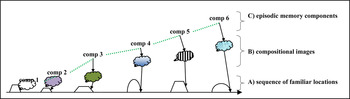
Figure 1. Encoding of an episodic memory with the classical method of loci technique. The individual draws upon (A) a familiar sequence of locations, such as a building or path with a known order. To each unique location, the individual associates (B) a distinctive compositional image that substitutes for (C) a component of the to-be-remembered episode. To recall the memory, the individual mentally “revisits” the locations and “retrieves” the image/component “placed” there. Because the location sequence is familiar, images linked to it can be accessed in any order. Distinctiveness of the compositional images derives from, for example, their visual vividness, bizarreness, or emotion. Dream imagery only rarely depicts familiar, coherently ordered sequences of locations but may at times fulfill the requirement of distinctiveness (see the text).
Llewellyn proposes a bold hypothesis about rapid eye movement (REM) dream function – that it elaboratively encodes episodic memories in a manner akin to classical mnemonic techniques. This work comes at a time when there is an upswing in interest (Smith Reference Smith2010; Wamsley & Stickgold Reference Wamsley and Stickgold2011) in how dreaming participates in the well-established memory functions of sleep (Diekelmann & Born Reference Diekelmann and Born2010; Walker & Stickgold Reference Walker and Stickgold2010). It may thus have heuristic value for this renewed line of inquiry. Nonetheless, her hypothesis is complex, freely mixing phenomenological and neurophysiological assumptions, and it remains speculative and untested. In this commentary, I consider whether dreamed location imagery possesses the qualities necessary to enhance memory as Llewellyn claims.
Invention of the ancient art of memory (AAOM) is attributed to Greek poet Simonides of Ceos (556–468 BCE), who developed the method of loci (MoL; Fig. 1) after purportedly identifying the remains of comrades crushed in a temple collapse solely from his memory of where they were sitting before he fortuitously left the building. The MoL became common in Greek oral traditions and remains among the most effective mnemonic techniques (Massen et al. Reference Massen, Vaterrodt-Plünnecke, Krings and Hilbig2009; Verhaeghen & Kliegl Reference Verhaeghen and Kliegl2000). The MoL facilitates memory for both abstract and concrete material (Wang & Thomas Reference Wang and Thomas2000), is especially effective with serially ordered material (e.g., episodic memories) and is most effective when the imagined pathways used are self-generated versus other-generated (Bellezza & Reddy Reference Bellezza and Reddy1978). It is a favored technique of mnemonists, as shown in a study of highly trained subjects, 90% of whom spontaneously used the MoL to complete study tasks (Maguire et al. Reference Maguire, Valentine, Wilding and Kapur2003). Some findings even suggest that the MoL is effective without using bizarre or atypical composite imagery; the latter have no effect on memory if the imagery employed is sufficiently concrete, lively, and emotional (Persensky & Senter Reference Persensky and Senter1970; Senter & Hoffman Reference Senter and Hoffman1976).
Encoding of an episodic memory with the classical method of loci technique. The individual draws upon (A) a familiar sequence of locations, such as a building or path with a known order. To each unique location, the individual associates (B) a distinctive compositional image that substitutes for (C) a component of the to-be-remembered episode. To recall the memory, the individual mentally “revisits” the locations and “retrieves” the image/component “placed” there. Because the location sequence is familiar, images linked to it can be accessed in any order. Distinctiveness of the compositional images derives from, for example, their visual vividness, bizarreness, or emotion. Dream imagery only rarely depicts familiar, coherently ordered sequences of locations but may at times fulfill the requirement of distinctiveness (see the text).
Given the centrality of the MoL technique to memory enhancement, a critical question for Llewellyn's hypothesis is: Does dreaming portray coherently ordered, familiar locations like those required for the MoL?
Evidence supports the view that it does not, that dream locations are neither familiar nor coherently ordered. First, subjects rate dream locations as familiar only infrequently. In one study (119 dreams, 331 locations), they indicated that only 35.5% of dream locations were either exact or slightly modified replications of previously experienced locations (Dorus et al. Reference Dorus, Dorus and Rechtschaffen1971). This value is lower than for characters (51.7%) or activities/interactions (39.1%) but parallels the 33.7% of dream settings that subjects in a normative study (N = 200) described as familiar (Hall & van de Castle Reference Hall and van de Castle1966). The latter value is an overestimate because familiarity scoring included famous settings that subjects may never have visited. Accordingly, another study estimates that familiar settings are the least frequent episodic memory element (17%) that subjects link to their dreams; less frequent even than themes, emotions, characters, or actions (Fosse et al. Reference Fosse, Fosse, Hobson and Stickgold2003).
Second, a lack of location ordering is suggested by the finding that dream locations are clearly the most frequent temporally discontinuous element (12.8%); they suddenly and unexpectedly appear, disappear, or transform (Revonsuo & Salmivalli Reference Revonsuo and Salmivalli1995). Other elements, such as persons, objects, or actions, are discontinuous only 1.5%–4.8% of the time. A second study (Rittenhouse et al. Reference Rittenhouse, Stickgold and Hobson1994) found discontinuities of location (10%) to be second only to discontinuities of plot (14%). Beyond such apparent discontinuity, however, successive dream locations may not be linked in any coherent sense (see example below). A dream protagonist might traverse several locations that are not logically connected and yet not notice this discontinuity.
Thus, the relative paucity of location familiarity and coherent ordering does not necessarily entail that dreams themselves are incoherent, but only that their coherence may be based on other qualities, such as emotion, narrative structure, or protagonist activity. Ambulatory motor activity, in particular, is prevalent in dream content (McCarley & Hobson Reference McCarley and Hobson1977) and sustains a sense of story continuity, even though the scenes through which movement occurs change frequently and unexpectedly. For example, one short dream (Hobson & McCarley Reference Hobson and McCarley1977) illustrating continuous motor activity also belies an absence of location continuity; in quick succession the dreamer reported: “sitting in front of a piano,” “walking around an amusement park,” “watching a band,” “walking up some steps,” “near rocks in the water,” and “filling a hole up with marble slabs” (p. 117). This array seems too disparate and incoherent to support MoL-like memory enhancement.
It could be argued that since even fictitious MoL locations are mnemonically effective (Yates Reference Yates1966), so too are the novel, fictitious locations of dreams. In fact, fictitious “virtual environments” are as effective for improving memory as is a standard, familiar MoL setting (Legge et al. Reference Legge, Madan, Ng and Caplan2012). However, the latter finding was for stimuli that were encoded immediately after exposure to the virtual environment, when memory for the environment had not yet dissipated. No testing of longer-term consolidation was undertaken, and it is doubtful that it could have occurred if the virtual environments were not also committed to memory as required by the MoL. Dream settings, though perhaps similarly “virtual,” are also not typically highly memorized.
It could also be argued that MoL familiarity and coherence requirements need not be based upon geographic or architectural locations to be effective. As Llewellyn's “lawsuit” example illustrates, a well-structured tableau containing very closely spaced locations may be effective; dream imagery may be much like this. Note, however, that such closely spaced MoL landmarks are less effective than are distantly spaced landmarks, such as one's route to work (Massen et al. Reference Massen, Vaterrodt-Plünnecke, Krings and Hilbig2009). Nonetheless, this argument implies that dream locations may be irrelevant to dreaming's memory function; the essential ingredient may be the formation of composite dream images.
In conclusion, research on the question of dreaming's MoL-like quality suggests that dreams do not fulfill certain basic requirements; locations are neither familiar nor coherently ordered and thus may not facilitate episodic memory. This conclusion dovetails with most, but not all (cf. Griessenberger et al. Reference Griessenberger, Hoedlmoser, Heib, Lechinger, Klimesch and Schabus2012; Rauchs et al. Reference Rauchs, Bertran, Guillery-Girard, Desgranges, Kerrouche, Denise, Foret and Eustache2004) evidence that either sleep does not consolidate episodic memory (Aly & Moscovitch Reference Aly and Moscovitch2010; Inostroza et al. Reference Inostroza, Binder and Born2013) or that episodic memory depends upon non–rapid eye movement (NREM), rather than REM, sleep (Daurat et al. Reference Daurat, Terrier, Foret and Tiberge2007; Drosopoulos et al. Reference Drosopoulos, Wagner and Born2005; Scullin Reference Scullin2012; van der Helm et al. Reference van der Helm, Gujar, Nishida and Walker2011a).