




No CrossRef data available.
Article contents
Composition and replay of mnemonic sequences: The contributions of REM and slow-wave sleep to episodic memory
Published online by Cambridge University Press: 21 November 2013
Abstract
We propose that rapid eye movement (REM) and slow-wave sleep contribute differently to the formation of episodic memories. REM sleep is important for building up invariant object representations that eventually recur to gamma-band oscillations in the neocortex. In contrast, slow-wave sleep is more directly involved in the consolidation of episodic memories through replay of sequential neural activity in hippocampal place cells.
Information
- Type
- Open Peer Commentary
- Information
- Copyright
- Copyright © Cambridge University Press 2013
References
Bragin, A., Jando, G., Nadasdy, Z., Hetke, J., Wise, K. & Buzsaki, G. (1995) Gamma (40–100 Hz) oscillation in the hippocampus of the behaving rat. Journal of Neuroscience
15:47–60.Google Scholar
Buhry, L., Azizi, A. H. & Cheng, S. (2011) Reactivation, replay, and preplay: How it might all fit together. Neural Plasticity
2011:1–11.Google Scholar
Cheng, S. & Frank, L. M. (2008) New experiences enhance coordinated neural activity in the hippocampus. Neuron
57:303–13.CrossRefGoogle ScholarPubMed
Cheng, S. & Frank, L. M. (2011) The structure of networks that produce the transformation from grid cells to place cells. Neuroscience
197:293–306.Google Scholar
Diba, K. & Buzsaki, G. (2007) Forward and reverse hippocampal place-cell sequences during ripples. Nature Neuroscience
10:1241–42.Google Scholar
Ekstrom, A. D., Kahana, M. J., Caplan, J. B., Fields, T. A., Isham, E. A., Newman, E. L. & Fried, I. (2003) Cellular networks underlying human spatial navigation. Nature
425(6954):184–88.Google Scholar
Engel, A. K., Fries, P., König, P., Brecht, M. & Singer, W. (1999) Temporal binding, binocular rivalry, and consciousness. Consciousness and Cognition
8:128–51.Google Scholar
Fischer, S., Hallschmid, M., Elsner, A. L. & Born, J. (2002) Sleep forms memory for finger skills. PNAS USA
99:11987–91.Google Scholar
Fosse, M. J., Fosse, R., Hobson, J. A. & Stickgold, R. J. (2003) Dreaming and episodic memory: A functional dissociation. Journal of Cognitive Neuroscience
15(1):1–9.Google Scholar
Gais, S. & Born, J. (2004) Declarative memory consolidation: Mechanisms acting during human sleep. Learning and Memory
11(6):679–85.CrossRefGoogle ScholarPubMed
Gray, C. M., König, P., Engel, A. K. & Singer, W. (1989) Oscillatory responses in cat visual cortex exhibit inter-columnar synchronization which reflects global stimulus properties
Nature
338:334–37.Google Scholar
Gupta, A. S., van der Meer, M. A., Touretzky, D. S. & Redish, A. D. (2012) Segmentation of spatial experience by hippocampal theta sequences. Nature Neuroscience
15:1032–39.Google Scholar
Karni, A., Tanne, D., Rubenstein, B. S., Askenasy, J. J. & Sagi, D. (1994) Dependence on REM sleep of overnight improvement of a perceptual skill. Science
265:679–82.CrossRefGoogle ScholarPubMed
Lee, A. K. & Wilson, M. A. (2002) Memory of sequential experience in the hippocampus during slow wave sleep. Neuron
36:1183–94.Google Scholar
Llinás, R. R. & Ribary, U. (1993) Coherent 40-Hz oscillation characterizes dream state in humans. Proceedings of the National Academy of Sciences USA
90:2078–81.Google Scholar
Louie, K. & Wilson, M. A. (2001) Temporally structured replay of awake hippocampal ensemble activity during rapid eye movement sleep. Neuron
29:145–56.Google Scholar
Maye, A. & Werning, M. (2004) Temporal binding of non-uniform objects. Neurocomputing
58–60:941–48.Google Scholar
O'Keefe, J. & Dostrovsky, J. (1971) The hippocampus as a spatial map. Preliminary evidence from unit activity in the freely-moving rat. Brain Research
34:171–75.Google Scholar
Palm, G. & Sommer, F. (1992) Information capacity in recurrent McCulloch–Pitts networks with sparsely coded memory states. Network: Computation in Neural Systems
3:177–86.Google Scholar
Quiroga, R. Q., Reddy, L., Kreiman, G., Koch, C. & Fried, I. (2005) Invariant visual representation by single neurons in the human brain. Nature
435:1102–107.Google Scholar
Scoville, W. B. & Milner, B. (1957) Loss of recent memory after bilateral hippocampal lesions. Journal of Neurology, Neurosurgery, and Psychiatry
20:11–21.CrossRefGoogle ScholarPubMed
Singer, W. (1999) Neuronal synchrony: A versatile code for the definition of relations?
Neuron
24:49–65.Google Scholar
Singer, W. & Gray, C. M. (1995) Visual feature integration and the temporal correlation hypothesis. Annual Review of Neuroscience
18:555–86.Google Scholar
Stumpf, C. (1965) The fast component in the electrical activity of rabbit's hippocampus. Electroencephalography and Clinical Neurophysiology
18:477–86.Google Scholar
Tucker, M. A., Hirota, Y, Wamsley, E. J., Lau, H., Chaklader, A. & Fishbein, W. (2006) A daytime nap containing solely non-REM sleep enhances declarative but not procedural memory. Neurobiology of Learning and Memory
86:241–47.Google Scholar
Werning, M. (2003a) Synchrony and composition: Toward a cognitive architecture between classicism and connectionism. In: Applications of mathematical logic in philosophy and linguistics, ed. Löwe, B., Malzkorn, W. & Löwe, B., pp. 261–78. Kluwer.Google Scholar
Werning, M. (2003b) Ventral vs. dorsal pathway: The source of the semantic object/event and the syntactic noun/verb distinction. Behavioral and Brain Sciences
26:299–300.Google Scholar
Werning, M. (2005a) Neuronal synchronization, covariation, and compositional representation. In: The compositionality of meaning and content, vol. 2: Applications to linguistics, philosophy and neuroscience, ed. Machery, E., Werning, M. & Machery, E., pp. 283–12. Ontos Verlag.Google Scholar
Werning, M. (2005b) The temporal dimension of thought: Cortical foundations of predicative representation. Synthese
146(1/2):203–24.Google Scholar
Werning, M. (2012) Non-symbolic compositional representation and its neuronal foundation: Towards an emulative semantics. In: The Oxford handbook of compositionality, ed. Werning, M., Hinzen, W. & Werning, M., pp. 633–54. Oxford University Press.Google Scholar
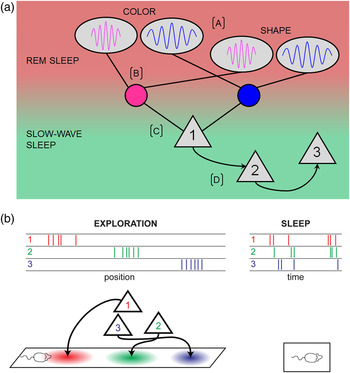
Figure 1. 1a: The contribution of REM and slow-wave sleep to the formation of episodic memories. (A) Objects are temporarily represented by neural synchronization between distributed neural feature representations. (B) Invariant object representations are generated. (C) Various objects are integrated into scenes at particular places. (D) Places are ordered in sequence. 1b: During active exploration of an environment, place cells are activated sequentially based on the locations of their place fields. The same cells become active in a similar order during subsequent slow-wave sleep in the absence of external inputs.
“The stuff of dreams is the stuff of memory,” Llewellyn argues (target article, abstract), and “REM dreaming may provide the most conducive state for the elaborative encoding of personal, emotionally salient memories” (sect. 6, para. 4). She thus postulates two intimate relations between dream and memory: (1) a content relation – the contents of dreams are constitutive for, if not identical with, the contents of memories; and (2) a causal relation – REM dream provides the main causal mechanism for memory consolidation. The formation of memories, as Llewellyn suggests, can be divided into three steps: (1) the composition of multiple elements into scenes, (2) the association of (emotionally tagged) scenes with loci, and (3) the ordering of scenes on the basis of ordered sequences of loci.
In the following, we propose prominent candidates for the neurobiological mechanisms that might underlie the three-step model, thus putting it on a firmer physiological foundation. At the same time, these very mechanisms lead us to question the evidence for the intimateness – especially of the causal relation between REM dream and memory.
Gamma-band (30–80-Hz) oscillation has been postulated as a vital mechanism for the object-related binding of distributed neuronal feature representations (Gray et al. Reference Gray, König, Engel and Singer1989; Singer & Gray Reference Singer and Gray1995; for a review, see Singer Reference Singer1999). There is evidence that gamma-band oscillation is constitutively involved in conscious awareness (Engel et al. Reference Engel, Fries, König, Brecht and Singer1999). Crucially, gamma-band oscillation is present in REM sleep and moreover characteristically distinguishes REM sleep from non-REM sleep (Llinás & Ribary Reference Llinás and Ribary1993). It has been found in the hippocampus of the rat and the rabbit (Bragin et al. Reference Bragin, Jando, Nadasdy, Hetke, Wise and Buzsaki1995; Stumpf Reference Stumpf1965). As we have shown in neural network simulations (Maye & Werning Reference Maye and Werning2004; Werning Reference Werning2003b; Reference Werning, Machery, Werning and Machery2005a; Reference Werning2005b; Reference Werning, Werning, Hinzen and Werning2012), gamma-band oscillation may subserve the generation of nonsymbolic, but still compositional, object representations. From this point of view, it seems indeed plausible that a composition of multiple features into objects takes place in REM sleep (Fig. 1a[A]) – for the integration of features into events, see Werning (Reference Werning, Löwe, Malzkorn and Löwe2003a). This supports step 1 of the three-step model.
1a: The contribution of REM and slow-wave sleep to the formation of episodic memories. (A) Objects are temporarily represented by neural synchronization between distributed neural feature representations. (B) Invariant object representations are generated. (C) Various objects are integrated into scenes at particular places. (D) Places are ordered in sequence. 1b: During active exploration of an environment, place cells are activated sequentially based on the locations of their place fields. The same cells become active in a similar order during subsequent slow-wave sleep in the absence of external inputs.
Place cells in the hippocampus of rodents fire action potentials only when the animal is located in a circumscribed location (Cheng & Frank Reference Cheng and Frank2011; O'Keefe and Dostrovsky Reference O'Keefe and Dostrovsky1971). Similar cells have been observed in the human hippocampus navigating a virtual reality environment (Ekstrom et al Reference Ekstrom, Kahana, Caplan, Fields, Isham, Newman and Fried2003). It seems reasonable to assume that hippocampal cells provide the neural basis for the representation of spatial locations required in step 2 of the three-step model (Fig. 1a[C]). The link between the hippocampus and the three-step model is further underscored by the fact that the hippocampus is also essential for episodic memory formation in humans (Scoville & Milner Reference Scoville and Milner1957).
Two more properties of place cells provide a tantalizing link to step 3 of the three-step model (Fig. 1a[D]). First, place cells' spiking is sequentially ordered during active behavior controlled by a 6- to 10-Hz oscillation (Gupta et al. Reference Gupta, van der Meer, Touretzky and Redish2012). Second, during quiescence or sleep, the same place cells are reactivated in the same sequence as shown in Figure 1b (Diba & Buzsaki Reference Diba and Buzsaki2007; Lee & Wilson Reference Lee and Wilson2002; for a review, see Buhry et al. Reference Buhry, Azizi and Cheng2011), and there are hints that these replay events occur during REM sleep (Louie & Wilson Reference Louie and Wilson2001). Replay is generally accompanied by sharp-wave/ripple (SWR) events, and we have found that SWR-related activity is enhanced when animals learn about novel spaces (Cheng & Frank Reference Cheng and Frank2008). We therefore fully agree with Llewellyn that the hippocampus is probably intimately involved in the storage and retrieval of episodic memories.
However, unlike Llewellyn, we believe that the experimental evidence suggests that slow-wave sleep (SWS) is important for consolidation of episodic memories, but REM sleep is not. First, in human studies, REM sleep improves procedural skills learned before (Fischer et al. Reference Fischer, Hallschmid, Elsner and Born2002; Karni et al. Reference Karni, Tanne, Rubenstein, Askenasy and Sagi1994) but has little influence on episodic memories (Gais & Born Reference Gais and Born2004). Second, SWS is important to consolidate declarative memories (Gais & Born Reference Gais and Born2004; Fosse et al. Reference Fosse, Fosse, Hobson and Stickgold2003; Tucker et al. Reference Tucker, Hirota, Wamsley, Lau, Chaklader and Fishbein2006). Third, the aforementioned neural sequences occur predominantly during SWS and the finding of sequential reactivation in REM sleep (Louie & Wilson Reference Louie and Wilson2001) has not been replicated by any other study.
Instead, we would suggest that a possible mechanism that links REM sleep to the formation of episodic memories might be the generation of invariant object representations. Cells representing objects in a way that is invariant with regard to particular features and independent of particular contexts were found in the hippocampus (Quiroga et al. Reference Quiroga, Reddy, Kreiman, Koch and Fried2005). Those representations might be regarded as rigid designators of objects (Kripke Reference Kripke1980) because they make objects cognitively accessible across times and independently of the detailed descriptive information in any particular context. These invariant object representations (“grandmother” cells/assemblies) exist alongside compositionally generated object representations in the neocortex bound by gamma-band oscillations. These two representational formats might interact with each other during REM sleep (Fig. 1a[B]), forging the appropriate synaptic connections between hippocampus and neocortex. For episodic memory, invariant representations provide a compression mechanism that avoids the need to store detailed sensory information. This is beneficial because, on the one hand, the storage capacity of the hippocampus is limited (cf. Palm & Sommer Reference Palm and Sommer1992), and, on the other, much of the detailed context-bound information processed in the neocortex is irrelevant for memory.
We thus concede that there might be an intimate content relation between REM dreaming and episodic memory because both essentially involve invariant object representations. However, the causal relation between REM dreaming and memory consolidation might be less intimate than Llewellyn assumes.
ACKNOWLEDGMENTS
This work was supported by a grant from the Stiftung Mercator and a grant (SFB 874, project B2) from the German Research Foundation (DFG).