


1. Introduction
The idea that sleep and dreaming complement memory function in wake has a long history (for broad reviews, see Hobson Reference Hobson1999a; Reference Hobson2002; Winson Reference Winson1986; Reference Winson1993). More recently, there is interest in the synergistic roles of rapid eye movement (REM) and non–rapid eye movement (NREM) in memory processes (see, e.g., Diekelmann et al. Reference Diekelmann, Wilhelm and Born2009; Ribeiro & Nicolelis Reference Ribeiro and Nicolelis2004; Stickgold Reference Stickgold2005; Reference Stickgold2009). The relationship, if any, between dreams and memory has remained enigmatic, however. “Why do we need to create an artificial world offline and spend two hours a day in it?” (Hobson Reference Hobson1999a, p. 73).
Aristotle (Reference Gallop350 B.C./1996) argued that experiences, like projectiles set in motion during wake, continue as memories in dreams. Freud (Reference Freud and Crick1899/1999, p. 12) claimed that “all the material” in dreams derives “in some way” from remembered waking experiences; he also identified the memory sources for dreams (see, e.g., those for “Wolf Man” [Freud Reference Freud1963, pp. 214–16]). Stickgold (Reference Stickgold2002) states that, in the absence of external sensory input, memories with derived meanings and symbols must be the source material for dreams. Many have argued that memory sources are key to dream construction (Baylor & Cavallero Reference Baylor and Cavallero2001; Cicogna & Bosinelli Reference Cicogna and Bosinelli2001; Foulkes Reference Foulkes1985; Kramer Reference Kramer2007; Nielsen & Stenstrom Reference Nielsen and Stenstrom2005). Some contend that these memory sources reflect emotional concerns (Domhoff Reference Domhoff1996; Hartmann Reference Hartmann1998; Schredl Reference Schredl, Pace-Schott, Solms, Blagrove and Harnad2003). Memories are not replayed in dreams (Fosse et al. Reference Fosse, Fosse, Hobson and Stickgold2003); instead, memory elements are merged and fused to construct visual scenes (cf. Hartmann Reference Hartmann1996; Hobson Reference Hobson1988, pp. 36–38; Walker & Stickgold Reference Walker and Stickgold2010). The significance (if any) of why memory elements unite in dream image composition remains elusive. This requires explanation in any account of the mnemonic function of dreaming. Stickgold et al. (Reference Stickgold, Hobson, Fosse and Fosse2001) pinpoint a “frustrating dearth” of evidence on dream construction and its possible functions. The article aims to make a contribution in this area.
Possibly linked to the conflation of memory elements (Cicogna & Bosinelli Reference Cicogna and Bosinelli2001) is the, often, bizarre nature of dream imagery (Fosse et al. Reference Fosse, Stickgold and Hobson2004; Hobson Reference Hobson2002; Scarone et al. Reference Scarone, Manzone, Gambini, Kantzas, Limosani, D'Agostino and Hobson2008). McCarley and Hoffman (Reference McCarley and Hoffman1981) report that 67% of REM dreams exhibit bizarreness. Indeed, the word “bizarre” is used to characterize a person/object/place that takes on multiple (apparently inconsistent) elements. Bizarreness is constrained in dreams, however. Bizarre dream characters/objects conform to “bizarreness rules” (Rittenhouse et al. Reference Rittenhouse, Stickgold and Hobson1994). These rules limit bizarreness to incongruities (inconsistent or fused features of people/objects/places), discontinuities (sudden changes in these features of people/objects/places), and indeterminacy (where the identity of a person/object/place remains explicitly vague).The constrained nature of dream bizarreness excludes many possibilities. For example, typical adult dreams do not feature monsters or people who transmogrify into walking pink blancmanges (cf. Hobson Reference Hobson2011, p. 163; Rittenhouse et al. Reference Rittenhouse, Stickgold and Hobson1994). Moreover, most of dream content is not bizarre and conforms to waking expectations (Domhoff Reference Domhoff2011; Domhoff & Scheider Reference Domhoff and Scheider2008; Snyder Reference Snyder, Madow and Snow1970; Snyder et al. Reference Snyder, Karacan, Tharp and Scott1968). Dreams do not resemble abstract art, for example.
This article argues that the sometimes bizarre (but rule bound) visually associative nature of a dream (along with other dream characteristics) can, at least partially, be understood through the principles underlying what has been termed the “ancient art of memory” (henceforth, AAOM). The article integrates knowledge of the AAOM, from the humanities, into work on dreams and memory in neurobiology and psychology. The AAOM is elaborative encoding in wake engendering a visual composition using imagery (which is often bizarre), association (particularly to place), organization, and narration and forming the basis of all effective memory techniques (see evidence cited later). This efficacy suggests that AAOM principles predict at least some aspects of how declarative memory is configured in the brain. Why might this be?
If the construction of REM dreams can be understood through AAOM principles (see later sections), REM dreaming may be elaborative encoding that results in a visual, hyperassociative, organized, narrative, mnemonic composition, which can integrate a recent memory into remote episodic neuronal assembly networks in the associative cortex (see later arguments). The question then arises of how this integration of recent episodic memories can be accomplished without catastrophic interference (McCloskey & Cohen Reference McCloskey, Cohen and Bower1989; Ratcliff Reference Ratcliff1990) with the content of remote memories. Since Müller and Pilzecker (Reference Müller and Pilzecker1900), the traditional answer has been slow consolidation. This answer convinces for semantic memory, where a body of knowledge is being formed but seems less satisfactory for episodic memory, which depends on the ability to differentiate between, and, thus, recall unique events. Even if integration is slow, it is still integration.
Fuster (Reference Fuster1999, p. 85) states that a memory is best construed as represented in an associative network or matrix of neurons. For prominent network models, see Anderson (Reference Anderson, LaBerge and Samuels1977), Ballard (Reference Ballard1986), Edelman (Reference Edelman1987), Feldman (Reference Feldman, Hinton and Anderson1981), Kohonen (Reference Kohonen1977), and McClelland and Rumelhart (Reference McClelland and Rumelhart1985). Fundamental to network structures and processes are nodes/junctions and connections/edges (for a review, see Sporns Reference Sporns2011a, pp. 38–40). With respect to brain networks, definitions of nodes/junction and connections/edges are still problematic; this is significant because definitional choices impact upon the way that networks are understood (Butts Reference Butts2009; Fornito et al. Reference Fornito, Zalesky, Pantelis and Bullmore2012; Zalesky et al. Reference Zalesky, Fornito, Harding, Cocchi, Yücel, Pantelis and Bullmore2010). Networks can be defined at micro, meso, and macro levels. At the micro level, nodes/junctions may be said to be constituted by individual neurons; at macro level, decisions are required over the parcellation of grey matter into regional nodes (Zalesky et al. Reference Zalesky, Fornito, Harding, Cocchi, Yücel, Pantelis and Bullmore2010). Neuronal assemblies may represent meso-level phenomena of particular relevance for memory networks (cf. Başar et al. Reference Başar, Başar-Eroğlu, Karakaş and Schürmann2000; Miller Reference Miller1996). At the meso level in episodic memory networks, junction/node and connection/edge are not well understood.
Segregation and integration are fundamental to the organization of the cerebral cortex (Tononi et al. Reference Tononi, Sporns and Edelman1994; Zeki Reference Zeki1978; Zeki & Shipp Reference Zeki and Shipp1988). Buzsáki (Reference Buzsáki2006, p. 65) argues that pattern completion and pattern separation are the basic functions of neuronal networks, expressed though the concepts of integration and differentiation, respectively. Fuster (Reference Fuster1999, p. 33) states that segregation and integration characterize memory networks; he uses the concepts of divergence and convergence. The answer to the problem of how episodic memories are both integrated and segregated in cortical networks may be that a REM dream, composed of associated memory elements, is a junction/node, thus enabling integration at the junction but segregation between the episodic memory representations along the connecting paths/edges that “meet,” and share elements, at a junction.
In support of this hypothesis, the structure of the article is as follows. The next subsection sets out the article's underlying assumptions about dreaming and memory. The second section describes the AAOM and explains why this constitutes elaborative encoding. The third section presents research from experimental psychology indicating that the principles on which the AAOM is based are mnemonic. This is followed by neurobiological evidence that these principles are expressed during REM dreaming, as a single dream (and its hypothesized memory sources) illustrates. The article then considers how the hypothesis can be tested and concludes with intimations on what this hypothesis implies for sleep stages, focusing particularly on REM dreaming and memory processes.
1.1. Some preliminary clarifications about dreams and memory
Before proceeding to explain the AAOM, some preliminary clarifications are necessary. The hypothesis on the relationship to the AAOM relates to REM (rather than NREM) dreams. The REM sleep stage is most correlated with dreaming mentation (Dement & Kleitman Reference Dement and Kleitman1957b; Hobson Reference Hobson2002; Reference Hobson2009; Nielson Reference Nielson, Pace-Schott, Solms, Blagrove and Harnad2003). REM dreams are more animated, characterized by vivid internal perceptions, charged with primary emotions, spatially defined, hyperassociative, and more bizarre than NREM dreams, which are briefer, more literal, thought-like, perseverative, and verbal (for reviews and debates over these distinctions/continuums, see Cavallero et al. Reference Cavallero, Foulkes, Hollifield and Terry1990; Desseilles et al. Reference Desseilles, Dang-Vu, Sterpenich and Schwartz2011a; Foulkes et al. Reference Foulkes, Bradley, Cavallero and Hollifield1989; Hobson Reference Hobson2002; Lavie et al. Reference Lavie, Matanya and Yehuda1984; Nielson Reference Nielson, Pace-Schott, Solms, Blagrove and Harnad2003). NREM dreams do not hyperassociate memories (Foulkes Reference Foulkes1985), which renders them less comparable (than REM) to the AAOM. As this article is concerned with whether the mnemonic principles of AAOM are isomorphic with dreaming “rules,” the focus is on REM rather than NREM dreams. Stickgold et al. (Reference Stickgold, Hobson, Fosse and Fosse2001) argue that REM and NREM are characterized by unique physiology and dream structure; hence, for many purposes, they should be considered separately. This is the position I take in this article also, although see Fosse and Domhoff (Reference Fosse, Domhoff, Barratt and McNamara2007), who report that early-night REM and late-night NREM dreams cannot be distinguished.
Psychology distinguishes declarative from non-declarative memory and subdivides declarative memory into semantic and episodic/autobiographical. This article relates to episodic memory: enduring memories of personally significant past events with contextual place and time underpinnings (Squire Reference Squire1987; Tulving Reference Tulving1983; Reference Tulving, Squire, Weinberger, Lynch and McGaugh1991). It is not concerned with habitual activities. William James (Reference James1890) suggested that association, through activities performed habitually while awake, is the foundation for all memory; thus, the associations that underpin the retention of habitual activities may be formed during wake, also. The article's hypothesis rests on the assumption of shallow encoding of episodic memories in wake. There is considerable evidence that semantic memories are encoded during wake. To avoid an overlong article, I do not review here the vast literature on encoding in wake. The function of episodic memory is understood as oriented to the future rather than the past (Schacter & Addis Reference Schacter and Addis2007b; Schacter et al. Reference Schacter, Addis and Buckner2007). The neural substrates for remembering the past and envisaging the future overlap – imagining the future relies on recombining memories of past experiences (Addis et al. Reference Addis, Wong and Schacter2007; Ellenbogen et al. Reference Ellenbogen, Hu, Payne, Titone and Walker2007; Schacter & Addis Reference Schacter and Addis2007b; Schacter et al. Reference Schacter, Addis and Buckner2007; Szpunar et al. Reference Szpunar, Watson and McDermott2007). Indeed, Conway (Reference Conway2009, p. 2307) proposes replacing “memory system” with “remembering–imaging system.” Imagining depends upon imaging.
Memories are reconstructed on retrieval (Bartlett Reference Bartlett1932; Conway & Pleydell-Pearce Reference Conway and Pleydell-Pearce2000; Hassabis & Maguire Reference Hassabis and Maguire2007; Neisser Reference Neisser, Gladwin and Sturtevant1962; Rubin et al. Reference Rubin, Schrauf and Greenberg2003; Schachtel Reference Schachtel1947; Schacter & Addis Reference Schacter and Addis2007b; Schacter et al. Reference Schacter, Norman and Koutstaal1998) not just from different modalities (visual, spatial, motor, language-related, and so on) but from memories that occurred in different time–space contexts (cf. multiple trace theory [Moscovitch & Nadel Reference Moscovitch and Nadel1998; Nadel & Moscovitch Reference Nadel and Moscovitch1997; Nadel et al. Reference Nadel, Samsonovitch, Ryan and Moscovitch2000]). Re-collection involves the parallel processing of many distributed networks (Fuster Reference Fuster1999, p. 210). Memory flexibility is engendered by sparse (only a fraction of any “whole” memory is represented at any location) and distributed (memories are held over large areas of neuronal space) memory networks (Buzsáki Reference Buzsáki2006, p. 290; Kanerva Reference Kanerva1988). This flexibility implies that memory is robust, but there is no certain memory output for any given input (Fuster Reference Fuster1999, p. 86). Reconstructed memories “bring past experience to bear on present thought and action” (Anderson Reference Anderson1997, p. 20). In doing so, “memory pulls us forward” (Robinson Reference Robinson2005, p. 192). Through this projective process, memory reveals identity – feelings, plans, accomplishments, disappointments, and relationships (cf. Neisser & Hyman Reference Neisser and Hyman2000). Without the “binding force of memory,” identity would be splintered (Kandel Reference Kandel2006). Identity is expressed through memories of emotional concerns (Archer Reference Archer2000, p. 10). Personal memories are always emotional. As Freeman (Reference Freeman1999, p. 114) points out, “Without emotion, there would be no remembering.”
Against these background assumptions about dreams and memory, the next section explains the principles that underlie the AAOM and are hypothesized to account, largely, for the mnemonic properties of REM dreams.
2. The ancient art of memory in waking consciousness
The AAOM was (and is) exploited in waking consciousness. Consciousness is a contested concept. This article is mainly concerned with two dimensions of consciousness: the phenomenological contents of REM dreaming consciousness, and the neurobiological architecture that makes REM dreaming consciousness possible. (For further elucidation of the way that consciousness is understood in this article, see, for example, Donald [Reference Donald1995] and Metzinger [Reference Metzinger2003b; Reference Metzinger2009].)
In the modern age, the content of waking consciousness is characterized by partial reliance on external memory banks. The clearest example is, of course, the Internet, which partially externalizes semantic and encyclopaedic memories. Consequently, cultural dependence on individual memory has diminished (Donald Reference Donald1991; Reference Donald1993). Perhaps related to this is the assumption that individual memory for episodic waking experiences “comes for free”; no special strategies are necessary, such memories occur as a “by-product of perception and comprehension” (Worthen & Hunt Reference Worthen and Hunt2011, p. 14). This modern notion that memories of waking experiences are formed and retained effortlessly and, thus, not as the result of cognitive, imaginative endeavour, contrasts strongly with the pre-modern view.
In classical antiquity, indeed, right up to the Early Middle Ages, learning the mnemonic craft was central to the education of the social elite (Carruthers & Ziolkowski Reference Carruthers, Ziolkowski, Carruthers and Ziolkowski2002). Classically, it was well understood that a flexible memory system works best not through learning by rote, nor by memorizing events “as they really are,” but through imaginatively associating the to-be-remembered material in a mental image. Indeed, pre-modern scholars would not have counted anything memorized through rote repetition as a true memory (Carruthers Reference Carruthers2008, pp. 22–23). Therefore, as Carruthers argues, the type of memory recognized by modern experimental psychology, as evidenced by the ability to reproduce exactly a list of items, would not have been seen as memory by pre-modern scholars. Rote memorization was undertaken in ancient and medieval education, however. “Learning by heart” provided a valuable reiterative foundation upon which a more flexible imaginative memory system could be constructed as it inculcated such habits as dividing up to-be-remembered material, which could then be linked together in a secure order (Carruthers & Ziolkowski Reference Carruthers, Ziolkowski, Carruthers and Ziolkowski2002, pp. xii–xiv). Flexibility and order were important because the AAOM focused mainly on the encoding of material needed for what were, often, extempore events, such as lectures, disputations, or sermons before live audiences (p. 3).
To the pre-modern mind, flexible memory worked through what I call imag-ination. To encode (rather than rote learn) a memory, it was necessary to envision – to form a mental image of – something that was not real, hence image plus imagination. The mnemonic image was not “real” because it associated several to-be-remembered things. Consequently, a memory was a composite image which had not been present to the senses. Memory and imag-ination were as one. Consequently, individual memory was revered: “Ancient and medieval people reserved their awe for memory” (Carruthers Reference Carruthers2008, p. 1).
Until quite recently (e.g., Conway's Reference Conway2009 “remembering-imagining system”), the modern era fostered a view of memory and imagination as polar opposites rather than mutually implicated. To the classical mind, however, memory was not simply concerned with retention but depended crucially upon imaginative composition (Carruthers & Ziolkowski Reference Carruthers, Ziolkowski, Carruthers and Ziolkowski2002, p. 3). In the AAOM, personally significant events, people, and thoughts are connected in ways which do not replicate how these events, people, and thoughts were actually related in ongoing daily waking experience but how they are meaningfully, emotionally associated from a personal perspective (Bolzoni Reference Bolzoni and Parzen2001; Carruthers Reference Carruthers2008; Yates Reference Yates1966). So, historically, memory was seen as a creative process where the to-be-remembered material was made memorable (in contemporary psychological terms, encoded and consolidated in long-term memory) through imaginative composition. The aim of AAOM was to produce memory cues or “chains of association that regenerate memories” (Bolzoni Reference Bolzoni and Parzen2001, p. xviii). Carruthers and Ziolkowski stress:
Memory works by association. Its connections are thus individual and particular, not universal.…The logic of memory is essentially “arbitrary,” in the Latin sense – dependent on one's experiences… desires and above all will.…Thus, while the colour “white” may remind me of “snow,” it may remind you of “milk” and thus send us along entirely different associative pathways with equal claims to be “true.” (Carruthers & Ziolkowski Reference Carruthers, Ziolkowski, Carruthers and Ziolkowski2002, p. 8)
The pre-modern view that all memory is associative is echoed in current neuroscience by Fuster (Reference Fuster1999, p. 2): “Association is an attribute of all memories, at the root of their genesis as well as their evocation.” Notably, the more bizarre, dramatic, absurd, or obscene the associative cue the memorizer creates, the more persistent the memory to which the cue has been associated and the easier the process of retrieval (Hughes Reference Hughes1997; Yates Reference Yates1966).
The visual sense was recognized as the most secure for the art of memory composition (Carruthers & Ziolkowski Reference Carruthers, Ziolkowski, Carruthers and Ziolkowski2002, pp. 11–12; Yates Reference Yates1966, p. 19). The AAOM emphasizes that a memory is something that is looked at rather than heard or spoken, both as it is committed to mind and when it is recalled (Carruthers Reference Carruthers2008, p. 24). To function mnemonically, visual images should be intense and affective; to remember “bitter,” for example, the image can portray a person vomiting on a bitter substance (Bradwardine Reference Bradwardine, Carruthers and Ziolkowski2002). Although other senses may be used for emphasis – for example, the sensation of taste may be invoked in this image of “bitter” – the visual medium is essential (cf. Carruthers & Ziolkowski Reference Carruthers, Ziolkowski, Carruthers and Ziolkowski2002, p. 11). A good memory image is charged with primary feelings like fear, desire, elation, or disgust; in contrast, a bad memory composition is anything dull, anything unlikely to command attention (Carruthers Reference Carruthers2008, p. 75). The images must be distinctive and, therefore, memorable; if ordinary events occur, they are emotionally heightened through, for example, violence, surprise, or titillation (Carruthers & Ziolkowski Reference Carruthers, Ziolkowski, Carruthers and Ziolkowski2002, p. 13). If the images take the form of people, these individuals should be well known to the memorizer or famous or, even better, infamous; uninteresting anonymous people do not make for effective cues (cf. Yates Reference Yates1966, p. 27).
To employ the AAOM, the to-be-remembered material is reorganized. Carruthers and Ziolkowski (Reference Carruthers, Ziolkowski, Carruthers and Ziolkowski2002, p. 4) comment that “material is first cut up into divisiones or distinctions, and then these segments are mentally marked and memorized in a readily recoverable order. Each segment should be ‘short’ (brevis), no larger than what your mental eye can encompass in a single glance or conspectus.” The order of the material is of paramount importance so that the divisiones can be recalled in sequence, with none omitted in error (p. 4). The number of divisiones (compositions or scenes) that can be retained in memory is limitless, but each composition (or scene) should be sparse, composed from not more than about “seven plus or minus two” people and/or objects (p. 9; cf. working memory [Miller Reference Miller1956]). Crowded, cluttered, or complex scenes do not make good memory images. Also the memory image is timeless – in the sense that rather than referencing the past, the composed image puts the to-be-remembered material in “real time,” thereby rendering the image more immediate and, therefore, more effective (Bolzoni Reference Bolzoni and Parzen2001, p. 214). If possible, to further command attention, the image should incorporate movement (Bradwardine Reference Bradwardine, Carruthers and Ziolkowski2002).
Once an emotionally tagged image is formed, it is associated with a locus, place, or landmark (as a mnemonic technique, this is sometimes termed the method of loci). Then another related image is connected to another related landmark and so on (Bolzoni Reference Bolzoni and Parzen2001, p. xvii). Suitable landmarks are simple locations easily brought to mind – like a house, a space, a corner, or an arch (Yates Reference Yates1966, p. 22). The method of loci relies on the creation of a ordered sequence. The located images are not arranged chronologically in time but connected through emotionally charged associations, particularly personal ones related to place (Carruthers Reference Carruthers2008, p. 76). For example, sometimes, memory images were placed at landmark locations along routes within familiar buildings (p. 18). Thus, emotional, creative association, and composition in the AAOM depends upon three essential components: images, locations/landmarks, and order (Bolzoni Reference Bolzoni and Parzen2001, p. xvi). As the locations/landmarks form an order, the compositional images can be easily recalled as the person who is remembering “passes again” through the places – as if retracing a journey (p. xvii). Using the AAOM, having identified one landmark (or the image it contains), it is possible to move either forwards or backwards as one follows the chain of associations (Carruthers & Ziolkowski Reference Carruthers, Ziolkowski, Carruthers and Ziolkowski2002, p. xiii; Yates Reference Yates1966, p. 22). For this reason “images in places” were termed “agent images”; to enable retrieval, they engender movement within memory's associational structure (Carruthers Reference Carruthers1998, p. 15).
As in modern psychology (cf. “encoding,” “storage,” and “retrieval”), pre-modern scholars distinguished among “composition,” “retention,” and “recollection” (Carruthers Reference Carruthers2008, p. 23). The “method of loci” locates images in places so that they can be found and “re-collected” (for “locational memory,” see Carruthers & Ziolkowski Reference Carruthers, Ziolkowski, Carruthers and Ziolkowski2002, pp. 6–8). To support “re-collection,” the AAOM is an art for searching and finding images (Carruthers Reference Carruthers2008, p. 23). Indeed, the AAOM is an ars inveniendi, a “tool of invention,” enabling the discovery and selective recombination of memories (Carruthers Reference Carruthers2009). Thus, classically, memory retrieval was understood as a process of reconstruction, just as the modern scholars (discussed earlier) now recognize. This renders the modern term “storage” an unfortunate metaphor, “‘storage’…is a curious intellectual model, for it suggests that our memories are essentially passive impressions of experiences…that can be taken out whole and unchanged” (Carruthers & Ziolkowski Reference Carruthers, Ziolkowski, Carruthers and Ziolkowski2002, p. 1). This is a point Carruthers emphasizes (1998, p. 8) with regard to the Ad Herennium scene described below. The purpose of this image is not to cue some pre-memorized “stored” speech but to enable the defence counsel to recall and return to pertinent issues while she or he extemporizes in response to court proceedings.
Yates (Reference Yates1966), quotes from Ad Herennium, a classical art-of-memory text compiled in Rome circa 86–82 B.C. She asks readers to imagine that they are the counsel for the defence in a lawsuit. The case is one of suspected poisoning, and material on the relevant issues is divided up. This first memory image is composed to make the accusation, motive, and presence of witnesses memorable. The further case details would have followed in successive linked images:
The prosecutor has said that the defendant killed a man by poison, has charged that the motive of the crime was to gain an inheritance, and declared that there are many witnesses and accessories to this act. We are forming a memory system about the whole case and we shall wish to put in our first memory locus an image to remind us of the accusation against our client. This is the image. We shall imagine the man in question as lying ill in bed, if we know him personally. If we do not know him, we shall yet take someone to be our invalid, but not a man of the lowest class so that he may come to mind at once. And we shall place the defendant at the bedside, holding in his right hand a cup, in his left, tablets, and on the fourth finger, a ram's testicles. In this way we can have in memory the man who was poisoned, the witnesses and the inheritance. The cup would remind of the poisoning, the tablets of the will or the inheritance, and the testicles of the ram through verbal similarity with testes – of the witnesses. (Yates Reference Yates1966, pp. 27–28)
This scene illustrates the mnemonic principles of an AAOM composition. All the selected to-be-remembered material is there, yet the scene can be easily encompassed in a single glance, being simple, sparse, organized, and in “real time.” Place, as spatial setting (not named geographic location) is clearly defined. The dramatis personae are either known personally to the memorizer or are of interest because of status or fame. In this scene, as described, it is not clear whether there is movement, but to enhance mnemonic effect there should be. Lastly, although the scene as a whole may be relatively commonplace, there is a bizarre, arresting and, in this case, rather disgusting detail to engage primary emotions and ensure distinctive mnemonic resonance.
The principles underlying the AAOM form the basis of all effective mnemonic techniques (see, e.g., Groninger Reference Groninger1971; Luria Reference Luria1968; Roediger Reference Roediger1980; Wang & Thomas Reference Wang and Thomas2000; Wilding & Valentine Reference Wilding and Valentine1997; Worthen & Hunt Reference Worthen and Hunt2011). Exceptional memorizers acquire their abilities through assimilating these mnemonic techniques rather than being born with great memories (Ericsson Reference Ericsson2003; Maguire et al. Reference Maguire, Valentine, Wilding and Kapur2003). Even if not involved in the action, the mnemonic functioning of imagery is enhanced if the memorizer takes themselves to be present – as an embodied and interested observer. Finally, the memorizer should compose the mnemonic so that the associations are personally meaningful.
2.1. A contemporary illustrative AAOM example
The following mnemonic also illustrates AAOM principles but is more than a tableau; it takes the form of a narrative and, therefore, relies on the method of loci.
-
Scene 1. I am walking alongside a river. I stop where the river narrows and is shallow. I glance down and see a ham in a net. A rat runs past the ham and crosses the river. Suddenly two bees land on a knot in the net, and then just as suddenly the two bees disappear.
-
Scene 2. A man wearing leggings, a padded jacket, and a high white collar is approaching me by the river. He shakes my hand. He carries a spear in his other hand.
-
Scene 3. I'm in a house. It seems to be my house. Through the glass in the front door, I can see a woman standing on the doorstep. I open the door, and she shows me lots of make-up in the case she is holding open.
In this scenario, I am a U.K. high school student who is learning about Shakespeare. I aim to remember: birthplace (Stratford upon Avon, U.K.), life era (Elizabethan), marriage (Anne Hathaway), children (Susanna, Hamnet, and Judith), and most famous works.
These first three scenes result from my division and organization of this to-be-remembered material. They are composed to visualize and memorize birthplace: (St) rat-ford (narrow, shallow place in the river); Avon (the river and the woman selling cosmetics); Hamnet/Hamlet and most famous line “To (two) be(es) or (k)not to(two) be(es)”; and Shake-spear-e himself. Subsequent scenes would be composed to visualize the other facts and works.
This mnemonic encompasses two aspects of memory that pre-modern scholars distinguished: memory for things, people, events, and ideas (memoria rerum); and memory for words (memoria verborum) (Bolzoni Reference Bolzoni and Parzen2001, p. xvii; Carruthers & Ziolkowski Reference Carruthers, Ziolkowski, Carruthers and Ziolkowski2002, p. 9; Yates Reference Yates1966, p. 24). For example, Shakespeare is memorized as a person (the man in leggings), and the word “Shake-spear-(e)” is also being committed to memory. In this respect, the memoria rerum/memoria verborum distinction does not only mirror the modern division between episodic and semantic memory, but it also reflects Paivio's (Reference Paivio1969; Reference Paivio1970; Reference Paivio1986; Reference Paivio2007) dual coding theory. Paivio (see also Kosslyn Reference Kosslyn1980; Reference Kosslyn1996) theorized that objects, events, and people are processed and represented non-verbally in a different subsystem from language (for a counter view that all mental representations are propositional, see, e.g., Pylyshyn Reference Pylyshyn1973; Reference Pylyshyn2002). The image system is specialized for processing spatial and relational information, whereas the verbal system is specialized for sequential information (Paivio Reference Paivio1986, p. 142). In Paivio's view, objects, events, and people are instantiated as mental images in long-term memory, whilst language gives rise to propositions. This view should not be taken as implying that “images” (any more than “words”) are actually “stored” in the brain, rather images and words are represented by different neuronal network changes. These instantiated changes can be reactivated. If the word is concrete, on retrieval both a proposition and an image may be activated. Abstract words are difficult to visualize; hence, they are processed only through propositions. Under dual coding, Paivio assumes that the non-verbal and verbal systems are functionally independent (one system can be active without the other, or both can be active in parallel). However, the two systems are interconnected so that, in appropriate conditions, activity in one system can trigger activity in the other. In the AAOM, verbal material can be easily dealt with only if the word is concrete – in the sense that it can be visualized (e.g., Shakespeare). In contrast, visualizing abstractions – that is, the “angst” of “to be(e) or (k)not to be(e)” – is problematic.
Just as in the Ad Herennium scene, the division and organization of the material, the associations, and the narrative obscure the actual nature of the to-be-remembered material. This composition cannot be identified immediately as relating to Shakespeare any more than the Ad Herennium scene is obviously a mnemonic for a case of poisoning. The “Shakespeare” connections are personally significant and, therefore, arbitrary (e.g., I chose to focus on Shakespeare's clothes and selected a travelling cosmetic saleswoman to personify the river “Avon”). As someone who is interested in clothes and cosmetics, these are obvious associations to me but are not necessarily so to others. I introduced bizarreness (the ham by the river) and the primary emotion of disgust (a rat runs by the ham). To enhance the mnemonic effect further, I imagine myself to be present and embodied. The route of “river, then the river path, then the house” seems unlikely, but I did once live in a house on a street which had a river running down the middle. I frequently walked by the river on the river path before I entered my house. Hence this route is mnemonic for me.
Another notable aspect is that, although the scenes form an ordered scene narrative, they are not chronological and, therefore, would function just as well if they ran the other way (i.e., the “Avon” scene could have been first). The narrative structure of the Shakespeare mnemonic is dictated by association rather than logical progression. For example, the third scene appears to be bizarrely discontinuous (as defined by Rittenhouse et al. Reference Rittenhouse, Stickgold and Hobson1994) with the second, but knowledge of the “Avon” link reveals an associational theme. (A river is present in scenes 1 and 2, and the river is, through visual analogy, “named” as Avon in scene 3 – although the word “Avon” never surfaces.)
The AAOM is elaborative encoding that uses the devices of visualization, association (particularly the dramatic and bizarre), organization, narration, embodiment, movement, and location as mnemonics. In psychology, what is the experimental evidence that these devices do function mnemonically?
3. Evidence on mnemonics in psychology
Modern experimental psychology has focused on normal memory processes or memory loss through lesion studies (for early research, see Scoville & Milner Reference Scoville and Milner1957). Exploring ways to enhance memory through mnemonics (or elaborative encoding) has been relatively neglected (Maguire et al. Reference Maguire, Valentine, Wilding and Kapur2003; Worthen & Hunt Reference Worthen and Hunt2011, p. 14). Nevertheless, there is some relevant work.
Early “depth of processing” research demonstrated that richer, elaborative, and more meaningful encodings resulted in better retention as compared with rote rehearsal (Bradshaw & Anderson Reference Bradshaw and Anderson1982; Craik & Jacoby Reference Craik, Jacoby and Nilsson1979; Craik & Lockhart Reference Craik and Lockhart1972; Craik et al. Reference Craik, Routh and Broadbent1983; Hyde & Jenkins Reference Hyde and Jenkins1973; Mandler Reference Mandler and Puff1979; Woodward et al. Reference Woodward, Bjork and Jongeward1973; Worthen & Hunt Reference Worthen, Hunt, Roediger III and Byrne2008). Moreover, the specificity of the encoding determined the effectiveness of retrieval cues (Tulving & Thomson Reference Tulving and Thomson1973). For example, my Shakespeare mnemonic would result in “cosmetics” cueing Shakespeare's birthplace through both converging upon “Avon.” Also, self-generated encodings are better retained than provided ones (Ironsmith & Lutz Reference Ironsmith and Lutz1996; Kuo & Hooper Reference Kuo and Hooper2004).
In terms of the various facets of elaborative encoding, a landmark study on the power of visual imagery vis-à-vis verbal material showed that “the capacity of recognition memory for pictures is almost limitless” (Standing Reference Standing1973). Shepard (Reference Shepard1967) demonstrated that subjects' recognition of memorized pictures was superior to either words or sentences. A high accuracy for the recollection of pictures was also shown by Nickerson (Reference Nickerson1965; Reference Nickerson1968) and Standing et al. (Reference Standing, Conezio and Haber1970). Richardson (Reference Richardson1980, p. 61) concludes, “These results are consistent with the idea that pictorial presentation gives rise to a distinctive and highly efficient means of storing information.” The human capacity to store images is immense; contrary to past assumptions, retained images are also detailed (Brady et al. Reference Brady, Konkle, Alvarez and Oliva2008). Indeed, pictorial detail enhanced rather than diminished retention (Vogt & Magnussen Reference Vogt and Magnussen2007).
Forming associative, interactive mental imagery is particularly potent for memory (Mandler Reference Mandler and Puff1979). A series of interacting pictures is remembered better than separate ones (Bower Reference Bower1970a; Epstein et al. Reference Epstein, Rock and Zuckerman1960; Richardson Reference Richardson1980, p. 6; Wollen & Lowry Reference Wollen and Lowry1974). Forming a composite image enhances memory – for example, remembering of the word “lamp” and the number 88 is greatly enhanced by imagining a neon light shaped to form the digits 88 compared with rote rehearsal of the word and number (Bower Reference Bower1970a; Reference Bower and Gregg1972). Spatial interaction that creates simple subject-action-object narratives between the to-be-remembered items is also efficacious (Epstein et al. Reference Epstein, Rock and Zuckerman1960; Rohwer Reference Rohwer1966). For example, remembering of the words “rock” and “bottle” is facilitated by imagining the scene of a rock breaking a bottle. Such examples led Bower (Reference Bower1970b) to suggest that “relational organizing” produces the mnemonic effects of associative imagery. As relational organizing increases, the to-be-remembered phenomena are transformed so that the mnemonic image becomes qualitatively different from the original material (Worthen & Hunt Reference Worthen and Hunt2011, p. 39).
Early experimental research also demonstrated that vivid, bizarre, or dramatic associative imagery (e.g., a dog with a pipe in its mouth or a crashed plane) is retained better than normal imagery. For example, Standing (Reference Standing1973) calculated that if one million vivid pictures could be presented, 731,400 would be preserved. Later experimental research that used bizarre items in mixed lists (some common items, some bizarre items) and unmixed lists (all items are bizarre) put the mnemonic effect of bizarreness down to distinctiveness (Hunt & Elliott Reference Hunt and Elliott1980; McDaniel & Einstein Reference McDaniel and Einstein1986; McDaniel et al. Reference McDaniel, Einstein, DeLosh, May and Brady1995; Reference McDaniel, DeLosh and Merritt2000; Worthen Reference Worthen, Hunt and Worthen2006). Clearly, if all presented items are bizarre, bizarreness becomes commonplace and loses its distinctiveness. Schmidt (Reference Schmidt1991) posits that distinctiveness operates at two levels: first within the local context (e.g., a bizarre item within a list of commonplace items) and, second, within a secondary context of prior experience and knowledge (e.g., I have never seen a dog with a pipe in its mouth). At both levels, Hirshman (Reference Hirshman1988) suggests that bizarreness violates expectations and so results in a startle reaction that triggers focused attention, which, in turn, generates more elaborate encoding during which the general context for the bizarre object or event is also better encoded, which results in the availability of a richer set of contextual cues for retrieval.
This mnemonic effect is well known for “flashbulb memories” of sensational public events (Brown & Kulik Reference Brown and Kulik1977). The gripping drama of a “flashbulb event,” such as the Twin Towers collapse, casts a “light” which enables the incorporation of the commonplace context. Thus, people recollect not just the dramatic event itself but also associated everyday events – what they were doing, where they were, who they were with, and how they felt when they heard the news (Finkenauer et al. Reference Finkenauer, Gisle, Luminet, Pennebaker, Paez and Rimé1997). The key mechanism underlying the flashbulb impact is the emotional response to the violation of expectations – the shock and surprise evoked (Hoskins Reference Hoskins2009). Emotionally arousing events are better remembered than emotionally neutral ones (Atienza & Cantero Reference Atienza and Cantero2008; Canli et al. Reference Canli, Zhao, Brewer, Gabrieli and Cahill2000; Dolcos et al. Reference Dolcos, LaBar and Cabeza2004; Kensinger Reference Kensinger2004; Sharot et al. Reference Sharot, Delgado and Phelps2004).
Marr (Reference Marr1970) remarked that more information has to be stored to remember a random picture than a patterned one; hence, imposing structure on to-be-remembered material aids memory “storage” efficiency. For example, Ericsson et al. (Reference Ericsson, Chase and Faloon1980) describe how a subject (interested in running) increased his memory span from 7 to 79 digits through chunking the digits and associating the chunks to personally meaningful information – for example, 3,492 was chunked from a list and re-coded as 3 minutes and 49.2 seconds – near the world-record mile time. Order and organization are mnemonic (Bower et al. Reference Bower, Clark, Lesgold and Winzenz1969; Cohen Reference Cohen1963). Both scenes and narratives are organizing schema (Mandler Reference Mandler1984, p. 8). For example, objects organized into a typical room layout are much easier to remember than ones which are randomly placed. Similarly, there is much more accurate recall if events are ordered into a narrative rather than presented as an unrelated series of discrete happenings (p. 89). Indeed, as Mandler (p. 53) argues that, if experience is not narrativized, then memories cannot be retained.
Experimental work on the relationship between embodiment and memory is strangely lacking, although there is increasing interest in embodied cognition in general (see, e.g., Clark Reference Clark1999; Metzinger Reference Metzinger2009; Wilson Reference Wilson2002). Merleau-Ponty's (Reference Merleau-Ponty1945/2002) seminal work on the embodied mind points out that embodied memories are the most resilient (see also Archer Reference Archer2000, p. 139). Glenberg (Reference Glenberg1997, p. 5) argues that embodied memories (as memories of subject-performed actions) are stronger than memories that rely on verbal descriptions; he cites the example that performing the command “open the book” results in better recollection than merely hearing the verbal command. Indeed, if the function of memory is to inform future action (Anderson Reference Anderson1997; Schacter & Addis Reference Schacter and Addis2007b), it would seem intuitively likely that embodied action would result in enhanced representations in memory (Benjamin & Bjork Reference Benjamin and Bjork1997).
In the AAOM, the person who is memorizing “looks at” the to-be-remembered images when both encoding and retrieving. These images have to be in recoverable order. Generally, they have been associated with landmarks on well-known routes. In a functional magnetic resonance imaging (fMRI) study on 10 “superior memorizers,” Maguire et al. (Reference Maguire, Valentine, Wilding and Kapur2003) found that nine used this “method of loci.” Empirical work has demonstrated that this technique is efficacious (Briggs et al. Reference Briggs, Hawkins and Crovitz1970; Crovitz Reference Crovitz1969; De Beni & Cornoldi Reference De Beni and Cornoldi1985; Lea Reference Lea1975; Moè & De Beni Reference Moè and De Beni2005; Roediger Reference Roediger1980; Ross & Lawrence Reference Ross and Lawrence1968) even when the loci are used repeatedly for different lists of items (Massen & Vaterrodt-Plünnecke Reference Massen and Vaterrodt-Plünnecke2006). Self-generated loci have been shown to be more effective than ones supplied by others (Moè & De Beni Reference Moè and De Beni2005). One memorist used a variant of the method of loci to memorize π to 65,536 digits (Raz et al. Reference Raz, Packard, Alexander, Buhle, Zhu, Yu and Peterson2009).
Along with the evidence (presented in the last section) that the AAOM is the basis of all effective memory techniques (and that memory “champions” employ these techniques rather than being born with exceptional memories), this section has reviewed experimental work in psychology that confirms the mnemonic properties of the AAOM. So there is indicative evidence that the AAOM optimizes memory performance. The next section first briefly reviews current neurobiological work on the relationship between sleep/dreaming and memory and then presents neurobiological evidence that the principles underlying the elaborative encoding of the AAOM (visualization, bizarre connections, organization, narration, embodiment, and place association) are realized in REM dreams.
4. Dreaming and memory in neurobiology
The long-standing idea (see Jenkins & Dallenbach Reference Jenkins and Dallenbach1924; Marr Reference Marr1971; Winson Reference Winson1986) that the “off-line” state of sleep enables memory in some way (or ways) has gained increasing acceptance (Diekelmann & Born Reference Diekelmann and Born2010; Gais & Born Reference Gais and Born2004; Squire Reference Squire2009; Stickgold Reference Stickgold2005; Reference Stickgold2006; Reference Stickgold2009). Recently, Wilhelm et al. (Reference Wilhelm, Diekelmann, Molzow, Ayoub, Mölle and Born2011) demonstrated that sleep selectively enhances memories expected to be of future relevance. There are still dissenting voices to the sleep-memory link, however (see, e.g., Vertes Reference Vertes2005b; Vertes & Siegel Reference Vertes and Siegel2005). The most widely accepted theory is that distinct sleep stages (REM, NREM, slow-wave sleep [SWS]) are differentially implicated in memory processes (Diekelmann et al. Reference Diekelmann, Wilhelm and Born2009; Ellenbogen et al. Reference Ellenbogen, Hu, Payne, Titone and Walker2007; Manoach et al. Reference Manoach, Thakkar, Stroynowski, Ely, McKinley, Wamsley, Djonlagic, Vangel, Goff and Stickgold2010; Payne & Nadel Reference Payne and Nadel2004; Rauchs et al. Reference Rauchs, Bertran, Guillery-Girard, Desgranges, Kerrouche, Denise, Foret and Eustache2004; Reference Rauchs, Desgranges, Foret and Eustache2005; Ribeiro & Nicolelis Reference Ribeiro and Nicolelis2004; Winson Reference Winson2004). Paller and Voss (Reference Paller and Voss2004) speculate that the complex interplay between different (but interdependent) sleep stages and different (but interdependent) memory processes may be likened to the progression of movements that together constitute a symphony. There is some debate over whether this interplay is best conceptualized as sequential – stressing the orderly succession of NREM and REM stages (Giuditta Reference Giuditta, Koella, Ruther and Schulz1985; Giuditta et al. Reference Giuditta, Ambrosini, Montagnese, Mandile, Cotugno, Grassi Zucconi and Vescia1995) – or dual process – emphasizing the differential action of SWS and REM (Plihal & Born Reference Plihal and Born1997; Reference Plihal and Born1999) – or, indeed, whether these two possibilities are actually divergent (for a review, see Rauchs et al. Reference Rauchs, Desgranges, Foret and Eustache2005).
There is also conflicting evidence on the interplay between sleep stages and the processing of declarative, emotional memories. For example, after distinguishing between early SWS and late-night REM-rich sleep, Plihal and Born (Reference Plihal and Born1997) argue that SWS consolidated declarative memories preferentially. In a later review, however, Ellenbogen et al. (Reference Ellenbogen, Payne and Stickgold2006, p. 720) conclude that “sleep consolidates emotionally arousing memories and REM sleep provides the unique mechanism.” Consolidation has been conceptualized as occurring on two levels: synaptic, through Hebbian plasticity and long-term potentiation (LTP; Hebb Reference Hebb1949), and system, reflecting the integration of recent with remote memories (see, e.g., Dudai Reference Dudai2004; Frankland & Bontempi Reference Frankland and Bontempi2005). Drawing on this synaptic/system distinction, Diekelmann and Born (Reference Diekelmann and Born2010) state that SWS supports system consolidation (integration) of declarative memories, whereas REM may be implicated in synaptic consolidation. In a response, Walker and Stickgold (Reference Walker and Stickgold2010) argue that REM may aid integration, a stage described as “beyond consolidation.” Some light may be shed on the various debates over the “consolidation” of emotional declarative memories through distinguishing and defining memory processes more clearly, whilst simultaneously recognizing their mutual interdependence.
Work in psychology conceptualizes declarative memory function as occurring in three stages: encoding–consolidation–retrieval. Research in neurobiology follows this threefold categorization. All three are hypothetical, indeed, metaphorical concepts. Despite their imprecision, these concepts are important as they serve to link neurobiological with behavioural research. However, neurobiologically informed sleep research has focused overwhelmingly on “consolidation,” which, since Müller and Pilzecker (Reference Müller and Pilzecker1900) introduced the concept, has generally been taken to imply progressive “stabilization” as a labile memory trace becomes permanent and resistant to “interference” (see, e.g., Dudai Reference Dudai2002; Reference Dudai2004). This more or less exclusive neurobiological concern with consolidation neglects a possible role for sleep in encoding and retrieval, although see Hennevin et al. (Reference Hennevin, Hars, Maho and Bloch1995) for discussion over whether REM sleep may enable further elaboration after initial consolidation; Ribeiro and Nicolelis (Reference Ribeiro and Nicolelis2004), who refer to deeper encoding over time; and Mander et al. (Reference Mander, Santhanam, Saletin and Walker2011), who show that NREM spindle oscillations restore episodic encoding abilities. Diekelmann and Born (Reference Diekelmann and Born2010, p. 114) express what appears to be a widely held assumption amongst sleep researchers: “Sleep promotes primarily the consolidation of memory, whereas memory encoding and retrieval take place most effectively during waking.”
The term “consolidation” is rarely clearly defined before it is used (Payne & Nadel Reference Payne and Nadel2004). Perhaps in consequence, the concept is expanding out from its original definition. There is now no consensus over what processes should be included under “consolidation” (Stickgold & Walker Reference Stickgold and Walker2007). Effectively, it has become an umbrella concept. Stickgold and Walker (Reference Stickgold and Walker2007) consider that evolution (following reconsolidation) is an aspect of ongoing consolidation and define consolidation to include processes of enhancement and integration as well as stabilization and destabilization. Diekelmann and Born (Reference Diekelmann and Born2010) include reorganization within their definition of consolidation. Such encompassing uses of “consolidation” may not best aid analysis as they obscure the possible contribution of other memory processes – albeit that all processes may be interrelated. There is no hard and fast distinction between encoding and consolidation – both could result in strengthening. There is, however, a long tradition in psychology of considering encoding to be a process that can be distinguished from consolidation (at least when consolidation is defined as stabilization).
Encoding involves attention, processing, and integration (Craik & Lockhart Reference Craik and Lockhart1972). Encoding is “shallow” when analysis remains at the perceptual level and “deep” or “elaborate” when the analysis meaningfully integrates features of the to-be-remembered experience with previously “stored” memories (Craik & Tulving Reference Craik and Tulving1975). Craik (Reference Craik2002) argues that elaborative encoding works through exploring meaning, inference, and implications – processes that enhance the distinctiveness of the memory. If distinctiveness is not enhanced, an episodic memory may become impossible to access and retrieve as it is too similar to others (cf. Lockhart et al. Reference Lockhart, Craik, Jacoby and Brown1976). Elaborative encoding also involves the binding together of features of a to-be-remembered experience with aspects of previous meaningfully related ones – resulting in an integrated and distinctive memory representation (Tulving Reference Tulving1983). The strength of any memory is largely a function of the extent (or depth) of elaborative encoding (Craik Reference Craik1983). Tulving et al. (Reference Tulving, Markowitsch, Craik, Habib and Houle1996) suggest that novelty (i.e., non-habitual, “off script” activities) determines the extent of elaborative encoding, which is the position adopted here also.
If both consolidation (as stabilization) and encoding continue during sleep then, within either the sequential or dual process theories, REM dreaming is an obvious possible candidate for performing elaborative encoding at the system level – as recent memories are associated and integrated with remote ones. Consolidation (as stabilization) could be an automatic process, not entailing an active conscious brain state (see, e.g., Stickgold & Walker Reference Stickgold and Walker2007), but elaborative encoding would require consciousness to make meaningful associations. Elaborative encoding through REM dreaming may identify meaningful, novel associations that can be physiologically integrated (or “consolidated”) into existing cortical networks as junctions during NREM. High acetylcholine levels during REM sleep with low levels during NREM could be indicative of encoding and consolidation, respectively (Hasselmo & McGaughy Reference Hasselmo and McGaughy2004).
However, the past characterization (in some quarters) of dreaming as a defective or epiphenomenal form of cognition exhibiting a “random selection of representation stimuli (or associations)” (Sarter & Bruno Reference Sarter and Bruno2000) or “defective binding” (Kahn et al. Reference Kahn, Pace-Schott and Hobson1997) or serving as a useful model for psychosis (Hobson Reference Hobson2004; Limosani et al. Reference Limosani, D'Agostino, Manzone and Scarone2011b) or schizophrenia (Gottesmann Reference Gottesmann2006) may have militated against the consideration of a cognitively demanding elaborative encoding function for dreaming. The AAOM is an intelligent and imaginative association of memories, but, as demonstrated earlier, its mnemonic product (hyperassociative mental imagery) obscures the to-be-remembered material. With memory sources masked, and mnemonic processes not identified as such, it would be easy to construe the resultant highly associative mental imagery of the AAOM as defective or epiphenomenal cognition. The next section explores whether REM dreaming may be the archetypal state for the elaborative encoding of emotional declarative memories. If so, the neurobiological substrate for REM dreaming may assist in understanding the broadly comparable but attenuated mnemonic functioning of the AAOM in wake.
With reference to a REM dream (self-identified as such), the next section illustrates how personal memories could be elaboratively encoded (see the Appendix for self-identified memory sources).
4.1. Quicksand dream: Illustration
This dream occurred in November 2003.
4.1.1. Scene 1
I am by the side of a huge structure: a bridge/flyover/bypass is to my right-hand side with a two-lane highway going over it.
4.1.2. Scene 2
Now I am walking along a quiet suburban road of neat houses with open front gardens while approaching a huge bridge. (It seems to be the structure in scene 1 but is now definitely a bridge with a wide, fast-flowing river below it.) But somehow I am also below the structure; it looms above me. Someone is with me, but I can't see him or her. Also, another female person may be behind us, but I can't see her either. Something is a bit wrong – even though the day is sunny and all seems fine. I start to feel uneasy. The last house down by the bridge at the end of the road seems to be under construction. I wonder, will anyone buy it? It's probably going to be too noisy. I think that buying this house may be a mistake. As I approach this last house, I notice how odd it looks – its shape appears rounded but is not clearly delineated. Then I see that something is covering the house. (I think this is maybe why its shape is not the usual one.) But I can't work out what this covering is – maybe it's a vast piece of cloth making the shape of the house more like the bridge. Then I perceive the colour – it's yellow – and I see that the house is covered in sand. I feel afraid.
4.1.3. Scene 3
Suddenly the scene ahead has changed – now I am approaching a beach rather than a river. The view ahead is very enticing. The tide is in. The sun is sparkling on the water. Lots of happy children are playing on the beach, but no adults. Suddenly a bad thing happens. A grown-up appears in the foreground and throws a child out across the sand. The child (now a small white bundle – a baby?) lands on his or her ear and rapidly disappears. Then another child/baby is thrown. I realize that this child/baby, too, may be swallowed up by the sand.
The dream ends as I wake up, terrified.
4.2. Is there neurobiological evidence that REM dreaming may perform an elaborative encoding function?
Using the attributes of the AAOM as the framework, these next subsections present evidence from neurobiology (and sleep research) for correspondences between REM dreaming and elaborative encoding in the following order: hyperassociation; visual complexity, imagination, and emotional arousal; narrativity and embodiment; organization; and movement and place association. Each subsection begins with an illustration from the “Quicksand” dream of the possible correspondence.
4.2.1. Hyperassociation
In scene 2, the bizarre house/bridge under construction on the edge of town, covered in sand and rendered a bad buy because of noise, appears to be a mnemonic composition generated through the hyperassociation of the gist of a recent memory with three remote ones. Hyperassociation ensures that, when retrieved in REM sleep, waking experiences are never replayed in entirety; instead, memory elements from waking experiences merge into a new organized mnemonic representation: the dream scene.
Numerous studies demonstrate that REM dreams incorporate elements of waking experiences (Arkin & Antrobus Reference Arkin, Antrobus, Arkin, Antrobus and Ellman1978; Baylor & Cavallero Reference Baylor and Cavallero2001; Cavallero & Cicogna Reference Cavallero, Cicogna, Cavallero and Foulkes1993; Cavallero et al. Reference Cavallero, Foulkes, Hollifield and Terry1990; De Koninck & Koulack Reference De Koninck and Koulack1975; Domhoff & Kamiya Reference Domhoff and Kamiya1964; Foulkes Reference Foulkes1967; Foulkes & Rechtschaffen Reference Foulkes and Rechtschaffen1964; Goodenough et al. Reference Goodenough, Witkin, Koulack and Cohen1975; Hall Reference Hall1966; Karacan et al. Reference Karacan, Goodenough, Shapiro and Starker1966; Maquet et al. Reference Maquet, Laureys, Peigneux, Fuchs, Petiau, Phillips, Aerts, Del Fiore, Degueldre, Meulemans, Luxen, Franck, Van Der Linden, Smith and Cleeremans2000; Whitman et al. Reference Whitman, Pierce, Maas and Baldridge1962; Witkin & Lewis Reference Witkin, Lewis, Witkin and Lewis1967; and cf. Freud's “day residues”). It has also been noted that memory elements are recombined through association, so they become difficult to distinguish in the dream (Foulkes Reference Foulkes1985, pp. 27–32; Hobson Reference Hobson1988; Nielsen & Stenstrom Reference Nielsen and Stenstrom2005; and cf. Freud's dream “disguise”).
The idea that dreams hyperassociate episodic memories stands in contrast to the limited phenomenological studies that concluded there was a functional dissociation between dreaming and episodic memory (Dement et al. Reference Dement, Kahn and Roffwarg1965; Fosse et al. Reference Fosse, Fosse, Hobson and Stickgold2003; Stickgold et al. Reference Stickgold, Malia, Maguire, Roddenberry and O'Connor2000). These studies, however, made two critical assumptions about the relationship between dreaming (or, in the case of Stickgold and colleagues, hypnagogic imagery) and episodic memory: First, consolidation (rather than elaborative encoding) was thought to be the memory process of interest; and, second, for consolidation to occur it was thought that episodic memories must be replayed. This article relies on different assumptions: The focus is on elaborative encoding (rather than consolidation), and meaningful emotional association with other memories (rather than replay) is taken as the essence of mnemonic function.
During REM dreaming, deactivation of prefrontal regions, which forge linear-logical associations supporting reasoning (Braun et al. Reference Braun, Balkin, Wesensten, Carson, Varga, Baldwin, Selbie, Belenky and Herscovitch1997; Maquet Reference Maquet2000; Reference Maquet2005; Maquet et al. Reference Maquet, Peters, Aerts, Delfiore, Degueldre, Luxen and Franck1996) along with increased limbic activity and the heightened activation of the visual associative cortex may enable hyperassociative memory images – that is, visual associations between memories. Concomitant with deactivation of prefrontal regions, suppression of aminergic neuromodulation during the REM sleep state results in less linear-logical cognition and more “fluid reasoning” and “flexible thought” (Hobson & Pace-Schott Reference Hobson and Pace-Schott2002; Walker et al. Reference Walker, Liston, Hobson and Stickgold2002). In a review of the evidence, Stickgold et al. (Reference Stickgold, Scott, Rittenhouse and Hobson1999) argue that sleep induces changes in memory associations, a suggestion first made by David Hartley (Reference Hartley1834). The house/bridge is an example of one of the Rittenhouse et al. (Reference Rittenhouse, Stickgold and Hobson1994) bizarreness categories, “incongruities” (inconsistent or fused features of people/objects/places), engendered through hyperassociation.
Fluid cognitive processes use associations to form novel relationships between phenomena, engendering creative thinking and the ability to solve problems (Walker et al. Reference Walker, Liston, Hobson and Stickgold2002). Fluid thought enables the identification of analogies (Lee et al. Reference Lee, Choi and Gray2007). Seeing analogies relies upon making associations between seemingly disparate phenomena (Esper Reference Esper1973). Compared to wake, associations have been described as “looser” or “weaker” in REM dreaming (Hartmann Reference Hartmann1991; Rittenhouse et al. Reference Rittenhouse, Stickgold and Hobson1994; Stickgold et al. Reference Stickgold, Scott, Rittenhouse and Hobson1999). The brain ignores predictable associations; instead, novel connections are sought out and strengthened (Stickgold Reference Stickgold, Pace-Schott, Solms, Blagrove and Harnad2003). Stickgold et al. (Reference Stickgold, Scott, Rittenhouse and Hobson1999, p. 182) showed that, “contrary to normal pattern of priming, subjects awakened from REM sleep showed greater priming by weak primes than by strong primes.…In contrast, strong priming exceeded weak priming in NREM sleep…a shift that we hypothesize underlies the bizarre and hyperassociative character of REM-sleep dreaming.” Forging novel associations (such as would be indicated by weak primes) is integral to both elaborative encoding and retrieval. William James (Reference James1890) argued that memory is enhanced though making diverse, non-obvious associations between experiences.
To make any emotionally salient associations between essentially different recent and remote memories, some novel commonality or pattern has to be detected. In “Quicksand,” this novel commonality is hypothesized to be “fear that defies logical analysis” (see the Appendix). The ability to make and “see” novel associations when connecting up recent and remote memories during REM dreaming may be the reason for the Wagner et al. (Reference Wagner, Gais, Haider, Verleger and Born2004) finding that sleep (as compared with the same period of wake) more than doubled the ability to have insight into a “hidden” pattern underlying sequences of digits. Similarly, Walker et al. (Reference Walker, Liston, Hobson and Stickgold2002) showed enhanced insight (a 32% increase in the number of anagrams solved) after REM awakenings, as opposed to NREM. And Cai et al. (Reference Cai, Mednick, Harrison, Kanady and Mednick2009) found that REM, as compared with quiet rest and NREM, enhanced the ability to produce a word that is associated with three test words that seem unrelated. Creativity works through spotting associations or patterns between phenomena that had previously been disconnected or thought to be irrelevant to each other (Martindale Reference Martindale, Smith, Ward and Finke1995). In this process, mental imagery can be highly significant in picturing the analogy. (For several examples of both scientific insight and artistic creativity attributed to sleep, see Maquet & Ruby Reference Maquet and Ruby2004.) Mazzarello (Reference Mazzarello2000) comments on Kekulé's insight into the structure of benzene: “Like a snake biting its tail, the circular chain of carbon atoms danced through the dreaming mind of August Kekulé.” At first glance, snakes and carbon atoms seem to have little in common, but in the imaginatively hyperassociative, visual dream world, the analogy was pictured.
4.2.2. Visual complexity, imagination, and emotional arousal
“Quicksand” is purely visual; no other sensory modalities are present. The house/bridge covered in sand is a work of the imagination in the sense that I never walked down a road and saw such a phenomenon. But this scene may be created through memory hyperassociation rendering the dream highly emotionally arousing through the primary instinct of fear, as demonstrated by my awakening.
Since the Aserinsky and Kleitman (Reference Aserinsky and Kleitman1953) and Dement and Kleitman's (Reference Dement and Kleitman1957b) studies, the intense visual imagery of REM dreaming has been of sustained interest. To what extent do other sensory modalities occur? Data on REM dreams, specifically, are limited. McCarley and Hoffman (Reference McCarley and Hoffman1981), after awakening 14 subjects from REM sleep and based on 104 laboratory dream reports, reported a 65% occurrence of an auditory experience, 1% olfactory, 0% pain, 1% gustatory, and 1% tactile. Snyder's (Reference Snyder, Madow and Snow1970) study was also on REM dreams: From 635 laboratory dream reports, he found a 76% occurrence of an auditory experience, <1% olfactory, 0% pain, 1% gustatory, and 1% tactile. From 3,372 home dream reports (REM and NREM were not distinguished), Zadra et al. (Reference Zadra, Nielsen and Donderi1997) found a 53% occurrence of an auditory experience, 1% of olfactory, 1% of pain, <1% of gustatory, and 0% tactile. Schredl (Reference Schredl2010) compared these studies and reported 100% visual modality; auditory occurrences were frequent but sporadic rather than continuous. Consistent with the existence of REM sleep in animals, which do not possess language, a REM dream is a visual rather than a spoken or heard narrative (Winson Reference Winson2002). Hobson (Reference Hobson1988, p. 245) concludes that “no amount of experimental suppression is capable of countering what must be the strongly physiological activation of the visual system in REM sleep.” As noted earlier, in the AAOM also, while other senses may occasionally be used for emphasis, the visual medium is essential (Carruthers & Ziolkowski Reference Carruthers, Ziolkowski, Carruthers and Ziolkowski2002, p. 11). As Paivio (Reference Paivio1971; Reference Paivio1986) remarks, visual imagery presents a multitude of possibilities for imaginative transformations. The visual sense is the only modality that easily enables hyperassociations: One person/object can assume aspects of the visual characteristics of another; people/objects can be blended; or elements of events that were, in reality, temporally discontiguous can happen together. This visual hyperassociation renders the imagery bizarre, as noted earlier.
As stated earlier, an internally generated AAOM memory composition is something that is mentally “looked at” rather than spoken or heard (Carruthers Reference Carruthers2008, p. 24). Using positron emission tomography (PET), Braun et al. (Reference Braun, Balkin, Wesensten, Gwadry, Carson, Varga, Baldwin, Belenky and Herscovitch1998) observed that, during REM dreaming, deactivation of the primary visual cortex is correlated with heightened activation of the visual associative cortex. This extrastriate activity was also associated with increased activation of limbic (and paralimbic) regions and reduced activity in frontal associational cortex. They suggested that this pattern may indicate that vivid internally generated visual images are being processed in a closed system, dissociated from external sensory input, as were the composite memory images of pre-modern scholars. This imagery is not static; it has been argued to be sensorimotor in character as it co-ordinates action with perception (Hobson Reference Hobson2002, p. 47; Llinás Reference Llinás2002, p. 1).
However, Nir and Tononi (Reference Nir and Tononi2010, p. 96) pose the following question: “Are dreams more like perception or imagination?” In a review, they argue that dreams are better seen as a “powerful form of imagination” as the flow of brain activity is backwards, as higher-order cognition is enriched with perceptual and sensory elements, rather than mainly forwards, as in waking perception, when external lower-level sensory stimuli are interpreted and synthesized through higher-order reasoning. Evidence that dreaming relies on visual imagination comes from experimental work. For example, Sprenger et al. (Reference Sprenger, Lappe-Osthege, Talamo, Gais, Kimmig and Helmchen2010) showed that when subjects imagine vivid scenes during dreaming, their REMs were similar to eye movements with open eyes when imagining remembered scenes in wake. In an fMRI study, Hassabis et al. (Reference Hassabis, Kumaran and Maguire2007) demonstrated that imagination and episodic memory share some neural substrates. As pointed out earlier, in the AAOM, although memory elements are real, the memory compositions are not real, being rather imaginative phantasmata – in the sense that these composite memory images had not been present to the senses (Carruthers Reference Carruthers2008, p. 31). As argued earlier, to enhance mnemonic function, visual images in the AAOM should be intense and affective (Magnus Reference Magnus, Carruthers and Ziolkowski2002).
Increased activation of limbic and paralimbic regions enables functional interplay between the amygdala and the anterior cingulate cortex, which may account for the emotional intensity and instinctive nature of REM dreaming (Gallagher & Chiba Reference Gallagher and Chiba1996; Maquet et al. Reference Maquet, Peters, Aerts, Delfiore, Degueldre, Luxen and Franck1996; Nofzinger et al. Reference Nofzinger, Mintun, Wiseman, Kupfer and Moore1997; Wagner et al. Reference Wagner, Gais and Born2001). Limbic and paralimbic regions have a key role in elaborating mnemonic traces, particularly in long-term memory (Squire Reference Squire1987; Zola-Morgan & Squire Reference Zola-Morgan and Squire1993).The level of activation of the amygdala during the encoding of emotional declarative memories correlates highly with subsequent recall (Canli et al. Reference Canli, Zhao, Brewer, Gabrieli and Cahill2000; McGaugh Reference McGaugh2004). Neuroimaging has confirmed the importance of the amygdala in heightened emotional response and, subsequent, improved retention (Cahill et al. Reference Cahill, Uncapher, Kilpatrick, Alkire and Turner2004). The amygdala has also been shown to enable emotional intelligence (Bar-On et al. Reference Bar-On, Tranel, Denburg and Bechara2003; Brierley et al. Reference Brierley, Medford, Shaw and David2004). Hence, the increased activation of the amygdala, limbic and paralimbic regions, and anterior cingulate cortex during REM dreaming may support emotionally intelligent elaborative encoding.
4.2.3. Narrativity and embodiment
“Quicksand” follows a story structure where I am embodied in the scenes. I never doubt that the events portrayed are actually unfolding in “real time” before my eyes, as demonstrated by my emotional response – the terror invoked by the events in scene 3.
If memories are retrieved into waking, they are cast into narratives where the audience is the self and/or others. REM dreams are also narrativized – the self is the sole audience. The narrative form is virtually obligatory (Kahn et al. Reference Kahn, Krippner and Combs2000) for the human mind/brain because narratives are our primary mode for meaning-making (Bruner Reference Bruner1990, p. 67; Reference Bruner1991). A narrative is constructed through making associations (Polkinghorne Reference Polkinghorne1988, p. 1). Waking narratives are based on memories, they are “spun from bits and pieces of experience, linking past happenings with present ones” (Kearney Reference Kearney2001, p. 5; cf. Moscovitch & Nadel Reference Moscovitch and Nadel1998). REM narratives may mirror waking ones in being constructed from “bits and pieces” of recent and remote memories. The key differences may lie in the connections forged between these “bits and pieces.” In REM, these links will be hyperassociational rather than more linear-logical, as in wake.
At the neurobiological level, the narrative structure of dreams has not been studied extensively, but there is some relevant work. Hobson (Reference Hobson2002, pp. 135, 145) concludes that instinct and emotion are the drivers of dream-plot elaboration and that narration depends on the left temporal cortex. The temporal lobe, “the seat of emotion-tinged memory” (Hobson Reference Hobson1999a, p. 152), is selectively activated in REM sleep (Hobson Reference Hobson2002, pp. 135, 145). Cipolli et al. (Reference Cipolli, Bolzani and Tuozzi1998) report that dream narratives are more complex, with greater thematic progression during the REM-rich second half of the night. In contrast, as discussed earlier, Rittenhouse et al. (Reference Rittenhouse, Stickgold and Hobson1994) describe REM dreaming narratives as exhibiting “discontinuities” rather than thematic progression. Using the AAOM as a model, I have already hypothesized that these discontinuities are only logical sequential ones; they make sense in terms of associational thematic dream scene progression. Several studies indicated there is thematic continuity between dream scenes. Cipolli et al. (Reference Cipolli, Bolzani and Tuozzi1998) thought this was demonstrated in the REM-rich second half of the night. Kramer et al. (Reference Kramer, Whitman, Baldridge and Lansky1964) argued that a night's dreams were interrelated. Rechtschaffen (Reference Rechtschaffen1978) considered that dreams demonstrated “thematic coherence.” Globus (Reference Globus1991) argued for “unifying concepts.” Seligman and Yellen (Reference Seligman and Yellen1987) considered that the “principle of adjacency” characterizes dreams (i.e., continuity could be seen between adjacent dream scenes). In a dream-splicing experiment conducted by Stickgold et al. (Reference Stickgold, Rittenhouse and Hobson1994), in which dream reports were cut into parts and then randomly recombined into spliced reports, there was sufficient thematic continuity for judges to distinguish intact from spliced reports. In “Quicksand,” scene 3 is logically discontinuous (another of the bizarreness categories of Rittenhouse et al. Reference Rittenhouse, Stickgold and Hobson1994) from scene 2, but there is a thematic continuity in the sand/death association.
Pontine-geniculate-occipital (PGO) waves, which are prevalent during REM dreaming, are probably generated by cholinergic excitation in the presence of aminergic inhibition (Mamelak & Hobson Reference Mamelak and Hobson1989). Jouvet (Reference Jouvet1967) proposed that PGO waves generate dream images as they project to visual, parietal, and temporal regions. PGO spikes are hard to evoke in waking (Hobson Reference Hobson1999a, p. 168). If they do arise, due to a strong novel unexpected event (e.g., an explosion), they elicit a startle response, which, in turn, focuses attention on the stimulus (Bowker & Morrison Reference Bowker and Morrison1976). Hobson (Reference Hobson1999a, p. 170) suggests that this focussed attention is evoked frequently during REM dreaming in response to the unanticipated precepts (incongruities and plot discontinuities) that are integral to REM narratives. There are two people in the dream whose identity is vague, an example of “indeterminacy,” the Rittenhouse et al. (Reference Rittenhouse, Stickgold and Hobson1994) third bizarreness category. Rendering some phenomena vague may ensure that attention is not deflected from the thematic narrative. Evidence from psychology (e.g., Hirshman Reference Hirshman1988, discussed earlier) is that mnemonic effects are enhanced by focussed attention. Kahn et al. (Reference Kahn, Krippner and Combs2000) further suggest that PGO waves may help maintain the momentum of REM dreaming narratives.
During dreams, a world appears and, mostly, there is an embodied self at its centre (Llinás Reference Llinás2002; Metzinger Reference Metzinger2009, p. 135). Snyder (Reference Snyder, Madow and Snow1970; p. 134) reports that a self appears in around 95% of REM dreams. This self is very agential – in the sense of almost always being active (Llewellyn Reference Llewellyn2011), although these actions are not under intentional control (Metzinger Reference Metzinger2009, p. 135). Tsakiris et al. (Reference Tsakiris, Prabhu and Haggard2006) showed that motor agency creates a coherent, unified sense of embodiment. As during wake, REM dreamers believe themselves to be the instigators of their actions and, generally, take a first-person perspective on events. Ruby and Decety (Reference Ruby and Decety2001) demonstrated that the somatosensory cortex is involved in distinguishing the actions of self from those of others and is activated only when taking a first-person perspective. The somatosensory cortex is activated during REM sleep (Maquet et al. Reference Maquet, Peters, Aerts, Delfiore, Degueldre, Luxen and Franck1996). As argued earlier, in the AAOM, if the memorizer imagines herself to generate (or be at least involved in) the action, the mnemonic impact is enhanced (Foer Reference Foer2011, p. 98). During REM dreams, the deactivation of the pre-frontal cortex precludes “reality testing.” In consequence, the reality of the simulated dream world and the actions of the sensorimotor self within it are not doubted.
4.2.4. Organization
Self-identified (see the Appendix) memory sources for scene 2 of “Quicksand” are a phone call from my eldest son about, inter alia, a possible house purchase (a recent memory); a stop to photograph bridges during a U.S. holiday (a remote memory); my childhood fear of quicksand (a very remote memory); and my second son's hearing problem (a memory of an ongoing concern). If these elements organized through complex cognition in REM dreaming, how does this occur?
REM dreaming is an active conscious state (Aserinsky & Kleitman Reference Aserinsky and Kleitman1953; Dement & Kleitman Reference Dement and Kleitman1957b). REM sleep was termed “paradoxical” by Jouvet (Reference Jouvet1962; Reference Jouvet1965) because “intense cerebral activity coincides with muscle atonia” (Jouvet Reference Jouvet and Garey1999, p. 41). Electroencephalograph recordings demonstrate widespread high-frequency, low-voltage EEG in both wake and REM sleep (for a review, see Gottesmann Reference Gottesmann1999). Llinás and Ribary (Reference Llinás and Ribary1993), who found 40-Hz oscillation on the human scalp during REM dreaming, propose that such oscillation induces both visual sensory binding and complex cognition. Crick and Koch (Reference Crick and Koch1990) suggest that subjective awareness is linked to 40-Hz oscillations in the relevant neuronal groups. Unitary conscious experience may be engendered through the functional connectivity enabled by 20- to 60-Hz oscillations in the gamma range (Damasio Reference Damasio1990b; Freeman Reference Freeman1975; Singer & Gray Reference Singer and Gray1995). During light NREM, however, although functional connectivity is preserved, neural communication is reduced across the network as a whole (Esser et al. Reference Esser, Hill and Tononi2009; Massimini et al. Reference Massimini, Ferrarelli, Murphy, Huber, Riedner, Casarotto and Tononi2010; Steriade Reference Steriade2003). In SWS, there is a breakdown of general connectivity (Massimini et al. Reference Massimini, Ferrarelli, Huber, Esser, Singh and Tononi2005; Spoormaker et al. Reference Spoormaker, Schröter, Gleiser, Andrade, Dresler, Wehrle, Sämann and Czisch2010). Concomitantly, REM is an open system, whereas NREM is a closed consummatory one (Buzsáki Reference Buzsáki1996; Reference Buzsáki2006). REM dreaming, like waking, is self-organizing (Kahn et al. Reference Kahn, Pace-Schott and Hobson1997; Reference Kahn, Krippner and Combs2000; Tononi Reference Tononi2004; Reference Tononi2008; Tononi & Edelman Reference Tononi and Edelman1998). Self-organized dynamic states are poised on the boundary between order and chaos (Goodwin Reference Goodwin1994). This state of self-organized criticality (Bak Reference Bak1996) engenders substantive patterning on neural activity (Combs & Krippner Reference Combs, Krippner, Hameroff, Kaszniak and Scott1998). Such patterning enables systems to accomplish complex tasks and evolve in a complex environment (Kauffman Reference Kauffman1993, p. 173). The self-organization of REM dreaming differs from that of waking, however, in that external sensory stimuli are gated; 40-Hz oscillations are not reset by external sensory input (Llinás & Paré; 1991; Llinás & Ribary Reference Llinás and Ribary1993), enabling increased attentiveness to internal cognitive processes (Kahn et al. Reference Kahn, Krippner and Combs2000; Llinás Reference Llinás2002, p. 130). Indeed, Llinás and Paré (Reference Llinás and Paré1991) conclude that the main electrophysiological difference between wake and REM sleep is “the weight given to sensory afferents in cognitive images; otherwise [they] are fundamentally equivalent brain states.”
Such evidence supports Solms (Reference Solms, Pace-Schott, Solms, Blagrove and Harnad2003a) argument that dreams are actively constructed through complex cognition. In a similar vein, Revonsuo (Reference Revonsuo, Pace-Schott, Solms, Blagrove and Harnad2003, p. 91) concludes that “there is no evidence that…essentially random activation could produce the phenomenology and narrative structure of fully developed dreams.” Based on experimental evidence, Walker and Stickgold (Reference Walker and Stickgold2010) suggest that sleep, and REM sleep specifically, engenders “unitized constructs” (see also Cicogna & Bosinelli Reference Cicogna and Bosinelli2001) through the organization of temporally distinct and seemingly disparate memories. Thus, there are indications that REM dreams self-organize to undertake a complex task. As “REM sleep can be considered as a modified attentive state in which attention is turned away from the sensory input, toward memories” (Llinás & Paré Reference Llinás and Paré1991, p. 525), this task could be elaborative encoding, engendering associational (rather than logical) AAOM-like mnemonic images. How may this organization in REM dreams relate to episodic memory networks in the cerebral cortex?
In contextual detail and event/place sequence, episodic memories are unique (cf. Nadel & Moscovitch Reference Nadel and Moscovitch1997). For example, I have had many phone calls with my eldest son, but, in its entirety, this phone call was unique. The specificity of episodic memories engenders personal identity (Kandel Reference Kandel2006) but causes an encoding problem because unique, recent, whole, episodic memories lack associative “hooks” to enable integration with other long-term memories. The key to this problem may be to split any recent whole episodic memory (e.g., the phone call from my son) into “micro-events” and integrate these separately (cf. “multiple trace theory” [Moscovitch & Nadel Reference Moscovitch and Nadel1998; Nadel & Moscovitch Reference Nadel and Moscovitch1997; Nadel et al. Reference Nadel, Samsonovitch, Ryan and Moscovitch2000]). These micro-events are analogous to the divisiones (or short segments) identified in the AAOM. If only micro-events, rather than whole episodic memories, are taken, then associations can be more readily identified. Elaborative encoding involves memory integration through identifying non-obvious, novel associations between disparate, and therefore distinctive, phenomena. For example, the U.S. bridge incident and the phone call from my eldest son are disparate, but both involved a “house on the edge of town” association. The hearing problem and the house purchase differ, but both have a “concern for son” association. A house that someone had died in and quicksand are distinctive phenomena, but, as I feared death through quicksand as a child, for me, both have a death association. Sand and a U.S. bridge that is partially built are different, but, as sand is a construction material, both share a “construction” association. Over and above these associations, irrational (i.e., defies logical analysis) fear may be the central association that serves to integrate the recent memory of the possible house purchase with the three other recent micro-event memories in scene 2 of “Quicksand.”
If REM dreams are triggered by the requirement to encode and integrate a recent memory in cortical memory networks, all REM dreams would be expected to encompass a recent experience. Freud (Reference Freud and Crick1899/1999) referred to “day-residues.” Nielsen and Powell (Reference Nielsen and Powell1992), who reported that “day-residues” appear in 65%–70% of single dream reports, suggest that if several, same-night dreams could be collected and compared to multiple events from the previous day, the hypothesis of 100% incorporation of day-residues may be supported. Aside from day-residues, recent events are also incorporated in dreams following the dream-lag effect, defined as a period of up to a week before the dream occurs (see Nielsen & Powell Reference Nielsen and Powell1988b; Reference Nielsen and Powell1989). In a review, Nielsen et al. (Reference Nielsen, Kuiken, Alain, Stenstrom and Powell2004) report that studies, fairly consistently, demonstrate that numbers of dream-lag incorporations are similar in magnitude to day-residue ones. Therefore, although not conclusive, this is strong evidence for the incorporation of recent memories in all dreams. (Research in this area does not distinguish between REM and NREM dreams.)
Figure 1 implies that episodic memories in the cerebral cortex are dispersed as several micro-events. Micro-events from different episodic memories are associated, through elaborative encoding, at junctions. The existence of junctions increases the number of ways that a micro-event can be recalled. For example, quicksand, the U.S. bridge/house, and my second son's hearing problem could all trigger the memory of my eldest son's possible house purchase. Memory recall increases directly with the number of ways that an item is associated, cued, or coded (James Reference James1890; Paivio Reference Paivio1971, p. 181; Schacter Reference Schacter2001, p. 68). However, these cues/associations must be distinctive (Schacter Reference Schacter2001, p. 52; cf. earlier discussion on the mnemonic function of “bizarreness”) so that the required item can be brought to mind.
Schematic representation of a cortical junction and connecting micro-event memories. A recent memory (my eldest son's possible house purchase) has been elaborately encoded through association with three, seemingly dissociated, remote memories. However, these four share a non-obvious association: irrational fear. A fundamental principle of networks (integration and segregation) enables these episodic memories to be integrated at a junction but otherwise segregated along separate networks. Network reorganization accompanies junction instantiation.

4.2.5. Spatial cognition and place association
“Quicksand” happens somewhere. In scene 2, the events occur as I am walking along a suburban road approaching a bridge over a river. Scene 3 shifts to a beach.
Dream consciousness creates a convincing illusion of motion through space (Hobson Reference Hobson1999a, p. 171). Fictive movement is convincingly real in REM dreaming. Motor and pre-motor cortices are highly activated (Maquet et al. Reference Maquet, Laureys, Peigneux, Fuchs, Petiau, Phillips, Aerts, Del Fiore, Degueldre, Meulemans, Luxen, Franck, Van Der Linden, Smith and Cleeremans2000), and motor output is blocked only through postsynaptic inhibition (Hobson Reference Hobson1999a, p. 183). Movements are frequent and diverse. Neuroimaging shows the activation of motor regions during REM sleep, including primary motor and pre-motor cortices, along with the cerebellum and basal ganglia; this activation is consistent with the motor content of dreams (Desseilles et al. Reference Desseilles, Dang-Vu, Sterpenich and Schwartz2011a). As already noted, muscle atonia is present in REM dreams (Jouvet Reference Jouvet1962; Reference Jouvet1965; Reference Jouvet and Garey1999). Despite this, the dreaming brain computes the expected consequences of movement (Hobson Reference Hobson1999a, p. 171). McCarley and Hoffman (Reference McCarley and Hoffman1981) state that, unlike the waking state where movement is episodic, 79% of REM dreams are characterized by lower-extremity movement, as required for forms of spatial navigation (e.g., walking, running, riding, and turning). Solms (Reference Solms, Pace-Schott, Solms, Blagrove and Harnad2003a) points out that right-sided lesions of the parieto-temporo-occipital junction result in loss of dreaming along with disruption to spatial cognition, suggesting that normal spatial cognition is critical to dreaming.
In dreams, spatial navigation is virtual but is experienced as realistic (Nielsen & Stenstrom Reference Nielsen and Stenstrom2005). Navigation during wake is replayed in dream imagery. For example, Wamsley and Stickgold (Reference Wamsley and Stickgold2010) describe the impact of a skiing arcade game on subsequent dream content as “dramatic.” If subjects are trained on a virtual maze navigation task, performance at retest is strongly associated with the task-related dream imagery experienced during an intervening nap; in contrast, waking thoughts about the virtual navigation task in the interval did not predict improvement (Wamsley et al. Reference Wamsley, Tucker, Payne, Benavides and Stickgold2010). Such results are congruent with Cook's (Reference Cook2011) conclusion that the visual imagery of dreaming and of cinematic scenes both rely upon a similar construction of navigable space. Thus, evidence from a variety of sources strongly supports the inference that spatial navigation abilities characterize human dreaming (for an illustrative spatial navigation dream, see Hobson Reference Hobson2005, pp. 55–57).
In the rat, during spatial exploration of the environment in wake, theta rhythm occurs selectively; in the same animal, theta rhythm is present throughout REM sleep (Vanderwolf Reference Vanderwolf1969; Winson Reference Winson1972). Spatial memory in rodents can be seen as a simple form of episodic-like memory (Deiana et al. Reference Deiana, Platt and Riedel2011). Buzsáki (Reference Buzsáki2005; Reference Buzsáki2006, p. 333) suggests that episodic memory in humans may have evolved from neural mechanisms that serve landmark spatial navigation (see also O'Keefe & Nadel Reference O'Keefe and Nadel1978; Winson Reference Winson1986, p. 213). It was argued earlier that there is evidence that, in humans, REM dreaming hyperassociates micro-events from episodic memories. If this is the case, the associations forged in REM dreaming may originally have encoded spatial landmarks but through evolutionary time became episodic also. This would explain the continuing presence of spatial navigation in dreaming. Theta rhythm is present during associative mnemonic processes (Miller Reference Miller1989; Reference Miller1991). Concomitantly, theta is necessary for the encoding of information, such as would be required during exploration in a novel environment (Buzsáki Reference Buzsáki2002; Vertes Reference Vertes2005a). As stated earlier, similar to wake, REM sleep is characterized by fast, low-voltage cortical activity; this is associated with theta rhythm (Jouvet Reference Jouvet1969; Winson Reference Winson2002). Theta and gamma oscillations predict the encoding and retrieval of declarative memories in humans (Osipova et al. Reference Osipova, Takashima, Oostenveld, Fernández, Maris and Jensen2006). Specifically, Lisman (Reference Lisman2005) argues that theta/gamma coding may preserve serial order. The method of loci preserves serial order through associating memories to places. Order preservation would be required in the retrieval of micro-events to reconstruct a whole episodic memory.
If REM dreams are elaborative encoding that transpires at the phenomenological level and, to function mnemonically, dreams must be retained at the neurobiological level, how may this occur? Buzsáki (Reference Buzsáki2006, pp. 285–92) maintains that the hippocampus is a “librarian” for the neocortex, enabling mnemonic navigation in neuronal space. Hyperassociative REM dreams could be retained to constitute the hippocampal index. The hippocampal indexing theory (Hirsh Reference Hirsh1974; Teyler & DiScenna Reference Teyler and DiScenna1986; Teyler & Rudy Reference Teyler and Rudy2007) posits that the hippocampus keeps an index of neocortical loci, which can be used in episodic memory retrieval. The theory is intuitively appealing because cortical networks are autoassociative, meaning that an element can restore the whole memory network (Buzsáki Reference Buzsáki2006; Kanerva Reference Kanerva1988; Kohonen Reference Kohonen1988; Marr Reference Marr1970; Wills et al. Reference Wills, Lever, Cacucci, Burgess and O'Keefe2005). CA3-CA3 is also an autoassociative network that instantiates back projections to the neocortex, enabling “hippocampo-neocortical dialogue” (Buzsáki Reference Buzsáki1996; Rolls Reference Rolls2007). An efficient hippocampal indexing system would be one in which the index enabled access to several related memories. (Analogously, an index in a book references the several places where related content can be found.) A way for the hippocampus to access related micro-event memories would be to index a series of internal cortical junctions (analogous to spatial navigation by the method of loci, which uses a series of landmarks).
5. The hippocampus
This hypothesis is congruent with the role of the hippocampus. As compared to waking, along with the amygdala, anterior cingulate, motor cortex, parahippocampal cortex, occipito-temporal visual cortex, and medial frontal areas, the hippocampus is preferentially activated in REM dreaming (Desseilles et al. Reference Desseilles, Dang-Vu, Sterpenich and Schwartz2011a; Hobson et al. Reference Hobson, Pace-Schott, Stickgold, Pace-Schott, Solms, Blagrove and Harnad2003, p. 32). Hippocampal function has been argued to be more attuned to memory for the associations between phenomena than for the phenomena themselves (Eichenbaum & Cohen Reference Eichenbaum and Cohen2001; Johnson & Chalfonte Reference Johnson, Chalfonte, Schacter and Tulving1994). Functional imaging data support this view of hippocampal associational function (Davachi Reference Davachi2006; Davachi & Wagner Reference Davachi and Wagner2002; Giovanello et al. Reference Giovanello, Schnyer and Verfaellie2004) and indicate that the hippocampal formation may be especially involved in associating elements of episodic memories (Henke et al. Reference Henke, Buck, Weber and Wieser1997). As remote memories are represented in cortical networks, the hypothesis is also consistent with the bidirectionality of “hippocampo-neocortical dialogue” that suggests one function of the hippocampal formation is to modify its (mnemonic) inputs from the neocortex and feed them back (Buzsáki Reference Buzsáki1996). Theta rhythm during REM may facilitate the transfer of memories from the neocortex to the hippocampus (Buzsáki Reference Buzsáki1996). As noted earlier, theta is required for encoding (Buzsáki Reference Buzsáki2002; Vertes Reference Vertes2005a). Elevated levels of acetylcholine during REM may also indicate encoding (Hasselmo & Bower Reference Hasselmo and Bower1993). Consistent with these high levels of acetylcholine, outflow from the hippocampus to the cortex is suppressed (Hobson & Pace-Schott Reference Hobson and Pace-Schott2002). With output to the cortex inhibited, hippocampal access to remote and recent memories is enhanced (Desseilles et al. Reference Desseilles, Dang-Vu, Sterpenich and Schwartz2011a; Hobson & Pace-Schott Reference Hobson and Pace-Schott2002; Ji & Wilson Reference Ji and Wilson2007), as would be required to form associations between them.
Following the elaborative encoding of recent memories with remote ones during REM dreams, the hippocampus may instantiate internal cortical junctions during NREM. During NREM, hippocampo-neocortical dialogue is reversed as there is outflow from the hippocampus to the neocortex (Hobson & Pace-Schott Reference Hobson and Pace-Schott2002). Evidence suggests that this outflow transfers representations to the neocortex and is associated with spindle activity (Buzsáki Reference Buzsáki1996; Reference Buzsáki2006). Research on animals has demonstrated a temporal correlation between cortical spindles and hippocampal sharp-wave/ripple bursts (Siapas & Wilson Reference Siapas and Wilson1998; Sirota et al. Reference Sirota, Csicsvari, Buhl and Buzsáki2003; Wierzynski et al. Reference Wierzynski, Lubenov, Gu and Siapas2009). Clemens et al. (Reference Clemens, Mölle, Eróss, Barsi, Halász and Born2007) demonstrated this temporal coupling in humans also. Spindle activity, particularly in stage 2 sleep, is related to improved declarative memory performance (Schabus et al. Reference Schabus, Gruber, Parapatics, Sauter, Klösch, Anderer, Klimesch, Saletu and Zeitlhofer2004). Tamminen et al. (Reference Tamminen, Payne, Stickgold, Wamsley and Gaskell2010) showed that spindle activity is associated with the integration of recent memories into cortical networks. Thus, hippocampal sharp waves/ripples and cortical spindles may represent the retention of REM dream scenes as hippocampal indices and the instantiation REM dream scenes as cortical junctions, respectively. Clemens et al. (Reference Clemens, Fabó and Halász2006) suggest hippocampal sharp-wave/ripple events and neocortical spindles may involve a matching of specific networks between the two structures. Matching would be required if hippocampal indices and neocortical junctions work together in retrieval. In allocentric spatial maps, junctions are represented by omnidirectional hippocampal place cells (O'Keefe & Dostrovsky Reference O'Keefe and Dostrovsky1971; O'Keefe & Nadel Reference O'Keefe and Nadel1978), which fire at landmarks, including junctions. During episodic retrieval, from internal maps, omnidirectional place cells would fire at junctions in episodic cortical networks after matching with hippocampal indices.
5.1. Two questions arising
If hyperassociative dream scenes do encode episodic memories and these scenes are retained as hippocampal indices, these are non-conscious phenomena used, in normal wake, to “search” for memories in cortical networks (cf. the non-conscious “ecphoric” process described by Tulving Reference Tulving1983). Two questions arise from this: First, how does a non-conscious hyperassociative index trigger conscious veridical episodic (i.e., situated in time and place) output? And how is the conscious output constrained to only the relevant episodic memory?
On the first question, non-conscious memory implies that a retained representation of a past episode can impact the way an associated new episode is experienced and so, consequently, on thought and action in relation to the new episode, even if the past episode is not consciously brought to mind. An abundance of experimental and theoretical material attests to the influence of non-conscious (or implicit) memory on consciousness. This article cannot cover all of that. See, for example, Graf and Schacter (Reference Graf and Schacter1985) for distinctions between explicit and implicit memory and Schacter (Reference Schacter1987) for the concept of implicit memory. There is evidence that memory retrieval into normal wake relies on both conscious and non-conscious processes (Jacoby Reference Jacoby1991; Rugg et al. Reference Rugg, Mark, Walla, Schloerscheidt, Birch and Allan1998; Slotnick & Schacter Reference Slotnick and Schacter2010; Tulving Reference Tulving1983). For episodic memories, which are consciously brought to mind, there is still uncertainty over how these non-conscious influences are physiologically expressed.
Lockhart et al. (Reference Lockhart, Craik, Jacoby and Brown1976) suggest that retrieval relies on dual processes. Moscovitch (Reference Moscovitch, Roediger III and Craik1989; Reference Moscovitch1992; Reference Moscovitch1994) argues that these dual processes are organizational (defined as temporal and spatial specificity), reliant on frontal systems, and associative (dependent upon the medial temporal lobe). In terms of this article's hypothesis, the associative micro-event components of any whole episodic memory are supplied by the dream scene/hippocampal indices, which are non-conscious. This hippocampal index can locate, through parallel processing, cortical junctions from which episodic micro-events can be “read off” to reconstruct a conscious whole episodic memory. For this to occur, the hippocampus must retain the ordering of the micro-events. Drosopoulos et al. (Reference Drosopoulos, Windau, Wagner and Born2007) found that sleep strengthens the order of events; they speculate that forward sequencing during sleep accomplishes this. Hippocampal involvement in sequencing of events has been shown in animals and humans (Caplan et al. Reference Caplan, Madsen, Schulze-Bonhage, Aschenbrenner-Scheibe, Newman and Kahana2003; Dragoi & Buzsáki Reference Dragoi and Buzsáki2006; Fortin et al. Reference Fortin, Agster and Eichenbaum2002). Once a memory is retrieved into normal wake, frontal systems add conscious temporal (“when”) and spatial (“where”) specificity to the associative component (Moscovitch Reference Moscovitch, Roediger III and Craik1989; Reference Moscovitch1992; Reference Moscovitch1994). There is other support for Moscovitch's proposal. Slotnick and Schacter (Reference Slotnick and Schacter2010) present evidence that supports a two-stage retrieval process (non-conscious associational followed by conscious temporal and geographically spatial) in the sense that non-conscious retrieval processes temporarily precede conscious ones. In a review, Freidman (Reference Freidman1993) argues that time as “when” is conferred on episodic memories only upon retrieval (see also Schacter Reference Schacter1995, p. 246). During retrieval in wake, pre-frontal cortical function would enable the reasoning necessary to establish “when” (cf. Fuster Reference Fuster1989; Reference Fuster1999; Reference Fuster2001; Reference Fuster2008). Source amnesia (remembering the information but not the time or place that information was acquired) has been noted in patients with frontal lobe lesions who are not otherwise amnesic (Janowsky et al. Reference Janowsky, Shimamura and Squire1989). Such processes imply double reconstruction – that is, episodic memories are reconstructed associatively and then reconstructed in terms of time and place. Consistent with the idea of reconstruction, episodic memory is highly flexible but not always reliable (cf. Damasio Reference Damasio1989; Reference Damasio1990a; Reference Damasio1990b; Meyer & Damasio Reference Meyer and Damasio2009; Squire et al. Reference Squire, Knowlton and Musen1993) and, in particular, source misattributions are often encountered (Schacter Reference Schacter1995, p. 73; 2001, pp. 93–94). Source misattributions would be expected if, as already argued, reconstruction of the associative components of memory is followed, in wake, by frontal lobe attribution of time–place specificity.
It should be noted that some authors argue against stark conscious/non-conscious or explicit/implicit dichotomies in favour of tripartite schema (see, e.g., Dehaene et al. Reference Dehaene, Changeux, Naccache, Sackur and Sergent2006). In presenting a tripartite schema in relation to memory networks, Fuster (Reference Fuster1997; Reference Fuster1999, pp. 292–93) argues that, for any active network, not all parts will be activated to the same degree: At any particular moment in the process of remembering, some network parts would only reach a processing, “P-threshold”; others would attain a sufficient degree of activation, “C-threshold,” to become conscious; whilst yet others would remain inhibited. Parts of a memory network become conscious in wake only when they are required for perception, thought, or action (cf. Fuster Reference Fuster1999, p. 107).
On the second question, if the hippocampus retains indices, for retrieval to occur, a pattern of incoming external stimuli (or an internal representation/composition) would be matched against these indices. There is considerable evidence that the hippocampus performs a match/mismatch function (Hasselmo Reference Hasselmo2005; Hasselmo et al. Reference Hasselmo, Hay, Ilyn and Gorchetchnikov2002; Manns et al. Reference Manns, Zilli, Ong, Hasselmo and Eichenbaum2007; Mizumori et al. Reference Mizumori, Ragozzino, Cooper and Leutgeb1999; Reference Mizumori, Cooper, Leutgeb and Pratt2000). For example, if “house on the edge of town” is the incoming pattern of external stimuli (due to, e.g., a conversation about house purchase), the “Quicksand” index and corresponding cortical junction can be accessed. But then how is the “house purchase” episodic micro-event read off? And how is conscious output constrained to that micro-event rather than, for example, the fear of quicksand? As the hippocampus is involved in relational matching, by definition, the incoming stimuli is a pattern which would trigger excitation, through autoassociation, along the “purchasing a house on the edge of town” episodic pathway. This process of serial travel through internal mnemonic space would be analogous to a one-dimensional (“dead reckoning”) journey in the world (see Buzsáki Reference Buzsáki2006, p. 328). Accordingly, to access the “purchasing a house on the edge of town” episodic element (or conceptual category), the following sequence is hypothesized to occur: After matching with the “Quicksand” index, the “Quicksand” junction becomes activated to the level of processing, but not consciousness, because it is not required for thought or action (see Fuster Reference Fuster1999, mentioned earlier). Conscious activation would then spread along the episodic “house purchase” pathway until the next junction occurs, at which excitation would be inhibited. Meanwhile, activation of the “Quicksand” junction may fall back from processing to inhibition. (For the self-organizing potential of networks with excitatory and inhibitory elements, see Buzsáki Reference Buzsáki2006, pp. 62–65.)
6. Summary
In this article, I have argued that the principles underlying the mnemonic functioning of the AAOM are realizable at the neurobiological level in REM sleep. In particular, this last section contends that recent memories are elaboratively encoded with remote ones by the hippocampus. On the phenomenological level, during REM sleep, this elaborative encoding would be experienced as a dream scene, which is retained by the hippocampus as a non-conscious index. The ordering of dream scenes in the whole index may still sometimes reflect a spatial allocentric route (as does the AAOM) but may more often be dictated by emotional and contextual associations (cf. Freud's method of free association). During NREM, this dream scene may be instantiated as a junction in the cortex. Hippocampal sharp waves/ripples and cortical spindles may represent the retention of hippocampal indices and the instantiation REM dream scenes as neocortical junctions, respectively. A non-conscious junction may constitute a spatial “address” for several non-obviously associated episodic memories, thus engendering “content addressability,” a widely recognized attribute of human memory (see, e.g., Crick & Mitchison Reference Crick and Mitchison1995; Fuster Reference Fuster1999, p. 86).
Schacter (Reference Schacter1992) argues that the distinction between conscious and non-conscious memory raises the question of whether the two occupy separate systems or are different processes that occur within the same system. This hypothesis suggests that non-conscious memory is not a distinct system; its neural correlate finds location at cortical junctions within episodic memory networks, which, in turn, are accessed through hippocampal indices. As demonstrated by Rugg et al. (Reference Rugg, Mark, Walla, Schloerscheidt, Birch and Allan1998), the neural correlates of conscious and non-conscious memory differ. This hypothesis implies that, in episodic memory networks, episodic memories that can become conscious are represented by connecting pathways, whereas hyperassociative junctions do not, normally, become conscious.
During NREM, loss of functional connectivity significantly impairs intracortical dialogue (Massimini et al. Reference Massimini, Ferrarelli, Huber, Esser, Singh and Tononi2005; Steriade Reference Steriade2003). This breakdown of functional cortical connectivity during NREM, even though the cortex remains active (Esser et al. Reference Esser, Hill and Tononi2009; Massimini et al. Reference Massimini, Ferrarelli, Huber, Esser, Singh and Tononi2005), may represent cortical reorganization to enable the instantiation of new junctions. This hypothesis that elaborative encoding of recent and remote memories takes place during REM dreams and the resultant mnemonic composition is instantiated as a junction during NREM sleep is in line with the most widely accepted current theory on the relationship between sleeping and memory – that is, that distinct sleep stages are differentially implicated in memory processes.
As compared to the waking state, REM dreaming is more perceptually vivid and hyperassociative as “analogy replaces analysis” (Hobson Reference Hobson2002, p. 27). REM dreams are also more emotionally intense and more driven by instinct (pp. 26–27). Moreover, also as compared with waking, there is enhanced access to remote memories in the presence of recent ones (Kahn et al. Reference Kahn, Pace-Schott and Hobson1997). Although the AAOM is (and was) practiced in waking consciousness, REM dreaming may provide the most conducive state for the elaborative encoding of personal, emotionally salient memories.
If, however, the dreaming and waking states became de-differentiated (see Llewellyn Reference Llewellyn2011), hippocampal indices and, hence, hyperassociational junctions may become conscious, thus precipitating psychosis; ultimately, schizophrenia may result as the mnemonic functioning of REM dreaming and the instantiation of junctions, possibly through spindle activity during NREM, are disrupted. Such a conclusion may be supported by studies demonstrating reduced sleep spindle activity in people with schizophrenia (Ferrarelli et al. Reference Ferrarelli, Huber, Peterson, Massimini, Murphy, Riedner, Watson, Bria and Tononi2007; Reference Ferrarelli, Peterson, Sarasso, Riedner, Murphy, Benca, Bria, Kalin and Tononi2010) and spindle impairments in early psychosis (Keshavan et al. Reference Keshavan, Montrose, Miewald and Jindal2011). If elaborative encoding during REM dreaming is followed by the instantiation of junctions in NREM, all sleep stages are differentially involved in memory processes. Hence, the preservation of differentiation between wake, REM dreaming, and NREM sleep is intimately involved in normal cognitive function.
7. How can this hypothesis be tested?
One approach is to test for memory retention in the absence of dreaming. If dreaming is elaborative encoding, then memory deficits would follow if dreaming ceased or was disrupted over the longer term. How would these deficits be manifested? As argued earlier in this article, the function of episodic memory is oriented to the future rather than the past (Schacter & Addis Reference Schacter and Addis2007b, Schacter et al. Reference Schacter, Addis and Buckner2007). Recombining memories of past experiences enables projection into the future (Addis et al. Reference Addis, Wong and Schacter2007; Ellenbogen et al. Reference Ellenbogen, Hu, Payne, Titone and Walker2007; Schacter & Addis Reference Schacter and Addis2007b; Szpunar et al. Reference Szpunar, Watson and McDermott2007). Memories of non-routine, emotionally salient experiences construct identity, are expressed through concerns, and engender plans for the future. Loss of dreaming would be anticipated to result in loss of identity, loss of emotional concerns, and loss of the ability to plan for the future.
Solms (Reference Solms1997) conducted a study which included patients with either lesions of the parieto-temporo-occipital junction or bilateral lesions of the ventromesial region who reported loss of dreaming. He observed that these patients became “aspontaneous, inert and apathetic” (Solms & Turnbull Reference Solms and Turnbull2002, p. 312). Such conditions would be anticipated where longer-term episodic memory loss has resulted in loss of identity, loss of memory for emotional concerns, and loss of the ability to plan for the future. However, to fully test this hypothesis, it is necessary to investigate episodic memory retention in patients who report loss of dreaming. Episodic memory function, however, is not usually investigated for past life events but is generally tested through word recall and/or recognition after short periods during waking (e.g., the Verbal Paired Associates [VPA] subtest from the Wechsler Memory Scale IV, which is widely used for assessing explicit episodic memory performance; see, e.g., Uttl Reference Uttl2005). Whilst such word tests should relate to the ability to encode and recall moment-to-moment experiences on a short-term basis throughout the day (somewhat confusingly, such short-term retention is considered an aspect of episodic memory; see Squire & Zola Reference Squire and Zola1998), they do not probe longer-term episodic retention. Evidently, it is difficult to impose experimental control on the ability to encode and retain meaningful subjective experiences (see, e.g., Burgess Reference Burgess2002). If, however, dreaming does perform an elaborative encoding function vis-à-vis enduring episodic memory, it is unlikely to be revealed through such devices as the VPA. (For example, see Genzel et al. [Reference Genzel, Dresler, Wehrle, Grözinger and Steiger2009], who, on the basis of VPA testing in wake, concluded that awakenings from SWS or REM do not affect sleep-dependent memory consolidation.) Semi-structured interviews (see, e.g., Kopelman et al. Reference Kopelman, Wilson and Baddeley1989) or the Galton-Crovitz technique cueing method (Crovitz & Schiffman Reference Crovitz and Schiffman1974; Galton Reference Galton1879) would be more productive possibilities. Research to date in this area has usually investigated the relationship between episodic memory function and sleep deprivation. For example, when Rauchs et al. (Reference Rauchs, Bertran, Guillery-Girard, Desgranges, Kerrouche, Denise, Foret and Eustache2004) used the What-Where-When task in conjunction with the Remember/Know paradigm, they found that REM sleep deprivation (as compared to SWS deprivation) resulted in subjects having a significantly lower recall for spatial information and giving significantly fewer “remember” responses. However, in a later review (Rauchs et al. Reference Rauchs, Desgranges, Foret and Eustache2005), some of the same team concluded that more studies supported SWS for episodic memory consolidation. Such results are difficult to reconcile. The hypothesis I propose here could, however, be considered in this context. If episodic memories are elaboratively encoded during REM dreams and then instantiated as cortical junctions (“system consolidation”) during NREM, both sleep stages are required for episodic retention.
Another possible avenue for testing is to examine whether, when individuals use AAOM techniques in wake, fMRI scans show neurobiological shifts to a more dream-like state. The AAOM relies on generating creative, non-obvious associations, which are narrativized within constructed visual scenes. Two studies provide examples of this type of approach. They are briefly discussed here. Limb and Braun (Reference Limb and Braun2008) conducted an fMRI study that compared the neural substrates of learned vis-à-vis improvised musical performance. For improvisation, there was deactivation of the dorso-lateral pre-frontal cortex; they argued this may be linked to “defocused, free-floating attention that permits spontaneous unplanned associations, and sudden insights or realizations” (p. 4). Deactivation of the dorso-lateral pre-frontal cortex is characteristic of dreaming, and, as discussed previously, creative insights have occurred in the dreaming state; therefore, the Limb and Braun study may provide a point of reference for the exploring the neural substrate of the AAOM in wake. Through fMRI, Hassabis et al. (Reference Hassabis, Kumaran and Maguire2007) demonstrated that episodic recollection and imagining experiences both rely on complex visual scene construction, which is underpinned by activation in the hippocampus, parahippocampal gyrus, and retrosplenial cortex. The AAOM and dreaming also generate complex scenes; hence, the study by Hassabis et al. also illustrates the type of fMRI study that could provide an evidence base for this article's hypothesis.
The AAOM is recognized as the most efficacious mnemonic technique in wake. If its use in wake shows similarity to the substrate of dreaming, this indicates that dreaming may be mnemonic. Specificity could be added to these indicative findings by testing for the loss of long-term memory for past events in the absence of dreaming. Thus, these two tests are complementary.
A third avenue is phenomenological. To illustrate this article's hypothesis, I used a dream. Can this approach be codified to form the basis for experimental work? The hypothesis suggests that both recent and remote memories feature in REM dreams. This is a difficulty. Requiring subjects to list all of their recent and remote memories would not be feasible. Subjects could self-identify memory sources for REM dreams, however. Dreams and their memory sources could then be split and judges asked to match them across multiple subjects.
8. Concluding comments
If REM dreaming, NREM sleep, and wake have complementary (or synergistic) memory functions, according to this article's hypothesis, how is this expressed? Elaborative encoding of episodic memories during REM dreaming may be followed by the instantiation of episodic junctions during NREM, as evidenced by spindle activity. There is a relationship between encoding and spindle activity: Bruni et al. (Reference Bruni, Ferri, Novelli, Terribili, Troianiello, Finotti, Leuzzi and Curatolo2009) suggest that spindle activity increases after successful encoding, and Mander et al. (Reference Mander, Santhanam, Saletin and Walker2011) show that elaborative encoding abilities are restored after spindle activity. Thus, REM dreaming periodicity may be explained by the requirement for NREM spindle activity to instantiate junctions before further periods of REM. This article's hypothesis is consistent with evidence that hippocampal sharp-wave/ripple bursts and cortical sleep spindle activity are associated with the transfer of representations from the hippocampus to the neocortex (Buzsáki Reference Buzsáki1996; Reference Buzsáki2006). The thesis is also congruent with the characterization of REM as an open system and NREM as a closed consummatory one (Buzsáki Reference Buzsáki1996; Reference Buzsáki2006), because REM dreaming would actively and consciously forge the visual compositions that are instantiated in NREM. There are indications of a relation between sleep spindles and neural plasticity (Rosanova & Ulrich Reference Rosanova and Ulrich2005; Steriade & Timofeev Reference Steriade and Timofeev2003), such as would be required for the instantiation of junctions.
There is growing evidence for the existence of two forms of spindles: slow (≤12-Hz) spindles, which are dominant over frontal regions, and fast (>12-Hz) spindles, which are distributed over central and parietal areas (Anderer et al. Reference Anderer, Klösch, Gruber, Trenker, Pascual-Marqui, Zeitlhofer, Barbanoj, Rappelsberger and Saletu2001; De Gennaro & Ferrara Reference De Gennaro and Ferrara2003). Fast spindles may be associated with transfer of representations from the hippocampus to the neocortex, whereas slow spindles may be related to cortico-cortical coupling or cross-linking in cortical networks (Doran Reference Doran2003; Mölle et al. Reference Mölle, Bergmann, Marshall and Born2011). Clearly, the instantiation of cortical junctions in NREM (following hippocampally mediated hyperassociation between memory elements in REM) would involve both the transfer of representations to the cortex and renewed cortico-cortical coupling or cross-linking. Clemens et al. (Reference Clemens, Fabó and Halász2005) reported that the numbers of slow spindles, particularly in left fronto-central areas, were highly correlated with overnight verbal memory retention. Clemens et al. (Reference Clemens, Fabó and Halász2006) found that overnight visuospatial memory correlated with fast parietal spindles; they noted accordance with the known association between parietal areas and visual imagery. These findings on differential topographical spindle involvement with verbal and visuospatial memory are consistent with Paivio's dual coding theory, as I discussed earlier in this article. Clemens et al. (Reference Clemens, Fabó and Halász2005) also found a correlation between time in NREM sleep and visuospatial memory, as demonstrated by the retention of faces. Such evidence may be consistent with the earlier instantiation of verbal memory junctions through slow spindles and the later instantiation of visuospatial memory junctions through fast parietal spindles after the onset of REM dreaming.
For this article, I hypothesized that elaborative encoding between episodic memory networks takes place during REM dreaming. Encoding also occurs during wake, however. Such encoding may be predominately semantic. Indeed, as discussed earlier in the article, the memory feats achieved through the AAOM in wake are concerned mainly with knowledge. Word-pair learning prior to sleep correlated with recall after sleep, having induced higher spindle activity; the spindle effect was largest during the first 90 minutes of sleep (Gais et al. Reference Gais, Mölle, Helms and Born2002), as would be consistent with the earlier instantiation of semantic (knowledge based) material. Tamminen et al. (Reference Tamminen, Payne, Stickgold, Wamsley and Gaskell2010) showed that spindle activity was associated with the integration of new semantic knowledge, acquired during wake, with existing neocortical knowledge. Therefore, semantic associations (formed during wake) could be instantiated (or “integrated”) as junctions during earlier periods of NREM sleep. Semantic “junctions,” however, are likely to take a different form from episodic ones, as is congruent with the existence of two types of spindles. As semantic material forms an integrated body of knowledge, the associations between items are, naturally, multiple and varied (cf. Fuster Reference Fuster1999, p. 216). Associations between items of knowledge can be subsumed into the body of knowledge. In contrast, the hyperassociations wrought between episodic memories through elaborative encoding engender a fabricated visual image. As argued earlier, episodic junctions are non-conscious. One reason for this may be that the material they portray is not real. In contrast, semantic associations are real. Hence, on retrieval, semantic associations can assume a conscious form.
If episodic memories are elaboratively encoded during REM dreams and junctions instantiated during NREM, both of these phenomena suggest robust reasons for memory processes continuing during sleep. The neuromodulatory regime that supports REM sleep and is hypothesized to enable emotionally charged hyperassociation would be detrimental to any strictly logical thought processes required in wake. The instantiation of junctions would involve prior cortical reorganization. Although junction instantiation would be likely, intermittently, to increase local network connectivity, reorganization would reduce large-scale neural communication; again, these processes would impair waking functionality. SWS is expressed in the first two periods of the sleep cycle, being much reduced (or obliterated) in later epochs. As stated earlier, SWS engenders a breakdown in cortical connectivity (Massimini et al. Reference Massimini, Ferrarelli, Huber, Esser, Singh and Tononi2005; Spoormaker et al. Reference Spoormaker, Schröter, Gleiser, Andrade, Dresler, Wehrle, Sämann and Czisch2010) such as would result from cortical network reorganization. In contrast, in NREM (outside of SWS), functional connectivity is preserved or even increased despite the fading of consciousness; this appears counterintuitive (Spoormaker et al. Reference Spoormaker, Czisch, Maquet and Jäncke2011). It is suggested, here, that this counterintuitive finding in light NREM may be engendered by the instantiation of junctions.
As stated earlier, temporal alignment has been demonstrated between cortical spindles and hippocampal sharp-wave/ripple events (Clemens et al. Reference Clemens, Mölle, Eróss, Barsi, Halász and Born2007; Siapas & Wilson Reference Siapas and Wilson1998; Sirota et al. Reference Sirota, Csicsvari, Buhl and Buzsáki2003; Wierzynski et al. Reference Wierzynski, Lubenov, Gu and Siapas2009). Such alignment may reflect the retention of hippocampal indices and the the instantiations of junctions, respectively. During recall, after matching with hippocampal indices, retrieval would be from “places” (i.e., internal cortical junctions). This brain function relies on landmark neural navigation in mnemonic space. The “method of loci” (the mnemonic strategy in wake which works through allocentric place association) mirrors this internal brain functioning. Through composing mnemonic representations and linking them thematically, the hippocampus creates more than an index. The hippocampus has its own ancient story, the stuff that dreams are made on. It begins not “Once upon a time” but “In the first place”
ACKNOWLEDGMENT
Thanks to Allan Hobson for his encouragement after reading early and later drafts of this article.
Appendix
A. “Quicksand”: Methodology and memory sources
1. Methodology
The illustrative dream “Quicksand” was self recorded as a text in a dream diary after awakening at home. It was, provisionally, self-identified as a REM dream following comparison with the REM dream characteristics noted earlier. As with any creative human product, there can be no claim that this dream is typical. The dream constitutes a single case study, which is the preferred method when the research is naturalistic and where experimental control over the phenomenon of interest is neither feasible nor desirable (Yin Reference Yin1991). Clearly, as with a single experiment, generalization is not possible from a single case (Guba & Lincoln Reference Guba and Lincoln1981). However, both single experiments and single cases facilitate in-depth exploration to engender theoretical propositions that can be tested across further instances (Yin Reference Yin1991).
Many of the memory sources of dreams are not obvious (Nielsen & Stenstrom Reference Nielsen and Stenstrom2005), so I adopted a hermeneutic approach to identify them. Hermeneutic inquiry can be applied to any text where associations are not readily apparent and, hence, have to be recovered (Ricoeur Reference Ricoeur and Ihde1974, p. 64). I adopted memory sources through hermeneutic processes of projection and modification; such processes replace Popper's (Reference Popper1959) conjecture and falsification, where the phenomenon under consideration is an open system (Ricoeur Reference Ricoeur and Thompson1981, p. 221). The hermeneutic process of recovery is not aimed at identifying the “world behind the text” or the hidden intention of the author but the “world in front of the text” – defined as “all those things the author could be aware of and (by design or by default) was not” (Bauman Reference Bauman1978, p. 229). Where the text is a dream (or dream report), Bauman's proposition implies that “downstream” memory sources have not been intentionally disguised by the dreamer (cf. Freud) but that the design of the “upstream” highly associative mnemonic process of dream construction has, by default (not design), obscured the recent and remote memories which constitute the dream.
Any hermeneutic endeavour produces findings that are essentially open in nature (Giddens Reference Giddens1984, pp. 284–85; Reference Giddens1993, pp. 168–70) in the sense that they can always be challenged, extended, or reassessed. Clearly, this is the case with the identification of the memory sources of dreams. As in the recall of any memory, the process is reconstructive (Bartlett Reference Bartlett1932; Conway & Pleydell-Pearce Reference Conway and Pleydell-Pearce2000; Hassabis & Maguire Reference Hassabis and Maguire2007; Neisser Reference Neisser, Gladwin and Sturtevant1962; Rubin et al. Reference Rubin, Schrauf and Greenberg2003; Schachtel Reference Schachtel1947; Schacter & Addis 2007; Schacter et al. Reference Schacter, Norman and Koutstaal1998). Hence, the reconstructed memory sources for “Quicksand” remain open to revision or addition. I report the dream only at this point.
2. The memory sources of “Quicksand”
Scenes 1 and 2 of “Quicksand” seem to associate elements of four memories: one recent (at the time of the dream) and three remote. One (remote) memory is dominant, two (recent and remote) feature quite strongly, and another (remote) is only peripherally present. These four memories seem to coalesce through association to the imagery of scene 2; for the sake of brevity, I will mainly discuss this scene.
First, the recent memory: At the time of the dream, my eldest son was planning to buy his first house and phoned me inter alia about his house purchase plans. He had been to see one on the edge of an old housing estate adjacent to a “good” part of town. The house was empty, the previous occupant, an elderly woman, having died in it. I feared this house might be “unlucky” but didn't voice this concern; I didn't want to appear irrational. But I still hoped he wouldn't buy the house.
Second, the dominant remote memory: In 2002, I had a working holiday driving around upstate New York with my then-partner, N, and his sister. N is interested in bridges and loves to stop and photograph examples. One day driving along a highway we pulled up next to an impressive sight – a massive new bridge under construction immediately next to an elegant, graceful, but collapsing old bridge. Both stretched out over a wide, fast-flowing river. N was keen to take photos, but access wasn't easy. We glanced behind us and saw several small houses bordering a bend in the river. N hit on the idea of driving along this road: If anyone were out in their garden, he would beg permission to take photos. It proved more difficult than expected to locate this place because, actually, the road was on the edge of a small housing estate, but, eventually, we found the right place. But unfortunately – even on this sunny afternoon – no one was in their garden. But N wasn't to be thwarted. We got out of the car and walked along the road. N decided to knock on the door of the house that looked the most promising, being closest to the bridge. I argued against this; it was lunchtime and people were probably eating. In my view, they would be annoyed at being disturbed.
But I was proved quite wrong. The woman who answered the door was delighted that we wanted to photograph the bridge from her garden. She declared the locals were tremendously proud of both the bridges, old and new. N's sister and I spent some time in this woman's garden, conversing with her as N took photos. He then persuaded us to stay for just a few more minutes – from here, N saw that we could get right up under where the new bridge was being constructed, where more great photos would be attainable. So we left the garden and found this place right under where the massive new concrete bridge was being built. As N and his sister were happily shooting away, I suddenly started to get a bad feeling: The new bridge from right up close looked “dead” to me – cold, hard, concrete, looming overhead. I thought the old bridge was actually far preferable. How could a new thing – something under construction – look so horrible? And the spot where we were standing was lonely – a kind of no-man's land. I wanted to move on to more pleasant things and escape this sudden irrational fear.
The third and most remote memory: When I was a small child (I do not remember the exact time/place context), my mother warned me against wandering off across beaches. She said children can die if they stray. “Quicksand” can suddenly swallow them up. In my childish imagination, I saw this “quick”-sand as very fine, soft, and sparkly – attractive but so fine that children (especially small ones) could quickly slip through and be engulfed. I loved being by the sea and playing on the beach. That something as delightful as a bright, sandy seashore should harbour a dreadful quicksand death trap seemed unbelievable, but my mother said it was true. This remote “Quicksand” memory has a subordinate role in scene 2 (the cloth-shroud-death-sand association to the house) but assumes a central role in scene 3 (not discussed here for reasons of brevity).
Lastly, another peripheral association: At the time of the dream, my second son had a long-standing and worrying problem with his hearing. As a result, he found noisy surroundings intolerable. In scene 2, the house is under construction. (Actually, in the U.S. holiday, it was the bridge, not the house, that was under construction.) The new bridge was being constructed from concrete. Sand is a component of concrete. When I stood below the new bridge, I experienced the irrational fear that I described earlier. From the perspective of my second son, the U.K./U.S. house would be a bad buy because construction work would render it too noisy. As with the sand theme, this “damaged hearing/ear” theme continues into scene 3 as the baby/child lands on his/her ear before disappearing into the sand.
From the perspective of waking consciousness, these four memories are dissociated. A stop to photograph bridges during a holiday, a phone call from my eldest son about a possible house purchase, quicksand, and my second son's hearing problem seem to have little in common. But associations can be identified. The first is place – the first two memories feature a house positioned “on the edge of town.” The second is an emotion – fear. During the stop to photograph bridges, under the new bridge I experienced a fear that I told myself was irrational. Similarly, on hearing about the house in which someone had died, I felt a fear that I tried to dismiss as illogical. My childish fear of quicksand was confused; it focused on the “wrong” type of sand. My son's hearing problem was worrying, but, at the time of the dream, the cause was unknown despite rational investigation. So these four fears shared a common feature – they defied logical analysis. Fear seems to drive the dream plot so that in scene 2 the feared object is the house/bridge under construction. Someone had died in the house – this association engenders the cloth–shroud association. The construction association seems to elicit both “sand” and “noisy,” which then associate to quicksand (which I feared as a child) and my second son's hearing problem, about which, at the time of the dream, I was fearful. Thus, scene 2 creates a nexus of associations initiated by place/fear.
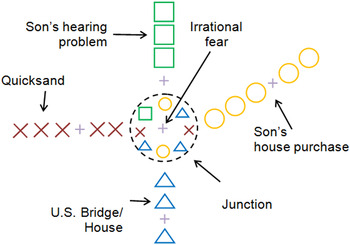



Target article
Such stuff as dreams are made on? Elaborative encoding, the ancient art of memory, and the hippocampus
Related commentaries (28)
A hippocampal indexing model of memory retrieval based on state trajectory reconstruction
A three-legged stool needs a stronger third leg
Beware of being captured by an analogy: Dreams are like many things
Composition and replay of mnemonic sequences: The contributions of REM and slow-wave sleep to episodic memory
Dissociative symptoms and REM sleep
Don't count your chickens before they're hatched: Elaborative encoding in REM dreaming in face of the physiology of sleep stages
Dream and emotion regulation: Insight from the ancient art of memory
Dreaming is not controlled by hippocampal mechanisms
Dreams are made of memories, but maybe not for memory
Dreams, mnemonics, and tuning for criticality
Elaborative encoding during REM dreaming as prospective emotion regulation
From Freud to acetylcholine: Does the AAOM suffice to construct a dream?
Minding the dream self: Perspectives from the analysis of self-experience in dreams
Mnemonic expertise during wakefulness and sleep
Ontological significance of the dream world
REM sleep and dreaming functions beyond reductionism
REM sleep, hippocampus, and memory processing: Insights from functional neuroimaging studies
Some Renaissance, Baroque, and contemporary cultural elaborations of the art of memory
Studying the relationship between dreaming and sleep-dependent memory processes: Methodological challenges
Such stuff as NREM dreams are made on?
Such stuff as psychoses are made on?
The analogy between dreams and the ancient art of memory is tempting but superficial
The ancient art of memory
The method of loci (MoL) and memory consolidation: Dreaming is not MoL-like
The seahorse, the almond, and the night-mare: Elaborative encoding during sleep-paralysis hallucinations?
The secret is at the crossways: Hodotopic organization and nonlinear dynamics of brain neural networks
The spaces left over between REM sleep, dreaming, hippocampal formation, and episodic autobiographical memory
“They who dream by day”: Parallels between Openness to Experience and dreaming
Author response
Such stuff as REM and NREM dreams are made on? An elaboration