




No CrossRef data available.
Article contents
Elaborative encoding during REM dreaming as prospective emotion regulation
Published online by Cambridge University Press: 21 November 2013
Abstract
Rapid eye movement (REM) dreaming results in “emotionally intelligent encoding,” according to the target article. Building on this, we argue that elaborative encoding alters emotional processing of upcoming events and thereby functions as prospective emotion regulation. After elaborative encoding, future events are appraised differently and result in a redirected emotional response. Disturbed elaborative encoding might be relevant for emotional dysregulation in psychopathology.
Information
- Type
- Open Peer Commentary
- Information
- Copyright
- Copyright © Cambridge University Press 2013
References
Aldao, A., Nolen-Hoeksema, S. & Schweizer, S. (2010) Emotion-regulation strategies across psychopathology: A meta-analytic review. Clinical Psychology Review
30:217–37. doi:10.1016/j.cpr.2009.11.004.Google Scholar
Goldin, P. R., McRae, K., Ramel, W. & Gross, J. J. (2008) The neural bases of emotion regulation: Reappraisal and suppression of negative emotion. Biological Psychiatry
63:577–86. doi:10.1016/j.biopsych.2007.05.031.Google Scholar
Gross, J. J. (2001) Emotion regulation in adulthood: Timing is everything. Current Directions in Psychological Science
10:214–19. doi: 10.1111/1467-8721.00152.CrossRefGoogle Scholar
Koole, S. (2009) The psychology of emotion regulation: An integrative review. Cognition and Emotion
23:4–41. doi:10.1080/02699930802619031.CrossRefGoogle Scholar
Pace-Schott, E. F., Shepherd, E., Spencer, R. M. C., Marcello, M., Tucker, M., Propper, R. E. & Stickgold, R. (2011) Napping promotes inter-session habituation to emotional stimuli. Neurobiology of Learning and Memory
95:24–36. doi:10.1016/j.nlm.2010.10.006.CrossRefGoogle ScholarPubMed
Spoormaker, V. I., Schröter, M. S., Andrade, K. C., Dresler, M., Kiem, S. A., Goya-Maldonado, R., Wetter, T. C., Holsboer, F., Sämann, P. G. & Czisch, M. (2011) Effects of rapid eye movement sleep deprivation on fear extinction recall and prediction error signaling. Human Brain Mapping
5:1–15. doi:10.1002/hbm.21369.Google Scholar
Walker, B. M. P. (2009) REM, dreams and emotional brain homeostasis. Frontiers in Neuroscience
3:442–43.Google Scholar
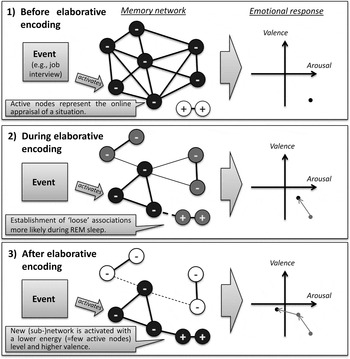
Figure 1. Illustration of the effects of elaborative encoding during rapid eye movement (REM) dreaming with its prospective emotion regulation impact on future events and their emotional responses. Nodes represent memory elements, and links between nodes represent associations. Nodes with a plus (minus) sign elicit “pleasant” (“unpleasant”) emotions. An event (left-hand side) is being appraised by activating memory network elements (center). This activation results in an emotional response that varies in valence and arousal (right-hand side). (1) Before elaborative encoding: The memory network has few clusters (divisions). Each node is linked with many local nodes. The activation (black) of any node is likely to coactivate other nodes. Distant memories are not linked to the local network and are inactive (white). (2) During elaborative encoding: The memory network is being elaboratively encoded during REM dreaming. Distant memories with potential incongruent valences are actively associated (hyperassociation during REM). Distinct memory clusters (divisions) emerge. Some links vanish. (3) After elaborative encoding: The memory network is now elaboratively encoded. Several distinct clusters have emerged. The activation of a node is likely to coactivate only a subset of related nodes. Less activation is expected to result in less arousal. The emotional response is likely to be redirected during future events.
The target article addresses elaborative memory encoding during rapid eye movement (REM) dreaming by integrating findings from different fields. Despite its focus on memory, the article relies extensively on concepts and findings from emotion research. Specifically, Llewellyn proposes that memory elements are being “emotionally tagged” (sect. 2, para. 9) and memory associations are being “emotionally charged” (sect. 2, para. 10; sect. 8, para. 4) during REM dreaming by using limbic structures such as the amygdala, thereby resulting in “emotionally intelligent elaborative encoding” (sect. 4.2.2, para. 5). However, emotionally intelligent encoding is not clearly defined in the target article. We propose that elaborative encoding during REM dreaming also supports emotional processing of future events (in an emotionally intelligent way). Thus, we argue that the encoding process during REM dreaming also functions as prospective emotion regulation. This hypothesis complements the common view that REM-sleep dreaming decreases or processes residual emotional load from the day before (e.g., Walker Reference Walker2009). Instead, REM dreaming is expected to prevent the accumulation of emotional load during the next day(s).
Emotion regulation during waking consciousness is defined as “a set of processes whereby people seek to redirect the spontaneous flow of their emotions” (Koole Reference Koole2009, p. 6). Correspondingly, we define emotion regulation during REM dreaming as set of processes whereby the spontaneous flow of emotions is redirected. The idea that active emotion regulation occurs during sleep and particularly REM sleep is not new. For example, an afternoon nap increases habituation to arousing stimuli (Pace-Schott et al. Reference Pace-Schott, Shepherd, Spencer, Marcello, Tucker, Propper and Stickgold2011) and REM sleep deprivation disturbs consolidation of fear extinction (Spoormaker et al. Reference Spoormaker, Schröter, Andrade, Dresler, Kiem, Goya-Maldonado, Wetter, Holsboer, Sämann and Czisch2011). However, prospective emotion regulation in the sleeping brain has not been considered.
The most extensively studied emotion regulation strategy that directly impacts future appraisals of events is named cognitive reappraisal. Reappraisal involves changing the appraisal process within a situation in order to modify the subsequent emotional response (Gross Reference Gross2001). For example, the reappraisal of a job interview as an opportunity to get to know potential, agreeable colleagues is likely to increase curiosity and decrease anxiety in the interview situation. Reappraisal is effective in reducing negative emotions, and habitual reappraisal is positively related to mental health (Aldao et al. Reference Aldao, Nolen-Hoeksema and Schweizer2010; Goldin et al. Reference Goldin, McRae, Ramel and Gross2008). However, reappraisal is a conscious process that is unlikely in the sleeping brain. How might prospective emotion regulation be implemented during sleep?
In our view, the target article provides a framework to conceptualize prospective emotion regulation during REM dreaming. Elaborative encoding during REM dreaming modifies memory networks and therefore affects the appraisal of upcoming events. We expect that new appraisals result in altered and potentially more adaptive (or “intelligent”) emotional responses. Our working model of the interaction of elaborative encoding and prospective emotion regulation during REM dreaming is presented in Figure 1.
Illustration of the effects of elaborative encoding during rapid eye movement (REM) dreaming with its prospective emotion regulation impact on future events and their emotional responses. Nodes represent memory elements, and links between nodes represent associations. Nodes with a plus (minus) sign elicit “pleasant” (“unpleasant”) emotions. An event (left-hand side) is being appraised by activating memory network elements (center). This activation results in an emotional response that varies in valence and arousal (right-hand side). (1) Before elaborative encoding: The memory network has few clusters (divisions). Each node is linked with many local nodes. The activation (black) of any node is likely to coactivate other nodes. Distant memories are not linked to the local network and are inactive (white). (2) During elaborative encoding: The memory network is being elaboratively encoded during REM dreaming. Distant memories with potential incongruent valences are actively associated (hyperassociation during REM). Distinct memory clusters (divisions) emerge. Some links vanish. (3) After elaborative encoding: The memory network is now elaboratively encoded. Several distinct clusters have emerged. The activation of a node is likely to coactivate only a subset of related nodes. Less activation is expected to result in less arousal. The emotional response is likely to be redirected during future events.
After successful elaborative encoding during REM dreaming, events will be appraised differently. Occasionally, however, elaborative encoding might be interrupted or might fail. In these cases, prospective emotion regulation is disturbed. Consequently, emotional load accumulates over the next day and thus demands more intentional and effortful emotion regulation attempts.
In sum, we argue that REM dreaming is able to redirect the flow of future emotions by elaboratively encoding novel events into existing memory networks, resulting in prospective emotion regulation. Next-day emotion dysregulation might be partially explainable by interrupted (clinical insomnia, experimental sleep deprivation) or disturbed REM dreaming (psychiatric disorders such as posttraumatic stress or depressive disorder). If research corroborates the prospective emotion regulation function of REM dreaming, its investigation in the context of psychopathology might provide valuable insights.