







No CrossRef data available.
Article contents
Slowing life history (K) can account for increasing micro-innovation rates and GDP growth, but not macro-innovation rates, which declined following the end of the Industrial Revolution
Published online by Cambridge University Press: 20 November 2019
Abstract
Baumard proposes that life history slowing in populations over time is the principal driver of innovation rates. We show that this is only true of micro-innovation rates, which reflect cognitive and economic specialization as an adaptation to high population density, and not macro-innovation rates, which relate more to a population's level of general intelligence.
Information
- Type
- Open Peer Commentary
- Information
- Copyright
- Copyright © Cambridge University Press 2019
References
Figueredo, A. J., Cabeza de Baca, T., Fernandes, H. B. F., Black, C. J., Peñaherrera-Aguirre, M., Hertler, S., Garcia, R. A., Meisenberg, G. & Woodley of Menie, M. A. (2017) A sequential canonical cascade model of social biogeography: Plants, parasites, and people. Evolutionary Psychological Science 1:40–61.Google Scholar
Figueredo, A. J., Peñaherrera-Aguirre, M., Fernandes, H. B. F., Lomayesva, S. L., Woodley of Menie, M. A., Hertler, S. C., Sarraf, M. A. (2019) War and peace: A diachronic social biogeography of life history strategy and between-group relations in two Western European populations. Journal of Methods and Measurement in the Social Sciences 10(1):36–75.Google Scholar
Fogel, R. W. (1964) Railroads and American economic growth: Essays in econometric history. Johns Hopkins Press.Google Scholar
Hertler, S. C., Figueredo, A. J., Peñaherrera-Aguirre, M., Fernandes, H. B. F. & Woodley of Menie, M. A. (2018) Life history evolution: A biological meta-theory for the social sciences. Palgrave Macmillan.Google Scholar
Huebner, J. (2005) A possible declining trend for worldwide innovation. Technological Forecasting and Social Change 72:980–86.Google Scholar
Inglehart, R. & Welzel, C. (2005) Modernization, cultural change, and democracy: The human development sequence. Cambridge University Press.Google Scholar
Pietschnig, J. & Voracek, M. (2015) One century of global IQ gains: A formal meta-analysis of the Flynn effect (1909–2013). Perspectives on Psychological Science 10:282–306.Google Scholar
Reeve, C. L., Heeney, M. D. & Woodley of Menie, M.A. (2018) A systematic review of the state of the literature relating parental general cognitive ability and number of offspring. Personality and Individual Differences 134:107–18.Google Scholar
Rindermann, H. & Becker, D. (2018) FLynn-effect and economic growth: Do national increases in intelligence lead to increases in GDP? Intelligence 69:87–93.Google Scholar
Sarraf, M. (2017) Review of historical variability in heritable general intelligence: Its evolutionary origins and socio-cultural consequences. Personality and Individual Differences 109:238–41.Google Scholar
Woodley, M. A. (2012) The social and scientific temporal correlates of genotypic intelligence and the Flynn effect. Intelligence 40:189–204.Google Scholar
Woodley, M. A., Figueredo, A. J., Ross, K. C. & Brown, S. D. (2013) Four successful tests of the cognitive differentiation-integration effort hypothesis. Intelligence 41:832–42.Google Scholar
Woodley of Menie, M. A., Cabeza de Baca, T., Fernandes, H. B. F., Madison, G. & Figueredo, A. J. (2017a) Slow and steady wins the race: K positively predicts fertility in the USA and Sweden. Evolutionary Psychological Science 3:109–17.Google Scholar
Woodley of Menie, M. A., Figueredo, A. J., Sarraf, M. A., Hertler, S. C., Fernandes, H. B. F. & Peñaherrera-Aguirre, M. (2017b) The rhythm of the west: A biohistory of the modern era AD 1600 to the present. Journal of Social Political and Economic Studies, Monograph Series, No. 37. Scott Townsend Press.Google Scholar
Woodley of Menie, M. A. & Madison, G. (2015) The association between g and K in a sample of 4246 Swedish twins: A behavior genetic analysis. Personality and Individual Differences 75:80–84.Google Scholar
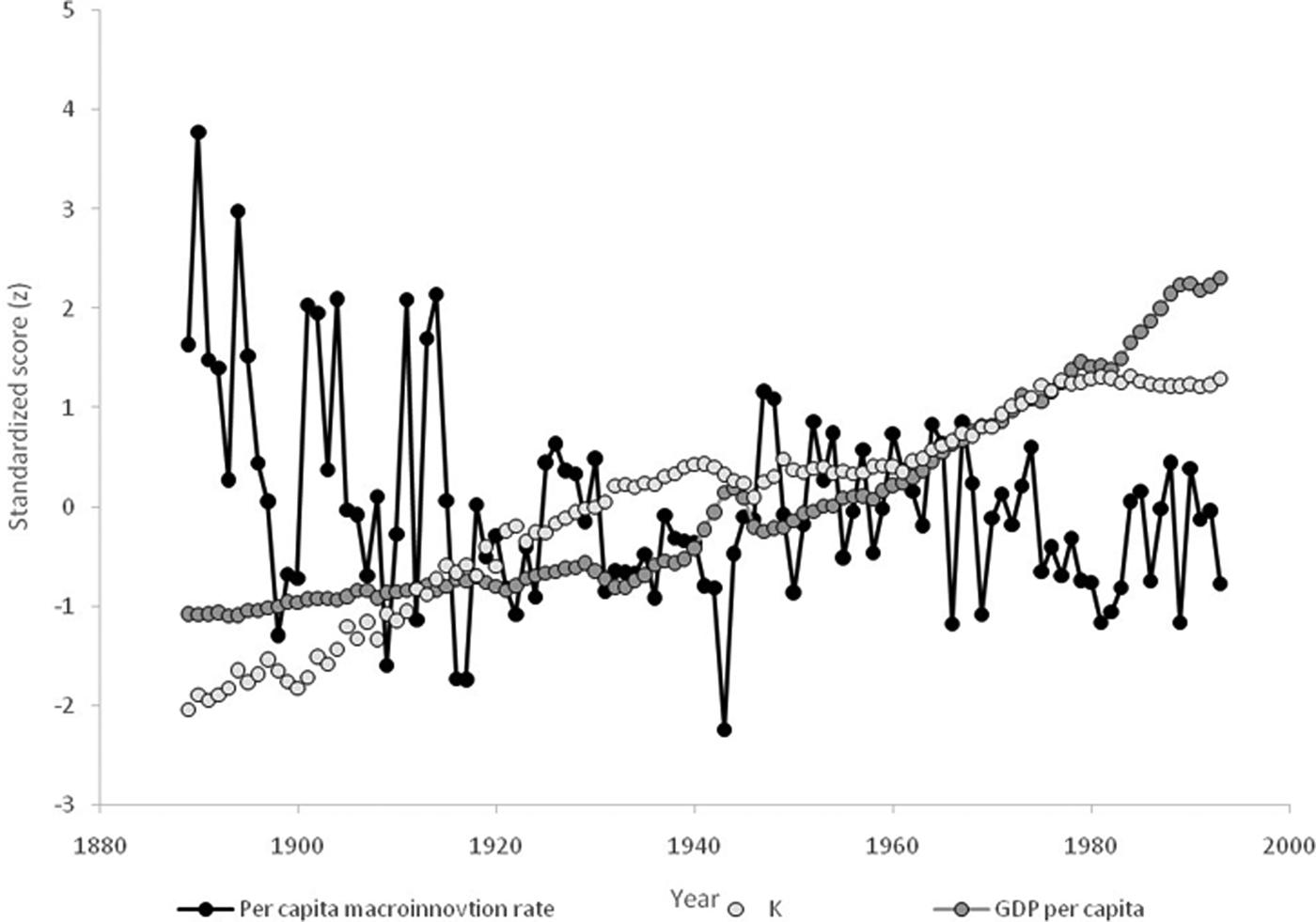
Figure 1. Temporal trends in per capita macro-innovation rates and GDP per capita, as well as a K-factor, sourced primarily from the United States and United Kingdom populations, spanning the years 1889 to 1993.
Target article
Related commentaries (24)
A needed amendment that explains too much and resolves little
Are both necessity and opportunity the mothers of innovations?
England first, America second: The ecological predictors of life history and innovation
There is little evidence that the Industrial Revolution was caused by a preference shift
Using big data to map the relationship between time perspectives and economic outputs
Data indicate that certain aspects of life history (K) have been historically slowing in Western populations, as Baumard observes – a trend that continues to the present. This process results from a combination of persistent genetic selection favoring those with higher levels of K (Woodley of Menie et al. Reference Woodley of Menie, Cabeza de Baca, Fernandes, Madison and Figueredo2017a) and epigenetic changes stemming from reduced levels of environmental risk (Mace Reference Mace1999). Previous work has investigated the role of secular life history slowing in the modernization sequence and concomitant sociological and economic trends (Figueredo et al. Reference Figueredo, Cabeza de Baca, Fernandes, Black, Peñaherrera-Aguirre, Hertler, Garcia, Meisenberg and Woodley of Menie2017; Hertler et al. Reference Hertler, Figueredo, Peñaherrera-Aguirre, Fernandes and Woodley of Menie2018; Woodley of Menie et al. Reference Woodley of Menie, Figueredo, Sarraf, Hertler, Fernandes and Peñaherrera-Aguirre2017b). Understanding how increasing K in industrialized populations relates to changing rates of innovation requires drawing a distinction between macro-innovation and micro-innovation, however. The former pertains to foundational developments in major domains of human accomplishment (such as science, medicine, and engineering) that multiple historians convergently rate as prominent (e.g., the development of the plough or nuclear fission technology), whereas the latter pertains to incremental developments and refinements of macro-innovations (e.g., new versions of smart phones) (Huebner Reference Huebner2005; Woodley Reference Woodley2012).
Prior research has found that increasing K likely drives micro-innovation, as K predicts the ability to invest resources into the cultivation of narrow cognitive abilities – potentially allowing individuals to specialize economically with respect to the development of facets of macro-innovations (Woodley et al. Reference Woodley, Figueredo, Ross and Brown2013). K has been shown to also be predictive of economic growth, both directly and indirectly, as more economic specialization in response to increased population density and concomitant microinnovative capacity among the workforce translates into greater national comparative advantage, as indicated by several major indicators of macroeconomic diversification in employment, production, and exports (Figueredo et al. Reference Figueredo, Cabeza de Baca, Fernandes, Black, Peñaherrera-Aguirre, Hertler, Garcia, Meisenberg and Woodley of Menie2017). Rising K has furthermore been identified as a basis of the Flynn effect or the secular increase in performance on certain IQ measures over time (Pietschnig & Voracek Reference Pietschnig and Voracek2015; Woodley Reference Woodley2012), and this effect has in turn been identified as a driver of economic growth (Pietschnig & Voracek Reference Pietschnig and Voracek2015; Rindermann & Becker Reference Rindermann and Becker2018; Woodley Reference Woodley2012). Across time, K may be independent of macro-innovation rates, which are dependent instead upon a population's level of general intelligence (g) – the ability to solve complex abstract and evolutionarily novel problems (Woodley of Menie et al. Reference Woodley of Menie, Figueredo, Sarraf, Hertler, Fernandes and Peñaherrera-Aguirre2017b). IQ is heterogeneous, and the Flynn effect involves gains on only specialized and narrow cognitive abilities; conversely, measures that track temporal trends in simple endophenotypes of g (such as simple reaction time and working memory), or highly heritable proxies (such as patterns of vocabulary usage), reveal the opposite pattern, that is, long-term decline (Sarraf Reference Sarraf2017; Woodley of Menie et al. Reference Woodley of Menie, Figueredo, Sarraf, Hertler, Fernandes and Peñaherrera-Aguirre2017b).
Among individuals within Western populations, there are only weak correlations between g and K measured using psychometric instruments, indicating that they relate to largely distinct neurological systems (Woodley of Menie & Madison Reference Woodley of Menie and Madison2015). This is further evidenced by the observation that in modernized Western populations, as was mentioned, K is under positive directional selection (Woodley of Menie et al. Reference Woodley of Menie, Figueredo, Sarraf, Hertler, Fernandes and Peñaherrera-Aguirre2017b), whereas in those same populations, g is under negative directional selection (hence the long-term decline; Reeve et al. Reference Reeve, Heeney and Woodley of Menie2018). The opposing phenotypic trajectories (rising K and decreasing g) can hence account for the rise in micro-innovation rates (as tracked by rising GDP per capita) and the decline in macro-innovation rates following the end of industrialization in Western nations. Consistent with this possibility, robust temporal correlations have been established between multiple convergent indicators of declining g and macro-innovation rates in the United States and United Kingdom across the nineteenth and twentieth centuries (Woodley of Menie et al. Reference Woodley of Menie, Figueredo, Sarraf, Hertler, Fernandes and Peñaherrera-Aguirre2017b). But the temporal association between K and micro-innovation rates is less well established. Here we examine this association using temporal correlations involving a latent chronometric K-factor composed of convergent trends in the utilization frequencies of both low- and high-K indicating vocabulary items tracked using Google Ngram Viewer; life expectancy, infant mortality, and total fertility rates (from Figueredo et al. Reference Figueredo, Peñaherrera-Aguirre, Fernandes, Lomayesva, Woodley of Menie, Hertler and Sarraf2019); and a measure of per capita macro-innovation rates and GDP per capita (from Woodley of Menie et al. Reference Woodley of Menie, Figueredo, Sarraf, Hertler, Fernandes and Peñaherrera-Aguirre2017b), predominantly sampled from the United States and United Kingdom, covering 104 years (1889–1993).
Consistent with expectations, there is a high-magnitude temporal correlation between K and GDP per capita in the United States and United Kingdom (r = .85, 95% confidence interval [CI] = .79–.90). A modest-magnitude negative temporal correlation between K and per capita macro-innovation rates is also present (r = –.39, 95% CI = –.54 to –.21), consistent with the expectation that macro-innovation rates are not driven by changes in levels of K, but by changes in other population-level parameters (such as average g, which is declining throughout this period; Woodley of Menie et al. Reference Woodley of Menie, Figueredo, Sarraf, Hertler, Fernandes and Peñaherrera-Aguirre2017b). GDP per capita and macro-innovation rates are weakly negatively correlated (r = –.24, 95% CI = –.41 to –.05). That these trends are largely independent of one another is consistent with Fogel's (Reference Fogel1964) observation that macro-innovations (such as the development of railway) did not add much value to the economy of the United States in and of themselves, with most of the value deriving from novel refinements and applications (micro-innovations) of these technologies (i.e., improvements in track manufacturing techniques, emplacement of new railway tracks).
Temporal trends in per capita macro-innovation rates and GDP per capita, as well as a K-factor, sourced primarily from the United States and United Kingdom populations, spanning the years 1889 to 1993.
These results highlight the pitfalls of failing to distinguish between macro-innovation and micro-innovation in models of modernization and should help to enhance the precision of Baumard's argument, by connecting it to prior relevant theoretical and empirical research in this area (e.g., Woodley of Menie et al. Reference Woodley of Menie, Figueredo, Sarraf, Hertler, Fernandes and Peñaherrera-Aguirre2017b, in which an alternative life history theoretic model of modernization is refined and tested). These empirical findings also allow for additional claims of Baumard's to be tested. For example, inasmuch as postmaterialistic values started to rise primarily in the “post-industrial” era of the West (Inglehart & Welzel Reference Inglehart and Welzel2005), and insofar as this trend may be connected to rising K, it is unlikely that these values globally benefit innovation rates, in that their relevant effects, if there are any, seem to be restricted to micro-innovation.