






No CrossRef data available.
Article contents
England first, America second: The ecological predictors of life history and innovation
Published online by Cambridge University Press: 20 November 2019
Abstract
We present data from 122 nations showing that Baumard's argument on the ecological predictors of life history strategies and innovation is incomplete. Our analyses indicate that wealth, parasite stress, and cold climate impose orthogonal effects on life histories, innovation, and industrialization. Baumard also overlooks the historical exploitation of other nations which significantly enlarged the “pooled energy budget” available to England.
Information
- Type
- Open Peer Commentary
- Information
- Copyright
- Copyright © Cambridge University Press 2019
Footnotes
Owing to project management and printer's errors, there were a number of mistakes in the original online version of this commentary. The funding information was incorrect; there were errors in Table 2 of the commentary; and two references were omitted, resulting in further errors to in-text reference citations. These errors have been corrected here and an erratum has beenpublished.
References
Barbaro, N. & Shackelford, T. K. (2017) Dimensions of environmental risk are unique theoretical constructs. Behavioral and Brain Sciences 40:12–13.Google Scholar
de Dreu, C. K. & van Dijk, M. A. (2018) Climatic shocks associate with innovation in science and technology. PloS One 13(1):e0190122.Google Scholar
de Pleijt, A. (2018) Human capital formation in the long run: Evidence from average years of schooling in England, 1300–1900. Cliometrica 12(1):99–126. Available at: https://doi.org/10.1007/s11698-016-0156-3.Google Scholar
de Zwart, P. & van Zanden, J. L. (2018) The origins of globalization: World trade in the making of the global economy, 1500–1800. Cambridge University Press.Google Scholar
Dutta, S., Lanvin, B. & Wunsch-Vincent, S., eds. (2018) The global innovation index 2018: Energizing the world with innovation, 11th edition. World Intellectual Property Organization.Google Scholar
European Commission (2018) Distance calculator. Available at: http://ec.europa.eu/dgs/education_culture/tools/distance_en.htm. Retrieved January 1, 2018.Google Scholar
Fincher, C. L. & Thornhill, R. (2012) Parasite-stress promotes in-group assortative sociality: The cases of strong family ties and heightened religiosity. Behavioral and Brain Sciences 35(2):61–79.Google Scholar
Foreman-Peck, J. & Zhou, P. (2018) Late marriage as a contributor to the industrial revolution in England. The Economic History Review 71(4):1073–99. Available at: https://doi.org/10.1111/ehr.12651.Google Scholar
Kramer, K. L. & Ellison, P. T. (2010) Pooled energy budgets: Resituating human energy allocation trade-offs. Evolutionary Anthropology: Issues, News, and Reviews 19:136–47.Google Scholar
Krams, I., Luoto, S., Rubika, A., Krama, T., Elferts, D., Kecko, S., Skrinda, I., Moore, F., Krams, R. & Rantala, M. J. (2019) A head start for life history development? Family income mediates associations between body height and immune response in men. American Journal of Physical Anthropology 168(3):421–27.Google Scholar
Luoto, S. (2019a) An updated theoretical framework for human sexual selection: From ecology, genetics, and life history to extended phenotypes. Adaptive Human Behavior and Physiology 5(1):48–102. Available at: https://doi.org/10.1007/s40750-018-0103-6.Google Scholar
Luoto, S. (2019b) Response to commentaries: Life history genetics, fluid intelligence, and extended phenotypes. Adaptive Human Behavior and Physiology. 5(1):112–15. https://doi.org/10.1007/s40750-019-0109-8.Google Scholar
Luoto, S., Krams, I. & Rantala, M. J. (2019a) A life history approach to the female sexual orientation spectrum: Evolution, development, causal mechanisms, and health. Archives of Sexual Behavior 48(5):1273–308. Available at: https://doi.org/10.1007/s10508-018-1261-0.Google Scholar
Luoto, S., Krams, I. & Rantala, M. J. (2019b) Response to commentaries: Life history evolution, causal mechanisms, and female sexual orientation. Archives of Sexual Behavior 48(5):1335–47. https://doi.org/10.1007/s10508-019-1439-0.Google Scholar
Lynn, R. (2012) IQs predict differences in the technological development of nations from 1000 BC through 2000 AD. Intelligence 40(5):439–44.Google Scholar
Orosz, G., Zimbardo, P. G., Boőthe, B. & Tóth-Király, I. (2017) The paradoxical effect of climate on time perspective considering resource accumulation. Behavioral and Brain Sciences 40:e92.Google Scholar
The Atlas of Economic Complexity (2017) Country complexity rankings. Internet database. Available at: http://atlas.cid.harvard.edu/rankings/. Retrieved December 6, 2017.Google Scholar
UN Statistics Division (2017) World Development Indicators 2014. Internet database. Available at: http://data.un.org/Default.aspx. Retrieved December 20, 2017.Google Scholar
Van de Vliert, E. (2013) White, gray, and black domains of cultural adaptations to climato-economic conditions. Behavioral and Brain Sciences 36(5):503–21. Available at: http://doi.org/10.1017/S0140525X13000277.Google Scholar
Van de Vliert, E. & Murray, D. R. (2018) Climate and creativity: Cold and heat trigger invention and innovation in richer populations. Creativity Research Journal 30 (1):17–28. Available at: http://doi.org/10.1080/10400419.2018.1411571.Google Scholar

Table 1. (Luoto et al.) Materials and sources
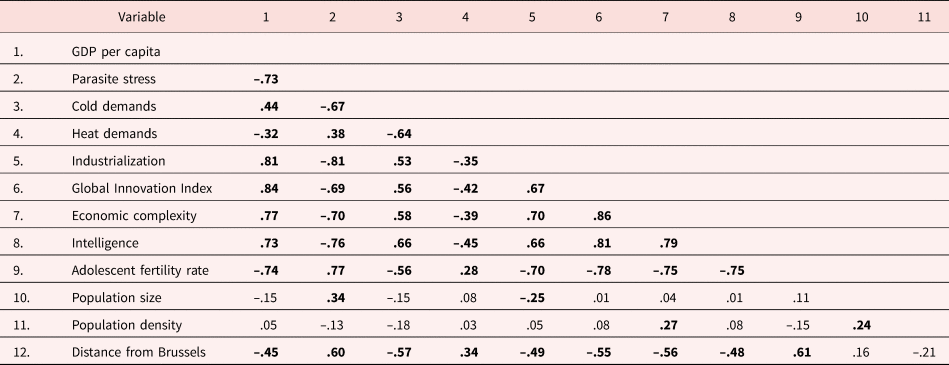
Table 2. (Luoto et al.) Correlations among variables

Table 3. (Luoto et al.) Multiple linear regression models without control variablesa

Table 4. (Luoto et al.) Multiple linear regression models with three control variablesa
A correction has been issued for this article:
Target article
Related commentaries (24)
A needed amendment that explains too much and resolves little
Are both necessity and opportunity the mothers of innovations?
England first, America second: The ecological predictors of life history and innovation
There is little evidence that the Industrial Revolution was caused by a preference shift
Using big data to map the relationship between time perspectives and economic outputs
Baumard provides an intriguing application of Life History Theory by analyzing a major economic transition in world history. Despite the merits of his model, it is deficient in several important ways. Materials and sources used in our analyses are listed in Table 1.
(Luoto et al.) Materials and sources
a Natural logarithm transformed because of high skew.
b Parasite stress data were collected from Fincher and Thornhill (Reference Fincher and Thornhill2012), who used the World Health Organization (WHO) variable Infectious Disease DALY for the year 2002 to collate a variable called combined parasite stress.
c Atmospheric cold demands are coded as the sum of the absolute downward deviations from 22°C for the average lowest temperature in the coldest month, the average highest temperature in the coldest month, the average lowest temperature in the hottest month, and the average highest temperature in the hottest month (Van de Vliert Reference Van de Vliert2013).
d Atmospheric heat demands are the sum of the absolute upward deviations from 22°C for the average lowest temperature in the coldest month, the average highest temperature in the coldest month, the average lowest temperature in the hottest month, and the average highest temperature in the hottest month (Van de Vliert Reference Van de Vliert2013).
e A factor score that represents the extent to which countries are engaged in industrial and service activities versus the agrarian sector (agriculture, fishing, and hunting).
f The relevant time frame of the data is unspecified in the source material.
g Births per 1,000 women aged 15–19.
Pooled energy budget
Baumard points out the increased wealth in England compared with rival nations, causally modelling this in Figure 2 through gradual technological accumulation. The “gilt elephant in the room” overlooked by Baumard is of course England's colonial history and slave trade (de Zwart & van Zanden Reference de Zwart and van Zanden2018). The concept of “pooled energy budget” (Kramer & Ellison Reference Kramer and Ellison2010; Krams et al. Reference Krams, Luoto, Rubika, Krama, Elferts, Kecko, Skrinda, Moore, Krams and Rantala2019) is useful for modelling English wealth and the nation's life history transition documented by Baumard. By exploiting the natural and human resources of other nations, by drawing energy from the resources and labour of other peoples, the English were able to substantially increase the pooled energy budget available to their own people. An important factor that sets England apart from other colonial powers is that its American colonies had a substantial production capacity and unprecedented population growth. Most material goods to fuel this growth were imported from England. This meant that England, which monopolized trade across the Atlantic, was able to pool a large amount of resources from its American colonies (de Zwart & van Zanden Reference de Zwart and van Zanden2018).
We argue that any life history model that seeks to explain the Industrial Revolution needs to account for this enlarged pool of energy that correspondingly disadvantaged other populations (such as native Americans and Africans, through genocide and slave trade). An increased energy budget can explain individual- and population-level variation in central life history parameters, including marital and reproductive timing, investment in human capital formation, and immune function (de Pleijt Reference de Pleijt2018; Foreman-Peck & Zhou Reference Foreman-Peck and Zhou2018; Krams et al. Reference Krams, Luoto, Rubika, Krama, Elferts, Kecko, Skrinda, Moore, Krams and Rantala2019; Luoto Reference Luoto2019a). It is not sufficient to argue that “gradual technological accumulation” led to the higher pooled energy budget available for the English prior to the Industrial Revolution: it is also important to acknowledge the exploitation of other nations in that causal process.
Different kinds of environmental harshness impose unique influences on innovation, life histories, and industrialization
A further problem in Baumard's article is the myopic discussion of environmental harshness that overlooks the important selective role of climate on human behaviour. In short, Baumard argues that harsh environments favour fast life histories while in stable, predictable environments people can invest in the future, thus developing slower life histories. Baumard's model oversimplifies predictions that arise from life history accounts of human behaviour and innovation. It neglects the important influence that climate has on time orientation, life history strategies, innovative capacity, and economic development (Luoto Reference Luoto2019a; Reference Luoto2019b; Orosz et al. Reference Orosz, Zimbardo, Boőthe and Tóth-Király2017).
Cold environments may impose selection pressures on organisms to invest in long-term orientation and cultural innovations (Luoto Reference Luoto2019a; Reference Luoto2019b, and references therein). Accordingly, the associations between atmospheric cold demands and various measures of innovation and industrialization are uniformly positive, strong, and significant (Table 2). Cold climate significantly predicts variation in innovation, economic complexity, and intelligence even when Gross Domestic Product (GDP) per capita, parasite stress, and heat demands are simultaneously entered into statistical models predicting innovation (Table 3). These effects remain significant when controlling for population size, population density, and distance from Central Europe (Table 4; see Luoto Reference Luoto2019a, for a rationale for using these controls). Importantly, cold climates may also select for slower life history strategies (Luoto Reference Luoto2019a; Reference Luoto2019b), as suggested by the significant negative correlation between cold demands and adolescent fertility (r = –.56, Table 2). These findings provide additional support for a theoretical framework that links cold climate with psychological dispositions and behaviours related to slow life history strategies and innovation (Luoto Reference Luoto2019a; Reference Luoto2019b).
(Luoto et al.) Correlations among variables
(Luoto et al.) Multiple linear regression models without control variables a
a Standardized coefficients of four independent variables (GDP per capita, parasite stress, cold demands, heat demands) on five dependent variables (industrialization, innovation, economic complexity, intelligence, adolescent fertility). No control variables introduced in the model. For coefficients in boldface, p < .01.
(Luoto et al.) Multiple linear regression models with three control variables a
a Standardized coefficients of four independent variables (GDP per capita, parasite stress, cold demands, heat demands) on five dependent variables (industrialization, innovation, economic complexity, intelligence, adolescent fertility) when controlling for population size, population density, and distance from Central Europe. For coefficients in boldface, p < .01.
It is noteworthy that heat demands impose less influence than cold demands on industrialization and innovation (Tables 2–4). Although cold climate significantly predicts increases in industrialization, innovation, and intelligence, heat demands and parasite stress are negatively associated with these variables (Table 2; see also Van de Vliert & Murray Reference Van de Vliert and Murray2018). These findings show that not all types of environmental harshness have similar effects on innovation and economic development. Cold demands impose selection pressures that are qualitatively different from those imposed by heat demands, parasite stress, and morbidity-mortality (Barbaro & Shackelford Reference Barbaro and Shackelford2017; Van de Vliert & Murray Reference Van de Vliert and Murray2018). Baumard's generalization that all harshness has similar effects on life history strategies is inconsistent with existing theory and findings.
We point out these findings, not because we think they necessarily explain the specific life history transition that Baumard describes in England, but because Baumard's argument is inconsistent with what is known about the influence of climate on human psychological and behavioural dispositions. We agree with Baumard that the two mechanisms of natural selection and adaptive plasticity do not work at the same time scale, and that adaptive plasticity may be more suitable for explaining the specific instance of the Industrial Revolution. However, when viewed globally, and with recourse to deeper evolutionary time, adaptive plasticity explains innovation and economic development only partially (Luoto Reference Luoto2019a; Reference Luoto2019b). Any model on life history, time orientation, and innovation is incomplete without taking into consideration the cross-culturally robust influence of cold demands on human psychological dispositions and behavioural outcomes.
Whether climate can explain the psychological origins of the Industrial Revolution is a more specific question. We do not think this is the case. Although cold periods predict longitudinal variation in innovation with moderate accuracy, the Industrial Revolution was not preceded by particularly severe cold periods (Fig. 1B in De Dreu & van Dijk Reference de Dreu and van Dijk2018). Cold demands may be a more significant factor in predicting global patterns of innovation and economic development (Luoto Reference Luoto, Krams and Rantala2019a; Reference Luoto, Krams and Rantala2019b) rather than explaining the specific tide of events that led to the Industrial Revolution.
Despite its shortcomings, there is much to commend in Baumard's model. Understanding the various pre- and postnatal factors that affect the calibration of life history strategies (Luoto et al. Reference Luoto, Krams and Rantala2019a; Reference Luoto, Krams and Rantala2019b) and the importance of the “pooled energy budget” that was accomplished through English exploitation of other nations’ natural and human resources will make Baumard's life history model biologically more compelling and historically more accurate.
Acknowledgments
This research was supported by the Emil Aaltonen Young Researcher Grant (S.L.), the Estonian Ministry of Education and Science (Grant PUT1223) (I.K.), and the Latvian Council of Science (Grant lzp-2018/1-0393) (I.K.).