






No CrossRef data available.
Article contents
Energy, transport, and consumption in the Industrial Revolution
Published online by Cambridge University Press: 20 November 2019
Abstract
We question Baumard's underlying assumption that humans have a propensity to innovate. Affordable transportation and energy underpinned the Industrial Revolution, making mass production/consumption possible. Although we cannot accept Baumard's thesis on the Industrial Revolution, it may help explain why complexity and innovation increase rapidly in the context of abundant energy.
Information
- Type
- Open Peer Commentary
- Information
- Copyright
- Copyright © Cambridge University Press 2019
References
Ambrose, S. H. (2001) Paleolithic technology and human evolution. Science 291:1748–53.Google Scholar
Broadberry, S., Campbell, B. M. S., Klein, A., Overton, M. & van Leeuwen, B. (2015) British economic growth, 1270–1870. Cambridge University Press.Google Scholar
Chayanov, A. V. (1966) The theory of peasant economy, trans. Smith, R. E. F. & Lane, C.. Richard D. Irwin for the American Economic Association.Google Scholar
Fouquet, R. & Broadberry, S. (2015) Seven centuries of European economic growth and decline. The Journal of Economic Perspectives 29:227–44.Google Scholar
Hall, C. A. S. (2004) The continuing importance of maximum power. Ecological Modelling 178:107–13.Google Scholar
Jones, A. H. M. (1964) The later Roman Empire: A social, economic and administrative survey, pp. 284–602. University of Oklahoma Press.Google Scholar
Maddison Project (2013) The Maddison Project database 2013 version. Available at: http://www.ggdc.net/maddison/maddison-project/home.htm.Google Scholar
Rendell, L., Boyd, R., Cownden, D., Enquist, M., Eriksson, K., Feldman, M. W., Fogarty, L., Ghirlanda, S., Lillicarap, T. & Laland, K. N. (2010) Why copy others? Insights from the Social Learning Strategies Tournament. Science 328:208–13.Google Scholar
Tainter, J. A. & Patzek, T. W. (2012) Drilling down: The Gulf oil debacle and our energy dilemma. Copernicus Books.Google Scholar
Tainter, J. A., Strumsky, D., Taylor, T. G., Arnold, M. & Lobo, J. (2018) Depletion vs. innovation: The fundamental question of sustainability. In: Physical limits to economic growth: Perspectives of economic, social, and complexity science, ed. Burlando, R. & Tartaglia, A., pp. 65–93. Routledge.Google Scholar
Taylor, T. G. & Tainter, J. A. (2016) The nexus of population, energy, innovation, and complexity. American Journal of Economics and Sociology 75:1005–43.Google Scholar
Warde, P. (2007) Energy consumption in England and Wales, 1560–2000. Consiglio Nazionale Delle Ricerche, Istituto Di Studi Sulle Società del Mediterraneo.Google Scholar
Wrigley, E. A. (2010) Energy and the English industrial revolution. Cambridge University Press.Google Scholar
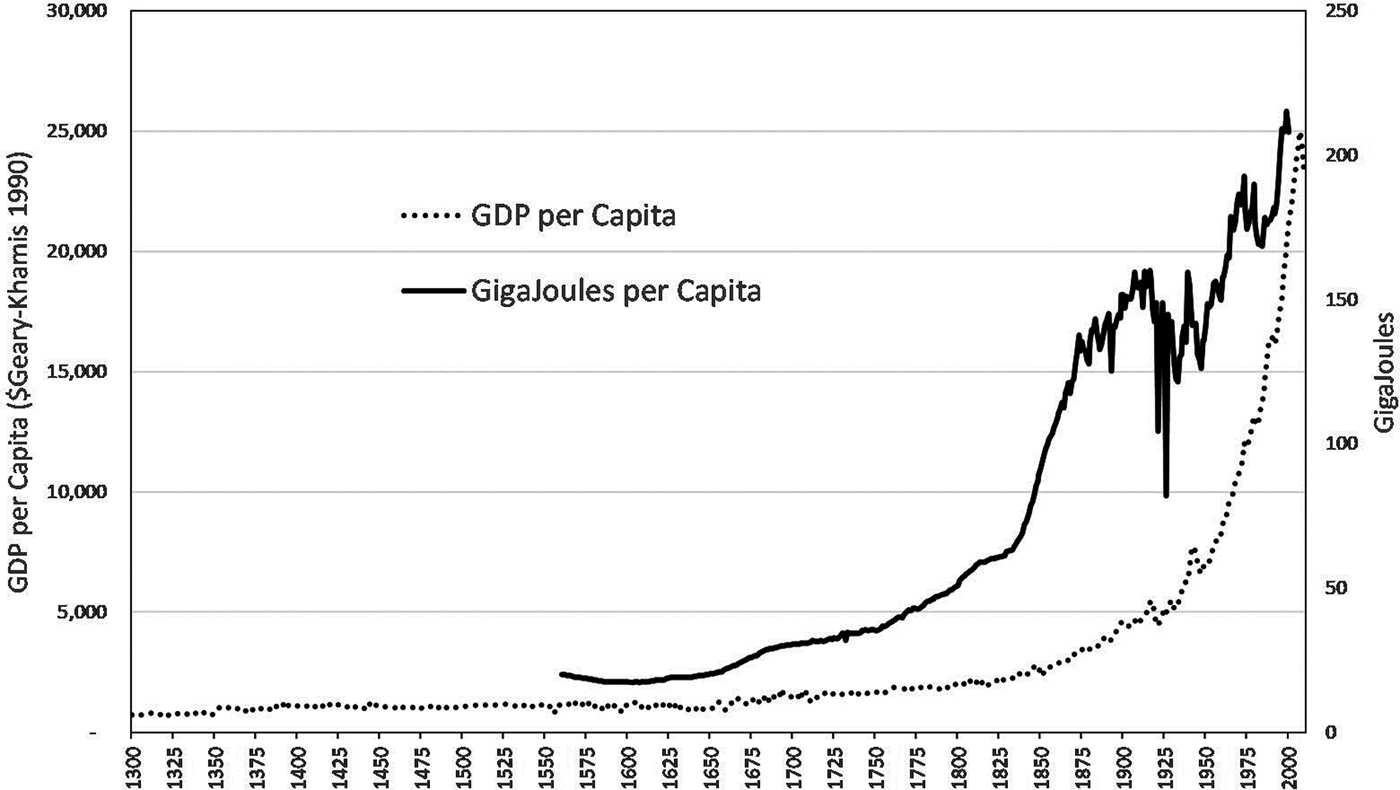
Figure 1. Abundant energy supplied by coal lifted the constraints of annual solar productivity, allowing rapid increases in complexity and innovation during the Industrial Revolution. (Data are from Broadberry et al. 2015; Fouquet & Broadberry 2015; Maddison Project 2013; Warde 2007.)
Target article
Related commentaries (24)
A needed amendment that explains too much and resolves little
Are both necessity and opportunity the mothers of innovations?
England first, America second: The ecological predictors of life history and innovation
There is little evidence that the Industrial Revolution was caused by a preference shift
Using big data to map the relationship between time perspectives and economic outputs
Baumard's conclusions are based on a specific view of history that should be made clear, and an assumption that remains implicit. The view is that the Industrial Revolution was the product of a historical accident, the fact that Britain was comparatively prosperous in the eighteenth century, leading members of the upper classes to innovate. Because this prosperity remains unexplained, and as the Industrial Revolution itself produced increasing prosperity, the thesis is unsatisfactory. We argue that Britain's prosperity derived from the rebound after the Black Death, followed by the transition to the coal-based economy.
Using Life History Theory (LHT), Baumard postulates that prosperity in eighteenth-century Britain unleashed innovation and, thus, the Industrial Revolution. Baumard's implicit assumption is that humans have an inherent propensity to innovate, and that we will do so when circumstances are favorable. One problem with this assumption is that it is conditioned by our circumstances today. Every member of an industrial society experiences frequent, institutionalized innovation, leading us to think that this is normal. Furthermore, we are socialized to value innovation, believing it to be something to which people aspire. In fact, innovation as we know it today is recent in human history. Our species, Homo sapiens, has a history of at least 300,000 years. Yet over these 300 millennia, systematic innovation is a phenomenon of only the past two centuries. Our ancestors in the Paleolithic experienced periods of tens of thousands of years with little technological change (Ambrose Reference Ambrose2001). That is, for periods of tens of thousands of years our ancestors did not innovate. Existing technologies were sufficient. Recent hunter-gatherers, such as the Kalahari San, work little to support themselves, and have been characterized as “the original affluent society” (Sahlins Reference Sahlins1972). LHT, as employed by Baumard, would suggest that such people should innovate. Yet they do not. In recent history there have been periods of hundreds to thousands of years with little technological change in many areas of life. Among recent peasant societies, the most prosperous households preferred leisure to extra work (leading to extra income) or to innovation (Chayanov Reference Chayanov, Smith and Lane1966). Recent research suggests that humans succeed best, not by innovating, but by copying (Rendell et al. Reference Rendell, Boyd, Cownden, Enquist, Eriksson, Feldman, Fogarty, Ghirlanda, Lillicarap and Laland2010). This history undercuts Baumard's thesis by illustrating that innovation is not an intrinsic human characteristic. Systematic innovation exists only in specific historical circumstances, including abundant energy and commercial competition (Tainter et al. Reference Tainter, Strumsky, Taylor, Arnold, Lobo, Burlando and Tartaglia2018).
Before the development of fossil fuels, the majority of humans were caught in a poverty trap, a self-reinforcing condition that keeps people in a condition of material want. In the past, part of the mechanism of the poverty trap was the cost of land transport. Data from the Roman period, with an economy similar to that of medieval Europe, illustrate the point. A wagon load of wheat would double in value with a land journey of only 480 km, a camel load, in 600 km. Transport by road was 28 to 56 times more costly than by sea. It cost less to ship grain from one end of the Mediterranean to the other than to cart it 120 km. The only goods that could profitably be transported long distances were luxury goods. The bulk of the population, existing on their own agricultural production, could not afford such goods (Jones Reference Jones1964, pp. 841–44). Similarly, in England, coal shipped over land doubled in price in a distance of 10 miles (Wrigley Reference Wrigley2010, p. 44). An industrial revolution can find sufficient customers, and lift living standards globally, only if people can access and afford its products. This was possible only with the development of canals and railroads (Smil Reference Smil1994, pp. 195–99; Wrigley Reference Wrigley2010, pp. 39, 44). Transport and energy were more fundamental to the Industrial Revolution than any propensity to innovate.
Was affluence necessarily a driver of the psychological and behavioral changes that led to high rates of innovation during the Industrial Revolution? Prior to the Industrial Revolution, several of the countries Baumard discusses experienced notable increases in affluence (Fouquet & Broadberry Reference Fouquet and Broadberry2015). The rise in Gross Domestic Product (GDP) per capita between 1300 and 1400 in Great Britain, The Netherlands, and Italy shown in Baumard's Figure 5 was a result of the Black Death, which left survivors with greater land and capital (Fouquet & Broadberry Reference Fouquet and Broadberry2015). In these cases, circumstances of affluence produced neither an industrial revolution nor high rates of innovation.
Humans have rarely had abundant energy. Prior to the use of coal, energy consumption was based mainly on annual solar productivity. Growth and change happen slowly in systems with such limited energy, and complexity emerges slowly. Abundant energy changes this. According to the Maximum Power Principle, excess energy in a system is quickly consumed, leading to growth, change, and/or accelerated processing of resources (Hall Reference Hall2004). When humans possess extra energy, as in the present era, it generates complexity (Tainter & Patzek Reference Tainter and Patzek2012). Innovation is one way complexity increases. While societies saw increases in affluence in earlier times, the difference in 1700s England was the availability of energy. We argue that the inexpensive and abundant energy supplied by the distribution and use of coal underpinned the material, societal, and psychological changes of the Industrial Revolution (Tainter et al. Reference Tainter, Strumsky, Taylor, Arnold, Lobo, Burlando and Tartaglia2018; Taylor & Tainter Reference Taylor and Tainter2016). Figure 1 charts the increasing GDP per capita of England and Wales alongside per capita energy consumption. High-quality, inexpensive energy created positive feedback cycles in innovation, population, agriculture, transportation, and urbanization (Wrigley Reference Wrigley2010), each requiring still more energy. Abundant energy was able to support the costs of this increasing complexity, including innovation. Although we cannot concur that Baumard has explained the origin of the Industrial Revolution, his application of LHT may help to clarify some of the growth in societal complexity of the past two centuries.
Abundant energy supplied by coal lifted the constraints of annual solar productivity, allowing rapid increases in complexity and innovation during the Industrial Revolution. (Data are from Broadberry et al. Reference Broadberry, Campbell, Klein, Overton and van Leeuwen2015; Fouquet & Broadberry Reference Fouquet and Broadberry2015; Maddison Project 2013; Warde Reference Warde2007.)