In providing an adaptive rationale for socioeconomic (SES) patterning of unhealthy behaviours, Pepper & Nettle (P&N) have made valuable steps towards a more enlightened approach to understanding the role of “lifestyle factors” in contributing to health inequalities. In explaining human behavioural responses to social deprivation, P&N focus most of their attention on one specific factor in shaping the evolution of adaptive behavioural responses: extrinsic mortality risk. However, they do explicitly state that their synthesis in principle should be generalizable to other factors that may shape evolutionary fitness. I take this opportunity to build on the sections of their work that go beyond the role of extrinsic mortality, focusing on the unique features of human fitness dynamics.
In the case of most animals, the question of why an organism might be selected to maintain investment in its body at a given age is a no-brainer: Stay alive and you may get to breed again and thereby pass on your genes. However, from such straightforward beginnings, the game of maximising long-term genetic representation is altered in humans – extensively, profoundly, and multidimensionally. The combination of advanced cognitive skills, a high degree of sociality, and cumulative culture means that the way that humans relate to their physical environments and to each other is unique. The resulting possibility of accumulation of different forms of “capital” creates new channels through which individuals can differ in their fitness prospects from one another. Schema for conceptualising these diverse capital forms are too numerous to discuss at length here (e.g., Bourdieu Reference Bourdieu and Richardson1986; Kaplan et al. Reference Kaplan, Lancaster and Robson2003). They may include physical possessions, land entitlement, technical skills, cognitive capacity, emotional resilience, social esteem, social contacts, and financial resources. Some of these forms of capital do exist in tangible physical form, but others are more abstract and are not subject to the same constraining laws of trade-offs and depreciation as somatic capital.
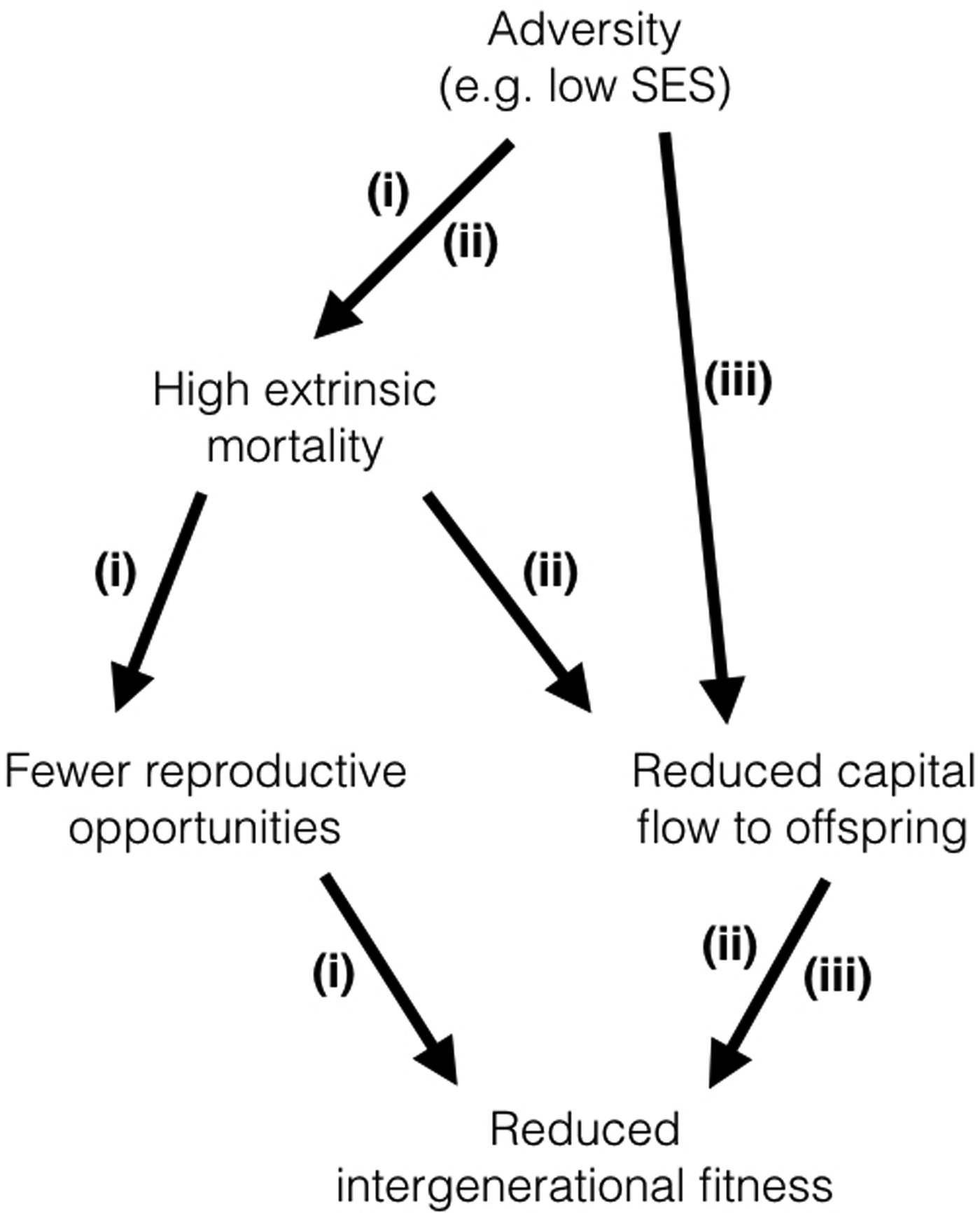
Inheritance of capital in these forms down the generations will have been central to human fitness dynamics, a matter that P&N touch upon in their mentions of educational investment. Those who are able to use their own capital to increase the capital held by their descendants will cause them to thrive, buffer them against environmental adversity, and ultimately enable them to multiply. In fact, selection for staying alive beyond the fifth decade (an ancestral feature of humans) can only have been entirely driven by intergenerational capital transfers from females, and this is probably mostly true for males also (Vinicius et al. Reference Vinicius, Mace and Migliano2014). Therefore, adaptive responses to adversity will be to a significant extent driven by the fact that the threat of reduced healthy years left to live not only decreases reproductive opportunities (Fig. 1, pathway i) but also decreases the opportunities to transmit capital down the generations to existing descendants (Fig. 1, pathway ii).
Figure 1.
Schematic showing three pathways through which adversity, such as low socioeconomic status, may reduce evolutionary fitness and to which behavioural adaptation may evolve.
Explicit acknowledgment of the separation of these pathways is pregnant with implication. A bigger question rears its head: Just how large a role does the reduced opportunity for intergenerational resource transfer play in shaping adaptive responses to adversity? (Fig. 1, pathway iii). P&N do allude to the role that social and financial capital limitation may play, but they do not consider the likely importance of such pathways relative to those that limit healthy life spans. In short, apparent evidence for adaptation to pathway i may also be evidence for adaptation to pathway iii as well as pathway ii.
A high degree of complexity in human fitness dynamics is engendered by the diverse forms of capital involved in these additional pathways and the various ways in which they can interact with one another. There are numerous opportunities for synergies and positive feedback processes operating within and between generations. Skills may be used to advance social positions. Possessions may be traded for favours. Parents may purchase education for their children. This complexity is likely to have been reflected in human adaptive evolution, specifically in cognitive processes that enable humans to adapt to the opportunities and constraints concomitant with possessing high or low levels of capital in the various currencies. Low SES individuals may lack capital in forms that high SES individuals take for granted (e.g., Mani et al. Reference Mani, Mullainathan, Shafir and Zhao2013) and behave in ways that are, once all is said and done, tractable and perhaps rational. This is likely a rich area for future research.
Caution must be applied when applying an adaptive framework to understanding the behavioural response to deprivation. For most of our evolutionary history, constraints on capital accumulation limited the extent to which individuals and lineages could deviate from one another in terms of status. The complexity of socially structured societies that have arisen since the dawn of agriculture has multiplied further still the ways by which individuals with means can advantage their descendants, leading to a dramatic increase in inequality (Borgerhoff Mulder et al. Reference Borgerhoff Mulder, Bowles, Hertz, Bell, Beise, Clark, Fazzio, Gurven, Hill, Hooper, Irons, Kaplan, Leonetti, Low, Marlowe, McElreath, Naidu, Nolin, Piraino, Quinlan, Schniter, Sear, Shenk, Smith, von Rueden and Wiessner2009). Adaptive evolution is unlikely to have had a chance to catch up with this specific development. Therefore, we must be alive to the prospect that individuals sometimes respond to inequality maladaptively or that adaptations may be achieved through general, rather than specific, cognitive processes.
Why does this matter? There are real implications of taking a broader approach to understanding human fitness dynamics that take the capacity for intergenerational resource transfer, in addition to intrinsic somatic health, to be central to adaptive behavioural processes. It is clear that many aspects of an individual's intrinsic capacity for healthy life are determined by early life processes beyond his or her control. Indeed, the capacity of policy makers to make a difference in the face of such tangible inequality, embodied as well as embedded, may be limited. What we might well call their capacity for “well-being,” on the other hand, is influenced by myriad different factors rooted in the social world and as a result may offer clues for routes of constructive intervention, with consequences for subsequent generations.





 You have
Access
In providing an adaptive rationale for socioeconomic (SES) patterning of unhealthy behaviours, Pepper & Nettle (P&N) have made valuable steps towards a more enlightened approach to understanding the role of “lifestyle factors” in contributing to health inequalities. In explaining human behavioural responses to social deprivation, P&N focus most of their attention on one specific factor in shaping the evolution of adaptive behavioural responses: extrinsic mortality risk. However, they do explicitly state that their synthesis in principle should be generalizable to other factors that may shape evolutionary fitness. I take this opportunity to build on the sections of their work that go beyond the role of extrinsic mortality, focusing on the unique features of human fitness dynamics.
In the case of most animals, the question of why an organism might be selected to maintain investment in its body at a given age is a no-brainer: Stay alive and you may get to breed again and thereby pass on your genes. However, from such straightforward beginnings, the game of maximising long-term genetic representation is altered in humans – extensively, profoundly, and multidimensionally. The combination of advanced cognitive skills, a high degree of sociality, and cumulative culture means that the way that humans relate to their physical environments and to each other is unique. The resulting possibility of accumulation of different forms of “capital” creates new channels through which individuals can differ in their fitness prospects from one another. Schema for conceptualising these diverse capital forms are too numerous to discuss at length here (e.g., Bourdieu Reference Bourdieu and Richardson1986; Kaplan et al. Reference Kaplan, Lancaster and Robson2003). They may include physical possessions, land entitlement, technical skills, cognitive capacity, emotional resilience, social esteem, social contacts, and financial resources. Some of these forms of capital do exist in tangible physical form, but others are more abstract and are not subject to the same constraining laws of trade-offs and depreciation as somatic capital.
Inheritance of capital in these forms down the generations will have been central to human fitness dynamics, a matter that P&N touch upon in their mentions of educational investment. Those who are able to use their own capital to increase the capital held by their descendants will cause them to thrive, buffer them against environmental adversity, and ultimately enable them to multiply. In fact, selection for staying alive beyond the fifth decade (an ancestral feature of humans) can only have been entirely driven by intergenerational capital transfers from females, and this is probably mostly true for males also (Vinicius et al. Reference Vinicius, Mace and Migliano2014). Therefore, adaptive responses to adversity will be to a significant extent driven by the fact that the threat of reduced healthy years left to live not only decreases reproductive opportunities (Fig. 1, pathway i) but also decreases the opportunities to transmit capital down the generations to existing descendants (Fig. 1, pathway ii).
Schematic showing three pathways through which adversity, such as low socioeconomic status, may reduce evolutionary fitness and to which behavioural adaptation may evolve.
Explicit acknowledgment of the separation of these pathways is pregnant with implication. A bigger question rears its head: Just how large a role does the reduced opportunity for intergenerational resource transfer play in shaping adaptive responses to adversity? (Fig. 1, pathway iii). P&N do allude to the role that social and financial capital limitation may play, but they do not consider the likely importance of such pathways relative to those that limit healthy life spans. In short, apparent evidence for adaptation to pathway i may also be evidence for adaptation to pathway iii as well as pathway ii.
A high degree of complexity in human fitness dynamics is engendered by the diverse forms of capital involved in these additional pathways and the various ways in which they can interact with one another. There are numerous opportunities for synergies and positive feedback processes operating within and between generations. Skills may be used to advance social positions. Possessions may be traded for favours. Parents may purchase education for their children. This complexity is likely to have been reflected in human adaptive evolution, specifically in cognitive processes that enable humans to adapt to the opportunities and constraints concomitant with possessing high or low levels of capital in the various currencies. Low SES individuals may lack capital in forms that high SES individuals take for granted (e.g., Mani et al. Reference Mani, Mullainathan, Shafir and Zhao2013) and behave in ways that are, once all is said and done, tractable and perhaps rational. This is likely a rich area for future research.
Caution must be applied when applying an adaptive framework to understanding the behavioural response to deprivation. For most of our evolutionary history, constraints on capital accumulation limited the extent to which individuals and lineages could deviate from one another in terms of status. The complexity of socially structured societies that have arisen since the dawn of agriculture has multiplied further still the ways by which individuals with means can advantage their descendants, leading to a dramatic increase in inequality (Borgerhoff Mulder et al. Reference Borgerhoff Mulder, Bowles, Hertz, Bell, Beise, Clark, Fazzio, Gurven, Hill, Hooper, Irons, Kaplan, Leonetti, Low, Marlowe, McElreath, Naidu, Nolin, Piraino, Quinlan, Schniter, Sear, Shenk, Smith, von Rueden and Wiessner2009). Adaptive evolution is unlikely to have had a chance to catch up with this specific development. Therefore, we must be alive to the prospect that individuals sometimes respond to inequality maladaptively or that adaptations may be achieved through general, rather than specific, cognitive processes.
Why does this matter? There are real implications of taking a broader approach to understanding human fitness dynamics that take the capacity for intergenerational resource transfer, in addition to intrinsic somatic health, to be central to adaptive behavioural processes. It is clear that many aspects of an individual's intrinsic capacity for healthy life are determined by early life processes beyond his or her control. Indeed, the capacity of policy makers to make a difference in the face of such tangible inequality, embodied as well as embedded, may be limited. What we might well call their capacity for “well-being,” on the other hand, is influenced by myriad different factors rooted in the social world and as a result may offer clues for routes of constructive intervention, with consequences for subsequent generations.