




No CrossRef data available.
Article contents
Loss of control is not necessary to induce behavioral consequences of deprivation: The case of religious fasting during Ramadan
Published online by Cambridge University Press: 29 November 2017
Abstract
Pepper & Nettle argue that the more present-oriented behavior associated with a low socioeconomic status is an adaptive response to having relatively little control over the future. However, a study of fasters during Ramadan shows that self-imposed deprivation, which carries no implications regarding the ability to realize deferred rewards, is associated with loss and risk aversion.
Information
- Type
- Open Peer Commentary
- Information
- Copyright
- Copyright © Cambridge University Press 2017
References
Atran, S. & Ginges, J. (2012) Religious and sacred imperatives in human conflict. Science
336(6083):855–57.CrossRefGoogle ScholarPubMed
Bari, A. & Robbins, T. W. (2013) Inhibition and impulsivity: Behavioral and neural basis of response control. Progress in Neurobiology
108:44–79.CrossRefGoogle ScholarPubMed
Callan, M. J., Shead, N. W. & Olson, J. M. (2011) Personal relative deprivation, delay discounting, and gambling. Journal of Personality and Social Psychology
101(5):955–73.CrossRefGoogle Scholar
Carter, E. C. & McCullough, M. E. (2010) Waiting, tolerating, and cooperating. Did religion evolve to prop up human's self-control abilities. Handbook of self-regulation: Research, theories, and applications, 2nd edn., ed. Vohs, K. D. & Baumeister, R. F., pp. 422–37. Guilford.Google Scholar
Gaechter, S., Johnson, E. J. & Herrmann, A. (2007) Individual-level loss aversion in riskless and risky choices. Available at: https://papers.ssrn.com/sol3/papers.cfm?abstract_id=1010597.CrossRefGoogle Scholar
Ginges, J., Hansen, I. & Norenzayan, A. (2009) Religion and support for suicide attacks. Psychological Science
20(2):224–30.CrossRefGoogle ScholarPubMed
Guiso, L., Sapienza, P. & Zingales, L. (2013) Time varying risk aversion. National Bureau of Economic Research Working Paper no. 19284.CrossRefGoogle Scholar
Haushofer, J. & Fehr, E. (2014) On the psychology of poverty. Science
344(6186):862–67.CrossRefGoogle ScholarPubMed
Henrich, J., Ensminger, J., McElreath, R., Barr, A., Barrett, C., Bolyanatz, A., Cardenas, J. C., Gurven, M., Gwako, E., Henrich, N., Lesorogol, C., Marlowe, F., Tracer, D. & Ziker, J. (2010) Markets, religion, community size, and the evolution of fairness and punishment. Science
327(5972):1480–84.CrossRefGoogle ScholarPubMed
Mani, A., Mullainathan, S., Shafir, E. & Zhao, J. (2013) Poverty impedes cognitive function. Science
341(6149):976–80.CrossRefGoogle ScholarPubMed
Norenzayan, A., Shariff, A. F. & Gervais, W. M. (2009) The evolution of religious misbelief. Behavioral and Brain Sciences
32(6):531–32.CrossRefGoogle Scholar
Salari Rad, M. & Ginges, J. (2017) Risk behavior in fasting Muslims during Ramadan: A study of self-induced scarcity. Preprint available at: https://osf.io/3ffgx.Google Scholar
Shah, A. K., Mullainathan, S. & Shafir, E. (2012) Some consequences of having too little. Science
338(6107):682–85.CrossRefGoogle ScholarPubMed
Yesuf, M. & Bluffstone, R. A. (2009) Poverty, risk aversion, and path dependence in low-income countries: Experimental evidence from Ethiopia. American Journal of Agricultural Economics
91(4):1022–37.CrossRefGoogle Scholar
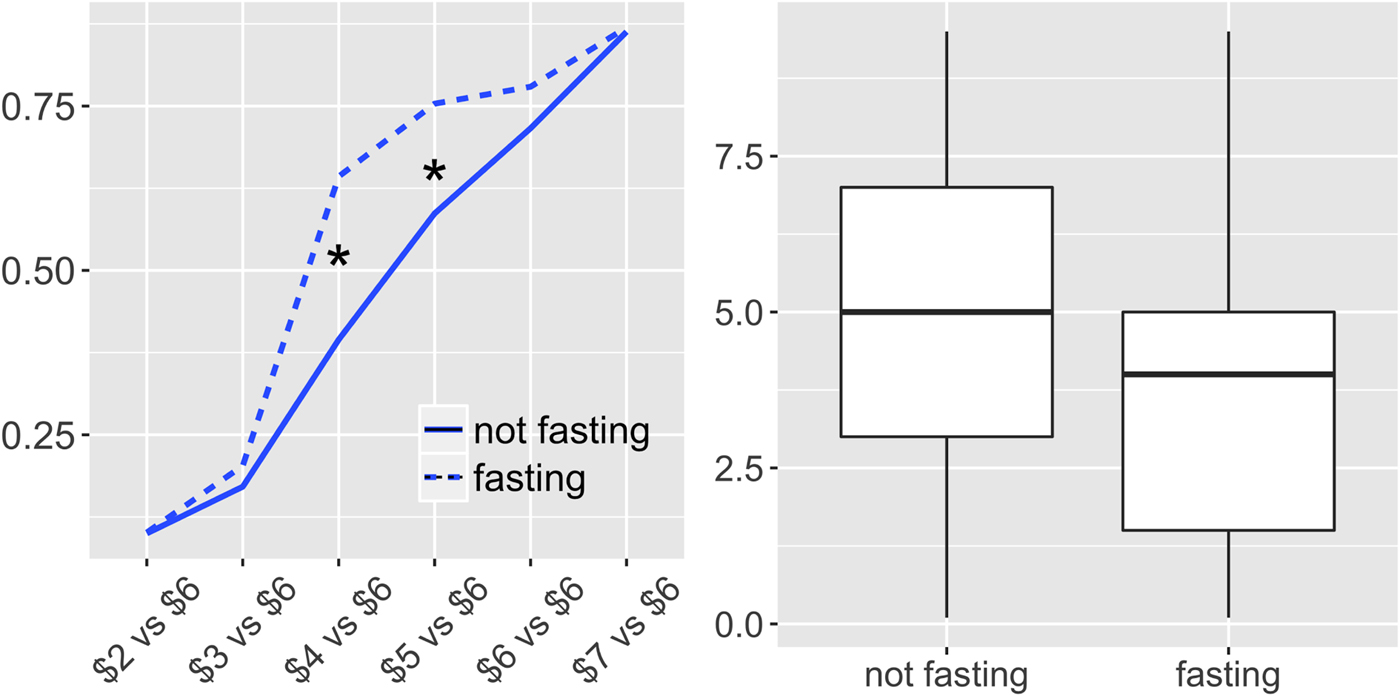
Figure 1. Fasters were more loss and risk averse than nonfasters. The left panel shows the proportion of participants who rejected each gamble shown on the horizontal axis. When choices were difficult (losing $4 vs. winning $6 and losing $5 vs. winning $6), fasters showed greater loss aversion by rejecting the gamble even though accepting it was the better choice. The right panel shows the average amounts (in thousands) that participants accepted to forgo a 50% chance of winning $10,000. Fasters showed greater risk aversion by requiring less money to forgo the gamble.
Poverty and associated resource scarcity have a profound negative influence on human decision making, leading to heightened risk aversion, loss aversion, and temporal discounting (Callan et al. Reference Callan, Shead and Olson2011; Yesuf & Bluffstone Reference Yesuf and Bluffstone2009). Pepper & Nettle (P&N) describe these consequences of deprivation as a behavioral constellation that they argue is an adaptive response to a relative lack of control over future events. Their target article offers an elegant “realist” perspective: The poor may be less patient and more impulsive, because for them, waiting does not promise the same outcomes as it does for the nonpoor, and lower perceived or actual control over future events leads to higher discounting of the future.
P&N's theoretical perspective differs from other explanations of the effects of scarcity on economic decision making. Alternative theories attribute the behavioral constellation of deprivation (BCD) directly to physiological and psychological effects of scarcity. For example, Haushofer and Fehr (Reference Haushofer and Fehr2014) review evidence suggesting that present-oriented choices are partly due to negative affect and increased physiological stress associated with scarcity. Other research shows that scarcity leads to attentional focus on present needs, to the detriment of longer-term tasks (Bari & Robbins Reference Bari and Robbins2013; Shah et al. Reference Shah, Mullainathan and Shafir2012) and is associated with impairment of the basic cognitive abilities needed to make good economic choices (Mani et al. Reference Mani, Mullainathan, Shafir and Zhao2013). Direct cognitive effects of scarcity are particularly damaging to P&N's account; it is difficult to understand how broad cognitive impairment is adaptive. However, our commentary focuses on a different aspect of P&N's account. P&N's theory suggests specific empirical hypotheses. If behavioral consequences of deprivation are adaptive responses to uncertainty, they should be limited to instances when deprivation is imposed by context and when deprivation implies an uncertain or short future.
Religiously motivated self-deprivation, which is a significant feature of human culture, offers a good test case of P&N's theory. Many religious traditions ask followers to undergo periodic instances of voluntary deprivation or abstinence, possibly to exercise willpower or as a costly signal of allegiance to gods and co-religionists (Atran & Ginges Reference Atran and Ginges2012). Cross-cultural prevalence of such practices suggests that they might have been favored by cultural selection for the benefits they confer to the expansion of human cooperation (Carter & McCullough Reference Carter, McCullough, Vohs and Baumeister2010; Ginges et al. Reference Ginges, Hansen and Norenzayan2009; Henrich et al. Reference Henrich, Ensminger, McElreath, Barr, Barrett, Bolyanatz, Cardenas, Gurven, Gwako, Henrich, Lesorogol, Marlowe, Tracer and Ziker2010; Norenzayan et al. Reference Norenzayan, Shariff and Gervais2009). P&N suggest that exogenously caused deprivation creates uncertainty about future prospects, making it adaptive to discount the future in decision making and leading people to more heavily weigh immediate and certain prospects over risky and longer-term ones. If their theory is correct and the BCD is an adaptive response to a lack of control over future prospects, it ought to be absent in cases of religiously motivated self-deprivation, such as fasting.
For more than a billion Muslims around the world, the month of Ramadan is marked by a stringent form of self-induced scarcity: fasting by refraining from eating and drinking between sunrise and sunset. We were interested in whether religiously motivated deprivation might have the same effect as involuntary deprivation on economic decision making. Religiously motivated deprivation is generally under an individual's control. The pressure of social norms notwithstanding, religious norms require people to break their fast or not fast at all if health risks are high. Fasters therefore have control over whether and how long they will continue their self-induced food deprivation. More importantly, fasting has no implications regarding future prospects, neither implying a shorter life span nor a more uncertain material future. If P&N's account is correct, this suggests that religiously motivated scarcity should not be detrimental to decision making. Yet if scarcity directly impairs cognition, those fasting should make poorer economic decisions.
We recruited a sample of 183 self-identified Muslims to participate in an online study during the last 10 days of Ramadan in 2016 (June 26–July 4). In this sample, 86 participants reported that they were fasting, and 97 stated that they were not fasting. Fasters scored higher on intrinsic religiosity, and our analyses controlled for this measure along with socioeconomic status (for details, see Salari Rad & Ginges Reference Salari Rad and Ginges2017). Participants completed two economic tasks. In a risk-aversion task, participants had to decide between receiving a sum of money for sure or having a 50% chance to win $10,000 (Guiso et al. Reference Guiso, Sapienza and Zingales2013). The amounts accepted to forgo the chance of winning the larger sum are indicators of risk aversion. In a loss-aversion task, participants were presented with six gambles with decreasing expected values and asked whether they would participate in each gamble (Gaechter et al. Reference Gaechter, Johnson and Herrmann2007). We found that fasters were more risk and loss averse, suggesting that self-induced deprivation has similar effects to involuntary deprivation (Fig. 1).
Fasters were more loss and risk averse than nonfasters. The left panel shows the proportion of participants who rejected each gamble shown on the horizontal axis. When choices were difficult (losing $4 vs. winning $6 and losing $5 vs. winning $6), fasters showed greater loss aversion by rejecting the gamble even though accepting it was the better choice. The right panel shows the average amounts (in thousands) that participants accepted to forgo a 50% chance of winning $10,000. Fasters showed greater risk aversion by requiring less money to forgo the gamble.
Our results suggest that P&N do not offer the best account for the effects of scarcity on economic decision making. Fasting respondents in our study knew that the fast would end at sunset and that they could end it at any time if they wished, yet they still made risk- and loss-averse decisions. This behavior suggests that perceived or actual control over future outcomes is not a necessary feature of the BCD.