




No CrossRef data available.
Article contents
Intertemporal impulsivity can also arise from persistent failure of long-term plans
Published online by Cambridge University Press: 29 November 2017
Abstract
We suggest that steep intertemporal discounting in individuals of low socioeconomic status (SES) may arise as a rational metacognitive adaptation to experiencing planning and control failures in long-term plans. Low SES individuals' plans fail more frequently because they operate close to budgetary boundaries, in turn because they consistently operate with limited budgets of money, status, trust, or other forms of social utility.
Information
- Type
- Open Peer Commentary
- Information
- Copyright
- Copyright © Cambridge University Press 2017
References
Dynan, K. E., Skinner, J. & Zeldes, S. P. (2000) Do the rich save more? National Bureau of Economic Research Working Paper no. 7906.Google Scholar
Greve, F. (2009) America's poor are its most generous. Seattle Times, May 23. Available at: http://seattletimes.nwsource.com.Google Scholar
Kidd, C., Palmeri, H. & Aslin, R. N. (2013) Rational snacking: Young children's decision-making on the marshmallow task is moderated by beliefs about environmental reliability. Cognition
126(1):109–14.Google Scholar
Kumar, D. & Srinivasan, N. (2014) Naturalizing sense of agency with a hierarchical event-control approach. PLOS ONE
9(3):e92431.Google Scholar
Kumar, D. & Srinivasan, N. (2017) Multi-scale control influences sense of agency: Investigating intentional binding using event-control approach. Consciousness and Cognition
49:1–14.CrossRefGoogle ScholarPubMed
National Crime Records Bureau, Ministry of Home Affairs, New Delhi. (2012) Crime in India. Available at: https://web.archive.org/web/20140620023952/http://ncrb.nic.in/CD-CII2012/Statistics2012.pdf.Google Scholar
OECD (2017) Household savings (indicator). Available at: https://data.oecd.org/hha/household-savings.htm.Google Scholar
Piff, P. K., Kraus, M. W., Côté, S., Cheng, B. H. & Keltner, D. (2010) Having less, giving more: The influence of social class on prosocial behavior. Journal of Personality and Social Psychology
99(5):771–84.Google Scholar
Suryanarayana, M. H., Agrawal, A. & Prabhu, K. S. (2011) Inequality-adjusted human development index for India's states. United Nations Development Programme (UNDP) India. http://www.undp.org/content/dam/india/docs/inequality_adjusted_human_development_index_for_indias_state1.pdf
Google Scholar
Tax Policy Center (2017, May 3) Household income quintiles. Available at: http://www.taxpolicycenter.org/statistics/household-income-quintiles.Google Scholar
United Nations Department of Economic and Social Affairs (2015) World Population Prospects 2017. United Nations Department of Economic and Social Affairs. Available at: https://esa.un.org/unpd/wpp/Download/Standard/Mortality/
Google Scholar
United Nations Office on Drugs and Crime (2013) Global study on homicide 2013: Trends, contexts, data. United Nations Office on Drugs and Crime.Google Scholar
Wilson, M. & Daly, M. (1997) Life expectancy, economic inequality, homicide, and reproductive timing in Chicago neighbourhoods. British Medical Journal
314(7089):1271–74.Google Scholar
World Bank. (n.d.) GDP per capita, PPP (current international $). Available at: http://data.worldbank.org/indicator/NY.GDP.PCAP.PP.CD.Google Scholar
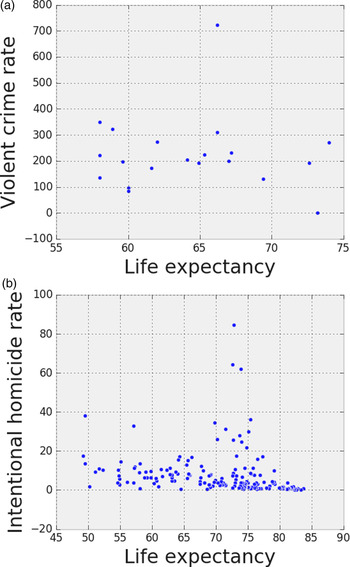
Figure 1. No evidence of relationship between exogenous mortality risk and crime rates in two large datasets. (a) Scatter plot of life expectancy at birth versus crime rate (per 100,000 capita) among states in India. (b) Scatter plot of life expectancy at birth versus intentional homicide rate across countries of the world
Pepper & Nettle's (P&N's) central claim is that intertemporal impulsivity is a function of rational adaptation to shorter time horizons, in turn drawn from an inference of mortality risk. The identification of differential temporal discounting as a unifying principle explaining multiple behaviour patterns seen under conditions of deprivation is a timely and compelling contribution of this target article. However, P&N's association of shorter planning horizons with exogenous mortality risk does not appear as compelling and seems to be an overextension of evolutionary psychology ideas that have historically lacked strong empirical justification.
In particular, the relationship between exogenous mortality risk and crime rates, identified in Chicago neighbourhoods (Wilson & Daly Reference Wilson and Daly1997), does not scale up well when we measure correlations between, to take just two examples, state-level life expectancy (Suryanarayana et al. Reference Suryanarayana, Agrawal and Prabhu2011) and overall crime rates among states in India (National Crime Records Bureau 2012) (see Fig. 1a)and cross-country life expectancy (United Nations Department of Economic and Social Affairs 2015) and intentional homicide rates (United Nations Office on Drugs and Crime 2013) (see Fig. 1b). The strength of this proposed causal link is also called into question by large differences in behaviour patterns between low SES populations in the United States and in developing countries. For example, P&N review an extensive literature that correlates low SES with a propensity to not save. Empirically, while households in the top income quintile (mean income $140,000/year as of the year 2000, according to the Tax Policy Center 2017) in the United States save around 23% of their income per year (Dynan et al. Reference Dynan, Skinner and Zeldes2000), the average savings rate in China with a purchasing power parity (PPP) adjusted average household income of $14,450 per year (World Bank, n.d.) was 38% as of 2014 (OECD 2017).
No evidence of relationship between exogenous mortality risk and crime rates in two large datasets. (a) Scatter plot of life expectancy at birth versus crime rate (per 100,000 capita) among states in India. (b) Scatter plot of life expectancy at birth versus intentional homicide rate across countries of the world
P&N also do not engage with some normatively positive behaviour reliably observed in low SES subjects – that is, greater prosocial behaviour. Prima facie, prosociality appears to fall within the ambit of the low SES behaviour; an intuitive association with intertemporal preference would suggest that low SES participants would put their payoff from winning the present transaction above the possible long-term benefits of prosocial behaviour. Yet Piff et al. (Reference Piff, Kraus, Côté, Cheng and Keltner2010) have shown in controlled lab experiments that low SES individuals are more generous, charitable, and helpful than high SES individuals. This experiment corroborates survey-based measurements, which also document greater charity, as a function of income levels, among people with low incomes (Greve Reference Greve2009). The question of how greater mortality risk might lead to greater charity is interesting theoretically, but it is perhaps even more important to mention such positive behaviour in low SES individuals in light of the putatively negative behaviours documented in the target article.
These disconnects with empirical data motivate looking for alternative causal mechanisms than mortality risk assessment by which low SES might lead to shorter planning horizons. We argue for an alternative source of intertemporal impulsivity that is not well described in the present article. We have been investigating the relationship between people's sense of control over their environments and their subjective sense of agency. Experiments on event-control and agency have shown that the sense of agency is strongly sensitive to the time scale on which people can effectively exercise control (Kumar & Srinivasan Reference Kumar and Srinivasan2014; Reference Kumar and Srinivasan2017). A natural corollary to this finding is that to maintain their sense of agency, agents may allocate mental resources preferentially to those time scales they find they can most effectively act upon.
Low SES individuals will naturally find planning and controlling actions at long time scales inefficient, because plans with low resource reservoirs underpinning them are more susceptible to being overturned by small random socioeconomic fluctuations – for example, price increases or delayed payments – than plans with substantial resource reservoirs. Thus, our alternative hypothesis is that the reason low SES subjects demonstrate steeper time discounting is that they have greater experience with planning and control failures caused by always operating close to budgetary boundaries, which in turn arise inevitably from having to consistently operate with limited budgets of money, status, trust, or other forms of social utility. Repeated encounters with such planning breakdowns will cause low resource agents to make shorter-time-horizon plans as a rational adaptation to planning failures with long-duration plans.
Interestingly, such planning failures need not just be caused by budget overruns; they can also be directly induced through experimenter intervention. This latter modality of planning failure is seen, for instance, in the experimental design of Kidd et al. (Reference Kidd, Palmeri and Aslin2013), who find that children paired with experimenters who had reneged on previous promises were more likely to prefer small assured rewards in the present than large rewards in the future. Thus, Kidd et al. (Reference Kidd, Palmeri and Aslin2013) are able to reproduce the central phenomenon of low SES behaviour – greater intertemporal discounting – using a simple trust-based manipulation. Our proposal, relating intertemporal discounting to metacognitive preference for information processing on useful time scales, is entirely compatible with this explanation. Children paired with unreliable experimenters obtain experience with planning failures on longer time scales and respond by promoting consideration of shorter time-scale plans, resulting in steeper intertemporal discounting.
Our proposal is also compatible with the finding of greater prosocial behaviour among low SES individuals. Deemphasising long-term plans reduces the opportunity cost of distributing economic surplus funds in the present – thus, the seemingly contradictory finding that people with smaller incomes prove to be more generous (in percentage terms). Once immediate needs are met, reduced planning on longer time horizons is expected to materialise in the precise spectrum of carpe diem behaviour seen empirically – lower savings rates, greater hedonic consumption, and greater charitable giving.