




No CrossRef data available.
Article contents
Ultrasociality: When institutions make a difference
Published online by Cambridge University Press: 30 June 2016
Abstract
We present arguments that the analogy between humans and social insects is coincidental, rather than based upon real similarities. In their claims, Gowdy & Krall largely omit the role of institutions in the formation of complex societies, warfare, and regulation. They also offer no strong explanation for the expansion of agriculture despite its early detrimental effects except the “mistake hypothesis” (cf. Diamond 1987).
Information
- Type
- Open Peer Commentary
- Information
- Copyright
- Copyright © Cambridge University Press 2016
References
Acemoglu, D., Johnson, S. & Robinson, J. A. (2005) Institutions as a fundamental cause of long-run growth. In: Handbook of economic growth, vol. 1: Part A, ed. Philippe, A. & Steven, N. D., pp. 385–72. Elsevier.Google Scholar
Bowles, S. (2009) Did warfare among ancestral hunter-gatherers affect the evolution of human social behaviors?
Science
324(5932):1293–98. doi: 10.1126/science.1168112.Google Scholar
Buonanno, P., Durante, R., Prarolo, G. & Vanin, P. (2015) Poor institutions, rich mines: Resource curse and the origins of the Sicilian Mafia. The Economic Journal
125(586):F175–202. doi: 10.1111/ecoj.12236. Available at: http://onlinelibrary.wiley.com/doi/10.1111/ecoj.12236/abstract/
Google Scholar
Diamond, J. (1987) The worst mistake in the history of the human race. Discover Magazine May 2, 1987, pp. 64–66. Available at: http://discovermagazine.com/1987/may/02-the-worst-mistake-in-the-history-of-the-human-race
Google Scholar
Easterly, W. & Levine, R. (2003) Tropics, germs, and crops: how endowments influence economic development. Journal of Monetary Economics
50(1):3–39. doi: 10.1016/S0304-3932(02)00200-3.Google Scholar
Grossman, G. M. & Krueger, A. B. (1995) Economic growth and the environment. The Quarterly Journal of Economics
110(2):353–77.Google Scholar
Hibbs, D. A. & Olsson, O. (2005) Biogeography and long-run economic development. European Economic Review
49(4):565–86. doi: 10.1016/j.euroecorev.2003.08.010.Google Scholar
Houdek, P. & Novakova, J. (2016) Frozen cultural plasticity. Behavioral and Brain Sciences
39:e42. 10.1017/S0140525X15000151
CrossRefGoogle ScholarPubMed
Kuznets, S. (1955) Economic growth and income inequality. American Economic Review
45(1):1–28.Google Scholar
North, D. C. & Thomas, R. P. (1976) The rise of the Western world: A new economic history. Cambridge University Press.Google Scholar
Olsson, O. & Paik, C. (2013) A Western reversal since the Neolithic? The long-run impact of early agriculture. Working Papers in Economics, No. 552. Department of Economics, University of Göthenburg, Sweden. Available at: Social Science Research Network, doi: 10.2139/ssrn.2206198, and site: http://papers.ssrn.com/sol3/papers.cfm?abstract_id=2206198. Also available at: http://hdl.handle.net/2077/32052; https://gupea.ub.gu.se/handle/2077/32052
Google Scholar
Ostrom, E. (1990) Governing the commons: The evolution of institutions for collective action. Cambridge University Press.Google Scholar
Richerson, P., Baldini, R., Bell, A. V., Demps, K., Frost, K., Hillis, V., Mathew, S., Newton, E. K., Naar, N., Newson, L., Ross, C., Smaldino, P. E., Waring, T. M. & Zefferman, M. (2016) Cultural group selection plays an essential role in explaining human cooperation: A sketch of the evidence. Behavioral and Brain Sciences
39:e30. doi: 10.1017/S0140525X1400106X.Google Scholar
Simon, H. (1990) A mechanism for social selection and successful altruism. Science
250(4988):1665–68. doi: 10.1126/science.2270480.Google Scholar
Thorpe, I. J. (2003) Anthropology, archaeology, and the origin of warfare. World Archaeology
35(1):145–65. doi: 10.1080/0043824032000079198.Google Scholar
Walker, P. L. (2001) A bioarchaeological perspective on the history of violence. Annual Review of Anthropology
30(1):573–96. doi: 10.1146/annurev.anthro.30.1.573.Google Scholar
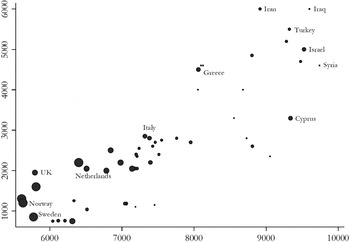
Figure 1. Time (years) since first state formation (y-axis) and average time since agricultural transition (x-axis) for 52 Western countries with markers weighted by GDP per capita in 2005. Reprinted by permission from Olsson and Paik (2013, Fig. 4).
In their interesting attempt at analogies, Gowdy & Krall (G&K) make, we think, some critical omissions that deserve to be commented upon. First, it is somewhat commonplace in economics (at least from Adam Smith on) to recognize the fact that biologically identical groups of people (societies) may come out very different depending on the rules and cultural norms governing their behavior – a set of factors modern economists like to bundle as institutions. Unsurprisingly, these institutions play a significant role in the origins of human ultrasociality (Acemoglu et al. Reference Acemoglu, Johnson, Robinson, Philippe and Steven2005; North & Thomas Reference North and Thomas1976; Richerson et al. Reference Richerson, Baldini, Bell, Demps, Frost, Hillis, Mathew, Newton, Naar, Newson, Ross, Smaldino, Waring and Zefferman2016), a fact that G&K “fully recognize” in the introduction (sect. 1) but choose to blot out almost entirely in the rest of the article. This is understandable, as it would undermine the purport of their article – the analogy between humans and social insects. Instead, they prefer to focus on one single aspect of ultrasociality – the transition to agriculture – buying uncritically into Jared Diamond's famous thesis (about this being the “worst mistake” in human history; Diamond Reference Diamond1987).
We argue, however, that agriculture is not the necessary and the only possible prerequisite of ultrasociality, but is rather incidental to it. Agriculture happens to be a natural candidate for triggering ultrasociality as food is typically the first scarce thing an individual (human or termite) seeks to secure. However, had food been plentiful, other scarce resources would have led to ultrasociality in species that already had a complex social organization capable of division of labor. In other words, once institutions are included in the analysis, G&K's analogy starts crumbling: There is nothing about human agriculture (or more broadly, development and economic growth) and resulting ultrasociality that makes it inherently and inescapably unsustainable in terms of inequality, environmental degradation, or violence. In all of these aspects, the effect of development is not necessarily negative (see the research program initiated by Kuznets [Reference Kuznets1955] for inequality and Grossman & Krueger [Reference Grossman and Krueger1995] for environment, or see e.g., Pinker [2011], which we refer to below, for violence) and is critically dependent on institutions.
Second, among human hunters and gatherers, division of labor – as a lower degree of ultrasociality – is also present. Some societies practicing agriculture have not reached much greater complexity than hunter-gatherer societies (Easterly & Levine Reference Easterly and Levine2003; Hibbs & Olsson Reference Hibbs and Olsson2005). However, social groups with strong institutions promoting trade, growth, and expansion have flourished through cultural group selection (Houdek & Novakova Reference Houdek and Novakova2016; Richerson et al. Reference Richerson, Baldini, Bell, Demps, Frost, Hillis, Mathew, Newton, Naar, Newson, Ross, Smaldino, Waring and Zefferman2016). The notion that institutions rather than agriculture per se fostered the emergence of ultrasociality is also supported by the fact that the regions within the Western world which had made a transition to Neolithic agriculture earlier are now generally poorer than the regions that had made it much later (Olsson & Paik Reference Olsson and Paik2013). Such economic disparity does not seem to stem from the later arrival of industrial revolution. While its cause remains unresolved, Olsson and Paik suggest that the development of early autocratic states created extractive institutions and that increased rent seeking, looting, and technological inertia could have led to the deterioration of these regions (i.e., low GDP per capita today), whereas the later adopters' institutions (e.g., with stronger emphasis on property rights) prevented such an outcome; see our Figure 1. (See also Buonanno et al. Reference Buonanno, Durante, Prarolo and Vanin2015), who offer a twentieth century example of weak formal institutions resulting in the emergence of mafia-type organizations).
Time (years) since first state formation (y-axis) and average time since agricultural transition (x-axis) for 52 Western countries with markers weighted by GDP per capita in 2005. Reprinted by permission from Olsson and Paik (Reference Olsson and Paik2013, Fig. 4).
Third, the claim about increased mortality due to violent deaths in agricultural societies in section 3.3 of the target article does not stand in light of evidence of violence-induced mortality across prehistoric societies (Bowles Reference Bowles2009; Thorpe Reference Thorpe2003; Walker Reference Walker2001). While G&K suggest a probable increase of violence in early, small agricultural communities, it seems that in larger and more organized societies, the per capita level of violence actually dropped. We should make a distinction between violence and war: though the latter appeared more in the complex agricultural societies, the former (including deaths in personal disputes as well as larger-scale conflicts) decreased. The cause may have been the formation of states and larger units, as Pinker (Reference Pinker2011) argues. We would like to stress that warfare itself is unlikely to contribute to the formation of complex ultrasocial societies without proper institutions.
Finally, on more abstract, purely economic (choice-theoretic) grounds, the very notion that humans gave up hunting-gathering and replaced it with agriculture only to find themselves worse off, begs the question of why they chose it in the first place and why they did not opt out to revert back to hunting-gathering. Mistakes and lock-ups are certainly possible: People can never foresee all consequences of their decisions and some may ex post turn out detrimental. Sooner or later, and certainly within the hundreds and thousands of years that G&K consider, one would expect people to have learned from and corrected their mistakes, or, eventually, be outcompeted by those who had not committed such mistakes in the first place (hunters-gatherers) or who had indeed corrected them. Either way, it is customary in economics that the burden of proof be placed on those who claim that people seem to act irrationally. G&K should have offered a theory that explains why that kind of bounded rationality behavior prevails or how group-level forces create and preserve such behavior (e.g., Ostrom Reference Ostrom1990; Simon Reference Simon1990). In contrast, G&K have chosen not to carry that burden of proof very far. Admittedly, they still may be correct. But in their article they provide no theory (much less an economic one) of why people engage in farming despite its early detrimental effects. And this is rather regrettable in a piece claiming to unveil the “economic origins” of ultrasociality (i.e., agriculture) in its title.