Gowdy & Krall (G&K) discuss common features of certain human and arthropod societies, which are characterized as ultrasocial societies. In this, they draw selectively on “the economics of production.” Their theory of production seems to parallel mine in McCain (Reference McCain2014), which I denote as a “complex combination of labor” theory. Georgescu-Roegen's theory is narrower (Georgescu-Roegen Reference Georgescu-Roegen1970; Reference Georgescu-Roegen1977b; Reference Georgescu-Roegen1977c; cf. Daly Reference Daly1977). However, G&K neglect the role of class systems, and their basis in threat, which may distinguish human from arthropod ultrasociality.
The early agricultural societies on which G&K focus much of their attention (see sect. 1) are what Samir Amin (Reference Amin1989) calls tributary societies. A tributary society is one in which the productive surplus of a group is seized by an armed minority by means of the threat of violence. This is an instance of a class society, in the Marxist sense, and seems to be the common form of the earliest class societies. The armed minority that G&K describe as specializing in defense (sect. 3), are also the dominant tribe who enforce both the loss of autonomy and the transfer of the surplus to themselves. The importance of class structures in human societies both provides an alternative to evolution to explain the persistence and growth of human societies and resolves some of the difficulties G&K acknowledge in their view. Among these are the combination of persistence and instability that human, but not arthropod, societies display.
A class society may be defined by the process by which it reproduces itself; this principle may differ from one class society to another. This is a mechanism by which the dominant class extracts the surplus from the group of which it is part and uses that surplus to recreate its ability to extract the surplus. In the case of a tributary society, a dominant tribe, cult, town, or city requires tribute from the producers in the society as a condition of being left in peace, and this surplus is redistributed among the armed force and its commanders, in such a way that their dominance is recreated.
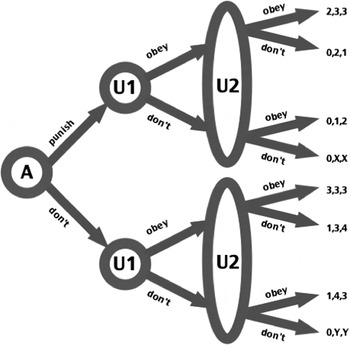
In case this circular causation seems too facile to constitute a theory, the point can be illustrated by game theory. In non-cooperative game theory, a threat is considered credible if it corresponds to a subgame perfect Nash equilibrium. (e.g., McCain Reference McCain2009, Ch. 6) While a three-person game will be a radical simplification of what in fact will be a large-N game, it will provide a useful illustration. Accordingly, consider Figure 1. There are three agents, an armed agent (A), and two unarmed agents (U1 and U2). The armed agent can choose between two strategies: a strategy of punishing either of the unarmed agents if one disobeys, or not doing so. These correspond to the first two arrows in the game tree in the figure, and those lead to subgames in which the two unarmed agents simultaneously choose to obey or not to obey. The numbers at the right are assumed proportionate to the payoffs to the armed agent (A) and the two unarmed agents (U1 and U2), respectively. Thus, for example, if A adopts the strategy of punishing disobedience, he must divert one-third of his tribute to maintenance of the capability of punishment, and actually imposing punishment costs the balance of it, also reducing the payoff of an obedient unarmed agent by one-third.
Figure 1.
A Game of Threat.
In case of universal disobedience, the payoff to the armed agent is zero, but the payoffs to the unarmed agents are given as unknowns, because there is some difference of opinion about well-being in the “state of nature.” (Compare McCain Reference McCain2014, pp. 208–212.) For now, assume that X = Y = 0, that is, where individuals act on individual autonomy productivity is reduced very drastically. This seems consistent with the schema of G&K, if not of Rousseau (Reference Rousseau and Cole1762). Then the only Nash equilibrium in the upper game is one at which both unarmed agents obey, and the payoff to the armed agent is 2. This is the subgame perfect equilibrium of the game. Scaled up to an appropriate number of agents, this seems a reliable sketch of a tributary society.
Threat presupposes intentionality, in that the person who submits the threat does so for the purpose of avoiding punishment, and the person who poses the threat does so for the purpose of obtaining this submission. That there is resistance to class dominance indicates that there is a decision; that a great majority make the decision along the lines suggested by the game model indicates that purpose plays a role in the decision. The resistance of the minority may reflect irrationality, but the payoffs in Figure 1 refer to an average unarmed agent, and might in an exceptional case differ sufficiently that the equilibrium would shift to disobedience. This could also be a factor in intergroup conflict. This is not to adopt the Marxist view that all conflict is at base class conflict. In tributary societies, dominant tribes and groups may lead their communities into aggressive conflict with one another, as G&K suggest. However, intragroup conflict and revolution become possibilities (see McCain Reference McCain2014, p. 212), as they do not seem to be in the arthropod societies.
One of the consequences of a class society is that a portion of the surplus may be diverted into the accumulation of what Austrian economics calls higher-order goods (McCain Reference McCain2014, pp. 18–25) in ways that increase the rate of surplus, that is, the surplus per producer. Of course, this is most directly associated with capitalist societies, but in the context of tributary societies we may note, as G&K do (sect. 1), the importance in early agricultural societies of canals and aqueducts and other structures. Dynamic growth might be a result of this accumulation.
In short, G&K seem to have neglected one of the most important determinants of the dynamics of human societies, the role of class systems based on threat. Because threat presupposes intentionality, and intentionality is not attributed to arthropods, this seems an important distinction.





 You have
Access
Gowdy & Krall (G&K) discuss common features of certain human and arthropod societies, which are characterized as ultrasocial societies. In this, they draw selectively on “the economics of production.” Their theory of production seems to parallel mine in McCain (Reference McCain2014), which I denote as a “complex combination of labor” theory. Georgescu-Roegen's theory is narrower (Georgescu-Roegen Reference Georgescu-Roegen1970; Reference Georgescu-Roegen1977b; Reference Georgescu-Roegen1977c; cf. Daly Reference Daly1977). However, G&K neglect the role of class systems, and their basis in threat, which may distinguish human from arthropod ultrasociality.
The early agricultural societies on which G&K focus much of their attention (see sect. 1) are what Samir Amin (Reference Amin1989) calls tributary societies. A tributary society is one in which the productive surplus of a group is seized by an armed minority by means of the threat of violence. This is an instance of a class society, in the Marxist sense, and seems to be the common form of the earliest class societies. The armed minority that G&K describe as specializing in defense (sect. 3), are also the dominant tribe who enforce both the loss of autonomy and the transfer of the surplus to themselves. The importance of class structures in human societies both provides an alternative to evolution to explain the persistence and growth of human societies and resolves some of the difficulties G&K acknowledge in their view. Among these are the combination of persistence and instability that human, but not arthropod, societies display.
A class society may be defined by the process by which it reproduces itself; this principle may differ from one class society to another. This is a mechanism by which the dominant class extracts the surplus from the group of which it is part and uses that surplus to recreate its ability to extract the surplus. In the case of a tributary society, a dominant tribe, cult, town, or city requires tribute from the producers in the society as a condition of being left in peace, and this surplus is redistributed among the armed force and its commanders, in such a way that their dominance is recreated.
In case this circular causation seems too facile to constitute a theory, the point can be illustrated by game theory. In non-cooperative game theory, a threat is considered credible if it corresponds to a subgame perfect Nash equilibrium. (e.g., McCain Reference McCain2009, Ch. 6) While a three-person game will be a radical simplification of what in fact will be a large-N game, it will provide a useful illustration. Accordingly, consider Figure 1. There are three agents, an armed agent (A), and two unarmed agents (U1 and U2). The armed agent can choose between two strategies: a strategy of punishing either of the unarmed agents if one disobeys, or not doing so. These correspond to the first two arrows in the game tree in the figure, and those lead to subgames in which the two unarmed agents simultaneously choose to obey or not to obey. The numbers at the right are assumed proportionate to the payoffs to the armed agent (A) and the two unarmed agents (U1 and U2), respectively. Thus, for example, if A adopts the strategy of punishing disobedience, he must divert one-third of his tribute to maintenance of the capability of punishment, and actually imposing punishment costs the balance of it, also reducing the payoff of an obedient unarmed agent by one-third.
A Game of Threat.
In case of universal disobedience, the payoff to the armed agent is zero, but the payoffs to the unarmed agents are given as unknowns, because there is some difference of opinion about well-being in the “state of nature.” (Compare McCain Reference McCain2014, pp. 208–212.) For now, assume that X = Y = 0, that is, where individuals act on individual autonomy productivity is reduced very drastically. This seems consistent with the schema of G&K, if not of Rousseau (Reference Rousseau and Cole1762). Then the only Nash equilibrium in the upper game is one at which both unarmed agents obey, and the payoff to the armed agent is 2. This is the subgame perfect equilibrium of the game. Scaled up to an appropriate number of agents, this seems a reliable sketch of a tributary society.
Threat presupposes intentionality, in that the person who submits the threat does so for the purpose of avoiding punishment, and the person who poses the threat does so for the purpose of obtaining this submission. That there is resistance to class dominance indicates that there is a decision; that a great majority make the decision along the lines suggested by the game model indicates that purpose plays a role in the decision. The resistance of the minority may reflect irrationality, but the payoffs in Figure 1 refer to an average unarmed agent, and might in an exceptional case differ sufficiently that the equilibrium would shift to disobedience. This could also be a factor in intergroup conflict. This is not to adopt the Marxist view that all conflict is at base class conflict. In tributary societies, dominant tribes and groups may lead their communities into aggressive conflict with one another, as G&K suggest. However, intragroup conflict and revolution become possibilities (see McCain Reference McCain2014, p. 212), as they do not seem to be in the arthropod societies.
One of the consequences of a class society is that a portion of the surplus may be diverted into the accumulation of what Austrian economics calls higher-order goods (McCain Reference McCain2014, pp. 18–25) in ways that increase the rate of surplus, that is, the surplus per producer. Of course, this is most directly associated with capitalist societies, but in the context of tributary societies we may note, as G&K do (sect. 1), the importance in early agricultural societies of canals and aqueducts and other structures. Dynamic growth might be a result of this accumulation.
In short, G&K seem to have neglected one of the most important determinants of the dynamics of human societies, the role of class systems based on threat. Because threat presupposes intentionality, and intentionality is not attributed to arthropods, this seems an important distinction.