To save content items to your account,
please confirm that you agree to abide by our usage policies.
If this is the first time you use this feature, you will be asked to authorise Cambridge Core to connect with your account.
Find out more about saving content to .
To save content items to your Kindle, first ensure no-reply@cambridge.org
is added to your Approved Personal Document E-mail List under your Personal Document Settings
on the Manage Your Content and Devices page of your Amazon account. Then enter the ‘name’ part
of your Kindle email address below.
Find out more about saving to your Kindle.
Note you can select to save to either the @free.kindle.com or @kindle.com variations.
‘@free.kindle.com’ emails are free but can only be saved to your device when it is connected to wi-fi.
‘@kindle.com’ emails can be delivered even when you are not connected to wi-fi, but note that service fees apply.
The past can be used as a methodological perspective from which to view the dynamics of the anthroposphere and its interaction with Earth systems. The chapter offers for comparison two historical perspectives on societal collapse, the Mediterranean around 1200 BCE, and the fall of the Rome-based order around the Mediterranean, the Black Sea and Europe around 400 AD. We live in the first World system with a global horizon, meaning that there can be no direct historical precedents when talking about the contours of system-wide collapse. The chapter argues that some lessons can nevertheless be drawn from historical cases that did involve the breakdown (and eventual reconstitution) of a multi-civilisational world order. It concludes that collapses have a multicausal character. They sometimes take the form of a reversion to the previous incarnation of the system, and they come as surprises to those experiencing them, even when the multiple causes were obviously well known as the system reached the tipping point of collapse.
This text concerns tangible and sensory aspects of petroglyph production with a primary focus on south Scandinavian Bronze Age rock art. The core of the study is based on an experimental trial of making a cupmark, a circle motif, and a shallow boat motif on a small granite outcrop. The aims were to measure time expenditure, the impact of water on the process, evaluate sensory aspects (e.g. colour, sound, and smell), and measure the visibility of the petroglyphs over time. The direct results of the experiment show that a cupmark can be produced within 12 minutes and a circle within an hour, using a direct technique with a small pointed hammerstone. The shallow boat motif took only seven minutes to make and was almost as visible (white) as the deeper circle motif, even without leaving any measurable depressions in the rock. The results of the present study are related to other published trials concerning Bronze Age rock art. This paper concludes that petroglyphs are probably less about making illustrative or communicative imagery but more about producing petrofacts: ritual devices with physical abilities, such as producing mineral dust or gathering and channelling water or other liquids.
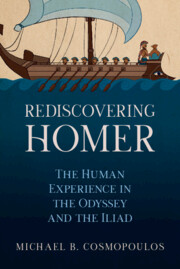
A timeless tale of a heroic character's journey through life, Homer's Odyssey has captured the imagination of readers from antiquity to the present day. Michael Cosmopoulos approaches this epic, together with the Iliad, not as remote works of literature, but as a living record of human experience shaped by war, loss, memory, and survival. He offers a poignant exploration of the aspects and consequences of war as captured in the Odyssey, including trauma, leadership and politics, human relations, religion and fate, and the struggle to return home and rebuild after upheaval. Cosmopoulos also situates both the Iliad and the Odyssey within the social conditions and the material realities of Greek society during the Aegean Bronze Age. Based on decades of archaeological field work and study of classical antiquity, and written in an accessible style, his book powerfully demonstrates how the poetry of ancient Greece preserves collective memory across the generations – and why these poems still speak to modern readers.
Previous attempts at explaining how geographically distant and disparate Bronze Age polities, like the chiefdoms of northern Europe and the urban states of the Mediterranean, were connected have focused on exchange networks. By combining insights from political science with archaeology, this article sets out to do two things. First, to reintroduce system thinking to model interconnectivities in the Bronze Age world, using an old trope in international relations studies as a lens and analytical tool. Second, to argue that diplomacy and war must be treated on a par with trade as institutions of such a system, of major importance for understanding international relations during the Bronze Age. The authors discuss the so-called Amarna system’s scope in time and space, exploring whether and how Bronze Age polities in the far north of Europe, as outsiders, can be plausibly construed as constitutive ‘others’.
The Bronze Age monument known as Hagbard’s Gallows in Sweden is a combination of monumental standing stones, rock art and mounds. A new research project uses optically stimulated luminescence and radiocarbon dating techniques to investigate the monument’s chronology.
Egypt and the Levant witnessed complex transformations across the Bronze Age. Beyond the rise and collapse of powerful cities and states were the long-distance connectivities that enabled the movements of people and animals, and the interlinked exchanges of commodities and ideas. By the Late Bronze Age, these connectivities exhibited markers of globalisation. This Element considers how such markers emerged and developed in the preceding centuries. Focusing on the third to mid-second millennium BCE, it brings together recent research on socio-political developments and cross-cultural interactions to give an overview of the transforming networks linking Old to early New Kingdom Egypt and EB III to LB I Levantine communities. In doing so, the Element incorporates approaches that move away from imperialist structures of exchange to consider how dynamic networks were negotiated and maintained across periods of socio-political change.
High-resolution archaeometallurgical analysis of production debris offers a direct means of reconstructing ancient metalmaking traditions, yet remains underexplored relative to the study of finished artefacts. By integrating slag morphology, microstructure and compositional data from Late Bronze Age Taldysai, this study reconstructs, for the first time in Eurasian Steppe archaeology, a continuous 300-year tradition of copper-alloy production. The results reveal technological continuity alongside innovation, including advanced furnace designs, shared metallurgical knowledge and episodes of experimentation. The authors state that these findings position local semipastoralist communities not as peripheral adopters but as active innovators at the heart of Bronze Age Eurasian metallurgical developments.
Although thousands of prehistoric standing stones have been recorded across Iberia, the lack of associated detailed contextual data allows ongoing debate about their possible functions. Following the chance discovery of a ‘diademated’ stela in 2018, excavations at Las Capellanías (Cañaveral de León, Huelva), in south-west Spain, led to the discovery of two more stelae and facilitated the compilation of vital contextual information. Here, the authors explore the association between these stelae, Bronze and Iron Age burials and an ancient routeway, revealing reuse, temporal persistence, geographical connectivity and cultural hybridisation in the widening networks of prehistoric Iberia.
Excavations at Xiaeryamakebu, located in the Qaidam Basin of north-west China, have uncovered a large Bronze Age settlement that includes residences and cemeteries. The site provides crucial insights into the Nuomuhong culture, its mortuary practices and local adaptation to the Tibetan Plateau.
Excavations at the Jizhong site in eastern China reveal the agricultural and horticultural range of the ancient Yue state, uncovering rice, gourds and fruit seeds, and the integration of proto-urban foodways with state development. This suggests that increasing dietary complexity and urban-rural integration were inherited by the subsequent Qin-Han dynasties.
The Element examines various facets of craftwork in small-scale societies that thrived in much of Central Europe during the Bronze Age (2300–800 BCE). These societies exhibited distinct structures and types of social bonds that formed the social and spatial backdrop for craft practices. Since most Bronze Age villages were inhabited by small groups, all forms of crafting were at least partially communal, fostering the exchange of experiences, skills, and knowledge both within and across different production areas. The public nature of crafting practices also encouraged discussions about applied tools, methods, skills, and the quality of the final products. The author explores overarching questions about communication and knowledge transfer within and beyond small groups, drawing on archaeological and ethnographic data. This includes considerations of standardization, personalization, imitation, seasonality, and cross-crafting. This title is also available as Open Access on Cambridge Core.
The deep history of weaving is attested by spindle whorls and loom weights, so the evolution of techniques may be tracked through changes in these durable artefacts; however, wooden looms rarely preserve. Here, the authors document a series of loom weights and associated charred timbers and fibres that represent the remains of a Bronze Age warp-weighted loom, uncovered at the settlement of Cabezo Redondo in south-eastern Spain. Based on the number, weight and size of the weights, hypothetical reconstructions of loom setup and resultant textile products are proposed, revealing possible diversification of weaving processes in the mid-second millennium BC.
A truncated conical-shaped building constructed using the cyclopean technique, called Talayot 1 or East Talayot, is conserved in the Talayotic settlement of Sant Agustí Vell. The monument has an internal chamber with two polylithic columns and a pilaster that helps holding up a roof made of large stone slabs, below which three well-conserved wooden beams can be seen, as well as the remains of two other beams, only one end of each is conserved. The study of a sample of each of these beams extracted from the outer rings of the trunks enable us to determine that all the beams come from the Olea europea L. (olive tree) species. The radiocarbon dating of the samples suggest that the trees from which the trunks come were felled between 1259–1123 cal BC. It was the first time that construction elements of a Menorcan talayot could be dated.
Excavations at Kalat-e Yavar offer new insights into prehistoric connectivity between the Iranian Plateau and Central Asia. Stratified deposits yielded ceramics and burials from the third/second millennia BCE, alongside architectural remains, pits, faunal/botanical assemblages and a kiln, marking the Bojnord Plain as a cultural contact zone.
The ability of urban centres to grow and persist through crises is often assessed qualitatively in archaeology but quantitative assessment is more elusive. Here, the authors explore urban resilience in ancient Mesopotamia by applying an adaptive cycle framework to the settlement dynamics of the Bronze and Iron Age Khabur Valley (c. 3000–600 BC). Using an integrated dataset of settlements and hollow ways, they identify patterns of growth, conservation, release and reorganisation across six periods, demonstrating the value of coupling archaeological data with resilience theory and network analysis to understand the adaptive capacities of complex archaeological societies.
This study of red ochre in mortuary contexts in Neolithic to Iron Age sites in Thailand reveals regional and temporal variation. Used extensively at Neolithic Khok Phanom Di, often as body paint, the material was absent at contemporaneous inland sites. Its reappearance in the Bronze Age signalled a symbolic shift in practice, with pieces of ochre incorporated into elaborate funerary rituals. These patterns suggest differing cultural origins and evolving rituals. By the Iron Age, ochre use declined, coinciding with the spread of new mortuary ideologies. The authors highlight how ochre is a powerful marker of identity, belief and cultural change.
For a long time, scholarship on the end of the Aegean Bronze Age has been preoccupied with political, ethnic/racial, economic, environmental, and other change; however, it has rarely centered the discussion on social change. Drawing from anthropological and sociological critiques of social change, the Element compares the Greek archaeological record before and after the collapse of 1200 BCE, focusing on developments in the 12th to early 10th centuries, which are examined against the background of the Mycenaean palatial system of the 14th and 13th centuries. The seven sections of the Element cover the reasons for the collapse of the Mycenaean palaces; socio-political, demographic, and socio-economic change after the collapse; and the manifestation of this change in settlements, burials, and sanctuaries. The Appendix offers a discussion of the relative and absolute chronologies of the period, with emphasis on recent important but debatable suggestions for revisions.
Between 2011 and 2017, excavations by a joint German-Georgian team at the Tabakoni settlement mound in the Colchis lowlands of western Georgia uncovered complex wooden constructions preserved in the waterlogged soils. Combined radiocarbon and dendrochronological dating, the first undertaking of its kind in Colchis, reveals that construction on a stable foundation for the site began in the twentieth century BC and identifies early evidence for the cultivation of millet. Subsequent occupation phases saw the careful levelling of previous structures and the addition of backfill, gradually building up the mound until it was ultimately abandoned in the second half of the first millennium BC.
Volume I offers a broad perspective on urban culture in the ancient European world. It begins with chronological overviews which paint in broad brushstrokes a picture that serves as a frame for the thematic chapters in the rest of the volume. Positioning ancient Europe within its wider context, it touches on Asia and Africa as regions that informed and were later influenced by urban development in Europe, with particular emphasis on the Mediterranean basin. Topics range from formal characteristics (including public space), water provision, waste disposal, urban maintenance, spaces for the dead, and border spaces; to ways of thinking about, visualising, and remembering cities in antiquity; to conflict within and between cities, economics, mobility and globalisation, intersectional urban experiences, slavery, political participation, and religion.