To save content items to your account,
please confirm that you agree to abide by our usage policies.
If this is the first time you use this feature, you will be asked to authorise Cambridge Core to connect with your account.
Find out more about saving content to .
To save content items to your Kindle, first ensure no-reply@cambridge.org
is added to your Approved Personal Document E-mail List under your Personal Document Settings
on the Manage Your Content and Devices page of your Amazon account. Then enter the ‘name’ part
of your Kindle email address below.
Find out more about saving to your Kindle.
Note you can select to save to either the @free.kindle.com or @kindle.com variations.
‘@free.kindle.com’ emails are free but can only be saved to your device when it is connected to wi-fi.
‘@kindle.com’ emails can be delivered even when you are not connected to wi-fi, but note that service fees apply.
The Constitutional Court’s decision to invalidate the presidential round of elections, organized in December 2024, deeply divided Romanian society and led to the country being downgraded to the status of a hybrid regime characterized by high volatility, high polarization, and the rise of far-right parties. Nicușor-Daniel Dan, the pro-European Mayor of Bucharest, won the presidential elections of May 2025, while the cabinet of Ilie-Gavril Bolojan adopted policies to avoid economic collapse in the summer. However, the structural problems that led to the rise of far-right parties remain unaddressed, whereas the economic austerity measures and the continued hold on power of corrupt politicians could lead to more public dissatisfaction.
This study investigates how parties adjust their offensive communication when facing the strategic dilemma of unowned issues becoming salient. Using party press releases from the two major South Korean parties across the 18th–20th presidential elections, it measures offensiveness with a KcELECTRA model fine-tuned on the Korean Offensive Language Dataset and constructs two outcomes, Aggregate Offensiveness and Offensive Intensity, by issue and day. The analysis reveals that parties generally escalate offensive communication as issue salience rises. Crucially, a significant interaction effect indicates that parties sharply intensify offensiveness specifically when unowned issues become salient. However, this strategic response varied during the 19th election following the presidential impeachment. The findings suggest that offensive communication is a strategic response to unfavourable issue competition environments, and the study demonstrates how deep-learning-based text analysis can quantify offensiveness in party communication.
While studies based on the civic voluntarism model generally suggest that stronger party identification increases electoral participation, other studies report mixed findings on the relationship between partisan strength and voter turnout. This study argues that the participatory effect of party identification depends on whether voters’ partisan identity is consistent with the party affiliation of their preferred candidate. Drawing on conflicted voter theory, we argue that when voters identify with one party but prefer a candidate nominated by another party, the psychological costs generated by betrayal aversion reduce their likelihood of voting. Using pooled survey data from the Taiwan Election and Democratization Study (TEDS) for Taiwan’s presidential elections from 2008 to 2024, our binary logistic regression results support this argument. This study contributes to the literature by showing that conflicted voter status should be incorporated into future studies of voter turnout. It also suggests that political parties should pay closer attention to conflicted voters in closely contested elections, because turnout differences within a small segment of the electorate can have notable political consequences.
Why do women and men vote differently in presidential elections? Much research on gender and vote choice has focused on the United States and Western Europe, with less attention to the Global South. We develop a theory of sex gaps in presidential voting, which shows how ideology, feminism, and gendered personalities may help explain them. To test this, we designed and fielded surveys for presidential elections in Chile in 2021, Brazil in 2022, and Argentina in 2023. Results show that ideology and feminism largely explain men’s and women’s divergent votes for presidential candidates. Leftists, self-identified feminists, and respondents with more feminist attitudes were more likely to vote for Gabriel Boric instead of José Antonio Kast, Luiz Inácio Lula da Silva over Jair Bolsonaro, and Sergio Massa rather than Javier Milei. Unlike in the United States, Latin Americans’ gendered personalities do not seem to influence their vote choice.
In this paper, we explore the electoral consequences of the opioid epidemic in the United States, particularly its relationship with the Republican vote share in US presidential elections. We argue that the worsening opioid crisis is associated with a shift toward the Republican Party, and that these gains result from a decline in both Democratic support and voter abstention. We test these expectations using county-level presidential election results and individual-level data. The findings show that increasing overdose death rates are associated with an increase in Republican votes and a decline in Democratic votes and voter abstention. Additionally, the survey analyses reveal that this relationship is strongest among independents. Independents are also more likely to support stricter border security and higher spending on law enforcement as drug death rates increase. Our study contributes to the growing literature on the political consequences of the drug crisis in the US by demonstrating how overdose death rates are associated with voting behavior, and identifying which voters are most likely to change their vote in response to this worsening situation.
Richard Nixon won a narrow popular and electoral vote victory in 1968. This article investigates whether newspaper endorsements, which heavily favored Nixon, were pivotal in his victory. Utilizing the shift in endorsements between 1964 and 1968, we find a sizable endorsement effect. This estimated effect was large enough to be pivotal: eliminating Nixon’s endorsement advantage would have deprived him of an Electoral College victory, resulting in a contingent election. Alternatively, if newspapers had endorsed his opponent, Hubert Humphrey, at the same rates they endorsed Johnson in 1964, Humphrey would have won the Electoral College.
The concluding chapter summarizes the book’s argument and findings and describes its key contributions. It then turns to discuss potential theoretical limitations that pertain to the strategic behavior by citizens and incumbents, and potential scope conditions for the theory’s ability to explain incumbency bias in presidential and legislative elections. The chapter also examines the normative implications of the book’s main findings for the state of democracy in Latin America and the developing world more broadly. The chapter closes by touching on the book’s policy implications. Taken together, these findings challenge the conventional wisdom that incumbency bias is a form of failed accountability in which clientelism insulates officeholders from electoral control, or that corruption deprives citizens of the ability to select good representatives.The book instead suggests that incumbency bias is the natural result of properly functioning electoral accountability institutions in settings where citizens have low-quality information. While no panacea, the findings suggest that enhancing the quality of democracy requires improving institutional design and citizens’ knowledge.
Republicans are increasingly hostile toward educational institutions, professors, and students in national and state politics, with conservative media portraying college campuses as hotspots of radical leftism while Republican politicians rhetorically and financially target universities. Intellectual opinion journalism has become more influential among liberals over time, exemplified by new online ventures and permeability between media and academia, while traditional venues for conservative intellectual discourse have lost influence to more populist and conspiratorial platforms. As a consequence of these developments, Republican voters no longer trust mainstream media and research to deliver nonpartisan information, preferring to accept and promote the claims of overtly ideological alternative sources. Republicans no longer trust scientists or universities either, with each taking on a more proactive political role. Slow liberal cultural advance is also apparent in nonprofits and advocacy organizations, increasingly aligning more institutions with Democrats. The information environments on each side thus reinforce their diverging electoral and governing trends.
Political scientists have long been concerned that a popularly elected presidency may destabilize competitive party systems. We develop and test a new theory holding that the impact is more immediate and severe than previously assumed. Coexisting legislative and presidential coalitions first and foremost impede the evolution of predictable party interactions at the executive level, which is the domain of the cabinet. This quality has become accessible for comparative research thanks to the concept of party system closure. Using a new dataset for all European democracies since 1848, we show that presidential elections undermine party system closure in two ways: (1) by confounding patterns of government formation (notably under powerful presidencies) and (2) by disturbing electoral/legislative politics, which in turn affect executive politics. The former, direct effect emerges as dominant from a series of panel analyses and case illustrations. These findings have important implications for current problems of constitutional design and institutional reform.
A core justification for the electoral college, and its violations of political equality, is that it is necessary to protect important interests that would be overlooked or harmed under a system of direct election of the president. Yet such claims are based on faulty premises. States—including states with small populations—do not embody coherent, unified interests and communities, and they have little need for protection. Even if they did, the electoral college does not provide it. Contrary to the claims of its supporters, candidates do not pay attention to small states. The electoral college actually distorts the campaign by discouraging candidates from paying attention to small states and to much of the rest of the country as well. Instead, they devote their attention to competitive states. It is also the case that people of color do not benefit from the electoral college, because they are not well positioned to determine the outcomes in states. As a result, the electoral college system discourages attention to their interests. It does, however, provide the potential for any cohesive special interest concentrated in a large, competitive state to exercise disproportionate power.
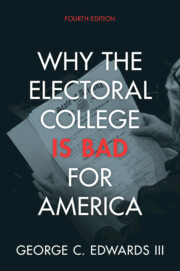
The electoral college is the extraordinarily complex mechanism by which Americans choose their president. Is there any justification for such a system, which may elect the candidate who does not receive the most votes? Today, with two of the last five presidential elections having gone to the popular vote loser and the debacle following the 2020 election, the electoral college's flaws are more apparent than ever. In this fourth edition of the definitive book on the electoral college, George Edwards employs rigorous analysis and systemic data to show how the system violates core democratic principles and does not provide the benefits its advocates claim. With a new chapter focusing on the 2020 election, Edwards addresses justifications for the electoral college that were popular among Trump supporters following the 2016 and 2020 elections. Edwards concludes by offering a straightforward approach to selecting the president that maximizes political equality.
Elections for the presidency, the Majles, and the city councils perpetuate the politics of hybridity, which in turn has left each of these institutions with conflicting legacies. Hybridity has left them neither democratic nor authoritarian, neither paragons of the people’s political will nor symbols and symptoms of an unresponsive and repressive state. Hybridity perpetuates the politics of ambivalence. It renders presidents and parliamentarians and city councilors ineffective if they cross amorphous, undefined redlines. But it also makes them exciting symbols of the popular will if they speak the people’s language, voice their complaints about prices, and promise to better their lives. Hybridity makes normal a neither-here-nor-there routine of the politics of voting and going along with the system, and, on occasion, breaking into protest out of frustration that rituals like voting matter little. Hybridity and ambivalence go hand in hand, reduce the costs of conformity, increase the price of rebellion, and make possible occasional bouts of protest and violence. Like elections, institutions such as the presidency and the parliament entail risks for the authoritarian core of the state, affording potential wildcards institutional platforms and resources to further their own agendas.
The Brazilian military has recently executed an unexpected return to politics by engaging more actively in domestic policymaking and implementation both before and during the Bolsonaro government, thus jeopardising democratic consolidation. To help understand this development, we examine why the military openly challenges civilian authority over some issues, while remaining silent on others. Whereas prior work emphasises external factors like civilians’ threats to military prerogatives, we argue that contestation of civilian authority stems in no small part from internal military conflict over how to utilise power. The military uses contestation to coordinate prerogatives with civilians and to communicate within the armed forces to increase cohesion. We illustrate this argument with case studies of military contestation surrounding political leadership selection and internal security, using the Army Commander's discourse via Twitter posts and public statements, plus key informant interviews and military publications.
Research has shown that first-time voting experiences affect subsequent voting behavior, with salient elections boosting subsequent turnout and non-salient ones suppressing it. We challenge this view. Following research on the context-dependent nature of habit formation, we argue that all elections should affect subsequent turnout in elections of the same type. Comparing individuals that differ only in how salient their first eligible election was (Presidential or Midterm), we find support for this expectation. Individuals are more likely to vote for, and be interested in, elections of the same type as their first voting experience. Leveraging voting age laws in the US, we also show that such laws affect subsequent participation by changing the type of election individuals are first eligible for.
El objetivo de este estudio es analizar hasta qué punto los cibermedios han permeado el ejercicio electoral latinoamericano. Los casos de estudio se centran en las campañas políticas presidenciales de los candidatos que disputaron las elecciones de Colombia y México en el 2018, bajo la perspectiva de la comunicación transmedia que permite la expansión de un relato a través de diversas plataformas. Asimismo, se propone de manera innovadora un modelo de sistemas intermediales transmedia como una propuesta metodológica de comunicación en escenarios electorales propios del contexto de la llamada cultura de convergencia mediática. La hipótesis de partida asume que lo transmedia no se hace todavía patente en los mensajes políticos y electorales. La metodología se centra en los casos de estudio de los principales candidatos y el análisis de contenido de sus webs y redes sociales (Twitter, Facebook y YouTube). El resultado evidencia cómo el discurso político usado por los candidatos migró a las plataformas digitales, pero mantuvo la tipología propia de los medios tradicionales, desconociendo aún las posibilidades que ofrece el transmedia storytelling para incentivar la participación activa de los posibles electores en la producción de contenidos para la campaña.
The primary topic of our chapter is the need for possible theoretical foundations of, and empirical approaches to, a developmental science of politics. We demonstrate the utility of studying political socialisation surrounding presidential elections by describing the results of a large study of US elementary-school-age children’s views of the 2016 US presidential election. We review some potential sources of influence on children's political knowledge and attitudes, highlighting the role of gender, and we speculate about the beliefs that children may have internalised from watching the 2016 election. Finally, we argue that US institutions and parents should strive to improve children's political socialisation by, for example, providing youth with environments that are rich in information related to the purpose and value of politics, and ripe with opportunities and encouragement for political thought and action.
Do messages that evoke a gendered leadership style affect attitudes toward well-known candidates? If so, among what sorts of voters? I show that voters’ evaluations of national politicians, including Hillary Clinton, can be influenced by presenting candidates as stereotypically masculine or feminine leaders. In two survey experiments of California registered voters (n = 1,800 each) conducted at the height of the 2016 presidential election campaign, I find that, on average, voters seemed to prefer both male and female politicians more when they were described as having feminine leadership styles. However, clear heterogeneous treatment effects occurred: Democrats, liberals, and women from all parties evaluated politicians more favorably when they were described as feminine; Republicans, conservatives, and voters for Donald Trump evaluated the same candidates less favorably when described as feminine. The findings have implications for scholarship that links gender stereotyping, partisanship, and ideology to voter behavior.
This chapter discusses the scope of the right to free elections in the Convention. It explores how this is largely limited to legislatures but there are debates about the application to presidential elections and referendums. The chapters includes a discussion on globalisation and the development of the free elections case law in respect of the European Parliament.
Chapter Three provides robust evidence of the racial anger gap and its consequences for participation. With the aid of findings from survey data providing nearly 40 years’ worth of information on black and white Americans’ political attitudes, emotions and participation, I demonstrate the effect of the anger gap on black turnout in political eras particularly threatening to the collective interests of African Americans. Insights on how the anger gap shaped black decisions to participate in electoral politics span the Reagan era to the dawn of the Trump era. The first object of respondents’ anger measured in this chapter is the set of presidential incumbents and major party candidates across election years. The second measure employed is an indicator of how often survey respondents felt angry over the course of the 2016 election. Whereas this is a more open-ended measure, analyses demonstrate that individuals’ reports of anger were closely ties to their perceptions of the figure who dominated the election season—Donald J. Trump. This chapter also explores whether the racial anger gap is moderated by the cross-cutting social identities of gender, age and education attained.
Until 2008, only White candidates represented either of the two major parties as presidential nominees. Hence, little is known about how race appeals are framed by or against non-White presidential candidates. Barack Obama's election as the Democratic Party nominee allows us to investigate this issue. In this article, we conduct a content analysis of over 160 advertisements from the 2008 U.S. presidential election to examine how race appeals were framed (or countered) by each campaign. We find that the Republican campaign employed implicit racial appeals that played upon stereotypes of non-Whites as “un-American” and “other” and Blacks as “dangerous,” “criminal,” “incompetent,” and “uppity.” In contrast, the Democratic campaign de-emphasized race, portrayed “other” as positive, reinforced American identity, and spoke out against negative advertisements.