Refine search
Actions for selected content:
414 results
2 - Transport of Chemical Species in the Atmosphere
-
- Book:
- Atmospheric Chemistry
- Print publication:
- 19 November 2026, pp 17-35
-
- Chapter
- Export citation
Diffusion-driven flow about an impermeable sphere or cylinder in a stably stratified liquid: the singular limit of small Rayleigh numbers
-
- Journal:
- Journal of Fluid Mechanics / Volume 1045 / 25 October 2026
- Published online by Cambridge University Press:
- 21 October 2026, A38
-
- Article
-
- You have access
- Open access
- HTML
- Export citation
Propagating fronts of convection rolls in Rayleigh–Bénard convection
-
- Journal:
- Journal of Fluid Mechanics / Volume 1043 / 25 September 2026
- Published online by Cambridge University Press:
- 28 September 2026, A44
-
- Article
-
- You have access
- Open access
- HTML
- Export citation
-
We investigate the propagation of counter-rotating convection rolls in Rayleigh–Bénard convection initiated locally in a quiescent fluid layer under supercritical conditions. The velocity of the front separating quiescent fluid from the forming convection rolls, and the wavenumber of the convection rolls remaining behind the front, are explored. We numerically investigate fronts of forming convection rolls over five orders of magnitude of the reduced Rayleigh number,
 $\epsilon$, in two- and three-dimensional domains, for a broad range of boundary conditions, and for different front initiation approaches. In all cases, the front velocity increases as
 $\epsilon ^{1/2}$ with increasing
 $\epsilon$ for
 $\epsilon \lesssim 1$ in agreement with predictions using the amplitude equation. The amplitude equation description of the front velocity remains accurate for
 $\epsilon \lesssim 10$ except when the Prandtl number is large which yields a velocity that is faster than predicted for a fluid layer far from threshold. The wavenumber of the convection rolls increases linearly with
 $\epsilon$ in agreement with the wavenumber that maximises the growth rate of perturbations in the linear regime. Farther from onset, the wavenumber growth transitions to a reduced scaling of
 $\epsilon ^{1/4}$ in agreement with predictions using the Swift–Hohenberg equation in the large-
 $\epsilon$ limit. The scalings describing the wavenumber variation with
 $\epsilon$ are independent of the domain geometry, boundary conditions and front initiation method. However, the front-selected wavenumber at criticality does not equal the critical wavenumber of the bulk instability, in general, and depends significantly upon these details. We compare our results with experimental measurements where possible.


The impact of a nonlinear equation of state on the convective instability of a radiatively heated system
-
- Journal:
- Journal of Fluid Mechanics / Volume 1041 / 25 August 2026
- Published online by Cambridge University Press:
- 27 August 2026, A15
-
- Article
-
- You have access
- Open access
- HTML
- Export citation
-
We consider convection in an internally heated system with a nonlinear equation of state (EOS) using linear stability analysis, direct numerical simulation (DNS) and weakly nonlinear analysis. Motivated by melt ponds on Arctic sea ice, we consider a fluid layer subject to heating from radiative absorption, an isothermal lower boundary and an imperfectly conducting top boundary. A modified Fourier spectral method is employed in the linear stability analysis to ensure numerical convergence. We perform two-dimensional DNS for a wide range of parameters, alongside representative three-dimensional cases. Both linear theory and the DNS show that the nonlinear EOS significantly influences the instability characteristics. We define a dimensionless parameter
 $\kappa _n$ to quantify the level of nonlinearity of the EOS, so that the Rayleigh number
 $ \textit{Ra}$ and
 $\kappa _n PrRa^2$ (where
 $ \textit{Pr}$ is the Prandtl number) act as a measure of the buoyancy-driven forcing caused by the linear and nonlinear parts of the EOS, respectively. With sufficiently large
 $ \textit{Ra}$, and increasing
 $|\kappa _n|$, the system undergoes a transition between different modal structures. There is bottom-up convection from the lower boundary with small
 $|\kappa _n|$, and shallow top-down convection from the top boundary with large
 $|\kappa _n|$. For intermediate
 $|\kappa _n|$ and increasing
 $ \textit{Ra}$, we find successive alternating windows of stability, instability, reemergence of stability and finally instability. A weakly nonlinear analysis indicates that the bifurcations are supercritical. The implications for mixing in Arctic melt ponds are discussed. The net heat flux across the atmosphere-pond interface varies depending on the flow regime.


Ultimate regimes in horizontal and internally heated convection
-
- Journal:
- Journal of Fluid Mechanics / Volume 1037 / 25 June 2026
- Published online by Cambridge University Press:
- 18 June 2026, R7
-
- Article
-
- You have access
- Open access
- HTML
- Export citation
-
We derive asymptotic models for the ultimate regimes in horizontal convection (HC) and pure internally heated convection (IHC), in analogy with our recent (2024) extension of the ultimate-regime model for Rayleigh–Bénard convection (RBC). To derive the corresponding models for HC and IHC, we combine turbulent boundary-layer relations with the exact dissipation balances for these two systems. For HC, the resulting scaling relations are consistent with the rigorous transport bound of Siggers et al. (2004 J. Fluid Mech. vol. 517, 55–70). For pure IHC, they are consistent with the exact HC–IHC balance analogy of Wang et al. (2021 Geophys. Res. Lett. vol. 48, e2020GL091198) and with the rigorous bounds on the convective-flux asymmetry in the equal-temperature-plates configuration (Arslan et al. 2021 J. Fluid Mech. vol. 919, A15). The main difference between RBC and HC/IHC is that, in the latter two cases, the global kinetic-energy balance does not contain the additional response factor (dimensionless convective heat flux in HC or inverse bulk temperature in IHC), whereas it does in RBC. As a consequence, for fixed Prandtl number
 ${\textit{Pr}}$, the ultimate-regime scaling exponent is
 $1/3$ for both HC and IHC, rather than
 $1/2$ as in RBC.


Suppression of Rayleigh–Bénard convection and restratification by horizontal convection
-
- Journal:
- Journal of Fluid Mechanics / Volume 1037 / 25 June 2026
- Published online by Cambridge University Press:
- 15 June 2026, A15
-
- Article
-
- You have access
- Open access
- HTML
- Export citation
-
We investigate the competition between horizontal convection (HC) and Rayleigh–Bénard convection (RBC) in a fluid layer subject to a uniform destabilising buoyancy flux at the bottom and a horizontally varying buoyancy distribution at the top. The RBC forcing imposes negative horizontal mean vertical buoyancy gradients at the top and bottom of the fluid layer. But if the HC forcing is sufficiently strong then the volume-averaged vertical buoyancy gradient,
 $\langle b_z \rangle$, is positive i.e. opposite in sign to destabilising RBC buoyancy gradients at the boundaries. If
 $\langle b_z \rangle \gt 0$ we say that the layer has been ‘restratified’. Using scaling analysis based on power integrals together with two-dimensional direct numerical simulations at Rayleigh numbers up to
 $10^{10}$, we identify two cases: a neutral stratification state, in which HC first offsets RBC so that
 $\langle b_z \rangle = 0$, and a strong stratification regime, in which HC dominates and
 $\langle b_z \rangle$ is opposite in sign, and greater in magnitude, than the prescribed destabilising vertical buoyancy gradient at the layer boundaries. For the range of parameters explored in this study, we derive scaling laws for the onset of these regimes in terms of the horizontal and vertical flux Rayleigh numbers,
 $\mathit{Ra_H}$ and
 $\mathit{Ra_V}$, finding
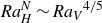 $\mathit{Ra}^{\mathit{N}}_{\mathit{H}} \sim \mathit{Ra_V}^{4/5}$ for the neutral state and
 $\mathit{Ra}^{\mathit{S}}_{\mathit{H}} \sim \mathit{Ra_V}$ for the onset of strong stratification. The results highlight the controlling role of the top boundary layer in setting the mean stratification and clarify the conditions under which HC suppresses RBC. These findings are relevant to geophysical environments such as subglacial lakes, and the oceans of snowball Earth and icy moons, where bottom heating and horizontal buoyancy variations jointly shape ocean stratification.


Prandtl number dependence of rotating internally heated convection
-
- Journal:
- Journal of Fluid Mechanics / Volume 1037 / 25 June 2026
- Published online by Cambridge University Press:
- 11 June 2026, A4
-
- Article
-
- You have access
- Open access
- HTML
- Export citation
-
We investigate the influence of the Prandtl number (
 $\textit{Pr}$) on penetrative internally heated convection (IHC) in both non-rotating and rotating regimes using three-dimensional direct numerical simulations. By varying
 $\textit{Pr}$ between 0.1 and 100, we show that the global mean temperature
 $\overline {\langle T \rangle }$ is not very sensitive to
 $\textit{Pr}$, and is primarily controlled by the dynamics of the unstably stratified top boundary layer. In contrast, the Prandtl number dictates the behaviour of the lower, stably stratified region and affects the vertical convective heat flux
 $\overline {\langle wT \rangle }$. In the non-rotating case, low-
 $\textit{Pr}$ fluids exhibit a ‘symmetry recovery’ where turbulent stirring agitates the stable layer, whereas high-
 $\textit{Pr}$ fluids transition towards a ‘dead zone’ of suppressed fluctuations. Under rotation, we find that
 $\overline {\langle wT \rangle }$ is enhanced across all Prandtl numbers, though global cooling efficiency, measured by the reduction in
 $\overline {\langle T \rangle }$, is only improved for
 $\textit{Pr}\geqslant 1$ due to the emergence of Ekman pumping. These results demonstrate that while IHC shares some scaling similarities with Rayleigh–Bénard convection at the top boundary, the internal stratification creates a unique sensitivity to
 $\textit{Pr}$ that is critical for understanding heat transport in planetary and stellar interiors.


Horizontal pumping using topography and heating patterns
-
- Journal:
- Journal of Fluid Mechanics / Volume 1034 / 10 May 2026
- Published online by Cambridge University Press:
- 05 May 2026, A39
-
- Article
-
- You have access
- Open access
- HTML
- Export citation
Convection in spherical Taylor–Couette flow under the influence of the dielectrophoretic force
-
- Journal:
- Journal of Fluid Mechanics / Volume 1033 / 25 April 2026
- Published online by Cambridge University Press:
- 10 April 2026, A4
-
- Article
-
- You have access
- Open access
- HTML
- Export citation
-
This study investigates convection in a non-isothermal spherical Taylor–Couette flow (sTC) under the influence of the dielectrophoretic (DEP) force. The convective flow is driven by differential rotation of the inner and outer boundaries rotating with
 $\varOmega$ and
 $\Delta {\varOmega }$ in combination of an electric tension applied between both shells to induce thermo-electrohydrodynamic (TEHD) convection. To understand the interaction between DEP force-driven and rotation-driven mechanisms, we first analysed TEHD convection and non-isothermal sTC flow independently. For the TEHD case, we establish scaling relations for heat transport by expressing the Nusselt number,
 ${\textit{Nu}}$, as a function of the electric Rayleigh number,
 ${\textit{Ra}}_{{E}}$, and the kinetic energy density,
 $\tilde {E}_k$. These relations are evaluated against classical models of convection to assess consistency and deviations. A similar approach was applied to the non-isothermal sTC flow in the absence of the DEP force, where we identified axisymmetric and non-axisymmetric flow regimes which were classified by
 ${\textit{Nu}}$,
 $\tilde {E}_k$ and
 $\Delta {\varOmega }$, and developed corresponding scaling relations. When both mechanisms were active,
 ${\textit{Nu}}$ generally increased, however, the DEP force locally suppressed angular momentum transport, especially near the equator. This interplay revealed three distinct regimes: (A) DEP force-dominated TEHD convection, (C) rotation-dominated non-isothermal sTC flow and (B) a transitional regime with reduced heat transport. A decomposition of a derived inflow Nusselt number,
 ${\textit{Nu}}^q$, based on conductive and convective contributions, further elucidated the underlying heat transport mechanism.


Natural convection and pattern interaction within an inclined two-dimensional slot
-
- Journal:
- Journal of Fluid Mechanics / Volume 1032 / 10 April 2026
- Published online by Cambridge University Press:
- 06 April 2026, A41
-
- Article
-
- You have access
- Open access
- HTML
- Export citation
Effects of weak centrifugal force in turbulent rotating thermal convection
-
- Journal:
- Journal of Fluid Mechanics / Volume 1030 / 10 March 2026
- Published online by Cambridge University Press:
- 03 March 2026, A26
-
- Article
-
- You have access
- HTML
- Export citation
-
This experimental study aims to clarify how and when a weak centrifugal force affects the turbulent rotating thermal convection system. For the bulk flow, the weak centrifugal effect is significant on long-time averaged flow fields, contrasting sharply with its negligible effect on the instantaneous fields. As for the sidewall flow, it is found that properties of the boundary zonal flow are influenced by the weak centrifugal force appreciably. The onset Froude number
 $\textit{Fr}_c^{\textit{local}}$, signalling when the weak centrifugal effects start to set in, is found to scale with Rayleigh number
 $Ra$ as
 $\textit{Fr}_c^{\textit{local}}\sim Ra^{0.55}$ over approximately two and a half decades of
 $Ra$. The underlying mechanism for this robust scaling is captured by the mechanism of local force balance, which involves three unknown local scales. With the help of both a viscous–Archimedean–Coriolis argument and the experimental data, these local scales are successfully resolved to reveal a consistent result with this 0.55 scaling.


A self-consistent numerical model of internal wave-induced mean flow oscillations in polar geometry
-
- Journal:
- Journal of Fluid Mechanics / Volume 1028 / 10 February 2026
- Published online by Cambridge University Press:
- 06 February 2026, A38
-
- Article
-
- You have access
- HTML
- Export citation
Enhancing the heat-transfer rate by inhomogeneous porous boundary in turbulent convection
-
- Journal:
- Journal of Fluid Mechanics / Volume 1028 / 10 February 2026
- Published online by Cambridge University Press:
- 05 February 2026, R1
-
- Article
-
- You have access
- HTML
- Export citation
Pattern selection between two-dimensional Rayleigh–Bénard convection and electroconvection near electrochemical surfaces
-
- Journal:
- Journal of Fluid Mechanics / Volume 1028 / 10 February 2026
- Published online by Cambridge University Press:
- 30 January 2026, A10
-
- Article
-
- You have access
- HTML
- Export citation
Analytical solution for the laminar wake behind a finite heat/mass sink
-
- Journal:
- Journal of Fluid Mechanics / Volume 1027 / 25 January 2026
- Published online by Cambridge University Press:
- 14 January 2026, A20
-
- Article
-
- You have access
- Open access
- HTML
- Export citation
Collective effects of neighbouring melting ice objects
-
- Journal:
- Journal of Fluid Mechanics / Volume 1027 / 25 January 2026
- Published online by Cambridge University Press:
- 12 January 2026, A10
-
- Article
-
- You have access
- Open access
- HTML
- Export citation
-
We present a study on the melting dynamics of neighbouring ice bodies by means of idealised simulations, focusing on collective effects, with the goal of obtaining fundamental insight into how collective interactions influence the melting of ice. Two neighbouring (vertically or horizontally aligned), square-shaped and equally sized ice objects (size of the order of centimetres) are immersed in quiescent fresh water at a temperature of
 ${20}\,^\circ \textrm {C}$. By performing two-dimensional direct numerical simulations, and using the phase-field method to model the phase change, the collective melting of these objects is studied. When the objects are horizontally aligned, no significant influence of the neighbouring object on the melting time is observed. On the other hand, when vertically aligned, although the melting of the upper object is mostly unaffected, the melting time and the morphology of the lower ice body strongly depends on the initial inter-object distance. We report that the melting of the bottom object can be enhanced by more than 10 %, or delayed more than 20 %, displaying a non-monotonic dependence on the initial object size. We show that this behaviour results from a non-trivial competition between layering of cold fluid, which lowers the heat transfer, and convective flows, which favour mixing and heat transfer. For this melting in mixed convection, we were able to collapse our data onto a single curve.

Dissolution-driven transport in a rotating horizontal cylinder
-
- Journal:
- Journal of Fluid Mechanics / Volume 1026 / 10 January 2026
- Published online by Cambridge University Press:
- 07 January 2026, A39
-
- Article
-
- You have access
- Open access
- HTML
- Export citation
-
We study the combined effects of natural convection and rotation on the dissolution of a solute in a solvent-filled circular cylinder. The density of the fluid increases with increasing concentration of the dissolved solute, and we model this using the Oberbeck–Boussinesq approximation. The underlying moving-boundary problem has been modelled by combining the Navier–Stokes equations with the advection–diffusion equation and a Stefan condition for the evolving solute–fluid interface. We use highly resolved numerical simulations to investigate the flow regimes, dissolution rates and mixing of the dissolved solute for
 $Sc = 1$,
 $Ra \in [10^5, 10^8]$ and
 $\varOmega \in [0, 2.5]$. In the absence of rotation and buoyancy, the distance of the interface from its initial position follows a square root relationship with time (
 $r_d \propto \sqrt {t}$), which ceases to exist at a later time due to the finite-size effect of the liquid domain. We then explore the rotation parameter, considering a range of rotation frequency – from smaller to larger, relative to the inverse of the buoyancy-induced time scale – and Rayleigh number. We show that the area of the dissolved solute varies nonlinearly with time depending on
 $Ra$ and
 $\varOmega$. The symmetry breaking of the interface is best described in terms of
 $Ra/\varOmega ^2$.


Scale-resolved turbulent Prandtl number for Rayleigh–Bénard convection at
 ${{\textit{Pr}}\boldsymbol{=}\boldsymbol{10}^{\boldsymbol{-3}}}$
-
- Journal:
- Journal of Fluid Mechanics / Volume 1026 / 10 January 2026
- Published online by Cambridge University Press:
- 26 December 2025, A6
-
- Article
-
- You have access
- Open access
- HTML
- Export citation
-
We present a framework to calculate the scale-resolved turbulent Prandtl number
 ${\textit{Pr}}_t$ for the well-mixed and highly inertial bulk of a turbulent Rayleigh–Bénard mesoscale convection layer at a molecular Prandtl number of
 ${\textit{Pr}}=10^{-3}$. It builds on Kolmogorov’s refined similarity hypothesis of homogeneous isotropic fluid and passive scalar turbulence, based on log–normally distributed amplitudes of kinetic energy and scalar dissipation rates that are coarse-grained over variable scales
 $r$ in the inertial subrange. Our definitions of turbulent (or eddy) viscosity and diffusivity do not rely on mean gradient-based Boussinesq closures of Reynolds stresses and convective heat fluxes. Such gradients are practically absent or indefinite in the bulk. The present study is based on direct numerical simulation of plane-layer convection at an aspect ratio of
 $\varGamma =25$ for Rayleigh numbers
 $10^5\leqslant Ra\leqslant 10^7$. We find that the turbulent Prandtl number is effectively up to four orders of magnitude larger than the molecular one,
 ${\textit{Pr}}_t\sim 10$. This holds particularly for the upper end of the inertial subrange, where the eddy diffusivity exceeds the molecular value,
 $\kappa _e(r)\gt \kappa$. Highly inertial low-Prandtl-number convection becomes effectively a higher-Prandtl-number turbulent flow, when turbulent mixing processes on scales that reach into the inertial range are included. This might have some relevance for prominent low-Prandtl-number applications, such as solar convection.


Harnessing cilium oscillations for enhanced transport in chaotic flow
-
- Journal:
- Journal of Fluid Mechanics / Volume 1026 / 10 January 2026
- Published online by Cambridge University Press:
- 26 December 2025, R1
-
- Article
-
- You have access
- HTML
- Export citation
5 - Meteorology and Climate of the Tropics in the Southern Hemisphere
-
-
- Book:
- Meteorology and Climate of the Southern Hemisphere
- Published online:
- 10 December 2025
- Print publication:
- 18 December 2025, pp 153-189
-
- Chapter
- Export citation
