To save content items to your account,
please confirm that you agree to abide by our usage policies.
If this is the first time you use this feature, you will be asked to authorise Cambridge Core to connect with your account.
Find out more about saving content to .
To save content items to your Kindle, first ensure no-reply@cambridge.org
is added to your Approved Personal Document E-mail List under your Personal Document Settings
on the Manage Your Content and Devices page of your Amazon account. Then enter the ‘name’ part
of your Kindle email address below.
Find out more about saving to your Kindle.
Note you can select to save to either the @free.kindle.com or @kindle.com variations.
‘@free.kindle.com’ emails are free but can only be saved to your device when it is connected to wi-fi.
‘@kindle.com’ emails can be delivered even when you are not connected to wi-fi, but note that service fees apply.
Residents of Syria in the mid-1250s – Franks and Arabic-speaking Muslims, Christians and Jews – would probably not have imagined the possibility of a region without Frankish communities and polities in Outremer, what today we call the Levant. King Louis IX’s crusade to Egypt in 1249–50 had ended in spectacular defeat, and a Mamlūk state of sorts had been established in 1250, bringing Ayyubid rule in Egypt to a close (discussed later). There were worrisome rumblings from the East – a large army under Hülegü (Chinggis Khan’s grandson and brother of the Great Khan Möngke (r. 1251–59)) had arrived in north-eastern Iran, and was working its way across that large country. But Louis IX had paid his ransom to the Mamlūks, been released, and had spent four years in Palestine rebuilding fortifications and strengthening the Frankish communities before he returned to France in 1254. The Mamlūks of Egypt and the Syrian Ayyubids had battled themselves to a standstill in the early 1250s, with an uneasy frontier somewhere between north-eastern Sinai and south-western Palestine.
The Byzantine reaction to the establishment of the Latin states in the wake of the First Crusade is puzzling at first sight. In themselves, the kingdom of Jerusalem, the principality of Antioch, the county of Tripoli and the county of Edessa posed no direct threat to the empire. On the contrary, they were potential allies against the Armenians of Cilicia, the Danishmendid Turks of Sebasteia and the Seljuk Turks of Ikonion, the enemies that the Byzantines would have to subdue if they were to restore their control over the areas of Asia Minor lost in the years after the Battle of Manzikert in 1071. Nevertheless, successive Byzantine emperors devoted considerable energy and resources to an attempt to bring the Latin states under their authority, leading three major military expeditions into the area. Some recent commentators have been perplexed by this apparent diversion from what might be regarded as the main task of reconquering Asia Minor and have interpreted it as part of a wider expansionist strategy that was designed to bring the empire’s frontiers up to the Euphrates.
Between the end of the war in Vietnam in 1975 and US–Vietnam diplomatic normalization in 1995, governmental negotiations often fell into a stalemate despite people’s desire for improved relations. The delayed normalization bore the impacts of the Cold War politics and regional conflicts among Vietnam, Cambodia, and China. This chapter argues that the US policy toward Vietnam from 1975 to the early 1990s was ambiguous and perplexing and that it was ordinary citizens who laid the groundwork for rapprochement. Standing in contrast with governmental animosity were numerous American citizens, especially Vietnam veterans, diligently crossing the Pacific Ocean to help build schools and hospitals, to promote cultural and academic exchange, and to advocate for diplomatic normalization. While their governments’ diplomacy was founded on distrust and political calculations, these ordinary citizens built their relations on trust and compassion that transcended national or political boundaries.
One of the defining episodes of postwar US–Japanese relations was the so-called Girard incident, in which specialist third-class William Girard shot and killed Sakai Naka, a Japanese woman who was picking up shell casings on a US firing range in January 1957. The shooting sparked a diplomatic crisis that shook the US–Japan alliance, leading many historians to situate the incident in the history of the two nations’ diplomatic relations after World War II. This chapter attempts to resituate the incident, in part, by showing that it was only one of at least 200 instances in which US sentries and soldiers fired on Japanese civilians from the start of the Allied Occupation through the beginning of the 1960s.
This Element reassesses early modern Mediterranean diplomacy by positioning the Grand Duchy of Tuscany at the centre of cross-confessional interactions with several Islamic powers between 1574 and 1610. It demonstrates how a small state shaped and used diplomacy to pursue commerce, security, and prestige in the Islamic Mediterranean, while remaining reliant on papal and Spanish Habsburg support. The argument rests on three case studies: Bongianni Gianfigliazzi's 1578 embassy in Ottoman Constantinople; Medici diplomacy in the Maghreb, facilitated by the Corsican agent Andrea Gaspari, embedded in both Algerian and Moroccan power networks; and the 1610 negotiations with Shah Abbas I's envoy concerning Persian captives in Livorno. Together, these episodes present diplomacy as performative, negotiated, and multi-actor, demonstrating that small polities actively shaped Mediterranean order in the late sixteenth and early seventeenth centuries.
When, why, and how did we, humans, develop our distinctive and paradoxical inclinations for both war and peace? This groundbreaking book investigates that central question by drawing on cutting-edge research and an unprecedented range of evidence from thirteen disciplines: biology, primatology, comparative ethology, behavioural ecology, anthropology, archaeology, criminology, social psychology, linguistics, demography, genetics, neuroscience, and climatology. The book shows how the capacities for both war and peace co-evolved gradually over millions of years through a mosaic-like pattern, with distinct but interacting components emerging at different moments and becoming integrated over evolutionary time. This deep-rooted trajectory has been shaped by feedback loops among biological, cultural, and environmental forces. With its expansive temporal horizon, cross-species comparisons, and empirical richness, this book offers a sweeping new account – and an indispensable resource – for anyone interested in the origins of the Janus-faced inclination for both war and peace in the human species.
How can we explain interactions between historical international orders? Despite growing interest in the role of marginal interactions in the evolution of international orders, scholars struggle to account for their contingency. Enduring commitments to substantialist approaches limit our ability to theorize the link between micro-level interactions in system encounters and macro-level international order, and vice versa. I argue that conflicts in system encounters can be explained as manifestations of a process through which international orders and their differences are constituted and negotiated. International orders and their differences exist in concrete instantiations only in the context of system encounters. Building on a practice-relational approach to international order, I propose that system encounters are characterized by a series of crises that challenge the taken-for-granted nature of established practices, prompting actors to articulate the relevant differences between them. I illustrate this process in the context of the Russian, Dutch, and British embassies to China during the seventeenth and eighteenth centuries and show how the relevant differences between the East Asian and European international orders can be reconstructed from those interactions. This paper advances the study of historical international orders and has important implications for how we think about conflicts in system encounters.
This article examines how the Greek-rite Albanian community of Barile, in the seventeenth-century Kingdom of Naples, negotiated the pressures of post-Tridentine religious reform while preserving elements of its ritual and social identity. In the aftermath of the Council of Trent, ecclesiastical authorities – particularly bishops and inquisitors – sought to regulate devotional life by suppressing practices classified as “superstitious.” These policies were gradually extended to Eastern Christian communities, which had previously enjoyed a degree of liturgical autonomy within the Kingdom of Naples. Focusing on the confrontation between Bishop Deodato Scaglia and the Greek community of Barile, this article explores how local actors responded to increasing pressure to conform to the Latin rite. Drawing on episcopal reports, inquisitorial correspondence, synodal decrees, and documents from the Congregation of Propaganda Fide, the study identifies four recurring patterns of adaptation: control of sacred space, intermarriage, factional organization, and diplomatic negotiation. It argues that practices labeled “superstitions” functioned not only as objects of repression but also as mechanisms through which the community articulated collective identity and negotiated confessional boundaries, showing that post-Tridentine reform operated through continuous negotiation rather than unilateral imposition.
The normalization of relations eluded the United States and the Socialist Republic of Vietnam even fifteen years after the fall of Saigon. Despite both sides maintaining negotiations on several issues, including Indochinese refugees, the accounting of missing American soldiers, and the Third Indochina War, tangible bilateral exchanges remained absent. While Hanoi’s embrace of Doi Moi in December 1986 initiated a pragmatic foreign policy, more impactful to US–Vietnamese diplomacy was Ronald Reagan’s decision to appoint General John Vessey as presidential emissary. Vietnam viewed Vessey’s position as proof that the US sought sustained, high-level negotiations. Moreover, they resulted in tangible humanitarian exchanges. This paper shows how Vessey’s appointment was the catalyst for stronger US–Vietnamese relations.
Previous attempts at explaining how geographically distant and disparate Bronze Age polities, like the chiefdoms of northern Europe and the urban states of the Mediterranean, were connected have focused on exchange networks. By combining insights from political science with archaeology, this article sets out to do two things. First, to reintroduce system thinking to model interconnectivities in the Bronze Age world, using an old trope in international relations studies as a lens and analytical tool. Second, to argue that diplomacy and war must be treated on a par with trade as institutions of such a system, of major importance for understanding international relations during the Bronze Age. The authors discuss the so-called Amarna system’s scope in time and space, exploring whether and how Bronze Age polities in the far north of Europe, as outsiders, can be plausibly construed as constitutive ‘others’.
The complex relationships between Indigenous groups in the area that became New Orleans undergird the ceremony by which Bienville founded the city in 1718, a ceremony that, in turn, presages the first theatrical production in the city in the early nineteenth century. Despite the massive die-off of the Indigenous, especially in the eighteenth century, as European diseases decimated their numbers, they remained visible in the city all the way into the early twentieth century, particularly through the spectacles of sports and craft-marketing and their close association with the well-known Creole missionary and poet, Father Adrien Rouquette.
Chapter 1 revives the traditional view that Sir William Temple had a profound influence on Swift against the recent tendency to underrate Temple. It does so by providing long overdue attention to the most neglected yet most substantial dimension of Temple’s career, literary work, and bequest to Swift: the international dimension. Temple’s teachings as diplomat and foreign policy essayist are primarily responsible for Swift’s heightened awareness of the intersection of domestic and international politics throughout his career. Hence also Swift’s recognition of the interdependence of domestic liberty and international security – the need to preserve liberty through not only constitutional balance but also international balance. This inextricable relationship is often overlooked by scholars focused on the domestic ideological binary of liberty versus authority. It reveals Temple’s and Swift’s shared opposition to domestic political polarization, even at the risk of being falsely accused of favoring absolutist, paternalistic, or arbitrary government.
Resolving the Israeli-Palestinian Conflict is aimed at politicians, diplomats, policymakers, scholars, journalists, and informed readers seeking to understand why peace efforts have repeatedly failed-and how true reconciliation remains possible. Based on over one hundred interviews with Middle-Eastern, European, and American leaders, alongside extensive archival research, the book offers rare insight into the dynamics of diplomacy. It reveals how trust, fairness, and political courage are vital for peace. By analysing pivotal moments-from Oslo to Camp David and the Abbas-Olmert talks, it identifies recurring mistakes and proposes strategies to foster mutual recognition and lasting coexistence. Both authoritative and accessible, the book blends history, law, ethics, and international relations into a practical roadmap for future peace efforts. Its interdisciplinary approach and use of primary sources make it both authoritative and engaging. Readers will come away with a deeper understanding of the conflict and the tools needed to help resolve it.
This chapter introduces the origins and development of international law in the ancient Near East, drawing on cuneiform sources from Mesopotamia, Syria, Anatolia and Iran. It outlines the evolution of political structures from city states to empires over three millennia, highlighting how norms of diplomacy, treaties, trade and warfare were shaped by customary practices rather than codified law. The chapter explores the geographical and historical context, the rediscovery of ancient texts and the role of religion and cosmology in shaping legal and diplomatic thought. It emphasizes the fragmentary yet rich nature of the evidence – treaties, letters and inscriptions – and argues for a coherent tradition of international norms rooted in moral and religious authority. The text also reflects on scholarly debates, including comparisons with biblical traditions and the limitations of Mesopotamian legal thought. Ultimately, it presents the ancient Near East as a foundational context for understanding the early development of international relations and law.
This chapter critically examines the existence and conceptualisation of ‘international law’ in the Greek and Roman world from 600 BC to AD 650. It challenges traditional minimalist views that exclude antiquity from the history of international law and proposes a recalibrated approach grounded in conceptual history. By analysing legal practices, treaties and philosophical notions such as jus gentium and dikaion koinon, the chapter explores how ancient societies regulated interpolity relations. It introduces eight analytical dichotomies – such as inside/outside, city state/empire, and law/non-law – to frame the discussion. Through case studies on war, diplomacy, trade and dispute resolution, the chapter argues that while ancient international law did not exist in a modern sense, it functioned as a prototype for legal norms governing relations between autonomous entities. The chapter concludes that international law in antiquity was not merely a precursor but a meaningful legal system in its own right, shaped by the need to structure a complex and often hostile world.
This chapter explores the existence and nature of international law in the Sasanian Persian Empire, particularly in its relations with Rome and Byzantium. It examines how the Sasanians conceptualized sovereignty, war and diplomacy, and whether they shared legal norms with their Roman counterparts. Drawing on epigraphic, literary and diplomatic sources, the chapter argues that the Sasanians recognized Rome as an equal sovereign power, as reflected in titles, diplomatic language (e.g. ‘brotherhood’), and treaty practices. It also identifies a Sasanian notion akin to the Roman concept of bellum justum, suggesting a shared understanding of just war. The chapter highlights the sophistication of Persian diplomacy, especially in the treaty of AD 561–2, which demonstrates mutual legal procedures, bilingual documentation and protections for religious minorities. These findings support the view that the Sasanian Empire participated in a form of international law, characterised by mutual recognition, legal formalism and evolving norms of coexistence.
Beginning in the 1950s, emerging from the British empire’s shadow, the Indian government helped dancers become globe-trotting, state-sponsored cultural ambassadors, projecting a vision of the young nation’s art as ancient, sophisticated, and spiritual. Asserting a ‘national culture’ (understood by the formerly colonized as essential to decolonization) involved its reconstitution, despite claims to civilizational continuity. This article reveals how dance became the natural candidate for global cultural projection, the ways in which the state allied with artists in this endeavour, and the conflicts this engendered between them. It offers insights into the state’s anxieties about the nation’s image globally, debates within civil society and between politicians about Indian culture, and the logic underlying how Indian dance was presented differently across the world. The global projection of culture and its reception abroad was part of the contested process of defining it at home. National culture took shape as it travelled the world.
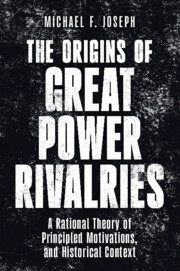
Michael F. Joseph's The Origins of Great Power Rivalries advances a comprehensive rationalist theory of how great powers assess emerging threats; why enduring great power rivalries unfold through either delayed competition, or delayed peace; and how diplomacy functions when rising powers emerge on the scene. In an important departure from traditional realist theory, Joseph argues that countries are motivated by distinct principles - normative values that shape foreign policy beyond simple security concerns. Exploring instances of great power competition, he explains why rational states draw qualitative inferences about rivals' intentions by examining the historical context of their demands, not just military capabilities. Offering an analysis of great power rivalries since 1850, Joseph illuminates British reactions to Stalin at the beginning of the Cold War, among other rivalries. He animates a theoretically sophisticated defense of America's approach to China in the post-Cold War era with 100s of Washington-insider interviews.
Chapter 6 brings in a transnational dimension to the study of China’s image-making in Ethiopia by examining the role of the West in conditioning this encounter. Drawing on interviews with core participants in Chinese initiatives, including Ethiopian elites and Chinese diplomatic professionals, the analysis reveals their shared aspirations for the West, and especially for the United States. Ethiopian participants tend to treat the West as a quality marker, and China as a secondary choice, and at times even as a pathway to experiencing the West. Ironically, Chinese soft power promoters also appear to uphold and aspire to Western hierarchies and use Ethiopia and Africa as a channel toward more desired professional destinations in the West. While Chinese official narratives invoke competition with the West, the actual participants in the Sino-African encounter still strive to be part of it.
Chapter 4 engages with China’s ideational power as part of its image-making in Ethiopia, and more broadly in Africa. The chapter directly speaks to the ongoing debates about the export of the China model to the Global South by delving into the content of and perceptions toward China’s official training programs of African elites. Rather than exporting a model, I find that Chinese educators and officials attempt to legitimize China’s governance (both domestic and global) and to show off China. The actual delivery of these trainings carries some consistency, such as the presentation of China as an alternative type of democracy, as well as some arbitrary content diffusion in specific governance domains like journalism. Far from passively buying into the “China model,” Ethiopian participants soften their perceptions of China, but also negotiate and reject some of its persuasion narratives and strategies.