Most cited
This page lists all time most cited articles for this title. Please use the publication date filters on the left if you would like to restrict this list to recently published content, for example to articles published in the last three years. The number of times each article was cited is displayed to the right of its title and can be clicked to access a list of all titles this article has been cited by.
Contents
- Cited by 32
A note on the laminar mixing of two uniform parallel semi-infinite streams
-
- Published online by Cambridge University Press:
- 29 March 2006, pp. 25-30
-
- Article
- Export citation
- Cited by 32
Deformation of a spherical capsule under oscillating shear flow
-
- Published online by Cambridge University Press:
- 02 December 2014, pp. 288-301
-
- Article
-
- You have access
- HTML
- Export citation
-
The deformation of a spherical capsule in oscillating shear flow is presented. The boundary element method is used to simulate the capsule motion under Stokes flow. We show that a capsule at high frequencies follows the deformation given by a leading-order prediction, which is derived from an assumption of small deformation limit. At low frequencies, on the other hand, a capsule shows an overshoot phenomenon where the maximum deformation is larger than that in steady shear flow. A larger overshoot is observed for larger capillary number or viscosity ratio. Using the maximum deformation in start-up shear flow, we evaluate the upper limit of deformation in oscillating shear flow. We also show that the overshoot phenomenon may appear when the quasi-steady orientation angle under steady shear flow is less than
 $9.0^{\circ }$ . We propose an equation to estimate the threshold frequency between the low-frequency range, where the capsule may have an overshoot, and the high-frequency range, where the deformation is given by the leading-order prediction. The equation only includes the viscosity ratio and the Taylor parameter under simple shear flow, so it can be extended to other deformable particles, such as bubbles and drops.

- Cited by 32
Topographic control of stratified flows: upstream jets, blocking and isolating layers
-
- Published online by Cambridge University Press:
- 16 July 2014, pp. 80-103
-
- Article
-
- You have access
- Export citation
- Cited by 32
The motion of solid particles suspended in viscoelastic liquids under torsional shear
-
- Published online by Cambridge University Press:
- 26 April 2006, pp. 199-222
-
- Article
- Export citation
- Cited by 32
On the non-linear Lamb-Taylor instability
-
- Published online by Cambridge University Press:
- 29 March 2006, pp. 619-631
-
- Article
- Export citation
- Cited by 32

Instability and the post-critical behaviour of two-dimensional inverted flags in axial flow
-
- Published online by Cambridge University Press:
- 12 March 2020, A14
-
- Article
-
- You have access
- HTML
- Export citation
- Cited by 32
Impact of two bodies one of which is covered by a thin layer of liquid
-
- Published online by Cambridge University Press:
- 26 April 2006, pp. 43-58
-
- Article
- Export citation
- Cited by 32
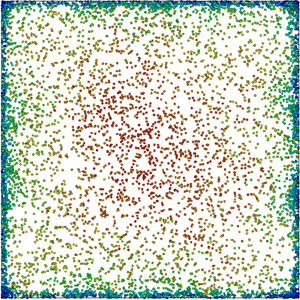
The effect of electrostatic charges on particle-laden duct flows
-
- Published online by Cambridge University Press:
- 29 December 2020, A21
-
- Article
-
- You have access
- HTML
- Export citation
-
We report on direct numerical simulations of the effect of electrostatic charges on particle-laden duct flows. The corresponding electrostatic forces are known to affect the particle dynamics at small scales and the associated turbophoretic drift. Our simulations, however, predicted that electrostatic forces also dominate the vortical motion of the particles, induced by the secondary flows of Prandtl's second kind of the carrier fluid. Herein, we treated flows at two frictional Reynolds numbers (
 $Re_{\tau }= 300$ and 600), two particle-to-gas density ratios (
 $\rho _{p}/\rho =1000$ and 7500) and three Coulombic-to-gravitational force ratios (
 $F_{el}/F_{g}=0$, 0.004 and 0.026). In flows with a high density ratio at
 $Re_{\tau }=600$ and
 $F_{el}/F_{g}=0.004$, the particles tend to accumulate at the walls. On the other hand, at a lower density ratio, respectively a higher
 $F_{el}/F_{g}$ of 0.026, the charged particles still follow the secondary flow structures that are developed in the duct. However, even in this case, the electrostatic forces counteract the particles’ inward flux from the wall and, as a result, their vortical motion in these secondary structures is significantly attenuated. This change in the flow pattern results in an increase of the particle number density at the bisectors of the walls by a factor of five compared with the corresponding flow with uncharged particles. Finally, at
 $Re_{\tau }=300$,
 $\rho _{p}/\rho =1000$ and
 $F_{el}/F_{g}=0.026$ the electrostatic forces dominate over the aerodynamic forces and gravity and, consequently, the particles no longer follow the streamlines of the carrier gas.


- Cited by 32
Similarity of decaying isotropic turbulence with a passive scalar
-
- Published online by Cambridge University Press:
- 21 April 2004, pp. 123-151
-
- Article
-
- You have access
- Export citation
- Cited by 32
Control of a swept-wing boundary layer using ring-type plasma actuators
-
- Published online by Cambridge University Press:
- 03 April 2018, pp. 36-60
-
- Article
-
- You have access
- HTML
- Export citation
- Cited by 32
Leakage from gravity currents in a porous medium. Part 1. A localized sink
-
- Published online by Cambridge University Press:
- 06 January 2011, pp. 391-413
-
- Article
-
- You have access
- Export citation
- Cited by 32
Stochastic coherent adaptive large eddy simulation of forced isotropic turbulence
-
- Published online by Cambridge University Press:
- 08 March 2010, pp. 453-470
-
- Article
-
- You have access
- Export citation
- Cited by 32
Three-dimensional effects on the transfer function of a rectangular-section body in turbulent flow
-
- Published online by Cambridge University Press:
- 10 June 2019, pp. 348-366
-
- Article
-
- You have access
- HTML
- Export citation
-
This paper investigates the influence of three-dimensional effects on the transfer function of a rectangular-section body in turbulent flow. The dimensionless factor
 $\unicode[STIX]{x1D713}$, as derived by Li et al. (J. Fluid Mech., vol. 847, 2018, pp. 768–785), is adapted to evaluate this influence. The calculation of
 $\unicode[STIX]{x1D713}$ requires the spanwise influence term. For this purpose, an adapted form of the lift coherence function is derived, enabling the use of the measured lift coherence for the estimation of the spanwise influence term. Three rectangular models with different cross-sections (chord-to-depth ratios of 3, 5 and 10) are chosen for testing, and a NACA 0015 airfoil model is tested for comparison. Using the measured spanwise influence terms, the dimensionless factors of these models are then numerically calculated under different ratios of the turbulent integral scale to the chord
 $\unicode[STIX]{x1D6FE}$ and aspect ratios
 $\unicode[STIX]{x1D703}$. It is shown that the dimensionless factors of the rectangular models increase as
 $\unicode[STIX]{x1D6FE}$ and
 $\unicode[STIX]{x1D703}$ increase, which are similar to the dimensionless factor of the airfoil model. If
 $\unicode[STIX]{x1D6FE}$ and
 $\unicode[STIX]{x1D703}$ have suitable values, the strip theory could be applicable to the rectangular-section body. It is also found that the dimensionless factors of all the rectangular models are larger than the dimensionless factor of the airfoil model under the same parameters. The smaller the chord-to-depth ratio is, the larger the dimensionless factor is. Using the strip theory to calculate the lift response of the rectangular-section body may provide more accurate estimation. Additionally, the one-wavenumber transfer functions of these models are determined under the consideration of the three-dimensional effects. The results show that the experimental transfer functions of the rectangular models cannot be captured by the Sears function. They are larger than the Sears function at lower frequencies, while falling at a faster rate as the frequency increases. For bluff bodies with separated flow, the modified transfer function presented here appears to be an appropriate approach.


- Cited by 32
The shear dynamo problem for small magnetic Reynolds numbers
-
- Published online by Cambridge University Press:
- 29 November 2010, pp. 265-285
-
- Article
-
- You have access
- Export citation
- Cited by 32
Tidal flow over topography: effect of excursion number on wave energetics and turbulence
-
- Published online by Cambridge University Press:
- 09 June 2014, pp. 259-283
-
- Article
-
- You have access
- Export citation
-
The excursion number,
 $\def \xmlpi #1{}\def \mathsfbi #1{\boldsymbol {\mathsf {#1}}}\let \le =\leqslant \let \leq =\leqslant \let \ge =\geqslant \let \geq =\geqslant \def \Pr {\mathit {Pr}}\def \Fr {\mathit {Fr}}\def \Rey {\mathit {Re}}Ex = U_0/\varOmega l$ , is a parameter that characterizes the ratio of streamwise fluid advection during a tidal oscillation of amplitude
 $U_0$ and frequency
 $\varOmega $ to the streamwise topographic length scale
 $l$ . Direct numerical simulations are performed to study how internal gravity waves and turbulence change when
 $Ex$ is varied from a low value (typical of a ridge in the deep ocean) to a value of unity (corresponding to energetic tides over a small topographic feature). An isolated obstacle having a smoothed triangular shape and 20 % of the streamwise length at critical slope is considered. With increasing values of
 $Ex$ , the near field of the internal waves loses its beam-like character, the wave response becomes asymmetric with respect to the ridge centre, and transient lee waves form. Analysis of the baroclinic energy balance shows significant reduction in the radiated wave flux in the cases with higher
 $Ex$ owing to a substantial rise in advection and baroclinic dissipation as well as a decrease in conversion. Turbulence changes qualitatively with increasing
 $Ex$ . In the situation with
 $Ex \sim 0.1$ , turbulence is intensified at the near-critical regions of the slope, and is also significant in the internal wave beams above the ridge where there is intensified shear. At
 $Ex = O(1)$ , the transient lee waves overturn adjacent to the ridge flanks and, owing to convective instability, buoyancy acts as a source for turbulent kinetic energy. The size of the turbulent overturns has a non-monotonic dependence on excursion number: the largest overturns, as tall as twice the obstacle height, occur in the
 $Ex = 0.4$ case, but there is a substantial decrease of overturn size at larger values of
 $Ex$ simulated here.


- Cited by 32
Ionizing argon boundary layers. Part 1. Quasi-steady flat-plate laminar boundary-layer flows
-
- Published online by Cambridge University Press:
- 12 April 2006, pp. 609-640
-
- Article
- Export citation
- Cited by 32
Boundary layer receptivity to free-stream sound on parabolic bodies
-
- Published online by Cambridge University Press:
- 10 August 1998, pp. 1-26
-
- Article
-
- You have access
- Export citation
- Cited by 32
Global linear stability analysis of jets in cross-flow
-
- Published online by Cambridge University Press:
- 12 September 2017, pp. 812-836
-
- Article
-
- You have access
- HTML
- Export citation
-
The stability of low-speed jets in cross-flow (JICF) is studied using tri-global linear stability analysis (GLSA). Simulations are performed at a Reynolds number of 2000, based on the jet exit diameter and the average velocity. A time stepper method is used in conjunction with the implicitly restarted Arnoldi iteration method. GLSA results are shown to capture the complex upstream shear-layer instabilities. The Strouhal numbers from GLSA match upstream shear-layer vertical velocity spectra and dynamic mode decomposition from simulation (Iyer & Mahesh, J. Fluid Mech., vol. 790, 2016, pp. 275–307) and experiment (Megerian et al., J. Fluid Mech., vol. 593, 2007, pp. 93–129). Additionally, the GLSA results are shown to be consistent with the transition from absolute to convective instability that the upstream shear layer of JICFs undergoes between
 $R=2$ to
 $R=4$ observed by Megerian et al. (J. Fluid Mech., vol. 593, 2007, pp. 93–129), where
 $R=\overline{v}_{jet}/u_{\infty }$ is the jet to cross-flow velocity ratio. The upstream shear-layer instability is shown to dominate when
 $R=2$ , whereas downstream shear-layer instabilities are shown to dominate when
 $R=4$ .


- Cited by 32
Wave-induced wind fluctuation over the sea
-
- Published online by Cambridge University Press:
- 29 March 2006, pp. 751-771
-
- Article
- Export citation
- Cited by 32
Numerical investigation of tandem-cylinder noise reduction using plasma-based flow control
-
- Published online by Cambridge University Press:
- 02 September 2014, pp. 422-451
-
- Article
-
- You have access
- Export citation
-
The noise of flow over tandem cylinders at
 $\def \xmlpi #1{}\def \mathsfbi #1{\boldsymbol {\mathsf {#1}}}\let \le =\leqslant \let \leq =\leqslant \let \ge =\geqslant \let \geq =\geqslant \def \Pr {\mathit {Pr}}\def \Fr {\mathit {Fr}}\def \Rey {\mathit {Re}}{\mathit{Re}}_D= 22\, 000$ and its reduction using single dielectric barrier discharge (SDBD) plasma actuators are simulated numerically both to confirm and extend experimental results. The numerical approach is based on large-eddy simulation (LES) for the turbulent flow field, a semi-empirical plasma actuation model, and Lighthill’s theory for acoustic calculation. Excellent agreement between LES and experimental results is obtained for both the baseline flow and flow with plasma control in terms of wake velocity profiles, turbulence intensity, and frequency spectra of pressure fluctuations on the downstream cylinder. The validated flow-field results allow an accurate acoustic analysis based on Lighthill’s equation, which is solved using a boundary-element method. The effectiveness of plasma actuators for reducing noise is clearly demonstrated. In the baseline flow, the acoustic field is dominated by the interaction between the downstream cylinder and the upstream wake. Through suppression of vortex shedding from the upstream cylinder, the interaction noise is reduced drastically by the plasma flow control, and the vortex-shedding noise from the downstream cylinder becomes equally important. At a free-stream Mach number of 0.2, the peak sound pressure level is reduced by approximately 16 dB. This suggests the viability of plasma actuation for active aeroacoustic control of airframe noise.

