We applaud De Dreu and Gross (D&G) for their novel approach to modeling conflict and for their new theoretical framework on attacker-defender conflicts. Using an asymmetric matrix game as a vehicle to study players’ motives to defend and to attack appears promising. However, we believe that a new theoretical framework should be able to integrate all pertinent prior research and, as such, should also account for known dynamics involved in symmetric conflicts. D&G (sect. 5, para. 1, emphasis added) argue that “symmetric conflicts … present a special class of conflict in which the motive to defend and the motive to attack and exploit are indistinguishable.” Continuing their argumentation, De D&G (sect. 5, para. 1) stress that “asymmetric games of attack and defense … allow to tease apart these distinct motives.” In contrast, we illustrate that the motives to defend and attack can also be disentangled in certain symmetric conflicts. Moreover, we show how broadening the focus to include symmetric conflicts enables the consideration of meaningful past insights – some of which contradict a central claim of the authors’ framework.
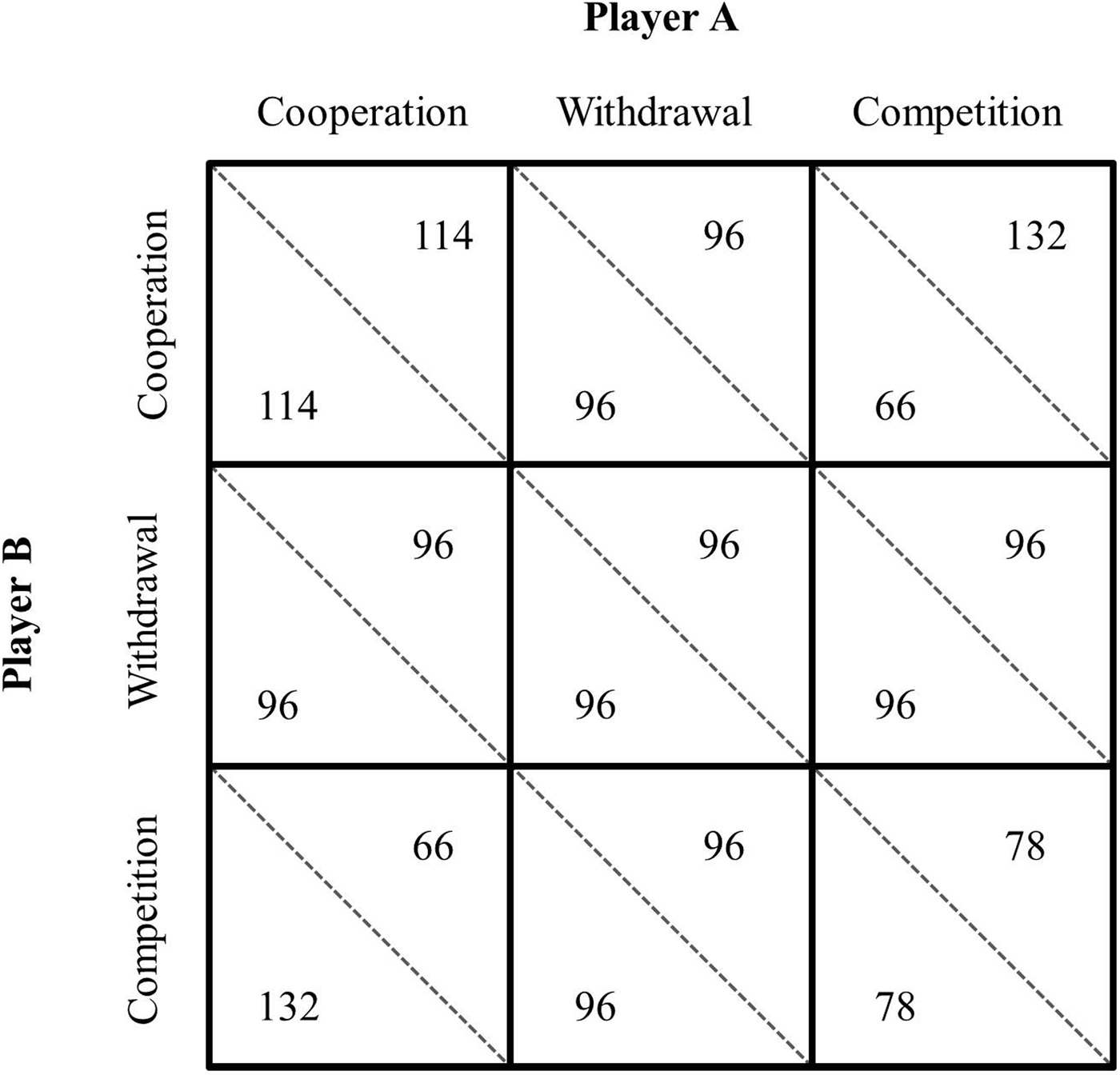
We fully agree that asymmetric games allow the motives of defense and attack to be teased apart, but symmetric games can also provide an opportunity to do so. In fact, this has been successfully done in prior research (e.g., Insko et al. Reference Insko, Schopler, Hoyle, Dardis and Graetz1990; Reference Insko, Schopler, Drigotas, Graetz, Kennedy, Cox and Bornstein1993; Schopler et al. Reference Schopler, Insko, Graetz, Drigotas, Smith and Dahl1993). Insko et al. (Reference Insko, Schopler, Hoyle, Dardis and Graetz1990) developed the so-called PDG-Alt matrix, in which the cooperation and competition options are complemented with a third option, termed withdrawal. Choosing this withdrawal option protects from exploitation by the other party (i.e., when one player is willing to cooperate but expects competition from the other player) and it secures outcomes that are “intermediate to those obtained when both players cooperate or both players compete” (Insko et al. Reference Insko, Schopler, Hoyle, Dardis and Graetz1990, pp. 71–72; see Fig. 1). Importantly, providing a withdrawal option in the game allows researchers to tease apart the motives to defend and to attack.
Figure 1.Visualization of a PDG-Alt matrix (adapted from Insko et al., Reference Insko, Schopler, Hoyle, Dardis and Graetz1990, p. 71). As explained by Insko et al. (Reference Insko, Schopler, Hoyle, Dardis and Graetz1990, p. 71), “the four corners of the matrix are a PDG matrix,” whereas “the center column and row … represent safe (defensive or withdrawal) responses in which the choice of the other player is irrelevant.”
To further illustrate how this is realized, and to explain why withdrawal is functionally equivalent to defense and why competition is functionally equivalent to attack, we draw on research on one-shot intergroup interactions with PDG and PDG-Alt matrices. Prior to the actual intergroup interaction, a substantial share of the groups expects competition by the other group, while a smaller, yet still substantial share of the groups expects cooperation (Insko et al. Reference Insko, Schopler, Drigotas, Graetz, Kennedy, Cox and Bornstein1993; Reference Insko, Schopler, Gaertner, Wildschut, Kozar, Pinter, Finkel, Brazil, Cecil and Montoya2001). For groups expecting competition in one-shot interactions, withdrawal represents a defensive choice: By choosing withdrawal, they secure medium-sized outcomes, and they are unaffected by the other group's choice, but they cannot maximize their outcomes and they cannot achieve better outcomes than the other group. For groups expecting cooperation in one-shot interactions, competition represents a choice to attack: By choosing competition, they may be able to maximize their own outcomes, at the expense of the other group. Thus, for one-time interactions in the PDG-Alt matrix, withdrawal corresponds to defense and competition to attack. (Note, however, that the motives underlying withdrawal become less clear when parties engage in repeated trials with the PDG-Alt matrix. On the one hand, choosing withdrawal may still be a defensive choice. On the other hand, choosing withdrawal may be a tactical choice, such that players only resort to withdrawal following own competition in a prior trial to prevent costs from revenge.)
Considering that defense and attack can also be teased apart in symmetric conflicts has theoretical and empirical implications: The empirical evidence provided by Insko and colleagues using the PDG-Alt matrix contradicts the central claim by D&G that it is more difficult to motivate and coordinate collective action for out-group attack than for in-group defense. Research using the PDG-Alt matrix showed – for one-time interactions – that groups choose competition (attack) at least as often as, if not even more often than, withdrawal (defense; Insko et al. Reference Insko, Schopler, Hoyle, Dardis and Graetz1990; Reference Insko, Schopler, Drigotas, Graetz, Kennedy, Cox and Bornstein1993; Schopler et al. Reference Schopler, Insko, Graetz, Drigotas, Smith and Dahl1993).
Other lines of research provide further evidence for this notion. For instance, studying groups’ and individuals’ offers in an Ultimatum Bargaining Game (UBG), Robert and Carnevale (Reference Robert and Carnevale1997) found that groups were particularly demanding. This demandingness cannot be explained by a defensive motive because demanding more than half of the available resources in a UBG does not represent a defensive choice.
Moreover, in negotiations, we also find a high prevalence of intergroup competition (e.g., Hüffmeier et al. Reference Hüffmeier, Zerres, Freund, Backhaus, Trötschel and Hertel2018; Zerres & Hüffmeier Reference Zerres and Hüffmeier2011), which does not support the claim that group members need to be specifically motivated and/or coordinated for attack. In negotiations, the parties do not make discrete and simultaneous choices in one or several trials – like they typically do in matrix games – but, rather, discuss the course of action in iterative steps. Thus, there is a low risk of being attacked while being unprepared for it. Accordingly, there is also a low need to engage in defensive acts or preemptive strikes. Yet, even in negotiation contexts, a surprisingly high level of competition especially among groups remains prevalent (e.g., Hüffmeier et al. Reference Hüffmeier, Zerres, Freund, Backhaus, Trötschel and Hertel2018; Zerres & Hüffmeier Reference Zerres and Hüffmeier2011).
In summary, both types of conflict – asymmetric as well as certain symmetric – allow the motives of defense and attack to be disentangled. Moreover, the predictions and findings for both conflict types differ from each other. Therefore, a framework on the mechanisms underlying defense and attack should be able to integrate both conflict types and reconcile these diverging findings. Going forward, we suggest considering the neglected line of research on symmetric conflicts and extending the scope of the proposed framework accordingly.






 You have
Access
We applaud De Dreu and Gross (D&G) for their novel approach to modeling conflict and for their new theoretical framework on attacker-defender conflicts. Using an asymmetric matrix game as a vehicle to study players’ motives to defend and to attack appears promising. However, we believe that a new theoretical framework should be able to integrate all pertinent prior research and, as such, should also account for known dynamics involved in symmetric conflicts. D&G (sect. 5, para. 1, emphasis added) argue that “symmetric conflicts … present a special class of conflict in which the motive to defend and the motive to attack and exploit are indistinguishable.” Continuing their argumentation, De D&G (sect. 5, para. 1) stress that “asymmetric games of attack and defense … allow to tease apart these distinct motives.” In contrast, we illustrate that the motives to defend and attack can also be disentangled in certain symmetric conflicts. Moreover, we show how broadening the focus to include symmetric conflicts enables the consideration of meaningful past insights – some of which contradict a central claim of the authors’ framework.
We fully agree that asymmetric games allow the motives of defense and attack to be teased apart, but symmetric games can also provide an opportunity to do so. In fact, this has been successfully done in prior research (e.g., Insko et al. Reference Insko, Schopler, Hoyle, Dardis and Graetz1990; Reference Insko, Schopler, Drigotas, Graetz, Kennedy, Cox and Bornstein1993; Schopler et al. Reference Schopler, Insko, Graetz, Drigotas, Smith and Dahl1993). Insko et al. (Reference Insko, Schopler, Hoyle, Dardis and Graetz1990) developed the so-called PDG-Alt matrix, in which the cooperation and competition options are complemented with a third option, termed withdrawal. Choosing this withdrawal option protects from exploitation by the other party (i.e., when one player is willing to cooperate but expects competition from the other player) and it secures outcomes that are “intermediate to those obtained when both players cooperate or both players compete” (Insko et al. Reference Insko, Schopler, Hoyle, Dardis and Graetz1990, pp. 71–72; see Fig. 1). Importantly, providing a withdrawal option in the game allows researchers to tease apart the motives to defend and to attack.
Visualization of a PDG-Alt matrix (adapted from Insko et al., Reference Insko, Schopler, Hoyle, Dardis and Graetz1990, p. 71). As explained by Insko et al. (Reference Insko, Schopler, Hoyle, Dardis and Graetz1990, p. 71), “the four corners of the matrix are a PDG matrix,” whereas “the center column and row … represent safe (defensive or withdrawal) responses in which the choice of the other player is irrelevant.”
To further illustrate how this is realized, and to explain why withdrawal is functionally equivalent to defense and why competition is functionally equivalent to attack, we draw on research on one-shot intergroup interactions with PDG and PDG-Alt matrices. Prior to the actual intergroup interaction, a substantial share of the groups expects competition by the other group, while a smaller, yet still substantial share of the groups expects cooperation (Insko et al. Reference Insko, Schopler, Drigotas, Graetz, Kennedy, Cox and Bornstein1993; Reference Insko, Schopler, Gaertner, Wildschut, Kozar, Pinter, Finkel, Brazil, Cecil and Montoya2001). For groups expecting competition in one-shot interactions, withdrawal represents a defensive choice: By choosing withdrawal, they secure medium-sized outcomes, and they are unaffected by the other group's choice, but they cannot maximize their outcomes and they cannot achieve better outcomes than the other group. For groups expecting cooperation in one-shot interactions, competition represents a choice to attack: By choosing competition, they may be able to maximize their own outcomes, at the expense of the other group. Thus, for one-time interactions in the PDG-Alt matrix, withdrawal corresponds to defense and competition to attack. (Note, however, that the motives underlying withdrawal become less clear when parties engage in repeated trials with the PDG-Alt matrix. On the one hand, choosing withdrawal may still be a defensive choice. On the other hand, choosing withdrawal may be a tactical choice, such that players only resort to withdrawal following own competition in a prior trial to prevent costs from revenge.)
Considering that defense and attack can also be teased apart in symmetric conflicts has theoretical and empirical implications: The empirical evidence provided by Insko and colleagues using the PDG-Alt matrix contradicts the central claim by D&G that it is more difficult to motivate and coordinate collective action for out-group attack than for in-group defense. Research using the PDG-Alt matrix showed – for one-time interactions – that groups choose competition (attack) at least as often as, if not even more often than, withdrawal (defense; Insko et al. Reference Insko, Schopler, Hoyle, Dardis and Graetz1990; Reference Insko, Schopler, Drigotas, Graetz, Kennedy, Cox and Bornstein1993; Schopler et al. Reference Schopler, Insko, Graetz, Drigotas, Smith and Dahl1993).
Other lines of research provide further evidence for this notion. For instance, studying groups’ and individuals’ offers in an Ultimatum Bargaining Game (UBG), Robert and Carnevale (Reference Robert and Carnevale1997) found that groups were particularly demanding. This demandingness cannot be explained by a defensive motive because demanding more than half of the available resources in a UBG does not represent a defensive choice.
Moreover, in negotiations, we also find a high prevalence of intergroup competition (e.g., Hüffmeier et al. Reference Hüffmeier, Zerres, Freund, Backhaus, Trötschel and Hertel2018; Zerres & Hüffmeier Reference Zerres and Hüffmeier2011), which does not support the claim that group members need to be specifically motivated and/or coordinated for attack. In negotiations, the parties do not make discrete and simultaneous choices in one or several trials – like they typically do in matrix games – but, rather, discuss the course of action in iterative steps. Thus, there is a low risk of being attacked while being unprepared for it. Accordingly, there is also a low need to engage in defensive acts or preemptive strikes. Yet, even in negotiation contexts, a surprisingly high level of competition especially among groups remains prevalent (e.g., Hüffmeier et al. Reference Hüffmeier, Zerres, Freund, Backhaus, Trötschel and Hertel2018; Zerres & Hüffmeier Reference Zerres and Hüffmeier2011).
In summary, both types of conflict – asymmetric as well as certain symmetric – allow the motives of defense and attack to be disentangled. Moreover, the predictions and findings for both conflict types differ from each other. Therefore, a framework on the mechanisms underlying defense and attack should be able to integrate both conflict types and reconcile these diverging findings. Going forward, we suggest considering the neglected line of research on symmetric conflicts and extending the scope of the proposed framework accordingly.