






No CrossRef data available.
Article contents
Behavioural inhibition and valuation of gain/loss are neurally distinct from approach/withdrawal
Published online by Cambridge University Press: 13 August 2019
Abstract
Gain or omission/termination of loss produces approach; while loss or omission/termination of gain produces withdrawal. Control of approach/withdrawal motivation is distinct from valuation of gain/loss and does not entail learning – making “reward” and “punishment” ambiguous. Approach-withdrawal goal conflict engages a neurally distinct Behavioural Inhibition System, which controls “anxiety” (conflict/passive avoidance) but not “fear” (withdrawal/active avoidance).
Information
- Type
- Open Peer Commentary
- Information
- Copyright
- Copyright © Cambridge University Press 2019
References
Adelman, H. M. & Maatsch, J. L. (1956) Learning and extinction based upon frustration, food reward, and exploratory tendency. Journal of Experimental Psychology 52:311–15.Google Scholar
Brown, J. S. (1948) Gradients of approach and avoidance responses and their relation to level of motivation. Journal of Comparative and Physiological Psychology 41:450–65.Google Scholar
Carver, C. S., Johnson, S. L. & Joormann, J. (2008) Serotonergic function, two-mode models of self-regulation, and vulnerability to depression: What depression has in common with impulsive aggression. Psychological Bulletin 134(6):912–43. doi:10.1037/a0013740.Google Scholar
Corr, P. J. (ed.) (2008) The reinforcement sensitivity theory of personality. Cambridge University Press.Google Scholar
Corr, P. J. (2016) Reinforcement Sensitivity Theory of Personality Questionnaires: Structural survey with recommendations. Personality and Individual Differences 89:60–64. doi:10.1016/j.paid.2015.09.045.Google Scholar
Corr, P. J., DeYoung, C. G. & McNaughton, N. (2013) Motivation and personality: A neuropsychological perspective. Social and Personality Psychology Compass 7:158–75.Google Scholar
Corr, P. J. & McNaughton, N. (2012) Neuroscience and approach/avoidance personality traits: A two stage (valuation-motivation) approach. Neuroscience and Biobehavioral Reviews 36:2339–54. doi:10.1016/j.neubiorev.2012.09.013.Google Scholar
Frost, R. & McNaughton, N. (2017) The neural basis of delay discounting: A review and preliminary model. Neuroscience and Biobehavioral Reviews 79:48–65. doi:10.1016/j.neubiorev.2017.04.022.Google Scholar
Gallup, G. G. (1965) Aggression in rats as a function of frustrative nonreward in a straight alley. Psychonomic Science 3:99–100.Google Scholar
Gray, J. A. (1977) Drug effects on fear and frustration: Possible limbic site of action of minor tranquilizers. In: Handbook of psychopharmacology: Vol. 8: Drugs, neurotransmitters and behaviour, ed. Iversen, L. L., Iversen, S. D. & Snyder, S. H., pp. 433–529. Plenum Press.Google Scholar
Gray, J. A. & McNaughton, N. (2000) The neuropsychology of anxiety: An enquiry into the functions of the septo-hippocampal system, 2nd edition. Oxford University Press.Google Scholar
Hall, P. J., Chong, W., McNaughton, N. & Corr, P. J. (2011) An economic perspective on the reinforcement sensitivity theory of personality. Personality and Individual Differences 51:242–47.Google Scholar
Kahneman, D. & Tversky, A. (1979) Prospect theory: An analysis of decision under risk. Econometrica 47:263–91.Google Scholar
Kelly, J. F. & Hake, D. F. (1970) An extinction-induced increase in an aggressive response with humans. Journal of the Experimental Analysis of Behavior 14:153–64.Google Scholar
McNaughton, N. (2018) What do you mean “anxiety”? Developing the first anxiety syndrome biomarker. Journal of the Royal Society of New Zealand 48:177–90. doi: 10.1080/03036758.2017.1358184.Google Scholar
McNaughton, N. & Corr, P. J. (2004) A two-dimensional neuropsychology of defense: Fear/anxiety and defensive distance. Neuroscience and Biobehavioral Reviews 28:285–305. doi:10.1016/j.neubiorev.2004.03.005.Google Scholar
McNaughton, N. & Corr, P. J. (2018) Survival circuits and risk assessment. Current Opinion in Behavioral Sciences 24:14–20. doi:10.1016/j.cobeha.2018.01.018.Google Scholar
McNaughton, N., DeYoung, C. G. & Corr, P. J. (2016) Approach/avoidance. In: Neuroimaging personality, social cognition and character, ed. Absher, J. R. & Cloutier, J., pp. 25–49. Elsevier.Google Scholar
Mobbs, D. & LeDoux, J. E. (2018) Editorial overview: Survival behaviors and circuits. Current Opinion in Behavioral Sciences 24:168–71. doi:10.1016/j.cobeha.2018.10.004.Google Scholar
Motta, S. C., Carobrez, A. P. & Canteras, N. S. (2017) The periaqueductal gray and primal emotional processing critical to influence complex defensive responses, fear learning and reward seeking. Neuroscience and Biobehavioral Reviews 76:39–47. doi:10.1016/j.neubiorev.2016.10.012.Google Scholar
Novemsky, N. & Kahneman, D. (2005) The boundaries of loss aversion. Journal of Marketing Research 42:119–28.Google Scholar
Paulus, M. P. & Stein, M. B. (2006) An insular view of anxiety. Biological Psychiatry, 60(4):383–87. doi:10.1016/j.biopsych.2006.03.042.Google Scholar
Renfrew, J. W. & Hutchinson, R. R. (1983) The motivation of aggression. In Satinoff, E. & Teitelbaum, P. (Eds.), Motivation (Vol. 6): Plenum Press.Google Scholar
Shadli, S. M., McIntosh, J., Glue, P. & McNaughton, N. (2015) An improved human anxiety process biomarker: Characterisation of frequency band, personality, and pharmacology. Translational Psychiatry 5:e699. doi:10.1038/tp.2015.188.Google Scholar
Tversky, A. & Kahneman, D. (1991) Loss aversion in riskless choice: A reference dependent model. The Quarterly Journal of Economics 106:1039–61.Google Scholar
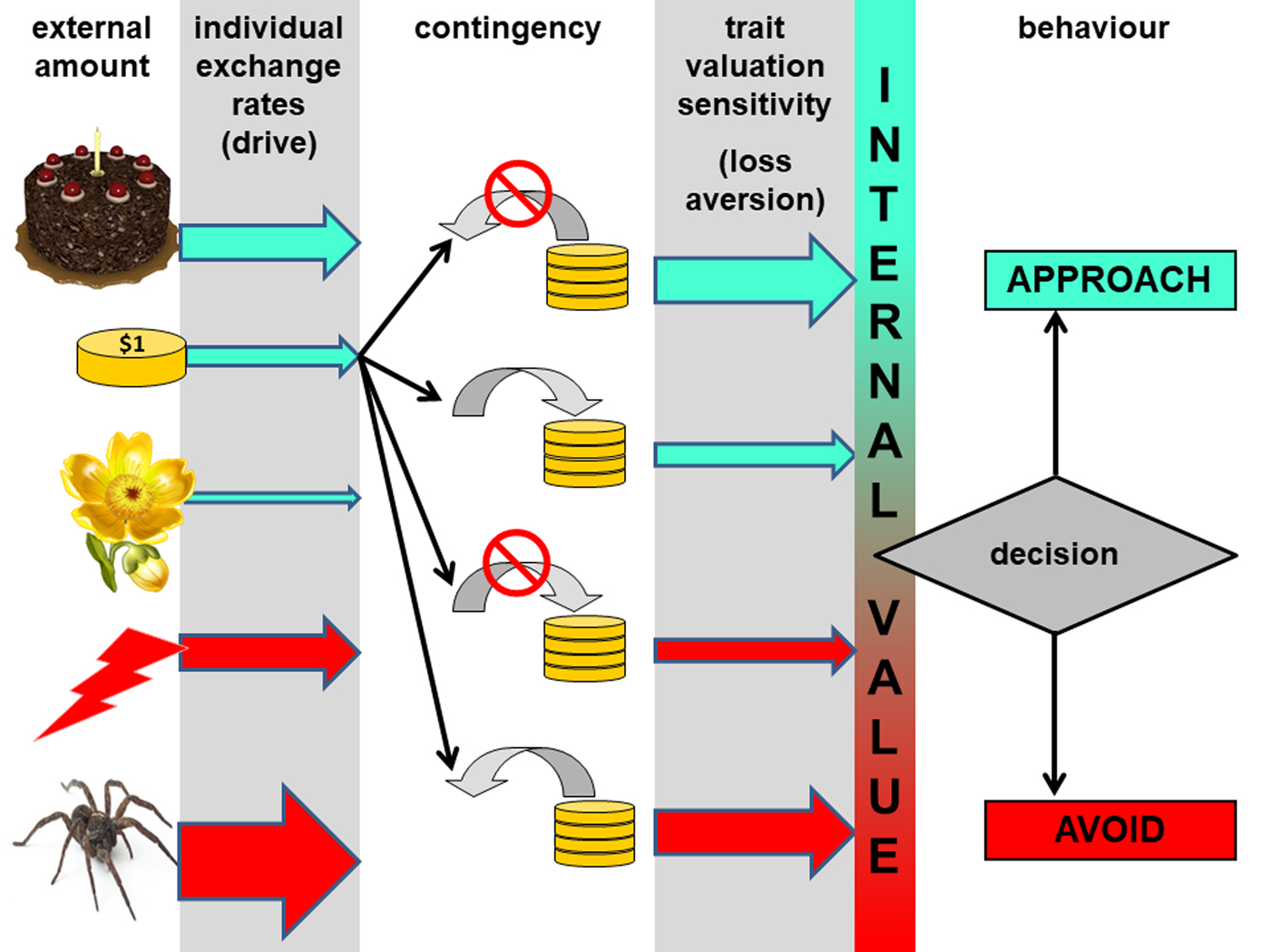
Figure 1. Relations between external amount, contingency, and value. An external item will have a specific amount (e.g., one entire cake) that, together with the current level of drive (which acts like a currency exchange rate) for that kind of item for that person, determines its primary internal value (thickness of arrows in first column). As shown for the case of $1, this interacts with whether the item will be gained or lost to determine the direction and size of its internal value, as ultimately measured by the effect on behaviour. The direction of this effect is reversed if the [expected] gain or loss is omitted. Loss (removal from a store of items) is most easily controlled with money but will also occur when, for example, one rat steals the food from another rat. Reprinted, with permission, from McNaughton et al. (2016).
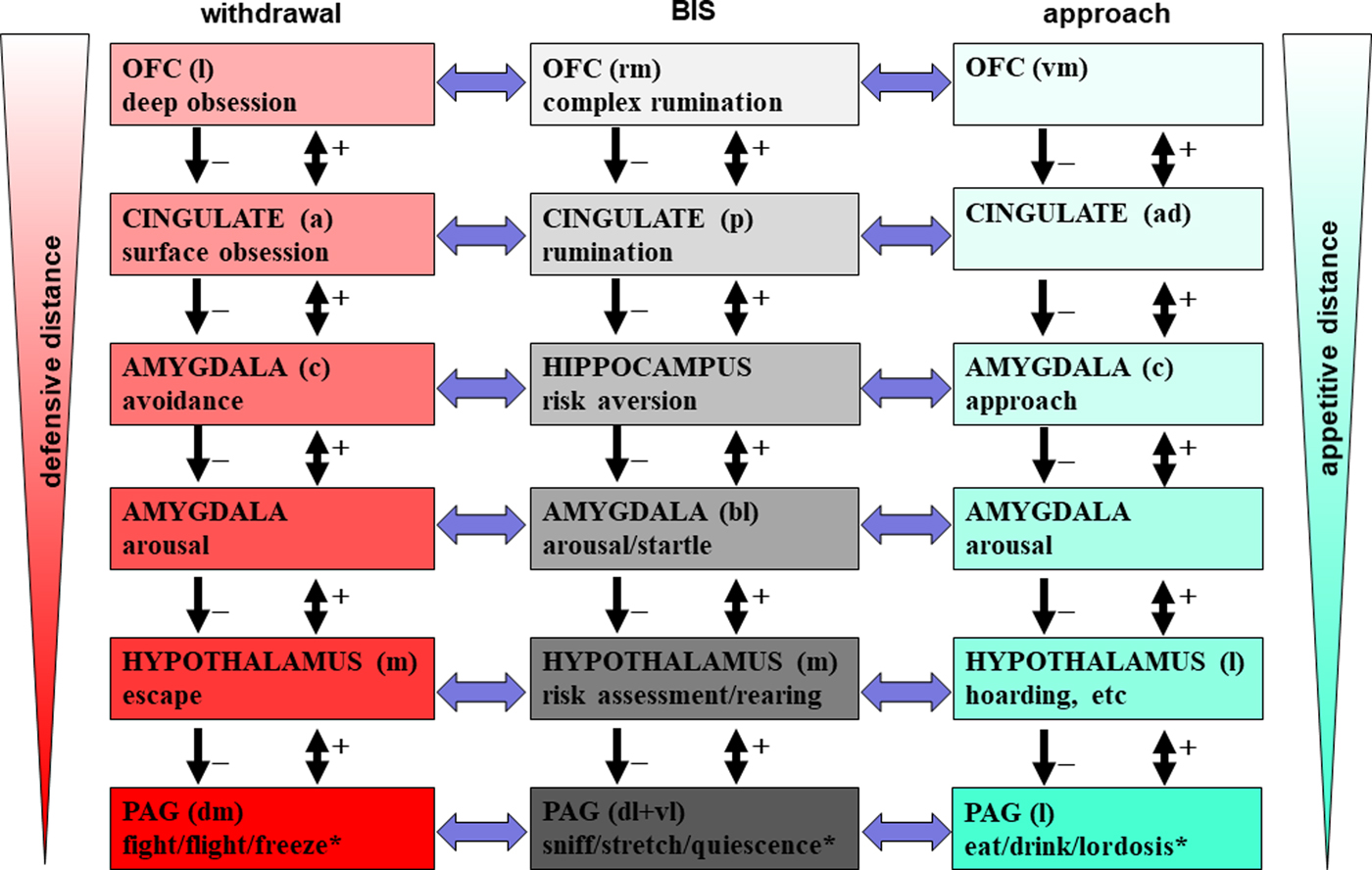
Figure 2. Hierarchical organization of approach, withdrawal, and behavioural inhibition (BIS) in terms of behaviour and neural level. Lower levels process small defensive distances; higher levels process greater ones (i.e., negative events that are more distant in space or time). Activation tends to spread through the whole system (double-headed black arrows), but strong activation of a higher level (e.g., avoidance) inhibits (single-headed arrows) the behavioural output from (but not the activation of) lower levels (e.g., escape). *Static postures that achieve withdrawal, conflict resolution, or approach, respectively. a = anterior; ad = anterodorsal; bl = basolateral; c = central; dl = dorsolateral; dm = dorsomedial; l = lateral; m = medial; OFC = orbital frontal cortex; p = posterior; PAG = periaqueductal grey; rm = rostromedial; vl = ventrolateral; vm = ventromedial. Reprinted, with permission, from McNaughton and Corr (2018).
Target article
Related commentaries (28)
Behavioural inhibition and valuation of gain/loss are neurally distinct from approach/withdrawal
Identity leadership: Managing perceptions of conflict for collective action
The multiple facets of psychopathy in attack and defense conflicts
Unraveling the role of oxytocin in the motivational structure of conflict
In section 3.1, De Dreu and Gross contrast reward seeking with loss aversion and conflate behavioural inhibition with fear and active avoidance. We argue that this confuses: (1) valuation with motivation; (2) anxiety with fear; and (3) reinforcers with reinforcement. Making these distinctions has consequences for their proposed neuropsychology.
The expectation/availability (innate or learned) of gain elicits approach. However, omission/termination of expected gain elicits defensive withdrawal (Adelman & Maatsch Reference Adelman and Maatsch1956) and attack (Gallup Reference Gallup1965; Kelly & Hake Reference Kelly and Hake1970), as does an explicit aversive stimulus, such as shock (Renfrew & Hutchinson Reference Renfrew, Hutchinson, Satinoff and Teitelbaum1983). Importantly, even in the presence of loss aversion (Kahneman & Tversky Reference Kahneman and Tversky1979; Novemsky & Kahneman Reference Novemsky and Kahneman2005; Tversky & Kahneman Reference Tversky and Kahneman1991), approach tendencies can be stronger than withdrawal (Hall et al. Reference Hall, Chong, McNaughton and Corr2011), likely as a result of their different goal gradients (Brown Reference Brown1948). So, approach/withdrawal motivations are controlled independently of gain/loss valuations (Hall et al. Reference Hall, Chong, McNaughton and Corr2011), and it is important to keep valuation and motivation theoretically separate (Corr & McNaughton Reference Corr and McNaughton2012) and always take into account the role of contingency (Fig. 1).
Relations between external amount, contingency, and value. An external item will have a specific amount (e.g., one entire cake) that, together with the current level of drive (which acts like a currency exchange rate) for that kind of item for that person, determines its primary internal value (thickness of arrows in first column). As shown for the case of $1, this interacts with whether the item will be gained or lost to determine the direction and size of its internal value, as ultimately measured by the effect on behaviour. The direction of this effect is reversed if the [expected] gain or loss is omitted. Loss (removal from a store of items) is most easily controlled with money but will also occur when, for example, one rat steals the food from another rat. Reprinted, with permission, from McNaughton et al. (Reference McNaughton, DeYoung, Corr, Absher and Cloutier2016).
It is also important to keep “anxiety” separate from “fear.” Despite their frequent semantic conflation (McNaughton Reference McNaughton2018), the neuropsychology and psychometric evidence are clear on their differences (Corr et al. Reference Corr, DeYoung and McNaughton2013). In contrast to a fear/withdrawal system that is sensitive to threat, the anxiolytic-sensitive Behavioural Inhibition System (Gray Reference Gray, Iversen, Iversen and Snyder1977) processes goal-conflict and amplifies behavioural inhibition/passive avoidance/defensive quiescence, attention, arousal, and negative bias (Gray & McNaughton Reference Gray and McNaughton2000; McNaughton & Corr Reference McNaughton and Corr2004). This is neurally distinct from the panicolytic-sensitive systems that mediate fight, flight, freezing, and withdrawal/active avoidance (Fig. 2), collectively known as the Fight-Flight-Freeze System (FFFS). Note that “fight” in this context is a defensive response and quite distinct as a behaviour from the predatory “attack” that is contrasted with “defense” in the target article – although in human personality questionnaire studies the relations between withdrawal, defensive attack, and predation are unclear (Corr Reference Corr2016). Contrary to the picture painted by De Dreu and Gross, it is anxiety rather than fear that is linked to the release of stress hormones like cortisol (see McNaughton Reference McNaughton1989, pp. 57–59); and, while 5HT1A agonists are anxiolytic but not panicolytic, the serotonin system as a whole innervates and affects not only the Behavioural Inhibition System but also the withdrawal and the approach systems, with quite high-level consequences (Carver et al. Reference Carver, Johnson and Joormann2008).
Hierarchical organization of approach, withdrawal, and behavioural inhibition (BIS) in terms of behaviour and neural level. Lower levels process small defensive distances; higher levels process greater ones (i.e., negative events that are more distant in space or time). Activation tends to spread through the whole system (double-headed black arrows), but strong activation of a higher level (e.g., avoidance) inhibits (single-headed arrows) the behavioural output from (but not the activation of) lower levels (e.g., escape). *Static postures that achieve withdrawal, conflict resolution, or approach, respectively. a = anterior; ad = anterodorsal; bl = basolateral; c = central; dl = dorsolateral; dm = dorsomedial; l = lateral; m = medial; OFC = orbital frontal cortex; p = posterior; PAG = periaqueductal grey; rm = rostromedial; vl = ventrolateral; vm = ventromedial. Reprinted, with permission, from McNaughton and Corr (Reference McNaughton and Corr2018).
For the same reasons, we think their picture of prefrontal control networks should be split and extended to subcortex. We agree that anxiety involves the inferior frontal gyrus (Shadli et al. Reference Shadli, McIntosh, Glue and McNaughton2015), basolateral amygdala, hippocampus, ventromedial orbital cortex (Fig. 2), and insula (Paulus & Stein Reference Paulus and Stein2006). However, we would add the posterior cingulate cortex, and, with risk assessment in particular (McNaughton & Corr Reference McNaughton and Corr2018), there is an important role for subcortical “survival circuits” (Mobbs & LeDoux Reference Mobbs and LeDoux2018) that include the dorso-lateral and ventro-lateral periaqueductal grey, anterior and lateral hypothalamus, and lateral septum (Motta et al. Reference Motta, Carobrez and Canteras2017). Critically, we see fear as neurally distinct, involving lateral orbital cortex, anterior cingulate, central amygdala, medial hypothalamus, and dorso-medial periaqueductal grey.
The three-system (approach, withdrawal, conflict) hierarchical neuropsychology we have described is also relevant to the trait considerations of section 3.6. “These systems mediate fluid moment-by-moment reactions to changing stimuli, with relatively stable person-specific sensitivities to these stimuli manifested in personality traits” (Corr et al. Reference Corr, DeYoung and McNaughton2013, p. 158) and are the basis for the Reinforcement Sensitivity Theory of personality (see Corr Reference Corr2008). Our perspective (avoiding the ambiguity of “reward”) suggests that attack (as a predatory approach tendency) and defense (functioning to allow withdrawal) likely depend on fundamentally similar hierarchical system architectures. Apparent prefrontal versus subcortical control differences between them likely depend on the usual difference in “motivational distance” in their eliciting situations. Initially, at least, a predator will be at a large appetitive distance from the prey, requiring extensive planning of its attack. Especially where an ambush is involved, the defensive response by the prey will be immediate and even undirected (at zero defensive distance). Impulse control also involves a balance between approach motivation and inhibition. The strength of inhibition can be affected by variations in conflict sensitivity (Gray & McNaughton Reference Gray and McNaughton2000) and in loss aversion (Tversky & Kahneman Reference Tversky and Kahneman1991); and approach can vary with the strength of delay discounting (Frost & McNaughton Reference Frost and McNaughton2017). The effects of traits on attack and defense clearly require a highly nuanced approach.