







No CrossRef data available.
Article contents
The attack and defense mechanisms: Perspectives from behavioral economics and game theory
Published online by Cambridge University Press: 13 August 2019
Abstract
This commentary complements the article by De Dreu and Gross (2019) from the perspectives of behavioral economics and game theory. It aims to provide a bridge between psychology/neuroscience research and economics research in attack-and-defense by stipulating relevant literature, clarifying theoretical structures, and suggesting improvements in experimental designs and possible further investigations.
Information
- Type
- Open Peer Commentary
- Information
- Copyright
- Copyright © Cambridge University Press 2019
References
Arce, D. G., Kovenock, D. & Roberson, B. (2012) Weakest-link attacker-defender games with multiple attack technologies. Naval Research Logistics (NRL) 59(6):457–69.Google Scholar
Baik, K. H., Kim, I. G. & Na, S. (2001) Bidding for a group-specific public-good prize. Journal of Public Economics, 82(3):415–29.Google Scholar
Baye, M. R., Kovenock, D. & De Vries, C. G. (1996) The all-pay auction with complete information. Economic Theory 8(2):291–305.Google Scholar
Baye, M. R., Kovenock, D. & De Vries, C. G. (2012) Contests with rank-order spillovers. Economic Theory 51(2):315–50.Google Scholar
Chowdhury, S. M., Jeon, J. Y. & Ramalingam, A. (2018) Property rights and loss aversion in contests. Economic Inquiry 56(3):1492–511.Google Scholar
Chowdhury, S. M. & Sheremeta, R. M. (2011) A generalized Tullock contest. Public Choice 147(3/4):413–20.Google Scholar
Chowdhury, S. M., Sheremeta, R. M. & Turocy, T. L. (2014) Overbidding and overspreading in rent-seeking experiments: Cost structure and prize allocation rules. Games and Economic Behavior 87:224–38.Google Scholar
Chowdhury, S. M. & Topolyan, I. (2016a) The attack-defense group contests: Best-shot versus weakest-link. Economic Inquiry 54:548–57.Google Scholar
Chowdhury, S. M. & Topolyan, I. (2016b) Best-shot versus weakest-link in political lobbying: an application of group all-pay auction. Social Choice and Welfare 47(4):959–71.Google Scholar
Clark, D. J. & Konrad, K. A. (2007) Asymmetric conflict: Weakest link against best shot. Journal of Conflict Resolution 51:457–69.Google Scholar
Dechenaux, E., Kovenock, D. & Sheremeta, R. M. (2015) A survey of experimental research on contests, all-pay auctions, and tournaments. Experimental Economics 18(4):609–69.Google Scholar
Kovenock, D. & Roberson, B. (2012) Conflicts with multiple battlefields. In: The Oxford handbook of the economics of peace and conflict, ed. Garfinkel, M. R. & Skaperdas, S., pp. 503–31. Oxford University Press.Google Scholar
Kovenock, D. & Roberson, B. (2018) The optimal defense of networks of targets. Economic Inquiry 56(4):2195–211.Google Scholar
Kovenock, D., Roberson, B. & Sheremeta, R. M. (2019) The attack and defense of weakest-link networks. Public Choice 179(3/4):175–94. Available at: https://doi.org/10.1007/s11127-018-0618-1.Google Scholar
Tullock, G. (1980) Efficient rent seeking. In: Toward a theory of the rent-seeking society, ed. Buchanan, J. M., Tollison, R. D. & Tullock, G., pp. 97–112. Texas A&M University Press.Google Scholar
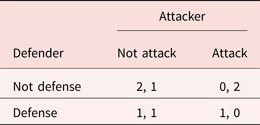
Table 1. Proposed AD-G
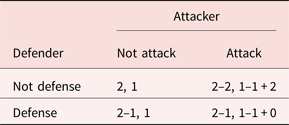
Table 2. Intended AD-G
Target article
Related commentaries (28)
Behavioural inhibition and valuation of gain/loss are neurally distinct from approach/withdrawal
Identity leadership: Managing perceptions of conflict for collective action
The multiple facets of psychopathy in attack and defense conflicts
Unraveling the role of oxytocin in the motivational structure of conflict
De Dreu and Gross (D&G) survey the literature on various behavioral aspects of attack-and-defense. While focusing mainly in the areas of psychology and neuroscience, they often use game-theoretic structure and results from behavioral economics to construct their review. The aim of this commentary is to complement their analyses with further relevant readings from behavioral economics and game theory, such that the baseline theoretical predictions may be clearer. We also provide some suggestions for the improvement and advancement of the experimental studies.
First, consider the game-theoretic aspects of attack and defense. Any conflict has the feature that the involved parties expend resources to win (or to avoid loss) and, irrespective of the outcome, the resources expended become sunk. Contest theory is the area of game theory that analyzes these situations. Two popular functions are used to determine the probability of winning of player i in such games. Both take the form $p_i = \left( {x_i^r /\mathop \sum \limits_i x_i^r} \right)$, where p i is the winning probability, x i is the resources spent by player i, and r ≥ 0 is a parameter. When the outcome of a conflict is deterministic, that is, when a player who expends even slightly more resources than the rival wins for sure, then it is an all-pay auction (Baye et al. Reference Baye, Kovenock and De Vries1996), and r = ∞. However, when there is enough noise in the conflict and the outcome is not that straightforward, then it is modeled as a “lottery” (Tullock Reference Tullock, Buchanan, Tollison and Tullock1980), and r = 1. Individual attack-and-defense conflicts feature rank-order spillovers, and these two types provide very different results (see Baye et al. [Reference Baye, Kovenock and De Vries2012] for all-pay auction and Chowdhury & Sheremeta [Reference Chowdhury and Sheremeta2011] for lottery). Although all-pay auction is covered at the end of section 2.2 in D&G, the important case of lottery is not considered.
Game-theoretic and behavioral models of attack and defense involve network externalities. But those for individual players and for groups are distinct (it is unclear in the article; see Note 4). See reviews of the theoretical and the experimental research by Kovenock and Roberson (Reference Kovenock, Roberson, Garfinkel and Skaperdas2012) and by Dechenaux et al. (Reference Dechenaux, Kovenock and Sheremeta2015).
In individual multibattle contests, players fight on multiple battlefields with limited resources. There may be an attacker (terrorist) who tries to destroy such battlefields and a defender (government) who tries to save those. Here, the battlefields are connected as weakest link for the defender and as best shot for the attacker. Theoretical solutions for such models are provided in Clark and Konrad (Reference Clark and Konrad2007), Arce et al. (Reference Arce, Kovenock and Roberson2012), and Kovenock and Roberson (Reference Kovenock and Roberson2018), among others. Experimental evidence (Kovenock et al. Reference Kovenock, Roberson and Sheremeta2019) reveals that the theory better predicts subject behavior for the all-pay auction than for the lottery.
In a group conflict, group members exert resources that go through a production technology to create “group effort,” which then determines the winning group. The technology can be additive (an easy version of this with all-pay auction a la Baik et al. [2001] is considered in D&G), or it can be something else. For attack and defense, the attackers face a best-shot technology, whereas the defenders face a weakest-link technology. Solutions are provided in Chowdhury and Topolyan (Reference Chowdhury and Topolyan2016a) for all-pay auction and in Chowdhury and Topolyan (Reference Chowdhury and Topolyan2016b) for the lottery; and the predictions are very different. Currently, there is no experimental research on such situations.
Note some important differences between psychology/neuroscience and economics experiments. Whereas economists stress use of a theoretical benchmark to understand behavioral mechanisms, others apply distinct techniques (e.g., functional magnetic resonance imaging). However, it is possible to combine both and arrive at a better understanding. The different disciplines independently arrive at the same results, which are not shared. For example, the high dispersion result (sect. 4.3 in D&G) is recognized as “overspreading” in economics (Chowdhury et al. Reference Chowdhury, Sheremeta and Turocy2014) but is never tested for an attack-and-defense frame.
For the individual attack-and-defense research, the article introduces a normal form of Attacker-Defender Game (AD-G). This (reproduced in Table 1) suggests that, although the theoretical equilibrium is in symmetric mixed strategies, in reality, defenders will choose “defend” more than attackers choose “attack.”
Proposed AD-G
Indeed, that turns out to be the case in the experiments, and it is explained through the idea of loss aversion. The subjects seemed to view the game as in Table 2, because loss-averse defenders weigh the negative amounts higher than their numerical values and play “defense” more.
Intended AD-G
However, until the game is framed as in Table 2 explicitly, it is unlikely that subjects understand the game in such a way. They view the game as in Table 1, and choose the “defense” option because that is the riskless option.
Chowdhury et al. (Reference Chowdhury, Jeon and Ramalingam2018) investigated the same but introduced a game with a lottery and continuous level of resources (instead of only two options). They essentially provided a general version of Table 2, controlled for risk, and still provided support for loss aversion resulting in higher expenditure in defense.
The simple AD-G in Table 1 cannot reflect the sunk cost of conflict, and that in Table 2 is an easy version of Chowdhury et al. (Reference Chowdhury, Jeon and Ramalingam2018) with binomial space and an all-pay auction. Hence, it will be interesting to investigate a similar general setup as in Chowdhury et al. (Reference Chowdhury, Jeon and Ramalingam2018) but with an all-pay auction – as implemented in the current study. It will also be useful to control for risk behavior along with other behavioral aspects, as detailed in the current study.
D&G successfully present the audience with an overview of attack-and-defense experiments (mainly) from psychology and neuroscience. We point out that to bridge those areas and behavioral economics/game theory, existing games that may be a better fit for investigating the same questions will allow theoretical benchmarks and behavioral mechanisms for predicted results. We also note that the current economics experiments do not exploit the techniques (e.g., response time, cognitive ability, eye tracking, neurological effects) used regularly in psychology and neuroscience. Using such techniques can provide broader knowledge. We hope for such a bridge to cross in the future.