De Dreu and Gross convincingly argue that symmetric conflict is the exception rather than the rule; conflict often involves attackers and defenders, rather than two equally placed parties. One of the central results of their investigation is that “people invest less in attack than defense and attack often fails” (abstract). Here, I point out a number of idiosyncratic features of the Attacker-Defender Game (AD-G), introduced and used by the authors to compare the respective propensities for attack and for defense, which may limit the generalizability of this result.
The authors introduce the AD-G as a model of asymmetric conflict. Each player – the attacker and the defender – decides whether or how much to invest in attack/defense. A successful attack occurs when the attacker invests more than the defender. The AD-G has two essential features: (1) Mutual cooperation is the most attractive option for defenders, but attackers are better off following a successful attack. (2) Defenders benefit from matching attackers’ investments, whereas attackers benefit from mismatching defenders’ investments.
First, I draw attention to the initial endowments, or power, available to attackers and defenders. In reality, these can greatly differ, for example, in conflict between terrorists and a state (low-power attacker vs. high-power defender), or between a multi-branch chain and a local shop the chain is trying to put out of business (high-power attacker vs. low-power defender). Although De Dreu and Gross acknowledge that “Asymmetry in power can be modeled by inequality in resource endowments in the AD-G contest game and can dramatically change the motivation to attack or to defend” (sect. 2.3, para. 2), the experiments they report on, in which they found that defenders invest more than attackers, feature equal endowments for attackers and defenders. Would results be different if endowments were not equal? This is more than just an interesting follow-up question; a positive answer implies that a main thesis of the target article is qualified by the allocation of endowments.
A related issue is that defenders in the AD-G are left with nothing following a successful attack. This design choice reflects the Dawkins and Krebs quote that opens section 3: “A rabbit runs faster than the fox, because the rabbit is running for his life while the fox is only running for his dinner.” But conflict isn't always about a defender running for his or her life. The stakes could be much smaller; for example, a revisionist state may seek to capture just a small part of a neighboring state's territory. It is reasonable to assume that defenders’ willingness to invest in defense will increase in the ratio between what they stand to lose (the stakes) and what they possess to begin with. For the rabbit escaping a fox, the ratio is 1; for the neighboring state, it is much lower.
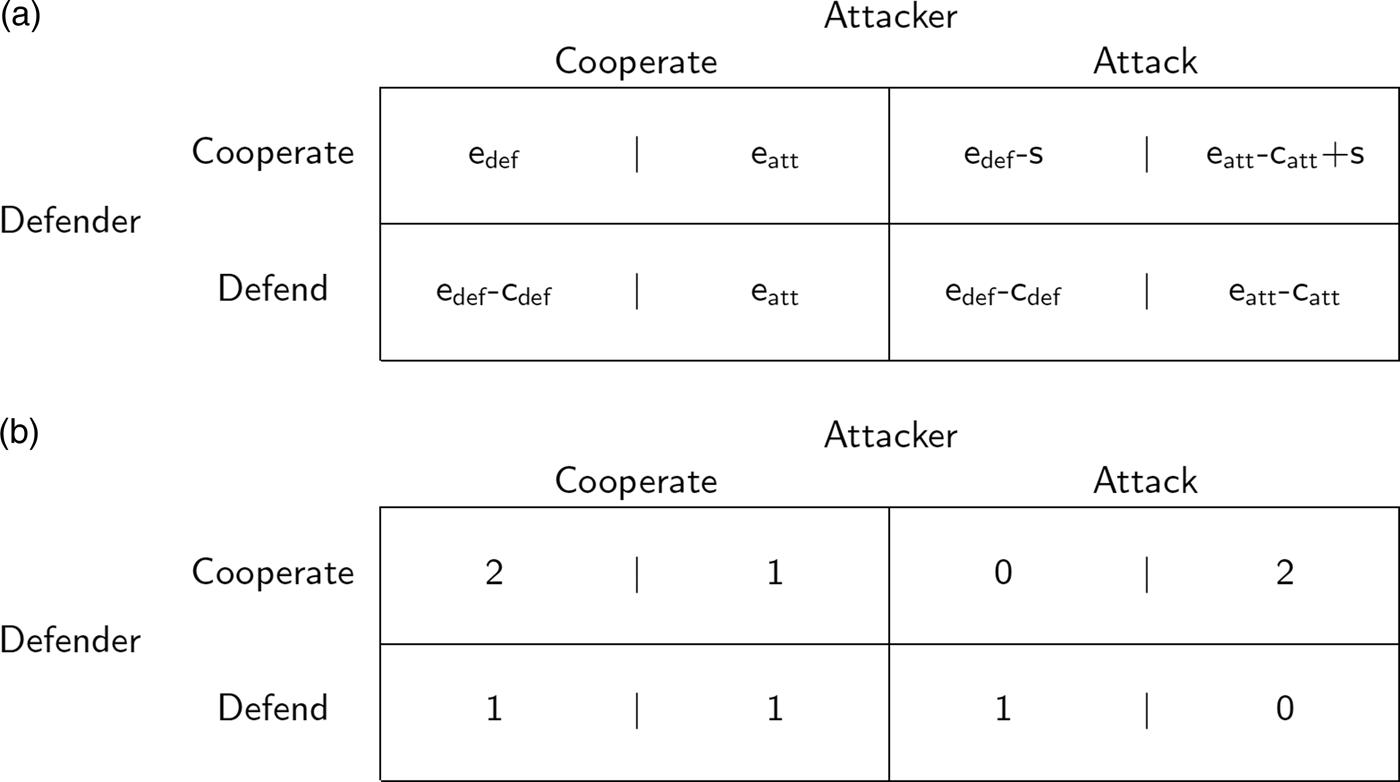
The AD-G, designed to model asymmetric conflict, retains a degree of symmetry with respect to the costs of attack and defense. To survive an attack, defenders need to invest at least as much as attackers. However, in reality the cost of defense could be either lower or higher than that of attack (e.g., when defending a fortified city or scattered villages, respectively). To provide initial insights on how respective costs of attack and defense (as well as stakes and initial endowments) affect the propensity to invest in attack and defense, I analyze a generalized version of the AD-G – the Generalized Attacker-Defender Game (GAD-G; Fig. 1) – which allows for freedom in a number of important parameters: (1) Defenders and attackers can have different endowments (e def and e att); (2) the stake(s) does not necessarily equal the defender's entire endowment (s ≤ e def); and (3) the cost of attack (c att) is independent from the cost of defense (c def).
Figure 1.(a) Generalized Attacker-Defender Game (GAD-G). e def = defender endowment; e att = attacker endowment; s = stakes; c def = defense cost; c att = attack cost. (b) When e def = s = 2, e att = 1, and c att = c def = 1, the GAD-G is identical to the ordinal version of the AD-G presented by De Dreu and Gross (sect. 2.1, para. 1).
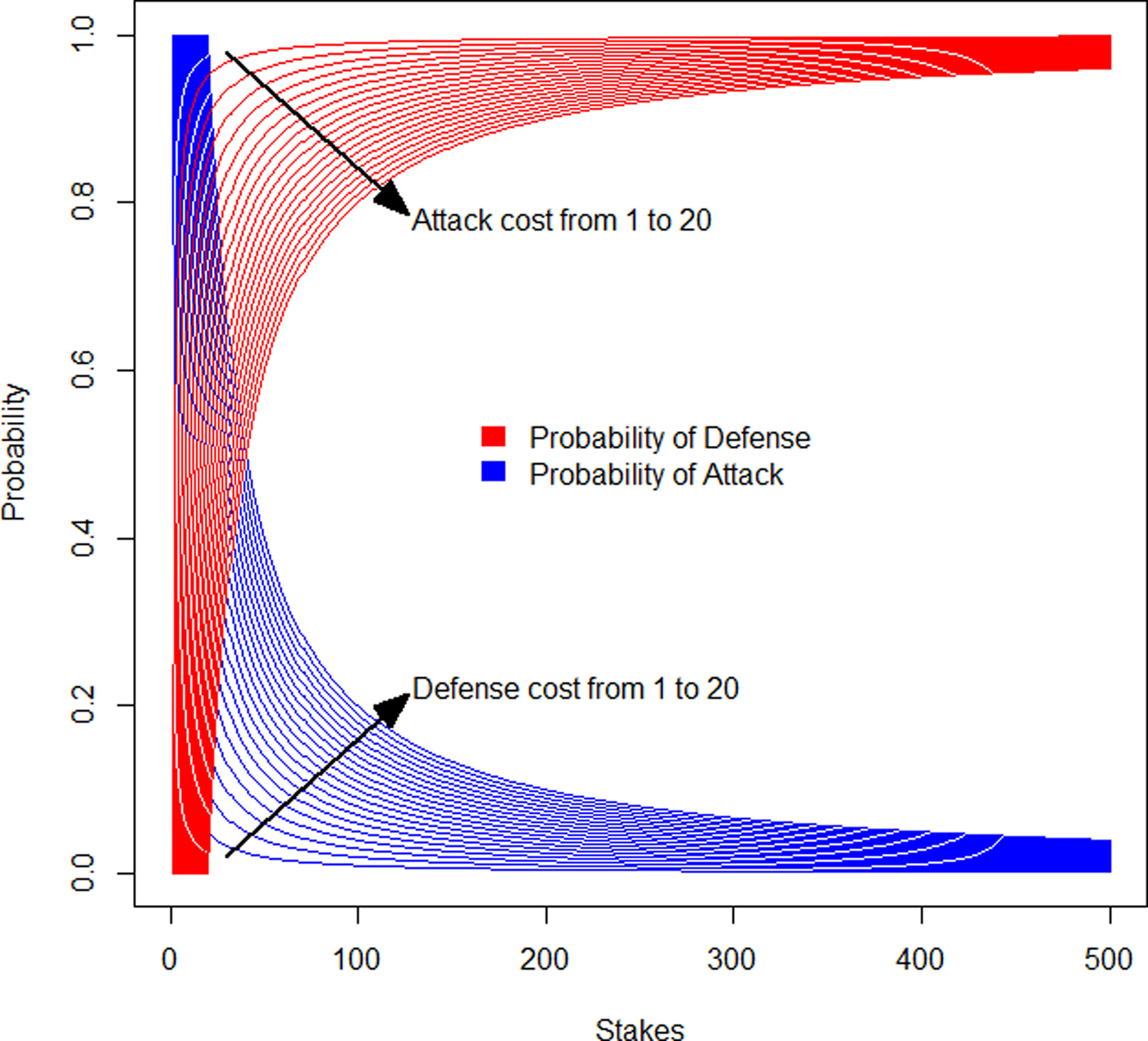
Assuming c att < s and c def < s, the GAD-G retains the essential features of the AD-G (see para. 2). Like the AD-G, there is no Nash equilibrium in pure strategies. In a mixed strategy equilibrium, the respective probabilities of attack and defense are c def/s and s – c att/s. These probabilities, for different stakes and different costs, are plotted in Figure 2 (note that the endowments e def and e att do not affect the mixed strategy equilibrium). It is evident that (i) as stakes grow larger, defense is more likely and attack is less likely; and (ii) attack (defense) is more (less) likely as the cost of defense (attack) increases. Crucially for the discussion here, when the stakes are low, the probability of attack in equilibrium is higher than the probability of defense, especially when defense and attack are expensive. If this intuition bares out in actual behavior, the particular stakes and the costs of attack and defense further qualify the result that defense is more likely than attack.
Figure 2.Mixed strategy equilibrium probabilities of attack and defense in the GAD-G. Each blue (red) curve indicates, for a given cost of defense (attack), the probability (in a mixed strategy equilibrium) that the attacker (defender) will choose to attack (defend), as a function of the stakes. Note that the probability of attack depends on the cost of defense (and on the stakes), and vice versa.
My last point has to do with the way (asymmetric) intergroup conflict is framed and perceived. Weisel and Zultan (Reference Weisel and Zultan2016) examine an asymmetric version of the Intergroup Prisoner's Dilemma (IPD; Bornstein Reference Bornstein2003). The game models conflict between attacker and victim (i.e., defender) groups. Members of the attacker group choose between keeping resources to themselves and contributing to their group at a personal cost. Contributions benefit the in-group and simultaneously harm the victim group. Members of the victim group face a similar choice, but their contributions do not affect the attacker group. Weisel and Zultan manipulate the way conflict is framed and perceived. In the Comparison frame, payoffs were expressed as a function of the difference between contributions in each group. In the Individual Harm frame, payoffs were expressed as a function of individual choices. The two frames are equivalent in terms of actual payoffs. The Comparison frame is similar to how De Dreu et al. (Reference De Dreu, Gross, Meder, Griffin, Prochazkova, Krikeb and Columbus2016a) describe the Intergroup AD-Contest Game, which they use to test asymmetric intergroup conflict. The results are similar as well; in both cases, defenders contribute more than attackers. Strikingly, Weisel and Zultan obtain the opposite pattern under the Individual Harm frame, where attackers invested more than defenders, suggesting that the way conflict is framed and perceived may crucially undermine the increased propensity for defense over attack.







De Dreu and Gross convincingly argue that symmetric conflict is the exception rather than the rule; conflict often involves attackers and defenders, rather than two equally placed parties. One of the central results of their investigation is that “people invest less in attack than defense and attack often fails” (abstract). Here, I point out a number of idiosyncratic features of the Attacker-Defender Game (AD-G), introduced and used by the authors to compare the respective propensities for attack and for defense, which may limit the generalizability of this result.
The authors introduce the AD-G as a model of asymmetric conflict. Each player – the attacker and the defender – decides whether or how much to invest in attack/defense. A successful attack occurs when the attacker invests more than the defender. The AD-G has two essential features: (1) Mutual cooperation is the most attractive option for defenders, but attackers are better off following a successful attack. (2) Defenders benefit from matching attackers’ investments, whereas attackers benefit from mismatching defenders’ investments.
First, I draw attention to the initial endowments, or power, available to attackers and defenders. In reality, these can greatly differ, for example, in conflict between terrorists and a state (low-power attacker vs. high-power defender), or between a multi-branch chain and a local shop the chain is trying to put out of business (high-power attacker vs. low-power defender). Although De Dreu and Gross acknowledge that “Asymmetry in power can be modeled by inequality in resource endowments in the AD-G contest game and can dramatically change the motivation to attack or to defend” (sect. 2.3, para. 2), the experiments they report on, in which they found that defenders invest more than attackers, feature equal endowments for attackers and defenders. Would results be different if endowments were not equal? This is more than just an interesting follow-up question; a positive answer implies that a main thesis of the target article is qualified by the allocation of endowments.
A related issue is that defenders in the AD-G are left with nothing following a successful attack. This design choice reflects the Dawkins and Krebs quote that opens section 3: “A rabbit runs faster than the fox, because the rabbit is running for his life while the fox is only running for his dinner.” But conflict isn't always about a defender running for his or her life. The stakes could be much smaller; for example, a revisionist state may seek to capture just a small part of a neighboring state's territory. It is reasonable to assume that defenders’ willingness to invest in defense will increase in the ratio between what they stand to lose (the stakes) and what they possess to begin with. For the rabbit escaping a fox, the ratio is 1; for the neighboring state, it is much lower.
The AD-G, designed to model asymmetric conflict, retains a degree of symmetry with respect to the costs of attack and defense. To survive an attack, defenders need to invest at least as much as attackers. However, in reality the cost of defense could be either lower or higher than that of attack (e.g., when defending a fortified city or scattered villages, respectively). To provide initial insights on how respective costs of attack and defense (as well as stakes and initial endowments) affect the propensity to invest in attack and defense, I analyze a generalized version of the AD-G – the Generalized Attacker-Defender Game (GAD-G; Fig. 1) – which allows for freedom in a number of important parameters: (1) Defenders and attackers can have different endowments (e def and e att); (2) the stake(s) does not necessarily equal the defender's entire endowment (s ≤ e def); and (3) the cost of attack (c att) is independent from the cost of defense (c def).
(a) Generalized Attacker-Defender Game (GAD-G). e def = defender endowment; e att = attacker endowment; s = stakes; c def = defense cost; c att = attack cost. (b) When e def = s = 2, e att = 1, and c att = c def = 1, the GAD-G is identical to the ordinal version of the AD-G presented by De Dreu and Gross (sect. 2.1, para. 1).
Assuming c att < s and c def < s, the GAD-G retains the essential features of the AD-G (see para. 2). Like the AD-G, there is no Nash equilibrium in pure strategies. In a mixed strategy equilibrium, the respective probabilities of attack and defense are c def/s and s – c att/s. These probabilities, for different stakes and different costs, are plotted in Figure 2 (note that the endowments e def and e att do not affect the mixed strategy equilibrium). It is evident that (i) as stakes grow larger, defense is more likely and attack is less likely; and (ii) attack (defense) is more (less) likely as the cost of defense (attack) increases. Crucially for the discussion here, when the stakes are low, the probability of attack in equilibrium is higher than the probability of defense, especially when defense and attack are expensive. If this intuition bares out in actual behavior, the particular stakes and the costs of attack and defense further qualify the result that defense is more likely than attack.
Mixed strategy equilibrium probabilities of attack and defense in the GAD-G. Each blue (red) curve indicates, for a given cost of defense (attack), the probability (in a mixed strategy equilibrium) that the attacker (defender) will choose to attack (defend), as a function of the stakes. Note that the probability of attack depends on the cost of defense (and on the stakes), and vice versa.
My last point has to do with the way (asymmetric) intergroup conflict is framed and perceived. Weisel and Zultan (Reference Weisel and Zultan2016) examine an asymmetric version of the Intergroup Prisoner's Dilemma (IPD; Bornstein Reference Bornstein2003). The game models conflict between attacker and victim (i.e., defender) groups. Members of the attacker group choose between keeping resources to themselves and contributing to their group at a personal cost. Contributions benefit the in-group and simultaneously harm the victim group. Members of the victim group face a similar choice, but their contributions do not affect the attacker group. Weisel and Zultan manipulate the way conflict is framed and perceived. In the Comparison frame, payoffs were expressed as a function of the difference between contributions in each group. In the Individual Harm frame, payoffs were expressed as a function of individual choices. The two frames are equivalent in terms of actual payoffs. The Comparison frame is similar to how De Dreu et al. (Reference De Dreu, Gross, Meder, Griffin, Prochazkova, Krikeb and Columbus2016a) describe the Intergroup AD-Contest Game, which they use to test asymmetric intergroup conflict. The results are similar as well; in both cases, defenders contribute more than attackers. Strikingly, Weisel and Zultan obtain the opposite pattern under the Individual Harm frame, where attackers invested more than defenders, suggesting that the way conflict is framed and perceived may crucially undermine the increased propensity for defense over attack.