



R1. Introduction
A substantial majority of past and present conflicts are about something owned by one and desired by another. These are the territorial struggles among nation states, the tribal raids for cattle, the neighborhood conflicts about parking spaces and barking dogs, and the board room battles for status. As such, human conflicts share many of the structural properties seen in conflicts among nonhuman animals, including the border patrols by groups of chimpanzees, shouting games between groups of territorial birds, between the lion and the wildebeest, even between viruses and their host's immune system. Yet when it comes to human conflict, theory and research heavily focused on symmetric conflicts and largely ignored the asymmetric nature of those conflicts in which one party seeks change and revision and the other party seeks to maintain the status quo.
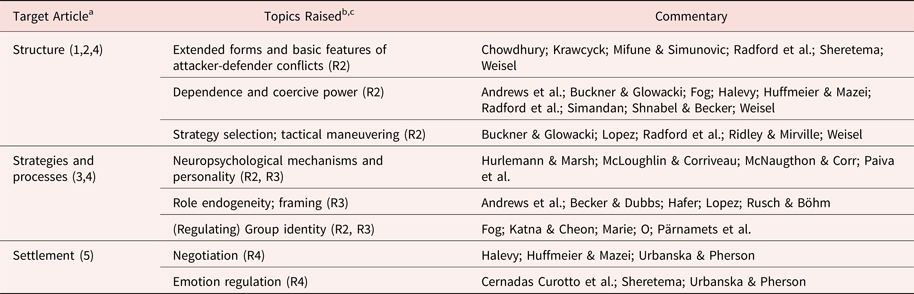
Our target article, therefore, examined the possible structural, neuropsychological, and sociocultural aspects of attacker-defender conflicts within and between groups of people. Twenty-seven commentaries from evolutionary and animal biology, human neuropsychology, anthropology, experimental economics, psychology, and the political sciences largely resonated with our perspective and add important new insights and ideas (see Table R1). Alone and in combination, the commentaries complement and extend our approach, and they offer a range of new hypotheses and possible strategies for conflict resolution and peace settlement. We discuss these insights and extensions in relation to (1) the structure and strategy of asymmetric conflict (sect. R2); (2) the emergence and enactment of attacker and defender positions, with implications for group identification and leadership (sect. R3); and (3) possible interventions that transform attacker-defender conflicts into mutual gains bargaining amenable for dispute resolution (sect. R4). Section R5 concludes.
Summary of main topics and issues raised across all commentaries

aMain sections in the target article.
bListed here are only topics that emerged across several commentaries.
cNumbers preceded by R refer to the relevant section in the response article.
R2. The structure and strategy of attacker-defender conflict
We modeled attacker-defender conflicts as an asymmetric game in which one party (attacker) competes to increase its gain and another party (defender) competes to protect against loss (Chowdhury; Sheretema; Weisel). Modeling conflict as an asymmetric game of strategy is neither believed nor intended to innovate game theory. It does, however, innovate conflict theory, generating novel hypotheses about the neural, psychological, and sociocultural mechanisms that operate during conflict, leading to better prediction of action tendencies and strategic maneuvering during conflict, and new ways of dispute resolution and conflict settlement.
Before moving to specific insights and extensions, two issues need to be clarified. First, we neither dismiss nor intended to devalue extant work on symmetric conflict (Huffmeier & Mazei). Yet, while we believe this earlier work can be insightful and of great help, we have argued that much of the work on symmetric conflicts cannot be extrapolated to conflicts between those who defend the status quo and those who seek to change it (Mifune & Simunovic; Weisel). Second, an asymmetric conflict model, first and foremost, helps identify the superordinate goals that antagonists have, with some wanting to keep what they have (viz., the status quo) and some wanting to take away what others have (viz., changing the status quo in its favor; also see Weisel). To achieve its superordinate goal of maintaining versus changing the status quo, antagonists have a range of strategies and tactics available. To defend the status quo, individuals and their groups may resort to pre-emptive strikes and pro-actively attack their revisionist aggressors. Such offensive actions serve as a means to protect and defend the status quo. Likewise, attackers may vigilantly protect their resources for attack. Such protective measures serve as a means to change the status quo in one's favor. Thus, in theory, the very same action – a preemptive strike, staying on guard, or creating political alliances – can serve the distinctly different goals of protection and defense, or seeking to change the status quo.
In the interest of parsimony, our basic asymmetric attack-defense model largely ignored structural features of the conflict that can be of great influence. One such feature is the presence or absence of an explicit reference point that defines the status quo; our binary AD-G lacks such an explicit reference point, although it is clearly defined in the AD-G contest version (also see Chowdhury). Our commentaries highlight several other structural features, most notably the probabilistic nature of conflict outcomes, the (un)availability of disengagement, and differences in coercive power between the attacker and the defender. We address these first and then discuss the means available for tactical maneuvering and strategy selection during attack and defense, including the matching-mismatching of strategies, and the timing and sequencing of moves and countermoves.
R2.1. Deterministic versus probabilistic conflict outcomes
Similar to related attacker-defender conflict games, we modeled asymmetric conflicts on the basis of the assumption that conflict outcomes are deterministic, defined by the strength of attack relative to defense (viz., all-pay auctions). Sometimes, however, conflict outcomes are probabilistic. Even when attack is more (versus less) powerful, defenders still survive (or are, nevertheless, defeated) (Chowdhury). Such “noise” can have many causes, including equipment failures and unforeseen environmental incidences. We share Chowdhury's intuition that (groups of) individuals may strategize and invest in conflict differently when outcomes are probabilistic rather than deterministic. Buckner & Glowacki's analysis of raiding parties even suggests that environmental incidences, like anticipated rainfall or darkness, are sometimes factored in when designing attack strategies and that doing so can substantially increase the attacker's success-rate. The AD-G can be modified to capture these intuitions by modeling the outcome of the contest as a lottery (see, e.g., Lacomba et al. Reference Lacomba, Lagos, Reuben and van Winden2014). In this case, investments of Party A (c A) increase the relative chance to succeed against Party B: p A = λc A/(λc A + c B), and vice versa, p B = 1 – p A. The lambda parameter captures a (dis)advantage of the invested resources of one party over another (e.g., rainfall being more advantageous for attackers), which is equivalent to an asymmetry in available resources across parties, creating a paradox of power (Hirshleifer Reference Hirshleifer1991). Risk-tolerance and loss aversion (Chowdhury), along with related constructs such as overconfidence and vigilance (see sect. 3 of the target article), are likely candidates that influence the behavior when conflict outcomes are probabilistic rather than deterministic, opening up interesting avenues for future research in asymmetric conflicts.
R2.2. Power to disengage and to coerce
Our target article focused on conflicts without options for so-called disengagement. In the AD-G, attackers can choose to attack more or less forcefully, and defenders can choose to invest more or less in defense. In contests (e.g., the AD-G with continuous action space), such conflict expenditures model the effort that antagonists invest in their goal pursuit (i.e., victory or survival). Theoretically, such conflict expenditures can reflect the number of troops being mobilized, the mounting of defensive structures, or the metabolic energy spent on, for example, running away. Nonetheless, commentators correctly note that antagonists oftentimes have or create additional options, including those for disengagement. Such disengagement options have been built into games of strategy. A good example is the PD-Alt (Huffmeier & Mazei; Miller & Holmes Reference Miller and Holmes1975) in which antagonists can choose the “withdrawal” option that secures better outcomes than unilateral cooperation but worse outcomes than unilateral competition. Antagonists opting for such withdrawal thus reduce interdependency (Bacharach & Lawler Reference Bacharach and Lawler1981; Giebels et al. Reference Giebels, De Dreu and Van de Vliert2000), protecting against the risk of being exploited but also foregoing the benefits of mutual cooperation or exploitation (Gross & De Dreu Reference Gross and De Dreu2019a; Yamagishi Reference Yamagishi1988).
Expanding the strategy space for defenders by allowing a choice between fighting back and running away would enable a more fine-grained analysis of the neural and emotional responses triggered in defenders. Particularly interesting in this regard is McNaughton & Corr's distinction between the anxiolytic-sensitive Behavioral Inhibition System that mediates defensive attention and arousal, and the panicolytic system that mediates fight-flight-freeze responses. It helps to decompose a vigilant defense from the outward anger that defenders may experience when facing the threat of attack (Andrews, Huddy, Kline, Nam, & Sawyer [Andrews et al.]). Expanding the strategy space with disengagement options would also allow the detection of trait-based differences in threat responding, with some individuals being more likely to protect themselves by fighting and others by withdrawing and disengaging from the relationship. The neuropsychological model sketched in McNaughton & Corr can serve as an excellent starting point for uncovering such individual differences and the model's underlying biology (also see Paiva, Coelho, Paison, Ribeiro, Almeida, Ferreira-Santos, Marques-Texeira, & Barbosa [Paiva et al.]).
Expanding the strategy space by including disengagement options can have important implications for intergroup attacker-defender conflicts. We agree with Buckner & Glowacki and Fog that, when individuals within defender groups can flee as an alternative to contributing to collective defense, the typical dynamics we see in intergroup attacker-defender contests may change. Free-rider incentives are typically stronger in attacker compared with defender groups, but such difference disappears when individuals in defender groups can disengage and flee from the group, especially when the anticipated costs of disengagement is lower than the anticipated costs of defense. The mere presence of such disengagement options may also undermine the defender group's cohesion and sense of shared identity, rendering it important for group leaders to create and build group identification and commitments among its members. Fog (also see Simandan) discusses this from an evolutionary perspective, suggesting that, when disengagement options are available, defensive warfare also may have given rise to preferences for strong leadership, discipline, punishment institutions, and intolerance of deviants.
Although not mentioned in the commentaries, expanding the strategy space with disengagement options should not be confined to defense. In as much as defenders may have a choice between fighting back and running away as a means to survive attacks, attackers may have a choice between attacking and production to increase wealth (Carter & Anderton Reference Carter and Anderton2001; Duffy & Kim Reference Duffy and Kim2005; Grossmann & Kim Reference Grossman and Kim2002). For example, organizations seeking to increase their profit margins can attempt a hostile take-over, invest in innovative production technologies, or some combination of both. Again, such alternative strategies essentially mean that (groups of) individuals reduce the interdependency within and/or between groups and forego the benefits of possible cooperation or conflict.
When disengagement options reside within only attackers or defenders, power differences emerge. Attacker threat becomes less pressing, for example, when defenders have solid escape options to complement the resources available for defensive aggression. Accordingly, bargaining and negotiation research showed that having a “Best Alternative to Negotiated Agreement” firms up negotiators, leading them to ask more and concede less (Halevy; also see Bazerman & Neale Reference Bazerman, Magliozzi and Neale1985; Carnevale & Pruitt Reference Carnevale and Pruitt1992; Giebels et al. Reference Giebels, De Dreu and Van de Vliert2000; Pinkley Reference Pinkley1995). Likewise, studies of public goods provision showed that the threat of punishment is ineffective when participants have outside options available and can thus escape costly sanctions (Gross & De Dreu Reference Gross and De Dreu2019a; Mulder et al. Reference Mulder, Van Dijk, De Cremer and Wilke2006). In short, when the (quality of) disengagement options are differentially distributed among attackers and defenders, differences in dependency emerge that render the less dependent party more powerful (Barclay & Raihani Reference Barclay and Raihani2016; Orbell & Dawes Reference Orbell and Dawes1993; Yamagishi Reference Yamagishi1988).
Asymmetries in dependency are but one reason for power differences to emerge between attackers and their defenders. Our commentaries raise two other sources of power that are both related to the ability to coerce the antagonist into submission – outnumbering the antagonist and having surplus resources to invest in fighting (Andrews et al.; Buckner & Glowacki; Radford, Schindler, & Fawcett [Radford et al.]; Ridley & Mirville; Shnabel & Becker; Weisel). Although differences in coercive capabilities and/or dependencies are theoretically orthogonal to the attacker or defender position, power differences may profoundly influence attack propensity and/or willingness to defend (versus surrender or fleeing) (Hafer). In his commentary, Weisel provides a generalized form of our basic attacker-defender game, which allows predictions when power differences between attacker and defender emerge and how such power differences should impact behavioral decisions related to attack and defense.
With regard to power differences, Shnabel & Becker's analysis of the psychology of advantaged and disadvantaged groups suggests complex interactions between the attacker versus defender position on the one hand, and the power differential vis-à-vis antagonist on the other. Specifically, disadvantaged groups that may have a latent desire to change the status quo (viz., attacker) are often apathetic, risk-averse, feel inferior, and lack confidence. Advantaged groups who stand to only lose (viz., defenders), in contrast, are more energetic, risk-tolerant, with stronger feelings of deservingness and superiority. History provides ample examples of such society-level dynamics in which the oppressed serve and justify their oppressors, including the Apartheid regime in South Africa, immigrant groups in contemporary Western societies, and enslaved tribal communities at the height of the Roman Empire (also see Andrews et al.). We suggest that Shnabel & Becker's important analysis can help explain why power differentials within societies can perpetuate and that disadvantageous groups remain passive and shun challenging the status quo, exactly because of a lack of risk-tolerance, confidence, and feelings of deservingness. From this lens, reinforcing a feeling of inferiority in disadvantageous groups, through, for example, racial or social ideology, can be seen as a means of advantageous groups (viz., defenders) to prevent attackers from developing the psychological prerequisites necessary for challenging the status quo and initiating a conflict. Societal disparities in wealth and power thus can be a source of conflict, but Shnabel & Becker's analysis of advantaged and disadvantaged groups highlight the important point that, next to economic factors, psychological factors need to be met before attacker-defender conflict arises.
R2.3. Games of strategy and matching-mismatching of attack and defense
In section 2 of our target article, we briefly referenced games of strategy that share key properties with the AD-G, including the hide-and-seek game, the matching pennies game, the inspection game, and the best-shot-weakest link game (Chowdhury; Krawczyk; Sheretema). Among these key features that set asymmetric conflicts apart from symmetric conflicts (including the PD-Alt discussed in Huffmeier & Mazei, which has multiple pure Nash equilibria) is that attackers optimize their earnings by mismatching their defenders’ strategy – compete when the other cooperates, otherwise cooperate – whereas defenders optimize their earnings by matching – compete when the other competes, otherwise cooperate.
Whereas action-reaction tendencies are core to the behavioral study of conflict and conflict resolution (e.g., Axelrod Reference Axelrod1984; Carnevale & Pruitt Reference Carnevale and Pruitt1992), we have limited insight into matching-mismatching in asymmetric conflicts of attack and defense. Krawczyk offers a useful entry to the formal and empirical literature of the general matching pennies game (Goeree et al. Reference Goeree, Holt and Palfrey2003; also see Eliaz & Rubinstein Reference Eliaz and Rubinstein2011; Franke et al. Reference Franke, Kanzow, Leininger and Schwartz2013), and Lopez provides a compelling discussion of mismatching and matching during coalitional conflicts and tribal raiding in particular. Both commentaries serve as excellent starting points for new research into the question of when and why people (fail to) mismatch during attack, and match during defense. In particular, the observation that mismatching may be more difficult and “counter-intuitive” than matching (Belot et al. Reference Belot, Crawford and Heyes2013; Crawford & Iriberri Reference Crawford and Iriberri2007; Li & Camerer Reference Li and Camerer2019) could explain why defenders not only are faster, but also disproportionately often survive their antagonists’ attacks in laboratory experiments (see Buckner & Glowacki and sect. R2.4). And it would fit the idea that evolutionary selection has favored ability for matching over mismatching, because failure to match during defense can be more devastating (i.e., foregoing life) than failure to mismatch (i.e., foregoing dinner; Dawkins & Krebs Reference Dawkins and Krebs1979; also see Hafer; Mifune & Simunovic; Weisel).
R2.4. Simultaneous versus sequential moves of attack and defense
The AD-G developed in the target article assumes that antagonists move simultaneously. Several commentaries highlight that, oftentimes, antagonists can or have to move sequentially (Buckner & Glowacki; Lopez; Simandan). In theory, such sequential decision-making in which either attackers or defenders select their strategy before the antagonist does should matter more, strategically and psychologically, when conflict outcomes are probabilistic rather than deterministic and when knowledge about the antagonist's strength is incomplete or imperfect. Under such conditions, attackers may have good reasons to strike first, or in the words of war scholar Von Clausewitz (Reference Von Clausewitz and Howard1832/1984): “Time … is less likely to bring favor to the victor than to the vanquished. … An offensive war requires above all a quick, irresistible decision. … Any kind of interruption, pause, or suspension of activity is inconsistent with the nature of offensive war” (p. 611). It is interesting to note that work reviewed by Buckner & Glowacki (also see Lopez) provides ample counter-examples, where attackers take their time to carefully design their attack strategy and minimize risk of casualties, and defenders act swiftly (including fleeing the scene). Their observation that such strategic use of time and planning is seen among nonhuman primates as well. Combined with the reproductive fitness functionalities of being a successful attacker (Becker & Dubbs; Buckner & Glowacki), this suggests that such strategic timing of attack behavior is adaptive.
Related to the issue of moves and countermoves is whether the attacker-defender contest is operationalized as a one-shot interaction or as a repeated interaction with a shadow of the past and future (Radford et al.; Ridley & Mirville; Rusch & Böhm). In some of our work, discussed in the target article, such ongoing interactions between attackers and defenders have been studied. Results show that attackers “track” their defenders’ history of play, form predictions about defenders’ likely strength in the next contest round, and adapt accordingly (e.g., De Dreu et al. Reference De Dreu, Gross, Meder, Griffin, Prochazkova, Krikeb and Columbus2016a; Zhang et al. Reference Zhang, Gross, De Dreu and Ma2019). This initial work can be extended in two important directions. First, with repeated interactions, there is the possibility of role shifts, where defenders who “survived” an attack turn the table and become attackers themselves, forcing their attackers into a defensive position. Radford et al. and Rusch & Böhm highlight how even anticipating such a possibility of role shifts and the concomitant fear of retaliation can already impact the likelihood and forcefulness with which attackers move against their defenders. Such role shifts also explain why defenders sometimes display anger and contempt (see Andrews et al.). We expect such approach-related emotions to emerge, especially when role shifts are possible and defenders can counter-attack and retaliate against their (former) aggressors.
The second key extension for the work on repeated attacker-defender contests is to make future fighting power conditional on past success. Indeed, nonhuman predators consume energy and can only repeat the chase a limited number of times until they are too depleted and weak to further attack their prey – predators can afford only a limited number of attacks until starvation becomes a serious possibility. Likewise, prey may successfully ward off initial attacks, but they may lack the resources and strength to ward off subsequent ones. Examples of attackers trying to starve the defenders until the point that they either surrender or are too weak to fight back are also abound in human conflicts. Yet, whereas this dynamic is well-documented and modeled in the literature on nonhuman predator-prey conflicts (Radford et al.; Ridley & Mirville), the study of human conflicts has largely ignored the dynamic increase or decrease in fighting capacity as a function of past success and failure. New work is needed to understand conflict dynamics when the lure of victory is countered by fear of retaliation and the relief of survival is countered by the threat of renewed attacks. We agree with Radford et al. and Ridley & Mirville that the work on animal conflict can help inform our understanding of human conflict in this regard (and many others).
R2.5. Summary and conclusions
When one party wants a change that is costly to the other side, attack-defense structures emerge in which parties may seek to realize their goals through a range of more or less competitive strategies and tactics. Our basic model of attacker-defender conflicts can be extended in two fundamental ways: (1) by allowing conflict outcomes to be probabilistic rather than deterministic, and (2) by incorporating differences in dependency and coercive capability. To understand strategic choices and tactical maneuvering, it will be useful to incorporate the shadows of the past and future, in which attackers and defenders react to their antagonist's prior moves, or can switch roles and retaliate. Incorporating such structural components would enable an even more fine-grained understanding of asymmetric conflicts within and between groups, including underlying biological, psychological, and sociocultural mechanisms. It also allows us to identify the important factors that predict under which circumstances attack-success increases.
R3. Framing the game and aligning people to fight
Among the main contributions advanced by the psychological sciences is that humans act on their subjective interpretation of the situation they are in (Halevy et al. Reference Halevy, Krebs and De Dreu2019; Rauthmann et al. Reference Rauthmann, Gallardo-Pujol, Guillaume, Todd, Nave, Sherman, Ziegler, Jones and Funder2014). Whereas we can identify conflict structures as asymmetric with or without a past and a future, and with or without power differences between the antagonists, what matters as much, if not more, is how people “perceive the game” (Balliet et at. Reference Balliet, Tybur and Van Lange2017; Halevy et al. Reference Halevy, Sagiv, Roccas and Bornstein2006). Thus, when the structure of the conflict allows for integrative, mutual gains but people perceive it as a winner-takes-all conflict, they fight rather than negotiate and oftentimes “leave money on the table” (De Dreu et al. Reference De Dreu, Koole and Steinel2000; Gelfand & Realo Reference Gelfand and Realo1999; Halevy et al. Reference Halevy, Chou, Murnighan, Mannix, Neale and Overbeck2011). Culture, socialization, and perhaps even biological factors condition how people interpret their natural and social surroundings and can, accordingly, profoundly impact their approach to conflict and conflict resolution (Halevy et al. Reference Halevy, Chou, Murnighan, Mannix, Neale and Overbeck2011; Reference Halevy, Krebs and De Dreu2019). In our target article (sects. 3 and 4), we touched upon the possibility that the structure of attacker-defender conflicts may not perfectly map onto the way the conflict, and one's role therein is perceived and enacted. Our commentaries pursue this further and in more detail (Halevy; Pärnamets, Reinero, Pereira, & Van Bavel [Pärnamets et al.]; Rusch & Böhm; Urbanska & Pherson) with regard to (1) the endogenous emergence of attacker and defender roles, and (2) the sociocultural interventions that frame the goals that groups of people pursue and commit to.
R3.1. Endogeneity of attacker and defender roles
Hafer makes a unique contribution to our theoretical outlook by identifying a strategic mechanism that explains role-contingent differences in conflict. She shows how population-wide differences in the ownership of assets emerge as a function of winning symmetric contests (e.g., for unclaimed, new territory), thus creating “haves” and “have-nots.” Whereas the haves stand something to lose and wish to defend their wealth (viz., defenders), the have-nots have something to gain, emerging as potential attackers. The intriguing prediction Hafer advances is that the population-wide distribution of defenders dominates that of attackers, something akin to the advantaged and disadvantaged groups addressed in Shnabel & Becker and in Andrews et al. Crucially, Hafer's analysis can explain the evolved neurobiological responses to attack and defense that we outlined in section 3 of our target article.
Several commentaries draw on evolutionary psychology to propose that males have evolved capacities to fit attack, whereas females are more likely to have evolved capacities to defend (Becker & Dubbs; Lopez). It would follow that females attack less aggressively than males, yet they defend at least as aggressively, if not more, than males. At present, however, we have no data to support such possibilities. When we compare the sexes in terms of effort spent in attack-defense contests, we find no significant interactions between sex and role (De Dreu et al. Reference De Dreu, Giacomantonio, Giffin and Vecchiato2019; De Dreu & Giffin Reference De Dreu and Giffin2018). Likewise, in the context of coalitional warfare, it may be that males have an evolved psychology to attack more than females (who have an evolved psychology to contribute to in-group defense [Lopez]). Again, however, we have no data to support such a possibility. In De Dreu et al. (Reference De Dreu, Gross, Meder, Griffin, Prochazkova, Krikeb and Columbus2016a), we were able to compare all-male, all-female and mixed-sex groups but found no differences in neither attack nor defense in a laboratory game setup. However, the study was not designed to examine sex-differences and the sample size was rather small. Intergroup AD-Gs, as proposed in our target article, along with the generalized versions developed in Weisel, can help to further elucidate this possibility of socially construed or biologically prepared sex-specific roles in asymmetric conflicts within or between groups of people.
Whereas the formal analysis offered by Hafer, and to some extent the evolutionary arguments for possible sex-differences by Becker & Dubbs and Lopez, purport that clear-cut defender and attacker types emerge, several commentaries emphasize that it is oftentimes unclear who is, or feels, to be an attacker or defender. Rusch & Böhm discuss two psychological mechanisms that bias people's perceptions of the conflict and their respective roles therein. Schema-based distrust, in which people unduly fear exploitation by rivaling out-groups, is one such mechanism that Rusch & Böhm suspect may lead people to feel being in a defender position and motivates preemptive aggression of out-groups. In keeping with our target article, we subsume schema-based distrust under the broader header of hostile attribution bias that serves defense and can, as we noted, trigger preemptive strikes even when no actual out-group danger exists. We agree with Rusch & Böhm that being the target of a preemptive strike by a trigger-happy defender may turn otherwise innocent and peace-abiding groups willing to retaliate. In such escalatory spirals of preemptive strikes and retaliatory counter-strikes, both sides may honestly feel being the defender against an unreasonably hostile out-group. Reconstructing who started in which position first or last becomes another psychological tool in the toolbox of conflict parties to motivate future collective action.
The second mechanism discussed in Rusch & Böhm is the explicit framing of one's own position as defensive rather than offensive. Halevy likewise discusses work on the mental representation of conflict, showing that people often perceive international conflicts as an asymmetric game in which “we” defend and “they” aggress (e.g., Halevy et al. Reference Halevy, Sagiv, Roccas and Bornstein2006; Plous Reference Plous1985). Consistent with our argument that being in a defender position mobilizes greater support for the group's cause than being in an attacker position, such explicit framing can help overcome the problem of incentive misalignment present in attacker groups (Halevy; Rusch & Böhm; also see Simandan; Andrews et al.). Pärnamets et al. suggest that effective leaders may have an intuitive grasp of the malleability of attack-defense dynamics and use rhetoric and propaganda to “frame the game” in terms of defense rather than offense. History provides ample examples of such framing and reframing (see also sect. 4.3 in the target article).
R3.2. Group identity and sacralization as incentive alignment strategies
A key argument developed in our target article is that group defense permits the endogenous emergence of in-group affiliation and identification more than out-group attack. McLoughlin & Corriveau take this argument further, using insights from developmental psychology. It is interesting to see that young children's in-group bias is first and foremost oriented towards the positivity of their in-group, driving loyalty and propensity to cooperate with similar others. Only at later age, children develop negative out-group bias as well, showing tendencies to derogate and discriminate against others who are “different.”
Such different developmental trajectories underlying early positive in-group bias and later negative out-group bias fit meta-analytic evidence showing that people are more likely to cooperate with in-group members, than to compete against out-group members (Balliet et al. Reference Balliet, Wu and De Dreu2014; also see Brewer Reference Brewer1979). We note with O that, indeed, the primary functionality of the in-group for young children is safety and protection, fitting the idea that developing a propensity for (in-group) defense early in life and more than for (out-group) attack is adaptive. Mifune & Simunovic, likewise, note that defensive motivation more than the desire to aggress and subordinate could be key to the evolved capacity for parochial altruism and in-group bounded cooperation in humans. Hurlemann & Marsh offer the possibility that the structurally preserved oxytocinergic system may modulate such parochial altruism aimed at preserving and protecting the in-group, if needed through offensive actions that neutralize the dangers posed by hostile out-groups (viz., preemptive strikes; also see De Dreu et al. Reference De Dreu, Greer, Handgraaf, Shalvi, Van Kleef, Baas, Ten Velden, Van Dijk and Feith2010; Reference De Dreu, Greer, Van Kleef, Shalvi and Handgraaf2011; Ten Velden et al. Reference Ten Velden, Daughters and De Dreu2017; Zhang et al. Reference Zhang, Gross, De Dreu and Ma2019).
While accepting the evidence, some commentaries noted that attacker groups not necessarily lack in-group identification and commitment, or even that in-group identification and commitment among attacker groups can be stronger than in defender groups. Simandan; O; and Fog all note, for example, that defender groups may be heterogeneous in their perception of out-group threat, or that specific factions within a defender group would suffer more from defeat than others. Such heterogeneity undermines a feeling of shared common fate and concomitant identification with and loyalty to their (defender) group. Vice versa, Katna & Cheon note that individuals in attacker groups may, through a process of identity fusion, immerse in their group and commit to the point where self-sacrifice is seemingly unavoidable and the only right thing to do.
Although we acknowledge that attacker groups may display strong(er) identification and commitment in some circumstances, we maintain that, all else constant, in-group identification and commitment are more likely to endogenously emerge when defending, and exogenous interventions by, for example, group leaders or institutions, are needed more to motivate attack. However, we have only limited evidence for our hypothesis, and herein lies a key target for future research. Such work could explore two possibilities. The first is leader rhetoric (Pärnamets et al.), which we discuss in section 4 of the target article. The second is sacralization and moral rigidity, a possibility raised by Marie. Sacralization refers to the all-or-nothing valuation of core social obligations, symbols, or natural resources to the extent that these obligations, symbols, and resources become a defining attribute of the in-group's identity and cause. Marie hypothesizes that humans have an evolved capacity to sacralize and reify moral obligations to attract the trust of in-group members, akin to the idea that parochial altruism signals loyalty to the group and leads to potential benefits through direct and indirect reciprocity within one's group (Balliet et al. Reference Balliet, Wu and De Dreu2014; Brewer Reference Brewer1979; Yamagishi & Kiyonari Reference Yamagishi and Kiyonari2000).
Some support for Marie's hypothesis derives from Ledgerwood, Liviatan, and Carnevale (Reference Ledgerwood, Liviatan and Carnevale2007) who showed, across four studies, that the value placed on material symbols (e.g., a building) depends on commitment to group identity, the extent to which a symbol can be used to represent in-group identity and situational variability in goal strength induced through group-identity affirmation or threat. Thus, property derives value from its capacity to serve as an effective means in the pursuit of group-identity goals. Also consistent with Marie's hypothesis is work showing that individuals negotiating moral as opposed to resource conflicts have stronger win-lose perceptions and therefore are less able to reach mutually beneficial, integrative agreements (Harinck et al. Reference Harinck, De Dreu and Van Vianen2000; Harinck & Druckman Reference Harinck and Druckman2017). It follows that sacralization and the resulting moral rigidity enable groups to, first, overcome possible incentive misalignments within their group through enhanced identification with their in-group. Second, moral rigidity can justify aggressive attacks on neighboring groups in terms of the sacred protection of the in-group's moral legacy and superiority.
R3.3. Summary and conclusions
Modeling conflict as an asymmetric game of attack and defense provides a lens through which conflict can be analyzed. Compared with symmetric models of conflict, asymmetric conflict models have stronger ecological validity, in that the majority of conflicts between individuals and their groups evolve around the desire to change versus to protect the status quo. Our commentators highlight another reason why conceptualizing conflict as an asymmetric game of attack and defense is important. Asymmetries are not only found in the structure of conflict, but also emerge in the subjective perceptions of one's own role in the conflict. Perceiving oneself as a defender of the in-group and its sacred resources and superior moral stance may be more fitting than perceiving oneself as an attacker of out-groups. Being a defender of the status quo may be more amenable to building and maintaining a positive view of oneself and the in-group than being a proponent of change and revision. This possibility could explain why leader rhetoric and propaganda emphasize the moral superiority and deservingness of the in-group along with the moral inferiority and threat inherent in rivaling out-groups. As we argued the functionality of such self-serving distortions is, first and foremost, reducing the incentive-alignment problem (making costly contributions) along with the coordination failure (organizing collective action at the right time and with the proper force) that groups suffer from attacking out-groups more than when defending the in-group against out-group threat. Exploring the psychological mechanism that allows individuals and groups to frame themselves as defenders and legitimize their actions may help us understand when and why conflicts arise and persist.
R4. Transforming the game: Solving attacker-defender conflict
Although our main goal was to highlight and develop asymmetric conflict theory, an important application of conflict theory is conflict resolution and dispute settlement. Our target article showed that attacker-defender conflict may require different interventions than symmetric conflicts, precisely because of the distinctly different roles and goals that attackers and defenders have for starting the conflict and continuing it. We focused on third-party interventions aimed at attackers, arguing that if third-party interventions can either improve the status quo or tax the possible spoils of war, attackers should be less motivated to compete and more motivated to accept the status quo. Urbanska & Pherson discuss the role of authority legitimacy, rightfully noting that outside interventions sometimes backfire when performed by third parties who lack the legitimate authority to do so. Halevy invokes negotiation theory, and Cernadas Curotto, Halperin, Sander, & Klimecki (Cernadas Curotto et al.) consider emotion regulation as additional means for conflict resolution. These we discuss in some detail.
R4.1. Negotiating settlements
Negotiation, with or without assistance from uninvolved third parties, is a tried-and-true technique for resolving conflict and reaching lasting agreements (Kelman Reference Kelman2006; Lax & Sebenius Reference Lax and Sebenius1986; Pruitt & Rubin Reference Pruitt and Rubin1986). Using our attacker-defender game as a backdrop, Halevy develops important insights for motivating attackers and defenders to give up fighting and to “come to the table” to negotiate an agreement. For such negotiations to work, Halevy rightfully notes that the game needs to be transformed into a coordination game in which both sides can actually win something. In a similar vein, Shnabel & Becker rightfully point out that a change in the status quo, desired by attackers, does not necessarily have to result in a loss for defenders. To defenders, a win could take the form of an increased sense of security; for attackers, it could take the form of an improved status quo. Negotiation scholars have developed various techniques for creating such “integrative potential,” including (1) increasing the number of issues that is part of the negotiation; (2) decomposing a few broad issues into multiple smaller ones; (3) considering issues in terms of underlying needs (e.g., security, prosperity); and (4) considering issues and their implications for need fulfillment, in combination rather than in isolation (Lax & Sebenius Reference Lax and Sebenius1986; Pruitt Reference Pruitt1981; Raiffa Reference Raiffa1982; Walton & McKersie Reference Walton and McKersie1965). We agree with Halevy that negotiation theory and research offer extant possibilities for constructive resolution of attacker-defender conflicts within and between groups of people. Further, the insight that social games are often differently perceived and construed on the psychological level (as touched upon by Halevy; Pärnamets et al.; Rusch & Böhm; Shnabel & Becker; Urbanska & Pherson) points to important intervention possibilities.
Halevy also suggests that negotiation theory offers insights into how attackers and defenders can be motivated to initiate negotiations. An important additional insight here derives from so-called readiness theory (Pruitt Reference Pruitt2007; Zartman Reference Zartman1989; Reference Zartman, Stern and Druckman2000). In brief, the idea is that antagonists shift from fighting to negotiation when there is (1) a mutually hurting stalemate in which continuation of the conflict is exceedingly costly (i.e., being stuck in a “bad” equilibrium), and (2) an optimistic belief that the other side is willing to lower its aspirations and able to make concessions. For example, the 1998 peace agreement between the Irish Republican Army (IRA) and the United Kingdom (UK) ended a bloody and mutually hurting conflict – the Troubles – over the independency of Northern Ireland. Pruitt (Reference Pruitt2007) attributes the outcome to (a) IRA and British discouragement about the likelihood of a military victory, (b) pressure from both sides’ allies and constituencies, and (c) growing optimism about the success of negotiation. In terms of our analysis, the Troubles can be conceived of a basic attacker-defender game between the revisionist IRA and the non-revisionist UK government. The lasting peace that was negotiated more than two decades ago indeed suggests, that negotiation can be instrumental in resolving attacker-defender conflicts. Readiness theory provides a good starting point to analyze and predict when and why attackers and defenders initiate negotiations as a means to resolve their differences.
R4.2. Regulating emotions
Inherent in readiness theory and critical to get negotiations started is an element of hope that future waste can be prevented, and optimism about creating an end to the conflict (Bar-Tal Reference Bar-Tal2001; Pliskin & Halperin Reference Pliskin, Halperin, Sharvit and Halperin2016; Pruitt Reference Pruitt2007). Hopelessness and concomitant apathy may be, indeed, among the key emotional states that characterize disadvantaged groups in society (Shnabel & Becker). Optimism requires the belief that the other can change (viz., malleability; Halperin et al. Reference Halperin, Russell, Trzesniewski, Gross and Dweck2011). Thus, to get negotiations started and to seek constructive rather than violent resolution of conflict, interventions may target the antagonist's hope and optimism.
Work summarized by Cernadas Curotto et al. shows that this can be done and indeed contributes to constructive conflict resolution. For example, Cernadas Curotto et al. draw on the idea that people are motivated to feel certain ways, and we agree that defenders may (i) have different emotional preferences than attackers, because certain emotions (ii) are instrumental to the antagonist's goals in the conflict. Sheretema discusses how such emotional states and preferences like guilt and inequity aversion, on the one hand, and anger and regret aversion, on the other hand, can lead to substantial deviations from what rational selfish agents in attacker-defender conflicts should do. Indeed, in recounting his experiences as a mediator in the Balkan conflicts, Holbrooke (Reference Holbrooke1999) describes a good example of such instrumental use of emotions: “Karadzic…said that our draft proposal was unacceptable. Suddenly, Mladic erupted. Pushing to the center of the circle, he began a long, emotional diatribe. … This was the intimidating style he had used with the Dutch commander at Srebrenica, with Janvier, and with so many others. He gave off a scent of danger. … I did not know if his rage was real or feigned, but this was the genuine Mladic, the one who could unleash a murderous rampage” (pp. 150–51). Cernadas Curotto et al. discuss several interventions to change emotions and emotion-based preferences, including reappraisal training and compassion training. Compassion training, in particular, may enable attackers to inhibit their willingness to change the status quo through violence and contribute to a de-escalatory move that allows both the attacker and the defender to negotiate rather than fight.
R4.3. Summary and conclusions
Asymmetric conflicts between attackers and defenders may not only be more frequent than the widely studied symmetric conflicts, but they may also offer and require different measures and interventions for conflict resolution and peace settlement. Next to the economic interventions we discussed in our target article, research and theory on negotiation, readiness, and emotion regulation offer interventions for conflict resolutions and suggest important pathways to peace.
R5. Conclusion
The conflicts that humans create and fight within and between groups can be meaningfully modeled as games of strategy. Grounded in the observation that emerging conflicts are more often between those who seek change and revision of the status quo, and those who seek to maintain and protect the status quo, we proposed to consider attacker-defender conflicts in more detail.
Our framework, along with the commentaries on our target article, largely focused on human conflict and the neuropsychological and sociocultural mechanisms that operate during attack and defense. The commentaries refined and added insights about the structural features of asymmetric conflict, the strategies people choose, and the tactical maneuvering that can take place, along with key moderators of group identification and possibilities for conflict resolution.
Whereas the study of human conflict largely neglected asymmetric conflicts between attackers and defenders, scholars in biology have long recognized the distinct dynamics between (group-hunting) predators and (herds of) prey. Without denying the possibility of unique psychological and cultural capabilities of the human species, we agree with Radford et al. and Ridley & Mirville that integrating the study of animal conflict with that of human conflict can be mutually beneficial and fruitful. Among other things, such integration can shed light on the long-term selection pressures emanating from asymmetric conflicts between attackers and defenders (Hafer; Mifune & Simunovic), including the possible group-selection pressures on the emergence of the (human) propensity for cooperation, indirect reciprocity, and parochial altruism (viz., Bowles & Gintis Reference Bowles and Gintis2011). Ultimately, such integration should enable a biologically tractable, ecologically valid, and psychologically plausible theory of conflict and cooperation within and between groups that is amenable to interventions for constructive conflict resolution and reduced suffering.
Acknowledgments
Preparation of this response article was facilitated by a visiting professorship grant from Sapienza University Rome to CKWDD and has received funding from the European Research Council (ERC) under the European Union's Horizon 2020 Research and Innovation Programme (AdG Agreement No. 785635) to CKWDD, and a Netherlands Science Foundation VENI Grant (016.Veni.195.078) to JG. The authors have no conflicts to declare.



Target article
Revisiting the form and function of conflict: Neurobiological, psychological, and cultural mechanisms for attack and defense within and between groups
Related commentaries (28)
A note on the endogeneity of attacker and defender roles in asymmetric conflicts
Advantaged- and disadvantaged-group members have motivations similar to those of defenders and attackers, but their psychological characteristics are fundamentally different
Attack versus defense: A strategic rationale for role differentiation in conflict
Behavioural inhibition and valuation of gain/loss are neurally distinct from approach/withdrawal
Between-group attack and defence in an ecological setting: Insights from nonhuman animals
But how does it develop? Adopting a sociocultural lens to the development of intergroup bias among children
Collective action problems in offensive and defensive warfare
Do people always invest less in attack than defense? Possible qualifying factors
Emotions in attacker-defender conflicts
Functional sex differences and signal forms have coevolved with conflict
Identity leadership: Managing perceptions of conflict for collective action
Levels of analysis and problems of evidential support in the study of asymmetric conflict
Matching pennies games as asymmetric models of conflict
Moral rigidity as a proximate facilitator of group cohesion and combativeness
Reasons to strike first
Resolving attacker-defender conflicts through intergroup negotiation
Symmetric conflicts also allow for the investigation of attack and defense
The attack and defense games
The attack and defense mechanisms: Perspectives from behavioral economics and game theory
The evolutionarily mismatched nature of modern group makeup and the proposed application of such knowledge on promoting unity among members during times of intergroup conflict
The importance of raiding ecology and sex differences in offensive and defensive warfare
The multiple facets of psychopathy in attack and defense conflicts
The political complexity of attack and defense
Toward the need to discriminate types of attackers and defenders in intergroup conflicts
Towards the elucidation of evolution of out-group aggression
Unraveling the role of oxytocin in the motivational structure of conflict
Using political sanctions to discourage intergroup attacks: Social identity and authority legitimacy
Using the research on intergroup conflict in nonhuman animals to help inform patterns of human intergroup conflict
Author response
Asymmetric conflict: Structures, strategies, and settlement