When people perceive a collection as having an amount, do they assign a conceptual category (number) to something that is experienced as a multitude of units, or is that conceptualization dependent on language? In Book 7 of Euclid's Elements (300 BC/Reference Euclid and Heath1956), Euclid famously defined a number as “a multitude of units” after having defined a unit, quite wonderfully, as “that by virtue of which each of the things that exist is called one” (p. 277). Leibovich et al. propose that whether nervous systems treat perceptual number as a multitude rather than a magnitude may be unknowable because perceived number cannot be isolated from all confounding perceptual continuous magnitudes that are typically correlated with number. But multiple information-processing systems in perception might work together to help obviate this concern. Here I consider how the fragile boundary between magnitudes and multitudes might be manifest in numerosity estimation.
Unlike most perceptual magnitudes (loudness, area, brightness), numerosity has a built in unit. To compare the numbers of two collections is to try to identify a relative quantity of units. For small collections of two or three, special geometrical or attention processes may differentiate categories, but for large numbers, clearly any estimate must be an approximation. Is it simply a sensed magnitude? There is evidence that even a collection as small as five fails to form a discriminable numeric category in human adults in the absence of linguistic labels (Gordon Reference Gordon2004).
For some, the adaptability of visually perceived number is to strongly suggest that large visual number is estimated based on correlated features (Durgin Reference Durgin1995). How else could 200 dots appear perceptually equivalent to 400 dots? It could not be that some of the dots are missing. Rather, some visual property is clearly being adapted, and locally rescaled, and that property seems to act like a continuous magnitude (like brightness, loudness, etc.). Durgin argued that effects of adaptation produced multiple visual consequences including the underestimation of apparent numerosity – which was most pronounced for high numbers (in the hundreds), but also changes in perceived spacing or distribution. Adaptation, like number comparison, provides no obvious way to unconfound number, except insofar as adaptation fails (i.e., true number triumphs).
Number comparisons may be thought of as comparing several visual magnitudes correlated with numerosity (including area, Allik & Tuulmets [Reference Allik and Tuulmets1991], and density). Whereas Anobile et al. (Reference Anobile, Cicchini and Burr2014) sought to distinguish between number perception and density perception using differential Weber fractions, as Leibovich et al. point out, even distinguishing two distinct sources of judgment does not show that either one of them is number itself.
Still, the existence of multiple sources of information relevant to estimating numbers does not show that number perception does not occur. Having multiple sources of information about depth that get combined into a common perceptual estimate does not mean that we do not perceive depth, but it is hard to infer the information content of perceptual experience solely from discriminations tasks or categorization tasks.
An alternative approach to studying number with humans is to use magnitude estimation rather than magnitude discrimination. That is, human participants who have a linguistic number system can estimate how many units are present, just as they can estimate other psychophysical properties. Studies by Krueger (Reference Krueger1972) and by Kaufman et al. (Reference Kaufman, Lord, Reese and Volkmann1949) have shown that dot collections as high as 200 dots are grossly underestimated, suggesting that “number” is (under) estimated rather than sensed for numbers of this magnitude. Perhaps this is just a translation problem of converting perceptions into words or maybe approximate “number” perception is just an adaptable continuous magnitude that humans conceptualize as being composed of units.
Alex Huk and I (Durgin Reference Durgin and Henik2016; Huk & Durgin Reference Huk and Durgin1996) tested how density adaptation affects number estimation. Participants who were adapted to dense texture to one side of fixation were briefly shown either one field of dots on one side or the other, or two fields of dots (one on each side). When only one field was flashed, they reported its apparent numerosity; when both fields flashed, they were to indicate which side appeared more numerous. The effect of adaptation on numerosity comparison was stronger as numerosity increased, and a similar pattern emerged for numerosity estimation.
The estimation data are shown in Figure 1. Number estimates were unaffected for 5 dots. But for more numerous collections (40 dots or more), estimates were about 25% lower in retinotopic regions adapted to dense (high numerosity) random dots fields than in unadapted regions. The average estimate for 256 actual dots, for example, was 154 in the unadapted region, and only 117 in the adapted region. Significantly, the numerosity estimation functions shown here in log-log space seem to bend significantly between 20 and 40 dots.
So what can we learn from magnitude estimates of numerosity? Magnitude estimation (i.e., assigning linguistic or symbolic numbers) for large non-symbolic numerosities behaves much like magnitude estimation data for other psychophysical magnitudes. It is consistently found that numeric estimates of large numbers of texture units are compressive in their scaling (have a slope less than 1 in log-log space). Additionally, the break between low and high numbers depicted in the graph is quite dramatic, and it encourages us to think, as Anobile et al. (Reference Anobile, Cicchini and Burr2014) also seem to propose, that numerosity is not a single perceptual dimension. In visual number perception, at least, number investigation probably ought to think of numbers higher than about 20 as perceptual magnitudes, not multitudes. But what does the growing effect of adaptation mean between 5 and 20? Five uniformly colored dots seem to be unaffected by adaptation. Our subjects, who have a linguistic number system, found this multitude of units easy to identify even when briefly flashed peripherally in a dense-adapted region. Beyond 5, performance seems quite different. Beyond 20, it seems different again.







When people perceive a collection as having an amount, do they assign a conceptual category (number) to something that is experienced as a multitude of units, or is that conceptualization dependent on language? In Book 7 of Euclid's Elements (300 BC/Reference Euclid and Heath1956), Euclid famously defined a number as “a multitude of units” after having defined a unit, quite wonderfully, as “that by virtue of which each of the things that exist is called one” (p. 277). Leibovich et al. propose that whether nervous systems treat perceptual number as a multitude rather than a magnitude may be unknowable because perceived number cannot be isolated from all confounding perceptual continuous magnitudes that are typically correlated with number. But multiple information-processing systems in perception might work together to help obviate this concern. Here I consider how the fragile boundary between magnitudes and multitudes might be manifest in numerosity estimation.
Unlike most perceptual magnitudes (loudness, area, brightness), numerosity has a built in unit. To compare the numbers of two collections is to try to identify a relative quantity of units. For small collections of two or three, special geometrical or attention processes may differentiate categories, but for large numbers, clearly any estimate must be an approximation. Is it simply a sensed magnitude? There is evidence that even a collection as small as five fails to form a discriminable numeric category in human adults in the absence of linguistic labels (Gordon Reference Gordon2004).
For some, the adaptability of visually perceived number is to strongly suggest that large visual number is estimated based on correlated features (Durgin Reference Durgin1995). How else could 200 dots appear perceptually equivalent to 400 dots? It could not be that some of the dots are missing. Rather, some visual property is clearly being adapted, and locally rescaled, and that property seems to act like a continuous magnitude (like brightness, loudness, etc.). Durgin argued that effects of adaptation produced multiple visual consequences including the underestimation of apparent numerosity – which was most pronounced for high numbers (in the hundreds), but also changes in perceived spacing or distribution. Adaptation, like number comparison, provides no obvious way to unconfound number, except insofar as adaptation fails (i.e., true number triumphs).
Number comparisons may be thought of as comparing several visual magnitudes correlated with numerosity (including area, Allik & Tuulmets [Reference Allik and Tuulmets1991], and density). Whereas Anobile et al. (Reference Anobile, Cicchini and Burr2014) sought to distinguish between number perception and density perception using differential Weber fractions, as Leibovich et al. point out, even distinguishing two distinct sources of judgment does not show that either one of them is number itself.
Still, the existence of multiple sources of information relevant to estimating numbers does not show that number perception does not occur. Having multiple sources of information about depth that get combined into a common perceptual estimate does not mean that we do not perceive depth, but it is hard to infer the information content of perceptual experience solely from discriminations tasks or categorization tasks.
An alternative approach to studying number with humans is to use magnitude estimation rather than magnitude discrimination. That is, human participants who have a linguistic number system can estimate how many units are present, just as they can estimate other psychophysical properties. Studies by Krueger (Reference Krueger1972) and by Kaufman et al. (Reference Kaufman, Lord, Reese and Volkmann1949) have shown that dot collections as high as 200 dots are grossly underestimated, suggesting that “number” is (under) estimated rather than sensed for numbers of this magnitude. Perhaps this is just a translation problem of converting perceptions into words or maybe approximate “number” perception is just an adaptable continuous magnitude that humans conceptualize as being composed of units.
Alex Huk and I (Durgin Reference Durgin and Henik2016; Huk & Durgin Reference Huk and Durgin1996) tested how density adaptation affects number estimation. Participants who were adapted to dense texture to one side of fixation were briefly shown either one field of dots on one side or the other, or two fields of dots (one on each side). When only one field was flashed, they reported its apparent numerosity; when both fields flashed, they were to indicate which side appeared more numerous. The effect of adaptation on numerosity comparison was stronger as numerosity increased, and a similar pattern emerged for numerosity estimation.
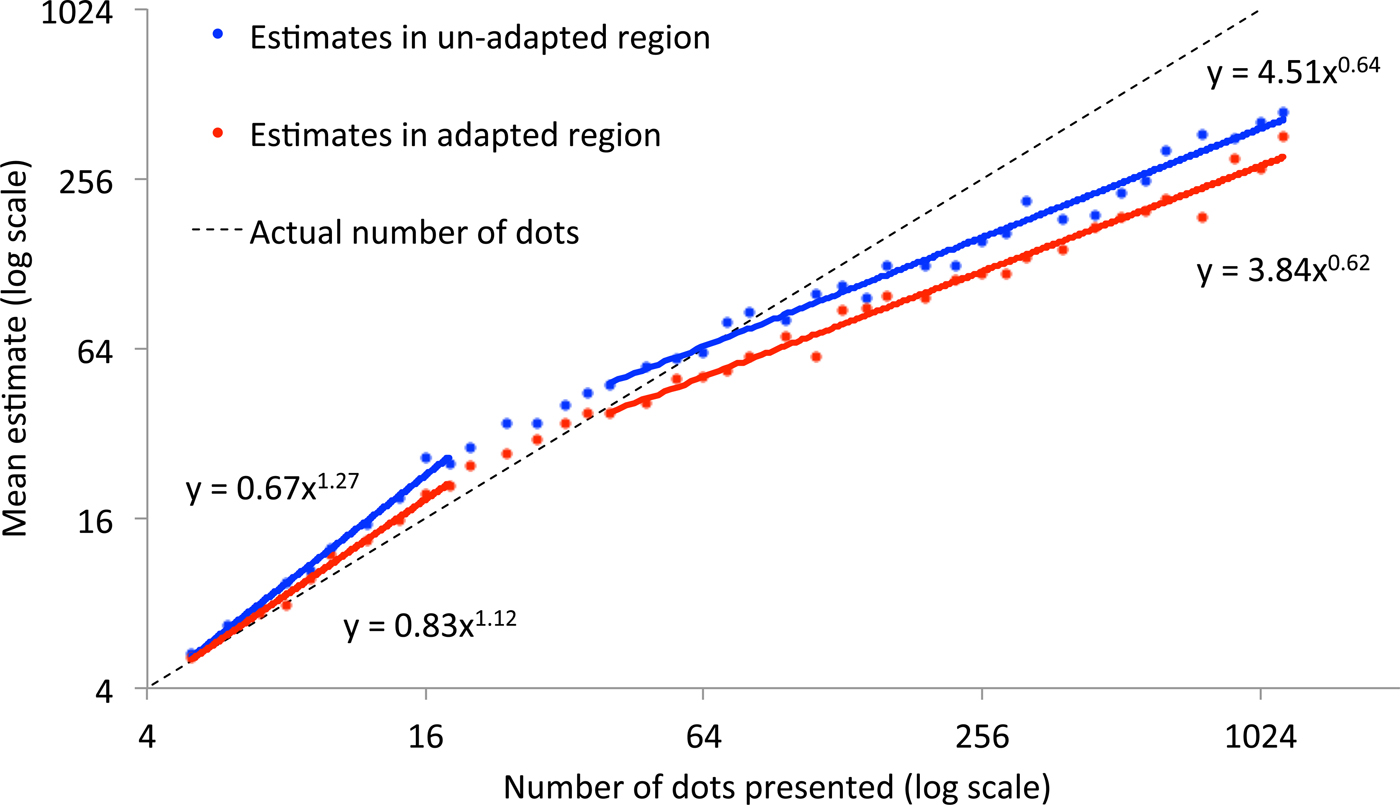
The estimation data are shown in Figure 1. Number estimates were unaffected for 5 dots. But for more numerous collections (40 dots or more), estimates were about 25% lower in retinotopic regions adapted to dense (high numerosity) random dots fields than in unadapted regions. The average estimate for 256 actual dots, for example, was 154 in the unadapted region, and only 117 in the adapted region. Significantly, the numerosity estimation functions shown here in log-log space seem to bend significantly between 20 and 40 dots.
Number estimation in adapted and unadapted regions (Durgin Reference Durgin and Henik2016; Huk & Durgin Reference Huk and Durgin1996). Data are re-plotted in a log-log scale and fit with power functions for values of 5–18 dots or 40–1,152 dots.
So what can we learn from magnitude estimates of numerosity? Magnitude estimation (i.e., assigning linguistic or symbolic numbers) for large non-symbolic numerosities behaves much like magnitude estimation data for other psychophysical magnitudes. It is consistently found that numeric estimates of large numbers of texture units are compressive in their scaling (have a slope less than 1 in log-log space). Additionally, the break between low and high numbers depicted in the graph is quite dramatic, and it encourages us to think, as Anobile et al. (Reference Anobile, Cicchini and Burr2014) also seem to propose, that numerosity is not a single perceptual dimension. In visual number perception, at least, number investigation probably ought to think of numbers higher than about 20 as perceptual magnitudes, not multitudes. But what does the growing effect of adaptation mean between 5 and 20? Five uniformly colored dots seem to be unaffected by adaptation. Our subjects, who have a linguistic number system, found this multitude of units easy to identify even when briefly flashed peripherally in a dense-adapted region. Beyond 5, performance seems quite different. Beyond 20, it seems different again.