






No CrossRef data available.
Article contents
From continuous magnitudes to symbolic numbers: The centrality of ratio
Published online by Cambridge University Press: 27 July 2017
Abstract
Leibovich et al.'s theory neither accounts for the deep connections between whole numbers and other classes of number nor provides a potential mechanism for mapping continuous magnitudes to symbolic numbers. We argue that focusing on non-symbolic ratio processing abilities can furnish a more expansive account of numerical cognition that remedies these shortcomings.
Information
- Type
- Open Peer Commentary
- Information
- Copyright
- Copyright © Cambridge University Press 2017
References
Barth, H. C. & Paladino, A. M. (2011) The development of numerical estimation: Evidence against a representational shift. Developmental Science
14(1):125–35. doi: 10.1111/j.1467-7687.2010.00962.x.Google Scholar
DeWolf, M., Grounds, M. A., Bassok, M. & Holyoak, K. J. (2014) Magnitude comparison with different types of rational numbers. Journal of Experimental Psychology: Human Perception and Performance
40(1):71–82. doi: 10.1037/a0032916.Google ScholarPubMed
Gallistel, C. R. & Gelman, R. (2000) Non-verbal numerical cognition: From reals to integers. Trends in Cognitive Sciences
4(2):59–65. doi: 10.1016/S1364-6613(99)01424-2.CrossRefGoogle ScholarPubMed
Halberda, J. & Feigenson, L. (2008) Developmental change in the acuity of the “number sense”: The approximate number system in 3-, 4-, 5-, and 6-year-olds and adults. Developmental Psychology
44(5):1457–65. doi: 10.1037/a0012682.Google Scholar
Henik, A. & Tzelgov, J. (1982) Is three greater than five: The relation between physical and semantic size in comparison tasks. Memory & Cognition
10(4):389–95. doi: 10.3758/BF03202431.Google Scholar
Jacob, S. N. & Nieder, A. (2009) Tuning to non-symbolic proportions in the human frontoparietal cortex. European Journal of Neuroscience
30(7):1432–42. doi: 10.1111/j.1460-9568.2009.06932.x.CrossRefGoogle ScholarPubMed
Jacob, S. N., Vallentin, D. & Nieder, A. (2012) Relating magnitudes: The brain's code for proportions. Trends in Cognitive Sciences
16(3):157–66. doi: 10.1016/j.tics.2012.02.002.CrossRefGoogle ScholarPubMed
Leibovich, T., Kallai, A. & Itamar, S. (2016a) What do we measure when we measure magnitudes? In: Continuous issues in numerical cognition, ed. Henik, A., pp. 355–73. Elsevier. doi: 10.1016/B978-0-12-801637-4.00016-0.Google Scholar
Matthews, P. G. & Chesney, D. L. (2015) Fractions as percepts? Exploring cross-format distance effects for fractional magnitudes. Cognitive Psychology
78:28–56. doi: 10.1016/j.cogpsych.2015.01.006.CrossRefGoogle ScholarPubMed
Matthews, P. G. & Lewis, M. R. (2016) Fractions we cannot ignore: The nonsymbolic ratio congruity effect. Cognitive Science. Available online. doi: 10.1111/cogs.12419.Google Scholar
Matthews, P. G., Lewis, M. R. & Hubbard, E. M. (2016) Individual differences in nonsymbolic ratio processing predict symbolic math performance. Psychological Science
27(2):191–202. doi: 10.1177/0956797615617799.Google Scholar
McCrink, K. & Wynn, K. (2007) Ratio abstraction by 6-month-old infants. Psychological Science
18(8):740–45. doi: 10.1111/j.1467-9280.2007.01969.x.Google Scholar
Moyer, R. S. & Landauer, T. K. (1967) Time required for judgements of numerical inequality. Nature
215(5109):1519–20. doi: 10.1038/2151519a0.CrossRefGoogle ScholarPubMed
Piazza, M. (2010) Neurocognitive start-up tools for symbolic number representations. Trends in Cognitive Sciences
14(12):542–51. doi: 10.1016/J.Tics.2010.09.008.Google Scholar
Siegler, R. S., Thompson, C. A. & Schneider, M. (2011) An integrated theory of whole number and fractions development. Cognitive Psychology
62(4):273–96. Available at: https://doi.org/10.1016/j.cogpsych.2011.03.001.Google Scholar
Thompson, C. A. & Opfer, J. E. (2010) How 15 hundred is like 15 cherries: Effect of progressive alignment on representational changes in numerical cognition. Child Development
81(6):1768–86. doi: 10.1111/j.1467-8624.2010.01509.x.Google Scholar
Vallentin, D. & Nieder, A. (2008) Behavioral and prefrontal representation of spatial proportions in the monkey. Current Biology
18(18):1420–25. doi: 10.1016/j.cub.2008.08.042.Google Scholar

Figure 1. Demonstration of the similarities between non-symbolic ratios made of line segments and number lines. From left to right, the panels represent (a) an example of a non-symbolic representation of the ratio 3:10 (or 10:3) based on stimuli from Vallentin and Nieder (2008), (b) the superimposition of the component stimuli of the ratio onto one line, and (c) how the addition of symbolic anchors yields the traditional number line estimation task. At a minimum, accurate number line estimation requires crossformat proportional reasoning, matching the symbolic 3/10 to a corresponding non-symbolic ratio.
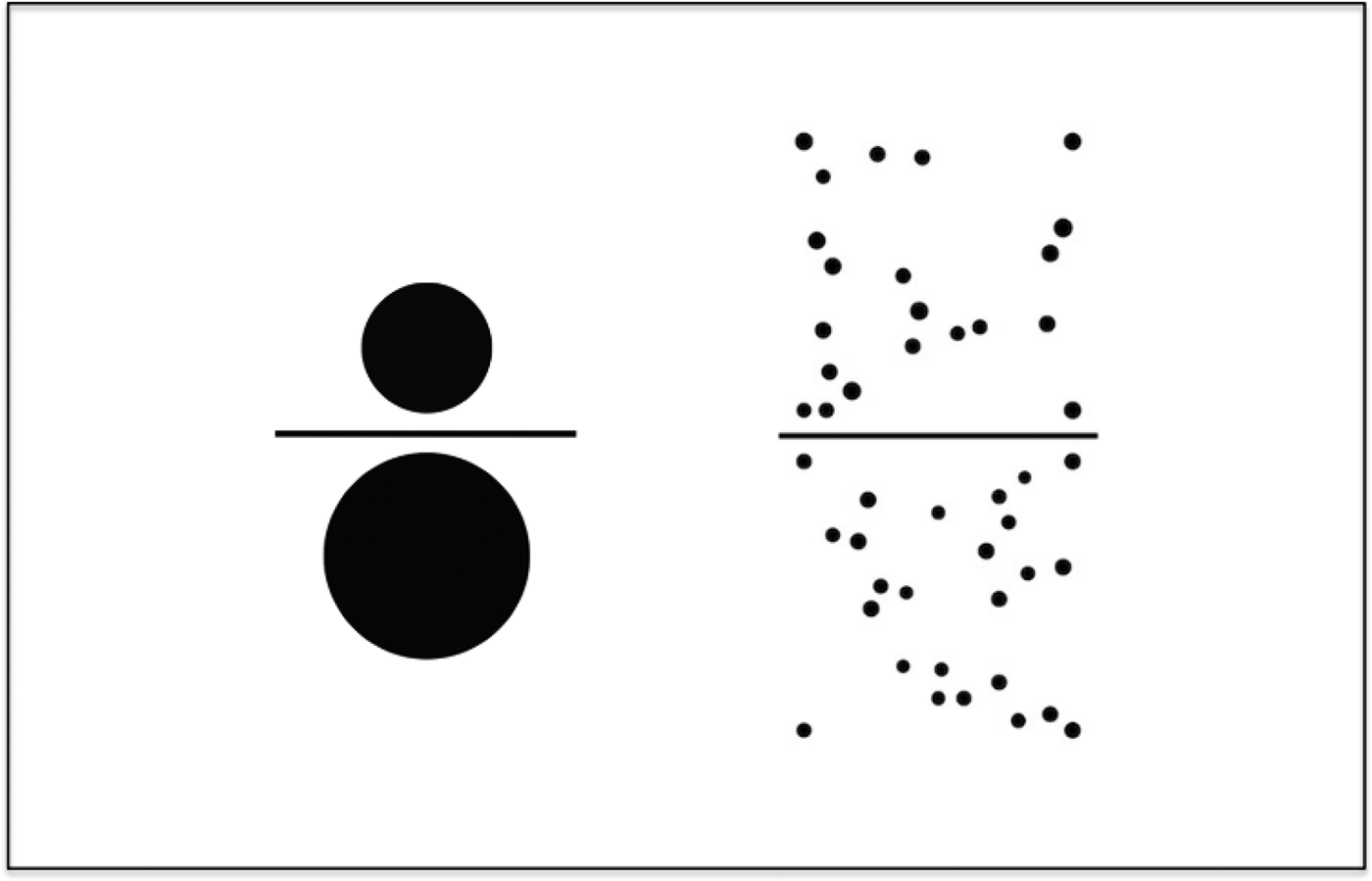
Figure 2. Matthews and Chesney (2015) found that participants could accurately compare non-symbolic ratios across different formats in about 1,100 ms – even faster than they could compare pairs of symbolic fractions. This ability to compare ratios across formats implies that participants could perceptually extract abstract ratio magnitudes in an analog form.
This commentary was motivated by two shortcomings of the target article by Leibovich et al.: First, its sole focus on whole numbers leaves out entire classes of numbers, such as fractions, that are integral to cultivating robust numerical understanding among children and adults (Siegler et al. Reference Siegler, Thompson and Schneider2011). Second, it does not offer a mechanism whereby continuous magnitudes can be linked to specific whole numbers. Subsequently, we argue that focusing on non-symbolic ratio processing abilities might furnish a more expansive account of numerical cognition, providing perceptual access to both twhole number and fraction magnitudes. Moreover, a ratio-focused account can provide a potential mechanism for mapping analog representations of continuous magnitudes to symbolic numbers.
Recent research has begun to systematically detail the ability of humans and other animals to perceive non-symbolic ratios (e.g., Jacob et al. Reference Jacob, Vallentin and Nieder2012; Matthews et al. Reference Matthews, Lewis and Hubbard2016; McCrink & Wynn Reference McCrink and Wynn2007). Instead of focusing on individual non-symbolic stimuli in isolation, this work focuses on perceiving ratio magnitudes that emerge from pairs of these stimuli considered in tandem (Fig. 1a). As the extent of non-symbolic ratio processing abilities becomes clearer, some have called for research that foregrounds ratio perception as a possible basis for numerical cognition more generally (e.g., Matthews et al. Reference Matthews, Lewis and Hubbard2016). Indeed, in a recent book chapter, Leibovich et al. (Reference Leibovich, Kallai, Itamar and Henik2016a) posited that the development of non-symbolic ratio perception “might be at the background of all other numerical developmental processes” (p. 370). In recognition of this fact, we view this commentary as an extension of the authors' own logic to address key gaps in the theory as presented in the target article.
Demonstration of the similarities between non-symbolic ratios made of line segments and number lines. From left to right, the panels represent (a) an example of a non-symbolic representation of the ratio 3:10 (or 10:3) based on stimuli from Vallentin and Nieder (Reference Vallentin and Nieder2008), (b) the superimposition of the component stimuli of the ratio onto one line, and (c) how the addition of symbolic anchors yields the traditional number line estimation task. At a minimum, accurate number line estimation requires crossformat proportional reasoning, matching the symbolic 3/10 to a corresponding non-symbolic ratio.
First, we argue that whole numbers are not the whole story. In presenting their integrated theory of numerical development, Siegler et al. (Reference Siegler, Thompson and Schneider2011) lamented that the field's focus on whole numbers has deflected attention from commonalities shared by both whole numbers and fractions. This is a particularly interesting point given that recent research has highlighted multiple commonalities in the ways we process different classes of number. To name a few:
1. Whole numbers and fractions have both been associated with size congruity effects (Henik & Tzelgov Reference Henik and Tzelgov1982; Matthews & Lewis Reference Matthews and Lewis2016).
2. Processing of both whole numbers and fractions recruits the intraparietal sulcus (IPS) (Jacob et al. Reference Jacob, Vallentin and Nieder2012; Piazza Reference Piazza2010).
3. Whole numbers and fractions can both be represented as magnitudes on number lines (e.g., Siegler et al. Reference Siegler, Thompson and Schneider2011).
4. Processing fractions and whole numbers exhibits distance effects in both symbolic (DeWolf et al. Reference DeWolf, Grounds, Bassok and Holyoak2014; Moyer & Landauer Reference Moyer and Landauer1967) and non-symbolic (Halberda & Feigenson Reference Halberda and Feigenson2008; Jacob & Nieder Reference Jacob and Nieder2009) forms.
This last fact results because numerical processing obeys Weber's law, and this has two very important implications. The first was perhaps stated best when Moyer and Landauer (Reference Moyer and Landauer1967) wrote that observed distance effects for symbolic numbers implied that it “is conceivable that [numerical] judgments are made in the same way as judgments of stimuli varying along physical continua” (p. 1520). The second is a corollary to the first and seems widely unappreciated: Weber's law is fundamentally parameterized in terms of ratios between stimulus magnitudes. Ironically, even the way we represent whole numbers is governed by the ratios among them. Together, these points raise considerable potential for integrating the psychophysics of perception with numerical processing via the conduit of ratio.
Furthermore, we argue that non-symbolic ratio lays the foundation for a pathway to understanding all real numbers. Leibovich et al.'s theory in the target article bears interesting parallels with Gallistel and Gelman's (Reference Gallistel and Gelman2000) theory that the primitive machinery for representing number works with real number magnitudes. The missing link for both is a compelling mechanism for establishing a correspondence between continuous non-symbolic magnitudes and specific number values. Herein lies the power of non-symbolic ratios. By juxtaposing two quantities instead of one, ratios of non-symbolic stimuli can be used to indicate specific values. Although neither the gray nor the black line segments presented in Figure 1a correspond to a specific number, the ratio between the two corresponds only to 3/10 (or 10/3). Thus, non-symbolic ratio provides perceptual access to both fractions and whole numbers. In fact, because the components are continuous, these non-symbolic ratios can be used to represent all real numbers. In this way, non-symbolic ratios provide a flexible route for mapping non-numerical stimuli to specific real number values.
The potential of this conceptualization becomes clearest when we consider that competent number line estimation (i.e., linear estimates) can be seen as a task bridging symbolic and non-symbolic proportional reasoning (e.g., Barth & Paladino Reference Barth and Paladino2011; Matthews & Hubbard, in press). Indeed, Thompson and Opfer's (Reference Thompson and Opfer2010) use of progressive alignment with number lines to improve children's symbolic number knowledge can be interpreted as a case in which non-symbolic ratio perception is used to facilitate analogical mapping that endows unfamiliar symbolic numbers with semantic meaning. This technique leverages the fact that 15:100 is the same as 150:1000 in that both are the same proportion of the way across the number line, a fact that can help children understand the way the base-10 system scales up. Given that non-symbolic ratio perception is abstract enough even to support comparisons between ratios composed of different types of stimuli (e.g., Matthews & Chesney Reference Matthews and Chesney2015) (Fig. 2), the possibilities for such analogical mapping abound. It may be that much of the psychophysical apparatus that operates in accord with Weber's law can be used to ground numerical intuitions. A focus on ratio processing stands to firmly situate numerical development within the generalized magnitude system proposed by the target article.
Matthews and Chesney (Reference Matthews and Chesney2015) found that participants could accurately compare non-symbolic ratios across different formats in about 1,100 ms – even faster than they could compare pairs of symbolic fractions. This ability to compare ratios across formats implies that participants could perceptually extract abstract ratio magnitudes in an analog form.
A comprehensive theory of numerical development should account for the deep connections between whole numbers and other classes of number, while accounting for relationships between symbolic and non-symbolic instantiations of numerical magnitudes. Leibovich et al.'s theory as presented in the target article neither accounts for numbers like fractions nor accounts for how continuous magnitudes can be mapped to specific numbers. However, adding a correction carving out a pivotal role for non-symbolic ratio perception might help provide the basis for a unified theory of numerical cognition.
ACKNOWLEDGMENTS
Support for this research was provided in part by the U.S. Department of Education Institute of Education Sciences (Grant R305A160295), the National Institutes of Health (Grant 1R03HD081087-01), the National Science Foundation (Grant DRL-1419973), and the Kent State University Postdoctoral Seed Grant Program.