






No CrossRef data available.
Article contents
Right idea, wrong magnitude system
Published online by Cambridge University Press: 27 July 2017
Abstract
Leibovich et al. claim that number representations are non-existent early in life and that the associations between number and continuous magnitudes reside in stimulus confounds. We challenge both claims – positing, instead, that number is represented independently of continuous magnitudes already in infancy, but is nonetheless more deeply connected to other magnitudes through adulthood than acknowledged by the “sense of magnitude” theory.
Information
- Type
- Open Peer Commentary
- Information
- Copyright
- Copyright © Cambridge University Press 2017
References
Atkinson, J. & Braddick, O. (1992) Visual segmentation of oriented textures by infants. Behavioural Brain Research
49:123–31.CrossRefGoogle ScholarPubMed
Atkinson, J., Braddick, O. & Braddick, F. (1974) Acuity and contrast sensitivity of infant vision. Nature
247:403–404.Google Scholar
Banks, M. S. & Salapatek, P. (1981) Infant pattern vision: A new approach based on the contrast sensitivity function. Journal of Experimental Child Psychology
31:1–45.Google Scholar
Bonny, J. W. & Lourenco, S. F. (in preparation) The impact of spatial context of non-symbolic number and cumulative area judgments.Google Scholar
Brown, A. M. & Yamamoto, M. (1986) Visual acuity in newborn and preterm infants measured with grating acuity cards. American Journal of Ophthalmology
102:245–53.Google Scholar
Cantrell, L. & Smith, L. B. (2013) Open questions and a proposal: A critical review of the evidence on infant numerical abilities. Cognition
128(3):331–52. doi: 10.1016/j.cognition.2013.04.008.Google Scholar
Carey, S. & Xu, F. (2001) Infants' knowledge of objects: Beyond object files and object tracking. Cognition
80:179–213.Google Scholar
Cordes, S. & Brannon, E. M. (2009) The relative salience of discrete and continuous quantity in young infants. Developmental Science
12(3):453–63. doi: 10.1111/j.1467-7687.2008.00781.x.Google Scholar
Cordes, S. & Brannon, E. M. (2011) Attending to one of many: When infants are surprisingly poor at discriminating an item's size. Frontiers in Psychology
2:65. doi: 10.3389/fpsyg.2011.00065.Google Scholar
DeWind, N. K. & Brannon, E. M. (2012) Malleability of the approximate number system: Effects of feedback and training. Frontiers in Human Neuroscience
6:68.Google Scholar
Harvey, B. M., Fracasso, A., Petridou, N. & Dumoulin, S. O. (2015) Topographic representations of object size and relationships with numerosity reveal generalized quantity processing in human parietal cortex. Proceedings of the National Academy of Sciences of the United States of America
112(44):13525–30. doi: 10.1073/pnas.1515414112.Google Scholar
Holmes, K. J. & Lourenco, S. F. (2011) Common spatial organization of number and emotional expression: A mental magnitude line. Brain and Cognition
77:315–23.Google Scholar
Izard, V., Sann, C., Spelke, E. S. & Steri, A. (2009) Newborn infants perceive abstract numbers. Proceedings of the National Academy of Sciences of the United States of America
106(25):10382–85.Google Scholar
Johnson, S. P. & Aslin, R. N. (1995) Perception of object unity in 2-month-old infants. Developmental Psychology
31:739–45.Google Scholar
Kellman, P. J. & Spelke, E. S. (1983) Perception of partly occluded objects in infancy. Cognitive Psychology
15:483–524.Google Scholar
Kestenbaum, R., Termine, N. & Spelke, E. S. (1987) Perception of objects and object boundaries by 3-month-old infants. British Journal of Developmental Psychology
5:367–83.Google Scholar
Leslie, A. M., Xu, F., Tremoulet, P. D., & Scholl, B. J. (1998) Indexing and the object concept: Developing ‘what’ and ‘where’ systems. Trends in Cognitive Sciences
2:10–18.CrossRefGoogle ScholarPubMed
Lourenco, S. F. (2015) On the relation between numerical and non-numerical magnitudes: Evidence for a general magnitude system. In: Evolutionary origins and early development of number processing, ed. Geary, D. C., Berch, D. B. & Koepke, K. M., pp. 145–74. Elsevier Academic Press.Google Scholar
Lourenco, S. F. (2016) How do humans represent numerical and nonnumerical magnitudes? Evidence for an integrated system of magnitude representation across development. In: Continuous issues in numerical cognition: How many or how much, ed. Henik, A., pp. 375–403. Elsevier Academic Press.Google Scholar
Lourenco, S. F. & Aulet, L. S. (submitted) Cross-magnitude interactions across development: Longitudinal support for a general magnitude system.Google Scholar
Lourenco, S. F., Ayzenberg, V. & Lyu, J. (2016) A general magnitude system in human adults: Evidence from a subliminal priming paradigm. Cortex
81:93–103.Google Scholar
Lourenco, S. F. & Bonny, J. W. (2016) Representations of numerical and non-numerical magnitude both contribute to mathematical competence in children. Developmental Science. Available online May 4, 2016. doi: 10.1111/desc.12418.Google Scholar
Lourenco, S. F. & Longo, M. R. (2010) General magnitude representation in human infants. Psychological Science
21:873–81.Google Scholar
Needham, A. (1998) Infants' use of featural information in the segregation of stationary objects. Infant Behavior and Development
21:47–76.Google Scholar
Odic, D., Libertus, M. E., Feigenson, L. & Halberda, J. (2013) Developmental change in the acuity of approximate number and area representations. Developmental Psychology
49(6):1103–12.Google Scholar
Piazza, M., Pica, P., Izard, V., Spelke, E. S. & Dehaene, S. (2013) Education enhances the acuity of the nonverbal approximate number system. Psychological Science
24:1037–43.Google Scholar
Slater, A., Morison, V., Somers, M., Mattock, A., Brown, E. & Taylor, D. (1990) Newborn and older infants' perception of partly occluded objects. Infant Behavior and Development
13:33–49.CrossRefGoogle Scholar
Valenza, E., Leo, I., Gava, L. & Simion, F. (2006) Perceptual completion in newborn human infants. Child Development
77(6):1810–21.Google Scholar
Wilcox, T. (1999) Object individuation: Infants' use of shape, size, pattern, and color. Cognition
72:125–66.Google Scholar
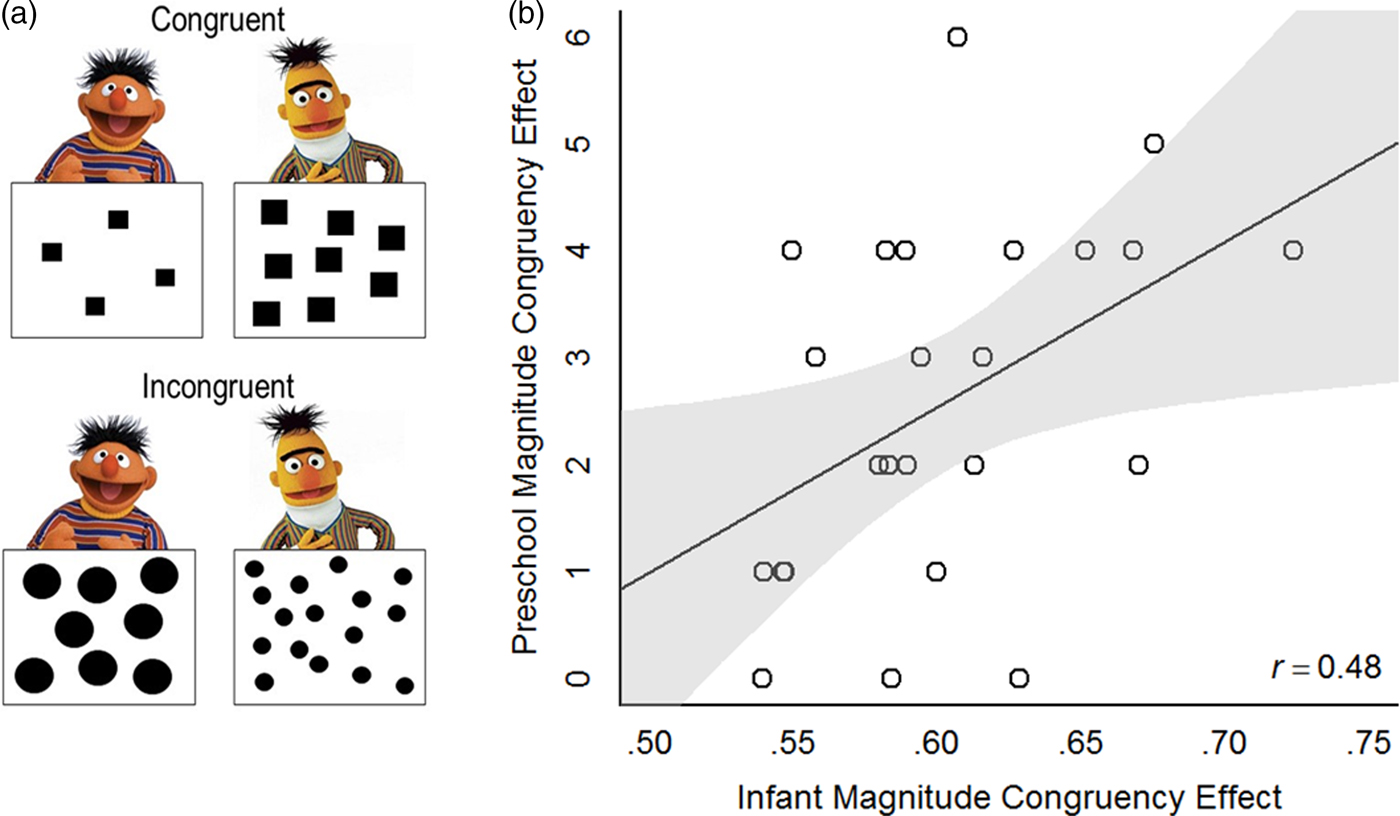
Figure 1. (A) Examples of congruent and incongruent trials in the numerical judgment task administered to preschool (3.5-year-old) children in the longitudinal study of Lourenco and Aulet (submitted). Children were asked to judge which character (Bert or Ernie) had the larger numerosity. On the congruent trials, the array with the larger numerosity was also larger in cumulative area and item size. On the incongruent trials, the array with the larger numerosity was smaller in cumulative area and item size. It is worth noting that mean accuracy on the incongruent trials was significantly above chance, confirming the use of number on this task while ensuring an assessment of the influence of area on number. (B) Scatterplot relating magnitude congruency effects across the two time points: infancy and preschool age. For the purpose of this commentary, we depict a subset of children (N = 25) whose scores were equal to or above 0.50 at time point 1 (infancy) and 0 at time point 2 (preschool), each of which indicates no association between magnitudes. Infant scores were computed as the proportion of looking time toward the novel test trials as a function of their total looking time (novel+familiar trials; see Lourenco & Longo [2010] for procedural details). Preschool scores were computed as the difference in errors between the two types of trials (incongruent−congruent). Children's performance at 9 months of age was significantly correlated with their performance at 3.5 years of age, suggesting that the association between magnitudes apparent in preverbal children remained relatively stable into preschool age. The scatterplot includes the best-fitting regression line and the 95% confidence interval (shaded area).
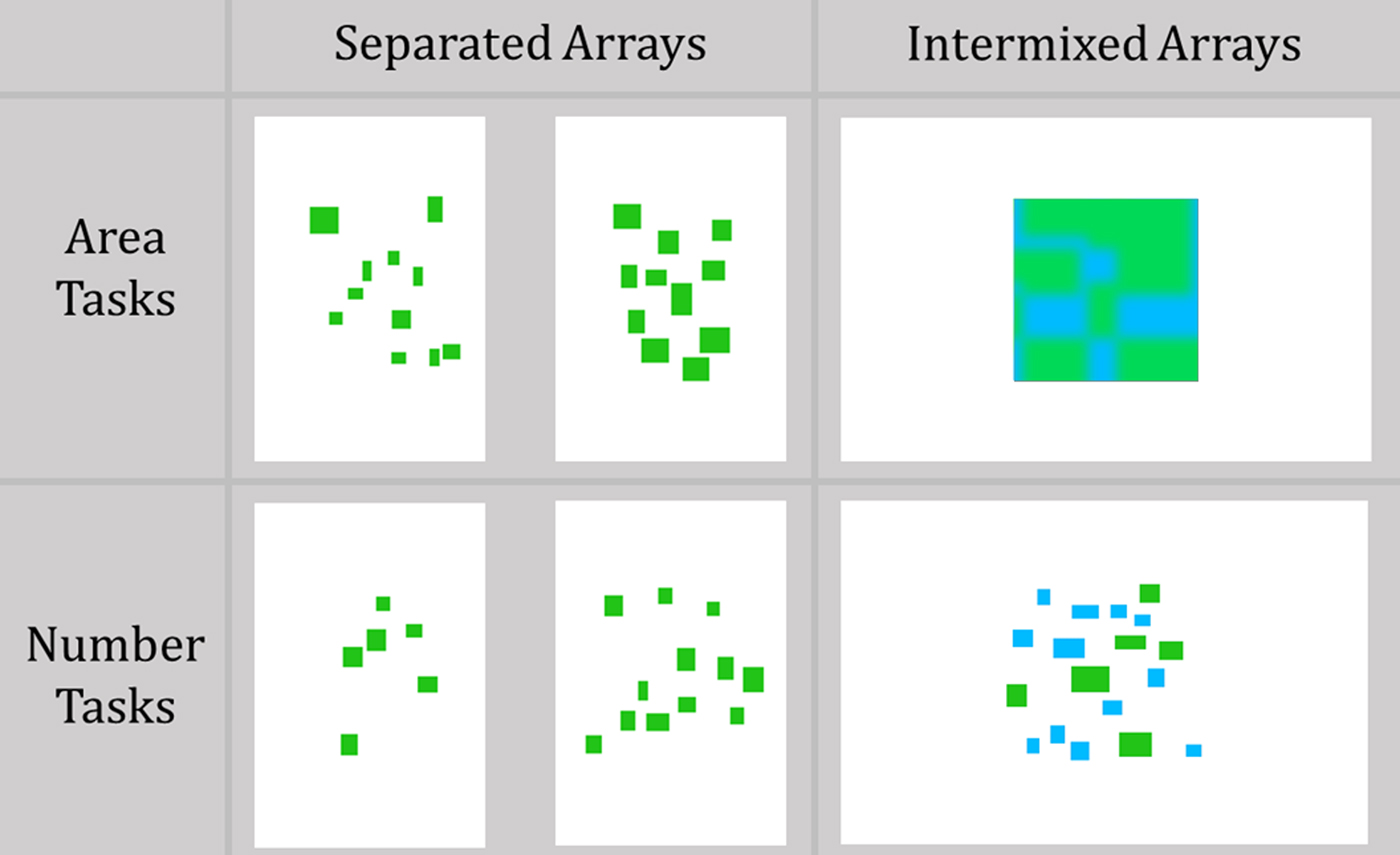
Figure 2. Examples of stimuli used by Bonny and Lourenco (in preparation) to compare the precision of children's number and area representations. In number and area tasks, children were asked to designate which array contained the greater magnitude. The left column shows displays that were spatially separated, with children selecting either a left or right array. The right column shows intermixed arrays, with children selecting either blue or green as having greater “paint” (area task) or “boxes” (number task). Cumulative area in this study was tested with both discrete (left column) and amorphous (right column) stimuli. Regardless of stimulus type, children never showed an advantage in making area judgments over number, as would be predicted by Leibovich et al.'s theory. Some studies report greater accuracy for area than for number judgments, but “area” in these studies involved single elements (DeWind & Brannon 2012; Piazza et al. 2013) or uniform displays akin to single elements (Odic et al. 2013). When comparing precision, cumulative area is the more appropriate counterpart to number because, like number, it applies to the set of items. Moreover, although infants and children might show greater sensitivity to other continuous magnitudes such as contour length (Cantrell & Smith 2013), the relevant contrast to number, based on Leibovich et al.'s logic, is cumulative area (or perhaps convex hull) because contour length requires object individuation akin to number.
Leibovich et al. argue that it is time to reconsider mainstream “number sense” theories, and as an alternative, they propose a “sense of magnitude” theory based on two central claims. The first is that mental representations of number are non-existent early in human life because number is not represented independently of continuous magnitudes prior to experience with language or the development of executive control. The second is that the associations between number and continuous magnitudes reside in stimulus confounds, making it virtually impossible to examine the true nature of magnitude representations, even in adults. Here, we challenge both claims, positing instead that number may be represented independently early in development, but nonetheless shows deep underlying connections with other magnitudes throughout life.
The idea that young infants lack number representations is based on a false premise, namely, that infants are unable to individuate objects. On the contrary, studies of object individuation suggest that by 4 months, infants are skilled at using motion, spatial separation, and featural cues such as shape and size to segment visual scenes, including distinguishing figure from ground, delineating the boundaries of connected or partially occluded objects, and tracking individual objects across time (Atkinson & Braddick Reference Atkinson and Braddick1992; Johnson & Aslin Reference Johnson and Aslin1995; Kellman & Spelke Reference Kellman and Spelke1983; Kestenbaum et al. Reference Kestenbaum, Termine and Spelke1987; Needham Reference Needham1998; Slater et al. Reference Slater, Morison, Somers, Mattock, Brown and Taylor1990; Valenza et al. Reference Valenza, Leo, Gava and Simion2006; Wilcox Reference Wilcox1999). Although infants of this age certainly have difficulty with object identification (i.e., what an object is [Carey & Xu Reference Carey and Xu2001; Leslie et al. Reference Leslie, Xu, Tremoulet and Scholl1998]), object individuation independent of identity is well within their capacity. Moreover, our own analysis of visual stimuli used to assess “number sense” in newborn infants challenges Leibovich et al.'s contention that object individuation is impossible because of newborns' poor vision (see sect. 8, e.g., Fig. 6). We calculated spatial frequency (SF) for 50 visual displays using the parameters (e.g., viewing distance: 60 cm) specified by Izard et al. (Reference Izard, Sann, Spelke and Steri2009). This analysis yielded a mean SF of 0.5 cycles/degree, well within the normal acuity of a newborn viewing a high-contrast image (Atkinson et al. Reference Atkinson, Braddick and Braddick1974; Banks & Salapatek Reference Banks and Salapatek1981; Brown & Yamamoto Reference Brown and Yamamoto1986). Even the most cluttered portions of these displays averaged 1.4 cycles/degree, a value lower than the upper limit of 1.8–2 cycles/degree of newborns' visual acuity.
Leibovich et al. argue that even after infants come to individuate objects, they still cannot differentiate number from continuous magnitudes because this ability depends on linguistic experience (e.g., number words) and executive control (e.g., inhibition). However, this claim is challenged by recent longitudinal data from our lab showing that individual differences in the associations of various magnitudes (number, area, and duration) at 9 months of age predict the extent to which number remains associated with area in the same children at 3.5 years of age (see Fig. 1). The continuity over this period argues against language as a mechanism of differentiation because the children were mostly preverbal at the earliest time point and therefore had not learned any number words. The continuity was also not explained by inter-individual variability in inhibitory control (measured using the Day-Night Stroop task at 3.5 years), arguing against executive control as a mechanism of differentiation. Although we agree with Leibovich et al. (and others) that number words and inhibition may facilitate differentiation of number from other magnitudes (perhaps by drawing attention to individual stimulus items), our longitudinal data suggest that neither factor is necessary, because at least some differentiation is apparent in preverbal infants and cannot be accounted for by inhibition more generally.
(A) Examples of congruent and incongruent trials in the numerical judgment task administered to preschool (3.5-year-old) children in the longitudinal study of Lourenco and Aulet (Reference Lourenco and Auletsubmitted). Children were asked to judge which character (Bert or Ernie) had the larger numerosity. On the congruent trials, the array with the larger numerosity was also larger in cumulative area and item size. On the incongruent trials, the array with the larger numerosity was smaller in cumulative area and item size. It is worth noting that mean accuracy on the incongruent trials was significantly above chance, confirming the use of number on this task while ensuring an assessment of the influence of area on number. (B) Scatterplot relating magnitude congruency effects across the two time points: infancy and preschool age. For the purpose of this commentary, we depict a subset of children (N = 25) whose scores were equal to or above 0.50 at time point 1 (infancy) and 0 at time point 2 (preschool), each of which indicates no association between magnitudes. Infant scores were computed as the proportion of looking time toward the novel test trials as a function of their total looking time (novel+familiar trials; see Lourenco & Longo [Reference Lourenco and Longo2010] for procedural details). Preschool scores were computed as the difference in errors between the two types of trials (incongruent−congruent). Children's performance at 9 months of age was significantly correlated with their performance at 3.5 years of age, suggesting that the association between magnitudes apparent in preverbal children remained relatively stable into preschool age. The scatterplot includes the best-fitting regression line and the 95% confidence interval (shaded area).
Another reason to doubt Leibovich et al.'s claim that number does not dissociate from continuous magnitudes until relatively late in development is that it makes a dubious prediction: Early representations of number should be less precise than those of continuous magnitudes because of children's earlier, and presumably greater, experience with the latter. Multiple studies examining discrimination sensitivity contradict this prediction. For example, Cordes and Brannon (Reference Cordes and Brannon2009; Reference Cordes and Brannon2011) found that 6-month-olds require a larger difference between sets when discriminating cumulative area than when discriminating number. Similarly, Bonny and Lourenco (Reference Bonny and Lourencoin preparation) found that 4- and 6-year-olds' judgments based on cumulative area were no more accurate than those based on numerosity, regardless of the type of display used to assess accuracy (see Fig. 2) and even when stimuli in the number task included continuous magnitudes incongruent with number.
Examples of stimuli used by Bonny and Lourenco (Reference Bonny and Lourencoin preparation) to compare the precision of children's number and area representations. In number and area tasks, children were asked to designate which array contained the greater magnitude. The left column shows displays that were spatially separated, with children selecting either a left or right array. The right column shows intermixed arrays, with children selecting either blue or green as having greater “paint” (area task) or “boxes” (number task). Cumulative area in this study was tested with both discrete (left column) and amorphous (right column) stimuli. Regardless of stimulus type, children never showed an advantage in making area judgments over number, as would be predicted by Leibovich et al.'s theory. Some studies report greater accuracy for area than for number judgments, but “area” in these studies involved single elements (DeWind & Brannon Reference DeWind and Brannon2012; Piazza et al. Reference Piazza, Pica, Izard, Spelke and Dehaene2013) or uniform displays akin to single elements (Odic et al. Reference Odic, Libertus, Feigenson and Halberda2013). When comparing precision, cumulative area is the more appropriate counterpart to number because, like number, it applies to the set of items. Moreover, although infants and children might show greater sensitivity to other continuous magnitudes such as contour length (Cantrell & Smith Reference Cantrell and Smith2013), the relevant contrast to number, based on Leibovich et al.'s logic, is cumulative area (or perhaps convex hull) because contour length requires object individuation akin to number.
The crux of Leibovich et al.'s sense of magnitude theory rests on the observation that continuous magnitudes available within non-symbolic arrays influence numerosity judgments, even in adults with mature language and executive control. According to this argument, the association between number and continuous magnitudes is merely a by-product of visual cues confounded with number in non-symbolic stimuli. However, accumulating behavioral and neural data suggest far deeper connections between number and other magnitudes. For example, even symbolic numbers, for which there are no visual confounds, affect representations of continuous magnitudes: Subliminally primed Arabic numerals bias adults' cumulative area judgments (Lourenco et al. Reference Lourenco, Ayzenberg and Lyu2016). Crucially, Lourenco et al. ruled out the possibility of priming effects at a decision stage, arguing instead for representations of number and area that partially overlap. Indeed, recent functional magnetic resonance imaging (fMRI) evidence is consistent with overlapping representations in parietal cortex. Harvey et al. (Reference Harvey, Fracasso, Petridou and Dumoulin2015) showed not only that number and area share topographic organization, but also that there was a correlation across these maps, with voxels displaying greater activation for larger numerosity also displaying greater activation for items larger in area – a finding that cannot reflect inhibitory processing, as in other neuroimaging studies discussed by Leibovich et al., because the correlation corresponded to a monotonic increase between magnitudes from different displays.
In summary, although we appreciate the prominence given to continuous magnitudes within Leibovich et al.'s sense of magnitude theory, we have argued that disregarding number representations early in development is a weakness (see also Lourenco & Bonny Reference Lourenco and Bonny2016) and that the emphasis on stimulus confounds misses the deeper underlying connections between numerical and non-numerical representations (see also Holmes & Lourenco Reference Holmes and Lourenco2011; Lourenco Reference Lourenco, Geary, Berch and Koepke2015; Reference Lourenco and Henik2016). The theory, though a well-intentioned alternative to extant number sense models, suffers from its own limitations.