Leibovich et al. review evidence about the extraction of numerosity from visual sets and question the view that numerosity is apprehended directly, through a dedicated system, from the number of elements in the display. They propose instead that numerosity results from the combination of several continuous dimensions that correlate with number, via a system that is built and refined throughout development.
Although we praise the enterprise, which makes current debates in the field visible, the empirical review does not do justice to the wealth and complexity of the evidence. As their declared aim is to challenge what they refer to as “number sense theory,” Leibovich et al. often appear selective and biased in their overview. For example, they reject Nys and Content's (Reference Nys and Content2012) claim that both number and area are extracted. In this study, subjects compared collections either for total area or for numerosity, and the congruency between number and aggregated area was manipulated orthogonally. The results showed effects of the irrelevant dimension in both tasks, suggesting that both dimensions are extracted automatically. Leibovich et al. discard this conclusion, citing as counterevidence studies that showed the influence of continuous dimensions on comparison performance, but did not examine the interference of numerosity on area. They further support their argument by referring to two studies that directly compared the interference of each dimension (number and area) on judgments of the other. Hurewitz et al. (Reference Hurewitz, Gelman and Schnitzer2006) reported no numerical interference on area comparison, but in their stimuli, the largest numerical ratio was half as large as the largest area ratio. Leibovich et al. (Reference Leibovich, Henik and Salti2015) used numerosities in the subitizing range (2–4), so the largest numerosity ratio was 2:1. Based on the three examples of incongruent pairs in their figure 1, we calculated that the total area ratios were around 5:1. Both studies thus failed to adequately match the range of variation of the two dimensions, and our point still holds.
Leibovich et al. argue that various continuous dimensions such as cumulated area of the elements, length of the contour, and density, are most often confounded with numerosity, and that they affect comparison performance despite efforts to control them. The conclusion is undisputable (and undisputed). But whether these effects have an impact on early extraction processes or later decision mechanisms is currently unclear. In adults, the influence of continuous cues seems much more limited in estimation than in comparison tasks (Gebuis & Reynvoet Reference Gebuis and Reynvoet2012c). Moreover, Content and Nys (Reference Content, Nys and Henik2016) observed no influence of continuous cues at all in nonverbal numerosity estimation with 4-year-olds.
Therefore, the influence of continuous dimensions does not challenge the hypothesis that numerosity is automatically extracted and used, as Nys and Content's results suggest (see also Cicchini et al. [Reference Cicchini, Anobile and Burr2016] for a similar argument). Leibovich et al. seem to have neglected some of the most convincing findings in this regard. Strong behavioral evidence that numerical magnitude is extracted independently of continuous dimensions comes from studies showing that numerosity estimation is changed by connecting some elements together without any modification, which would alter the continuous cues (Franconeri et al. Reference Franconeri, Bemis and Alvarez2009; He et al. Reference He, Zhang, Zhou and Chen2009, Kirjakovski & Matsumoto Reference Kirjakovski and Matsumoto2016). Adaptation effects (Anobile et al. Reference Anobile, Cicchini and Burr2016c) also indicate the existence of a dedicated perceptual mechanism for numerosity.
Leibovich et al.'s conclusion is neither new nor controversial. It does not discredit number sense theory, as the authors acknowledge in the concluding section. Continuous dimensions are indeed most often correlated with number in our experience of the world. No wonder that we would tend to use them, when possible, in comparing collections. Rather, the thrust of the theory is that humans and other species are equipped with a mechanism making it possible to extract and encode discrete magnitudes directly from sensory stimulations. The proposal put forward by the authors aims at offering an alternative to number sense theory. It takes the form of a developmental scenario, whereby numerical competence emerges from learning “the correlation between numerosity and continuous magnitudes.”
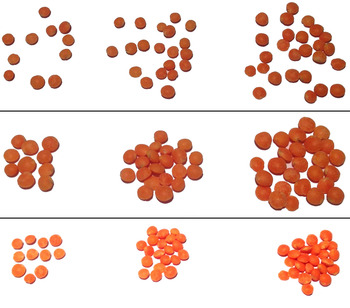
There are at least two logical flaws with this view. The first is its circularity. Capturing the correlation between numerosity and other dimensions requires representing numerosity in the first place. The authors acknowledge it and simply propose that number words would serve to trigger the emergence of numerosity. But how would number words make contact with numerosities? No answer is offered. The second and even more serious issue is that it is unclear whether continuous dimensions are sufficient to extract a representation of number, because the natural correlations between numerosity and continuous magnitudes even if most often present, are not stable in the world (see Figure 1). Sometimes numerosity could be predicted from contour area rather than occupancy, and sometimes it is the other way round. Therefore, whereas multiple cues may serve as proxies to order collections by numerosity, it is unclear how they could subserve the estimation of number.
Figure 1.
Three examples of collections varying in numerosity. In each triplet, there are correlations between numerosity, contour length, occupancy, aggregated area, and so forth. These continuous cues can help order the collections, but they cannot serve to determine the numerosity, as the nature of the predictive relation changes from one triplet to another.
To conclude, we would argue that a minimal requirement for future theoretical endeavours about numerosity processing would be to seriously consider and implement distinctions between the mechanism of numerosity extraction, the format of numerosity representation, and the decision processes that are required to perform a given task. That (some) continuous magnitudes would be extracted and combined in some weighted average to deliver a representation of number is one logical possibility. How the weights are determined without reference to numerosity remains, however, to be clarified. Yet another possibility would be that continuous magnitude information only affects late decision stages. Other scenarios are also possible, and we believe, more plausible. One is a specific, direct, numerosity extraction mechanism based on sampling the visual scene for individual elements feeding into a common magnitude representation system (see Cantlon et al. Reference Cantlon, Platt and Brannon2009b).







Leibovich et al. review evidence about the extraction of numerosity from visual sets and question the view that numerosity is apprehended directly, through a dedicated system, from the number of elements in the display. They propose instead that numerosity results from the combination of several continuous dimensions that correlate with number, via a system that is built and refined throughout development.
Although we praise the enterprise, which makes current debates in the field visible, the empirical review does not do justice to the wealth and complexity of the evidence. As their declared aim is to challenge what they refer to as “number sense theory,” Leibovich et al. often appear selective and biased in their overview. For example, they reject Nys and Content's (Reference Nys and Content2012) claim that both number and area are extracted. In this study, subjects compared collections either for total area or for numerosity, and the congruency between number and aggregated area was manipulated orthogonally. The results showed effects of the irrelevant dimension in both tasks, suggesting that both dimensions are extracted automatically. Leibovich et al. discard this conclusion, citing as counterevidence studies that showed the influence of continuous dimensions on comparison performance, but did not examine the interference of numerosity on area. They further support their argument by referring to two studies that directly compared the interference of each dimension (number and area) on judgments of the other. Hurewitz et al. (Reference Hurewitz, Gelman and Schnitzer2006) reported no numerical interference on area comparison, but in their stimuli, the largest numerical ratio was half as large as the largest area ratio. Leibovich et al. (Reference Leibovich, Henik and Salti2015) used numerosities in the subitizing range (2–4), so the largest numerosity ratio was 2:1. Based on the three examples of incongruent pairs in their figure 1, we calculated that the total area ratios were around 5:1. Both studies thus failed to adequately match the range of variation of the two dimensions, and our point still holds.
Leibovich et al. argue that various continuous dimensions such as cumulated area of the elements, length of the contour, and density, are most often confounded with numerosity, and that they affect comparison performance despite efforts to control them. The conclusion is undisputable (and undisputed). But whether these effects have an impact on early extraction processes or later decision mechanisms is currently unclear. In adults, the influence of continuous cues seems much more limited in estimation than in comparison tasks (Gebuis & Reynvoet Reference Gebuis and Reynvoet2012c). Moreover, Content and Nys (Reference Content, Nys and Henik2016) observed no influence of continuous cues at all in nonverbal numerosity estimation with 4-year-olds.
Therefore, the influence of continuous dimensions does not challenge the hypothesis that numerosity is automatically extracted and used, as Nys and Content's results suggest (see also Cicchini et al. [Reference Cicchini, Anobile and Burr2016] for a similar argument). Leibovich et al. seem to have neglected some of the most convincing findings in this regard. Strong behavioral evidence that numerical magnitude is extracted independently of continuous dimensions comes from studies showing that numerosity estimation is changed by connecting some elements together without any modification, which would alter the continuous cues (Franconeri et al. Reference Franconeri, Bemis and Alvarez2009; He et al. Reference He, Zhang, Zhou and Chen2009, Kirjakovski & Matsumoto Reference Kirjakovski and Matsumoto2016). Adaptation effects (Anobile et al. Reference Anobile, Cicchini and Burr2016c) also indicate the existence of a dedicated perceptual mechanism for numerosity.
Leibovich et al.'s conclusion is neither new nor controversial. It does not discredit number sense theory, as the authors acknowledge in the concluding section. Continuous dimensions are indeed most often correlated with number in our experience of the world. No wonder that we would tend to use them, when possible, in comparing collections. Rather, the thrust of the theory is that humans and other species are equipped with a mechanism making it possible to extract and encode discrete magnitudes directly from sensory stimulations. The proposal put forward by the authors aims at offering an alternative to number sense theory. It takes the form of a developmental scenario, whereby numerical competence emerges from learning “the correlation between numerosity and continuous magnitudes.”
There are at least two logical flaws with this view. The first is its circularity. Capturing the correlation between numerosity and other dimensions requires representing numerosity in the first place. The authors acknowledge it and simply propose that number words would serve to trigger the emergence of numerosity. But how would number words make contact with numerosities? No answer is offered. The second and even more serious issue is that it is unclear whether continuous dimensions are sufficient to extract a representation of number, because the natural correlations between numerosity and continuous magnitudes even if most often present, are not stable in the world (see Figure 1). Sometimes numerosity could be predicted from contour area rather than occupancy, and sometimes it is the other way round. Therefore, whereas multiple cues may serve as proxies to order collections by numerosity, it is unclear how they could subserve the estimation of number.
Three examples of collections varying in numerosity. In each triplet, there are correlations between numerosity, contour length, occupancy, aggregated area, and so forth. These continuous cues can help order the collections, but they cannot serve to determine the numerosity, as the nature of the predictive relation changes from one triplet to another.
To conclude, we would argue that a minimal requirement for future theoretical endeavours about numerosity processing would be to seriously consider and implement distinctions between the mechanism of numerosity extraction, the format of numerosity representation, and the decision processes that are required to perform a given task. That (some) continuous magnitudes would be extracted and combined in some weighted average to deliver a representation of number is one logical possibility. How the weights are determined without reference to numerosity remains, however, to be clarified. Yet another possibility would be that continuous magnitude information only affects late decision stages. Other scenarios are also possible, and we believe, more plausible. One is a specific, direct, numerosity extraction mechanism based on sampling the visual scene for individual elements feeding into a common magnitude representation system (see Cantlon et al. Reference Cantlon, Platt and Brannon2009b).