






No CrossRef data available.
Article contents
Evidence for a number sense
Published online by Cambridge University Press: 27 July 2017
Abstract
Numerosity is inherently confounded by related stimulus attributes such as density and area, and many studies have reported interactions of various strengths between area, density, and numerosity. However, direct measurements of sensitivity within the area-density-numerosity space show that numerosity emerges as the most spontaneous and sensitive dimension, strongly supporting the existence of a dedicated number sense.
Information
- Type
- Open Peer Commentary
- Information
- Copyright
- Copyright © Cambridge University Press 2017
References
Anobile, G., Arrighi, R., Togoli, I. & Burr, D. C. (2016a) A shared numerical representation for action and perception. Elife
5:e16161. doi: 10.7554/eLife.16161.CrossRefGoogle ScholarPubMed
Anobile, G., Castaldi, E., Turi, M., Tinelli, F. & Burr, D. C. (2016b) Numerosity but not texture-density discrimination correlates with math ability in children. Developmental Psychology
52(8):1206–16. doi: 10.1037/dev0000155.CrossRefGoogle Scholar
Anobile, G., Cicchini, G. M. & Burr, D. C. (2016c) Number as a primary perceptual attribute: A review. Perception
45
(1–2):5–31. doi: 10.1177/0301006615602599.CrossRefGoogle ScholarPubMed
Arrighi, R., Togoli, I. & Burr, D. C. (2014) A generalized sense of number. Proceedings of the Royal Society B
281:20141791. Available at: http://dx.doi.org/10.1098/rspb.2014.1791
CrossRefGoogle ScholarPubMed
Binda, P., Morrone, M. C. & Bremmer, F. (2012) Saccadic compression of symbolic numerical magnitude. PLoS ONE
7(11):e49587. doi: 10.1371/journal.pone.0049587.CrossRefGoogle ScholarPubMed
Brown, S. W. (1995) Time, change, and motion: The effects of stimulus movement on temporal perception. Perception and Psychophysics
57(1):105–16.CrossRefGoogle ScholarPubMed
Burr, D. C. & Ross, J. (1986) Visual processing of motion. Trends in Neurosciences
9:304–307. doi: 10.1016/0166-2236(86)90088-3.CrossRefGoogle Scholar
Burr, D. C., Ross, J., Binda, P. & Morrone, M. C. (2010) Saccades compress space, time and number. Trends in Cognitive Sciences
14(12):528–33. doi: 10.1016/j.tics.2010.09.005.CrossRefGoogle Scholar
Burr, D. C. & Thompson, P. (2011) Motion psychophysics: 1985–2010. Vision Research
51(13):1431–56. doi:10.1016/j.visres.2011.02.008.CrossRefGoogle ScholarPubMed
Cicchini, G. M., Anobile, G. & Burr, D. C. (2016) Spontaneous perception of numerosity in humans. Nature Communications
7:12536. doi: 10.1038/ncomms12536.CrossRefGoogle ScholarPubMed
Dakin, S. C., Tibber, M. S., Greenwood, J. A., Kingdom, F. A. A. & Morgan, M. J. (2011) A common visual metric for approximate number and density. Proceedings of the National Academy of Sciences of the United States of America
108(49):19552–57. doi: 10.1073/Pnas.1113195108.CrossRefGoogle ScholarPubMed
Dehaene, S., Bossini, S. & Giraux, P. (1993) The mental representation of parity and number magnitude. Journal of Experimental Psychology
122:371–96.CrossRefGoogle Scholar
Gebuis, T. & Reynvoet, B. (2012c) The role of visual information in numerosity estimation. PLoS ONE
7(5):e37426. doi: 10.1371/journal.pone.0037426.CrossRefGoogle ScholarPubMed
Gegenfurtner, K. R. & Hawken, M. J. (1996) Perceived velocity of luminance, chromatic and non-Fourier stimuli: Influence of contrast and temporal frequency. Vision Research
36(9):1281–90.CrossRefGoogle ScholarPubMed
Halberda, J., Mazzocco, M. M. & Feigenson, L. (2008) Individual differences in non-verbal number acuity correlate with maths achievement. Nature
455(7213):665–68. doi: 10.1038/nature07246.CrossRefGoogle ScholarPubMed
Harvey, B. M., Fracasso, A., Petridou, N. & Dumoulin, S. O. (2015) Topographic representations of object size and relationships with numerosity reveal generalized quantity processing in human parietal cortex. Proceedings of the National Academy of Sciences of the United States of America
112(44):13525–30. doi: 10.1073/pnas.1515414112.CrossRefGoogle ScholarPubMed
Harvey, B. M., Klein, B. P., Petridou, N. & Dumoulin, S. O. (2013) Topographic representation of numerosity in the human parietal cortex. Science
341(6150):1123–26. doi: 10.1126/science.1239052.CrossRefGoogle ScholarPubMed
Hubbard, E. M., Piazza, M., Pinel, P. & Dehaene, S. (2005) Interactions between number and space in parietal cortex. Nature Reviews Neuroscience
6(6):435–48. doi: 10.1038/nrn1684.CrossRefGoogle ScholarPubMed
Izard, V., Sann, C., Spelke, E. S. & Steri, A. (2009) Newborn infants perceive abstract numbers. Proceedings of the National Academy of Sciences of the United States of America
106(25):10382–85.CrossRefGoogle ScholarPubMed
Kanai, R., Paffen, C. L., Hogendoorn, H. & Verstraten, F. A. (2006) Time dilation in dynamic visual display. Journal of Vision
6(12):1421–30. doi: 10.1167/6.12.8.CrossRefGoogle ScholarPubMed
Kaneko, S. & Murakami, I. (2009) Perceived duration of visual motion increases with speed. Journal of Vision
9(7):14. doi: 10.1167/9.7.14.CrossRefGoogle ScholarPubMed
MacAdam, D. L. (1942) Visual sensitivities to color differences in daylight. Journal of the Optical Society of America
32(5):247–74. doi:10.1364/JOSA.32.000247.CrossRefGoogle Scholar
Piazza, M. (2010) Neurocognitive start-up tools for symbolic number representations. Trends in Cognitive Sciences
14(12):542–51. doi: 10.1016/J.Tics.2010.09.008.CrossRefGoogle ScholarPubMed
Thompson, P. (1982) Perceived rate of movement depends on contrast. Vision Research
22(3):377–80.CrossRefGoogle ScholarPubMed
Walsh, V. (2003) A theory of magnitude: Common cortical metrics of time, space and quantity. Trends in Cognitive Sciences
7(11):483–88. doi: 10.1016/j.tics.2003.09.002.CrossRefGoogle ScholarPubMed
Xuan, B., Zhang, D., He, S. & Chen, X. (2007) Larger stimuli are judged to last longer. Journal of Vision
7(10):2 1–5. doi: 10.1167/7.10.2.CrossRefGoogle ScholarPubMed
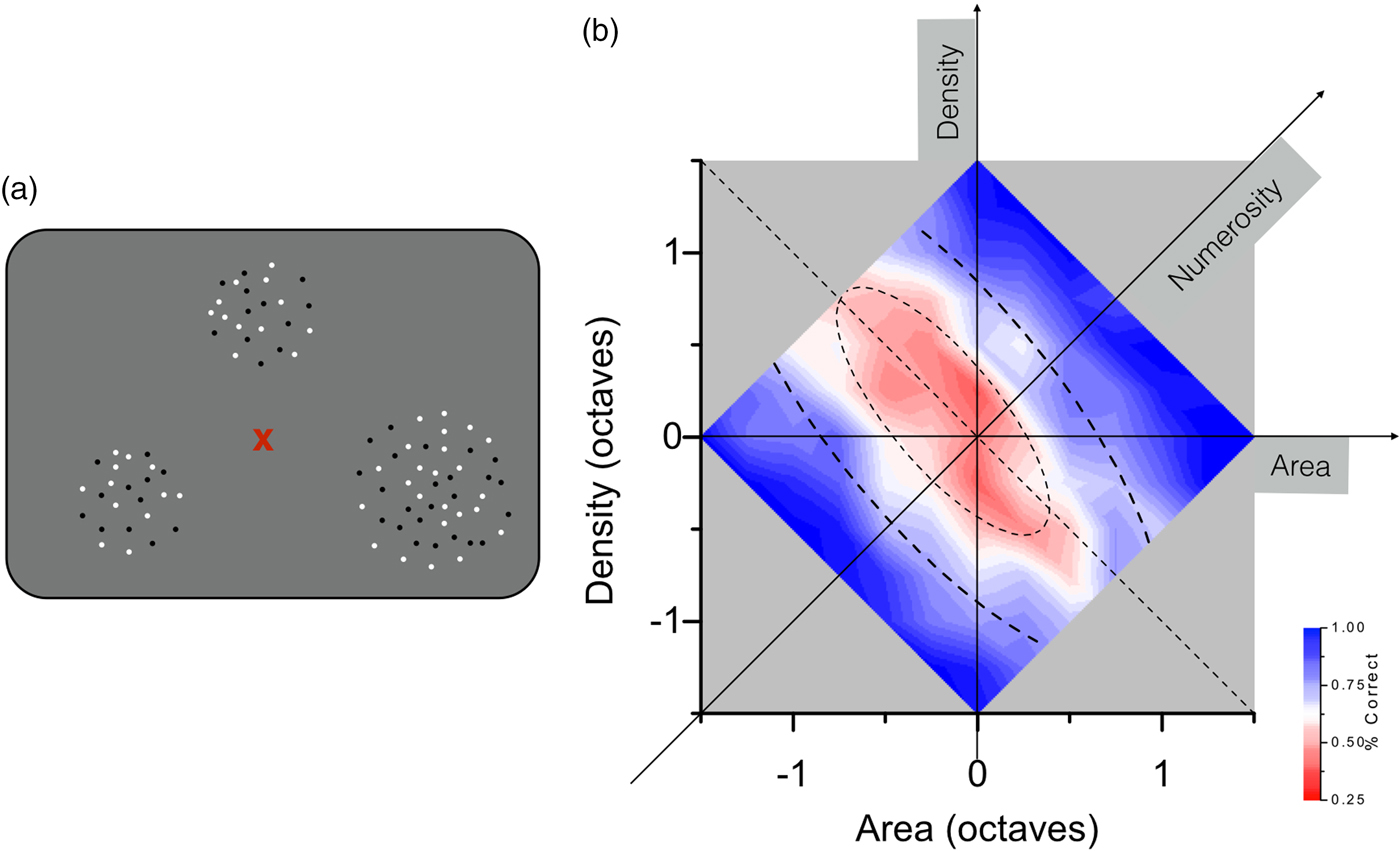
Figure 1. Discrimination boundaries in two-dimensional log area-density space. (A) Example of stimuli used in the odd-one-out task. Two are identical “standards,” defined as the origin of the space of panel B (24 dots, 40 square degrees); the other is the target, randomly positioned (lower right in this case), defined by a randomly chosen position in the colored part of the space (double numerosity in this example). (B) Thresholds in log area-density space. The abscissa defines the logarithmic difference in area between target and standard, and the ordinate, the logarithmic difference in density. Numerosity, the sum of log density and log area, increases along the positive diagonal. The heat map plots percent correct performance for all conditions. The two ellipses show 50% and 75% right responses, obtained from a two-dimensional Gaussian fit to the data. The aspect ratio of the ellipses is 4:1 octaves, implying a 16-fold difference between discriminations in numerosity and the orthogonal direction. Reproduced with permission from Cicchini et al. (2016).
In the target article, Leibovich et al. rightly conclude that researchers should not simply assume the existence of a number sense, but put the hypothesis to the test. Cicchini et al. (Reference Cicchini, Anobile and Burr2016) recently did so in a direct and rigorous manner. Borrowing from color science, they measured the equivalent of “MacAdam ellipses”: discrimination thresholds in two-dimensional color space, whose short axis corresponds to the most sensitive direction, implying the action of specific mechanisms (MacAdam Reference MacAdam1942).
Numerosity is the product of density and area, which defines a two-dimensional “numerosity space,” with numerosity following the positive diagonal (Fig. 1). We measured discrimination thresholds within this space, using an “odd-one-out” technique (see Fig. 1A). Discriminations are well described by an elongated ellipse, with the short axis defining maximum sensitivity aligned to the numerosity diagonal. Sensitivity along this axis was 16 times higher than the orthogonal direction, showing that numerosity is the most sensitive dimension: just as red-green is a sensitive direction in color-space.
Discrimination boundaries in two-dimensional log area-density space. (A) Example of stimuli used in the odd-one-out task. Two are identical “standards,” defined as the origin of the space of panel B (24 dots, 40 square degrees); the other is the target, randomly positioned (lower right in this case), defined by a randomly chosen position in the colored part of the space (double numerosity in this example). (B) Thresholds in log area-density space. The abscissa defines the logarithmic difference in area between target and standard, and the ordinate, the logarithmic difference in density. Numerosity, the sum of log density and log area, increases along the positive diagonal. The heat map plots percent correct performance for all conditions. The two ellipses show 50% and 75% right responses, obtained from a two-dimensional Gaussian fit to the data. The aspect ratio of the ellipses is 4:1 octaves, implying a 16-fold difference between discriminations in numerosity and the orthogonal direction. Reproduced with permission from Cicchini et al. (Reference Cicchini, Anobile and Burr2016).
There was no a priori guarantee that numerosity would be the most sensitive dimension. This was clearly demonstrated by the fact that at high densities, where items were too crowded to be segregated, and numerosity discriminations are subject to different psychophysical laws (for review, see Anobile et al. Reference Anobile, Cicchini and Burr2016c), the results were quite different. The discrimination ellipses become more circular and are well predicted by independent encoding of area and density (Cicchini et al. Reference Cicchini, Anobile and Burr2016). The clear differences in processing of sparse and dense arrays highlight the action of specialized mechanisms for numerosity, which operate only under conditions where the items can be perceptually segregated.
Cross-modal and cross-format studies lend further support for the number sense, which may be more generalized than previously thought. Adapting to rapid or slow sequences of auditory or visual elements strongly affects the apparent numerosity of subsequent sequences of items, both visual and auditory (Arrighi et al. Reference Arrighi, Togoli and Burr2014). Importantly, the numerosity of spatial arrays is also affected by adaptation to temporal sequences, implying that the number of items – however presented – is encoded by a truly abstract system that transcends sensory modality, as well as space and time.
It is, however, important to note that the existence of specialized numerosity mechanisms does not preclude the possibility of interactions with other related attributes. Cicchini et al. (Reference Cicchini, Anobile and Burr2016) also measured discrimination ellipses with a more subjective technique, where subjects were asked to make explicit judgments about numerosity, density, or area for stimuli within the area/density space. Clear interactions emerged. Discrimination boundaries for number judgments were not oriented exactly along the number axis, but at 37°, slightly toward the area axis and away from density (by about 17%), agreeing with other studies (e.g., Dakin et al. Reference Dakin, Tibber, Greenwood, Kingdom and Morgan2011; Gebuis & Reynvoet Reference Gebuis and Reynvoet2012c). However, the boundary for area judgments was drawn toward number by 53%, suggesting that number was as important as area in judging area, and that for density was drawn toward number by 78%, suggesting that density judgments are mediated by numerosity (rather than the other way round). These results are not at odds with those discussed in the target article showing that number estimates can be slightly influenced by area or density, but indicate that interactions in the other direction are in fact far stronger: Number strongly influences both area and density, suggesting that number is the more basic attribute.
Interactions between seemingly unrelated perceptual attributes abound: Apparent speed depends on luminance, contrast, and color (Gegenfurtner & Hawken Reference Gegenfurtner and Hawken1996; Thompson Reference Thompson1982); interval duration depends on speed (Brown, Reference Brown1995; Kanai et al. Reference Kanai, Paffen, Hogendoorn and Verstraten2006; Kaneko & Murakami Reference Kaneko and Murakami2009); event duration depends on size (Xuan et al. Reference Xuan, Zhang, He and Chen2007); number depends not only on size and density, but also on eye movements (Binda et al. Reference Binda, Morrone and Bremmer2012; Burr et al. Reference Burr, Ross, Binda and Morrone2010) and the region of visual space where stimuli are displayed (Dehaene et al. Reference Dehaene, Bossini and Giraux1993; Hubbard et al. Reference Hubbard, Piazza, Pinel and Dehaene2005). More recently, we demonstrated interactions between action and number estimation, for both sequentially presented items and spatial arrays (Anobile et al. Reference Anobile, Arrighi, Togoli and Burr2016a), pointing to even more far-reaching interconnections.
The fact that systems interact with each other does not preclude the existence of specialized mechanisms. That duration depends on speed and size does equate time with space, and very few would deny the existence of dedicated motion mechanisms, despite clear interactions with contrast, color, form, and time (Burr & Ross Reference Burr and Ross1986; Burr & Thompson Reference Burr and Thompson2011). As Leibovich et al. point out, Harvey et al. (Reference Harvey, Klein, Petridou and Dumoulin2013) have demonstrated a clear neuronal map for numerosity, robust to changes in low-level features. More recently, they have shown that the same area contains a tuning map for size (Harvey et al. Reference Harvey, Fracasso, Petridou and Dumoulin2015). The two maps do not superimpose and may not involve the same neurons; however, they coexist in the same area of brain, highly consistent with the notion of a brain area dedicated to magnitude estimation (Walsh Reference Walsh2003). The mapping for the two properties is clearly separable: This would allow for the independent estimation of size and number, but with a certain amount of cross talk.
To conclude, a great deal of evidence suggests that humans perceive number spontaneously, with dedicated mechanisms. Whether these mechanisms are innate is harder to prove. However, developmental studies show that thresholds for numerosity discrimination are more adultlike at 6 years of age than are those for dense-texture discrimination (Anobile et al. Reference Anobile, Castaldi, Turi, Tinelli and Burr2016b), reinforcing other studies (Izard et al. Reference Izard, Sann, Spelke and Steri2009) reporting early emergence of number discrimination. Importantly, precision for numerosity, but not texture density, correlates with mathematics achievement in school-age children (Anobile et al. Reference Anobile, Castaldi, Turi, Tinelli and Burr2016b), adding weight to the idea that numerosity mechanisms act as a “start-up tool” for later acquisition of mathematics (Halberda et al. Reference Halberda, Mazzocco and Feigenson2008; Piazza Reference Piazza2010). This strong link with mathematics provides a further motivation to understand fully the mechanisms underlying the perception of number and, possibly, the foundations for mathematics.