




No CrossRef data available.
Article contents
From synthetic modeling of social interaction to dynamic theories of brain–body–environment–body–brain systems
Published online by Cambridge University Press: 25 July 2013
Abstract
Synthetic approaches to social interaction support the development of a second-person neuroscience. Agent-based models and psychological experiments can be related in a mutually informing manner. Models have the advantage of making the nonlinear brain–body–environment–body–brain system as a whole accessible to analysis by dynamical systems theory. We highlight some general principles of how social interaction can partially constitute an individual's behavior.
Information
- Type
- Open Peer Commentary
- Information
- Copyright
- Copyright © Cambridge University Press 2013
References
Beer, R. D. (2000) Dynamical approaches to cognitive science. Trends in Cognitive Sciences
4(3):91–99.Google ScholarPubMed
De Jaegher, H., Di Paolo, E. & Gallagher, S. (2010) Can social interaction constitute social cognition?
Trends in Cognitive Sciences
14(10):441–47. Available at: http://dx.doi.org/10.1016/j.tics.2010.06.009.CrossRefGoogle ScholarPubMed
De Jaegher, H. & Froese, T. (2009) On the role of social interaction in individual agency. Adaptive Behavior
17(5):444–60.CrossRefGoogle Scholar
Di Paolo, E. A., Rohde, M. & Iizuka, H. (2008) Sensitivity to social contingency or stability of interaction? Modelling the dynamics of perceptual crossing. New Ideas in Psychology
26(2):278–94.Google Scholar
Froese, T. & Di Paolo, E. A. (2008) Stability of coordination requires mutuality of interaction in a model of embodied agents. In: From animals to animats 10: 10th International Conference on Simulation of Adaptive Behavior, SAB 2008, ed. Asada, M., Hallam, J. C. T., Meyer, J.-A. & Tani, J., pp. 52–61. Springer-Verlag.Google Scholar
Froese, T. & Di Paolo, E. A. (2010) Modeling social interaction as perceptual crossing: An investigation into the dynamics of the interaction process. Connection Science
22(1):43–68. Available at: http://dx.doi.org/10.1080/09540090903197928.Google Scholar
Froese, T. & Di Paolo, E. A. (2011a) The enactive approach: Theoretical sketches from cell to society. Pragmatics and Cognition
19(1):1–36.Google Scholar
Froese, T. & Di Paolo, E. A. (2011b) Toward minimally social behavior: Social psychology meets evolutionary robotics. In: Advances in artificial life: Darwin meets von Neumann. 10th European Conference, ECAL 2009, ed. Kampis, G., Karsai, I. & Szathmáry, E., pp. 426–33. Springer-Verlag.Google Scholar
Froese, T. & Fuchs, T. (2012) The extended body: A case study in the neurophenomenology of social interaction. Phenomenology and the Cognitive Sciences
11(2):205–35.Google Scholar
Froese, T. & Gallagher, S. (2010) Phenomenology and artificial life: Toward a technological supplementation of phenomenological methodology. Husserl Studies
26(2):83–106.CrossRefGoogle Scholar
Froese, T. & Gallagher, S. (2012) Getting interaction theory (IT) together: Integrating developmental, phenomenological, enactive, and dynamical approaches to social interaction. Interaction Studies
13(3):436–68.CrossRefGoogle Scholar
Froese, T., Lenay, C. & Ikegami, T. (2012) Imitation by social interaction? Analysis of a minimal agent-based model of the correspondence problem. Frontiers in Human Neuroscience
6:202. doi: 10.3389/fnhum.2012.00202.CrossRefGoogle ScholarPubMed
Iizuka, H. & Di Paolo, E. A. (2007) Minimal agency detection of embodied agents. In: Advances in artificial life: 9th European Conference, ECAL 2007, ed. Almeida e Costa, F., Rocha, L. M., Costa, E., Harvey, I. & Coutinho, A., pp. 485–94. Springer-Verlag.Google Scholar
Ikegami, T. & Iizuka, H. (2007) Turn-taking interaction as a cooperative and co-creative process. Infant Behavior and Development
30(2):278–88.Google Scholar
Murray, L. & Trevarthen, C. (1985) Emotional regulation of interactions between two-month-olds and their mothers. In: Social perception in infants, ed. Field, T. M. & Fox, N. A., pp. 177–97. Ablex.Google Scholar
Quinn, M., Smith, C., Mayley, G.. & Husbands, P. (2003) Evolving controllers for a homogeneous system of physical robots: Structured cooperation with minimal sensors. Philosophical Transactions of the Royal Society of London, A: Mathematical, Physical and Engineering Sciences
361(1811):2321–43.CrossRefGoogle ScholarPubMed
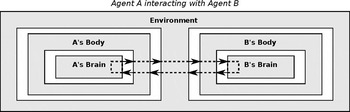
Figure 1. Illustration of a dynamical perspective on the interac tion between two situated, embodied agents. Following the approach advocated by Beer (2000), an agent's nervous system (abbreviated as “brain”), body, and environment are each conceptualized as dynamical systems that are parametrically coupled. Here we extend this approach to show that when agent A is interacting with agent B their mutual coupling constitutes a brain–body–environment–body–brain system. Social interaction is partially constitutive of social cognition: An individual agent's social behavior depends on the coupling of all the subsystems and cannot properly be attributed to any one component in isolation from the others.
We agree with Schilbach et al. that the neuroscience of sociality should be enriched by a better understanding of the constitutive role of social interaction. An important challenge faced by the development of a second-person neuroscience is to devise new concepts and methods that can adequately capture and explain its complex dynamics.
From a dynamical perspective, an agent's behavior is an emergent property of the brain–body–environment nonlinear system (Beer Reference Beer2000). The parametric coupling between subsystems (i.e., its brain, body, and environment) constitutes one encompassing system, and it is only in this holistic context that the agent's behavior can be distinguished as such. The same applies to social behavior among several agents. In the case when the current environment of an agent A includes another agent B, and vice versa, their mutual nonlinear coupling entails the temporary constitution of a multi-agent system (Froese & Di Paolo Reference Froese and Di Paolo2011a). On this view, social interaction is one kind of process in an irreducible “brain–body–environment–body–brain” system as a whole, as shown in Figure 1.
Illustration of a dynamical perspective on the interac tion between two situated, embodied agents. Following the approach advocated by Beer (Reference Beer2000), an agent's nervous system (abbreviated as “brain”), body, and environment are each conceptualized as dynamical systems that are parametrically coupled. Here we extend this approach to show that when agent A is interacting with agent B their mutual coupling constitutes a brain–body–environment–body–brain system. Social interaction is partially constitutive of social cognition: An individual agent's social behavior depends on the coupling of all the subsystems and cannot properly be attributed to any one component in isolation from the others.
One insight that follows from this approach is that uni-directionally coupled agents (i.e., A is a detached observer of B) and mutually coupled agents (i.e., A and B interact with each other) are fundamentally different kinds of systems. In the former situation, common in the literature but hardly deserving to be called “social,” B is merely an independent parameter of A's environment. In the latter situation, the nonlinear coupling between A and B results in emergent structures of the interaction process that provide top-down modulation of the two agents' behavior. Therefore, the effective degrees of freedom of an agent involved in social interaction will continually be modified. This provides a basic dynamical account of the intuition expressed by Schilbach et al. that “social cognition is fundamentally different when we are in interaction with others rather than merely observing them” (target article, Abstract). Furthermore, we do not need to assume any specialized neural modules to explain such qualitative difference in brain activity, because it is the interaction process itself that constitutes the systemic difference.
As a case in point, this insight allows us to clearly distinguish between the two situations of “double TV monitor” experiments (Murray & Trevarthen Reference Murray, Trevarthen, Field and Fox1985): When an infant is interacting with its mother via the live video transmission, there is one kind of overall system; when it is watching the mother via video playback, there is a qualitatively different kind of system. This systemic difference between the two situations allows us to explain qualitative changes in the infant's behavior in a relational manner, since the behavior is either part of a social interaction or it is not. Various models of this experimental setup have repeatedly confirmed that the removal of mutual responsiveness, that is, social contingency, through playback will lead to qualitative changes in an agent's behavior, even without the presence of specialized neural modules inside of the agent's brain (Froese & Di Paolo Reference Froese, Di Paolo, Asada, Hallam, Meyer and Tani2008; Froese & Fuchs Reference Froese and Fuchs2012; Iizuka & Di Paolo Reference Iizuka, Di Paolo, Almeida e Costa, Rocha, Costa, Harvey and Coutinho2007; Ikegami & Iizuka Reference Ikegami and Iizuka2007).
Moreover, only mutually coupled systems offer the possibility that the behaviors of the agents become entrained in such a way that the social interaction process is conditioned by its own self-sustaining organization. The implications of such autonomous interaction dynamics have been much discussed by the enactive approach to social cognition (De Jaegher et al. Reference De Jaegher, Di Paolo and Gallagher2010). Various models have investigated the dynamical underpinnings of autonomous interaction processes, and illustrated how they enable and constrain individual behavior (De Jaegher & Froese Reference De Jaegher and Froese2009). It appears that one important explanatory factor is the increased stability of mutually responsive engagement (Di Paolo et al. Reference Di Paolo, Rohde and Iizuka2008), which can in some cases make it easier for agents to jointly achieve tasks, but in other cases makes it more difficult for them to escape from the constraints of their mutual entrainment (Froese & Di Paolo Reference Froese and Di Paolo2010).
The systemic differences between detached social observation and mutual social interaction are even more pronounced when we consider that social interaction is normally not merely about mutual coupling, like the passive exchange of heat among commuters standing inside a packed metro. Social interaction is about coordinating to devise and realize shared goals (Froese & Di Paolo Reference Froese and Di Paolo2011a). One agent's behavior creates an opening for a joint action that can only be realized through the appropriate behavior of another agent. For instance, the act of giving a present to someone is constituted by one's giving as well as the other's receiving (without the other's corresponding act of acceptance the necessary conditions of one's giving cannot be satisfied).
A special property of social coordination is that it enables flexible renegotiation of an interaction process; robotic and modeling research has shown that such renegotiations can emerge spontaneously from the interaction dynamics (Froese & Di Paolo Reference Froese, Di Paolo, Kampis, Karsai and Szathmáry2011b; Quinn et al. Reference Quinn, Smith, Mayley and Husbands2003). One reason for this flexibility is that agents are able to co-regulate their internal dynamics via the interaction process (Froese & Fuchs Reference Froese and Fuchs2012; Froese et al. Reference Froese, Lenay and Ikegami2012). They take advantage of the fact that they constitute one complex system, and that the organization of the state-space of each brain component is partially dependent on the organization of the state-space of the whole brain–body–environment–body–brain system.
Finally, we emphasize that this dynamical systems approach is suitable for taking the first-person perspective into account. These models can supplement traditional methods of phenomenology (Froese & Gallagher Reference Froese and Gallagher2010), and they serve as a bridge between second-person neuroscience and phenomenological accounts of intersubjectivity (Froese & Fuchs Reference Froese and Fuchs2012; Froese & Gallagher Reference Froese and Gallagher2012).