




No CrossRef data available.
Article contents
The second person in “I”-“you”-“it” triadic interactions
Published online by Cambridge University Press: 25 July 2013
Abstract
Second person social cognition cannot be restricted to dyadic interactions between two persons (the “I” and the “you”). Many instances of social communication are triadic, and involve a third person (the “him/her/it”), which is the object of the interaction. We discuss neuropsychological and brain imaging data showing that triadic interactions involve dedicated brain networks distinct from those of dyadic interactions.
Information
- Type
- Open Peer Commentary
- Information
- Copyright
- Copyright © Cambridge University Press 2013
References
Baron-Cohen, S. (1989) Perceptual role taking and protodeclarative pointing in autism. British Journal of Developmental Psychology
7:113–27.Google Scholar
Baron-Cohen, S. (2005) The empathizing system: A revision of the 1994 model of the mindreading system. In: Origins of the social mind, ed. Ellis, B. & Bjorklund, D.. Guilford.Google Scholar
Charman, T. (2003) Why is joint attention a pivotal skill in autism?
Philosophical Transactions of the Royal Society of London B: Biological Sciences
358(1430):315–24.Google Scholar
Cleret de Langavant, L., Remy, P., Trinkler, I., McIntyre, J., Dupoux, E., Berthoz, A. & Bachoud-Levi, A.-C. (2011) Behavioral and neural correlates of communication via pointing. PLoS One
6(3):e17719.CrossRefGoogle ScholarPubMed
Cleret de Langavant, L., Trinkler, I., Cesaro, P. & Bachoud-Levi, A. C. (2009) Heterotopagnosia: When I point at parts of your body. Neuropsychologia
47(7):1745–55.CrossRefGoogle ScholarPubMed
Cleret de Langavant, L., Trinkler, I., Remy, P., Thirioux, B., McIntyre, J., Berthoz, A., Dupoux, E. & Bachoud-Levi, A. C. (2012) Viewing another person's body as a target object: A behavioural and PET study of pointing. Neuropsychologia
50(8):1801–13.CrossRefGoogle ScholarPubMed
Degos, J.-D., Bachoud-Lévi, A.-C., Ergis, A.-M., Petrissans, J.-L. & Cesaro, P. (1997) Selective inability to point to extrapersonal targets after left posterior parietal lesion: An objectivisation disorder?
Neurocase
3:31–39.Google Scholar
de Waal, F. B. M. (2005) A century of getting to know the chimpanzee. Nature
437:56–59.Google Scholar
de Waal, F. B. M. & Malini, S. (2010) Prosocial primates: Selfish and unselfish motivations. Philosophical Transactions of the Royal Society of London: B Biological Sciences
365(1553):2711–22.Google Scholar
Felician, O., Ceccaldi, M., Didic, M., Thinus-Blanc, C. & Poncet, M. (2003) Pointing to body parts: A double dissociation study. Neuropsychologia
41:1307–16.Google Scholar
Gómez, J. C. (2005) Joint attention and the notion of subject: Insights from apes, normal children, and children with autism. In: Joint attention: Communication and other minds, ed. Eilan, N., Hoerl, C., McCormack, T. & Roessler, J.. Clarendon Press.Google Scholar
Hobson, R. P. & Hobson, J. (2012) Joint attention or joint engagement? Insights from autism. In: Joint attention: New developments in psychology, philosophy of mind, and social neuroscience, ed. Seemann, A.. MIT Press.Google Scholar
Kugiumutzakis, G. (1998) Neonatal imitation in the intersubjective companion space. In: Intersubjective communication and emotion in early ontogeny, ed. Braten, S., pp. 63–88. Cambridge University Press.Google Scholar
Rekers, Y., Haun, D. B. & Tomasello, M. (2011) Children, but not chimpanzees, prefer to collaborate. Current Biology
21(20):1756–58.Google Scholar
Tomasello, M. & Carpenter, M. (2005) The emergence of social cognition in three young chimpanzees. Monograph of the Society for Research in Child Development
70(1):vii–132.Google Scholar
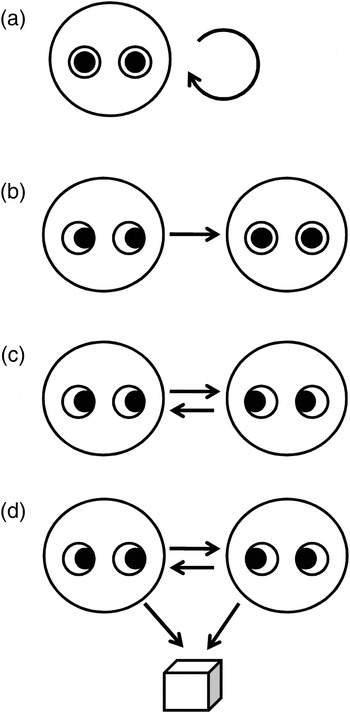
Figure 1. Four distinct perspectives in social cognition: (a) first person perspective, (b) third person perspective, (c) second person perspective: dyadic interaction, (d) second person perspective: triadic interaction.
Schilbach et al. defend the idea that social cognition research would benefit from studying “real-time social encounters in a truly interactive manner” (target article, Abstract). Endorsing “second-person” neuroscience would bridge the gap between the solipsist view of first person perspective, and third person social psychology. We agree with this idea, but we point out that second person studies cannot be restricted to dyadic relationships between two persons. Indeed, communicative or collaborative interactions always involve a third component: an object, a person, an event, or even the goal of the interaction itself. Therefore, many social interactions are intrinsically triadic (“I” talk to “you” about “him/her/it”).
Dyadic interactions are present very early in human infants as can be seen in the emotional domain (emotional contagion, attachment, etc.; see Hobson & Hobson Reference Hobson, Hobson and Seemann2012) and in the communicative domain (turn taking; see Kugiumutzakis Reference Kugiumutzakis and Braten1998). They are also present in social animals in a variety of behaviors (feeding, grooming, courting, dominance/submission displays, etc.; de Waal Reference de Waal2005). Yet, they are distinct from triadic interactions (see our Figure 1), which emerge in humans only at the end of the first year and are considered to play a pivotal role in the development of human social cognition (Baron-Cohen Reference Baron-Cohen, Ellis and Bjorklund2005; Charman Reference Charman2003). Impairment or delay in the acquisition of these triadic interactions has been observed in patients with autism whose social and communicative skills are severely affected (Baron-Cohen Reference Baron-Cohen1989). In nonhuman primates only some limited abilities for triadic interactions are observed – for example, instrumental pointing, in which the addressee is used to get an object of interest (Gómez Reference Gómez, Eilan, Hoerl, McCormack and Roessler2005), or limited cooperation in hunting (de Waal & Malini Reference de Waal and Malini2010); but not communicative pointing, in which the addressee is invited to share the perceptual experience about an object (Tomasello & Carpenter Reference Tomasello and Carpenter2005), or fully fledged cooperation (Rekers et al. Reference Rekers, Haun and Tomasello2011).
Four distinct perspectives in social cognition: (a) first person perspective, (b) third person perspective, (c) second person perspective: dyadic interaction, (d) second person perspective: triadic interaction.
Neuropsychological studies enable the disentanglement of triadic from dyadic interactions. Heterotopagnosia is a puzzling acquired deficit which only arises in triadic situations where the target object is a human person: Patients cannot point at another person's body parts, although they can grasp or touch them. They can also point correctly at dolls' body parts, at videos of humans, at pieces of clothing, and at their own body, thus indicating a specific difficulty for communicative pointing directed to the physical body of another human (Cleret de Langavant et al. Reference Cleret de Langavant, Trinkler, Cesaro and Bachoud-Levi2009; Degos et al. Reference Degos, Bachoud-Lévi, Ergis, Petrissans and Cesaro1997; Felician et al. Reference Felician, Ceccaldi, Didic, Thinus-Blanc and Poncet2003). Interestingly, most of the errors consist of pointing at their own body parts, which they rationalize by stating that the body parts of the target individual occupy the same space as their own body parts.
Heterotopagnosia cannot be explained by a simple impairment of a human body representation or by other current theories in social cognition (Cleret de Langavant et al. Reference Cleret de Langavant, Trinkler, Cesaro and Bachoud-Levi2009), but this syndrome reveals a crucial difference between dyadic and triadic interactions. Grasping and touching other's body parts involve a dyadic relationship between “I” and the target of the gesture. In contrast, pointing involves the triadic relationship of communication where “I” show to “you” the object “it” or the person “him/her.” Comparing the kinematics of pointing at objects in both communicative and non-communicative situations in healthy participants, we showed a spatial reshaping of the pointing gesture according to the communicative interaction with a second person and to the position of the second person relative to the first person. This suggests that in communicative pointing, we use a heterocentric reference frame encoding the body and perspective of the second person who is addressed (“I” represent how “you” represent “this”). Such a reference is not used when pointing is dyadic or in grasping or touching. PET-scan imaging shows that this reference frame involves the right posterior superior temporal sulcus region and the right medial prefrontal cortex (Cleret de Langavant et al. Reference Cleret de Langavant, Remy, Trinkler, McIntyre, Dupoux, Berthoz and Bachoud-Levi2011).
In addition, because performance in heterotopagnosia differs according to the object of the pointing (a real human or a figure of a human), we compared pointing at a living human's body, at a manikin's body, and at artifacts in healthy participants. Reaction times for pointing at artifacts or at a manikin's body parts were similar, whereas pointing at body parts of real persons was slower than pointing at artifacts. This demonstrated the specificity of the body of other persons: Only a real person can be viewed both as a subject to communicate with (“you”) or an object to communicate about (“him” or “her”). The left posterior intraparietal sulcus region was activated in healthy participants while they were pointing at another person's body (Cleret de Langavant et al. Reference Cleret de Langavant, Trinkler, Remy, Thirioux, McIntyre, Berthoz, Dupoux and Bachoud-Levi2012). Presumably, damage in this area explains why patients with heterotopagnosia cannot consider the other person under both views (“you” and “him/her”) simultaneously.
On the basis of our research on heterotopagnosia, we conclude that a second-person neuroscience should assess communicative/collaborative triadic interactions, as they offer a richer situation, including the switching of perspectives or frame of references between “you” and “him/her” perspectives. In a triadic interaction, the roles of the second and third persons are constantly dynamically redefined. This requirement should be taken into account in experimental designs using computerized avatars as opposed to real life participants.
ACKNOWLEDGMENT
The authors thank Laura Robotham for editing the English of this commentary.