The so-called dark matter in social neuroscience contains the experience of social emotions such as embarrassment, guilt, or pride. Thus, second-person neuroscience is an ideal framework to shed light upon the neural foundations of social emotions. Schilbach et al. do not emphasize in their review the great potential second-person neuroscience could have on social emotion research. This aspect is important, where broadening our understanding of social emotions as an integral part of the human emotional repertoire is overdue.
Social emotions require the representation of oneself in relation to others and primarily emerge through reciprocal interaction between two or more individuals (Tangney et al. Reference Tangney, Stuewig and Mashek2007). Despite the constraints of the laboratory setting, social neuroscience studies have investigated social emotions such as embarrassment (Krach et al. Reference Krach, Cohrs, de Echeverría Loebell, Kircher, Sommer, Jansen and Paulus2011; Takahashi et al. Reference Takahashi, Yahata, Koeda, Matsuda, Asai and Okubo2004), pride (Takahashi et al. Reference Takahashi, Matsuura, Koeda, Yahata, Suhara, Kato and Okubo2008), shame, and guilt (Wagner et al. Reference Wagner, N'Diaye, Ethofer and Vuilleumier2011). Commonly used in this research is some form of written or pictorial vignette that asks participants to judge, simulate or re-enact a briefly described situation. In doing so, the integral part of social emotions – the reciprocal interaction with others and also the representation of oneself in relation to others – remains “dark matter.” It is unlikely that paradigms using vignettes have been able to fully capture the neural foundations of the actual experience of social emotion. Given the relevance of social emotions regarding developmental psychology and mental disorders, the lack of knowledge is intriguing.
In order to induce and assess social emotions in a social neuroscience laboratory, strong emotional engagement and reciprocal interaction are necessary in the experimental setting. However, we question whether direct, continuous reciprocal interactions are necessary. Rather, it is the mental representation of oneself in relation to others that is essential. This representation has to be implemented in the participant's mind, resulting in social immersion. We understand social immersion to be a state that makes the participant perceive others as active, salient, and significant during the experiment. In order to implement this state, not only the content of the experiment (e.g., emotional vignettes) has to be carefully manipulated, but also the context of the experiment has to be actively designed (e.g., compelling cover story). The latter enables participants to immerse in a constructed social reality that is highly controllable by the experimenter. Instead of treating social emotions as a mere side-effect within social interactions, the control of the experimental context allows selective priming of specific social emotions.
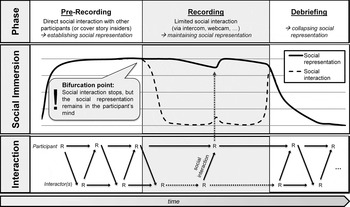
In a state of social immersion, the mental representation of oneself in relation to others (i.e., the social representation) and the actual social interaction might not be corresponding during the entire experiment (see our Figure 1). In the pre-recording phase, initial face-to-face interaction establishes a social representation of others as active, salient, and significant. When the data recording starts (e.g., participant enters scanner room), the trajectories of the social representation and the social interaction bifurcate. Now, without direct, continuous interaction it is possible to elicit ecologically valid social emotions. Referring to the target article, this means that a class B interaction contingency is perceived as class D interaction contingency (cf. schematic depictions 1B and 1D of the target article's Fig. 1).
Figure 1.
Schematic depiction of experimental phase (top), level of social immersion (middle), and interaction contingencies (bottom) over time. In the Pre-Recording phase, the participant acquires a social representation of herself in relation to others by direct social interaction and emotional engagement (left side). In the Recording phase, the direct social interactions stops at the bifurcation point (e.g., participants enters MRI scanner room), but the social representation persists. Intermittent direct social interactions assure the maintenance of the social representation (e.g., short intercom exchange). At debriefing, a correspondence between the social representation and social interaction is re-established.
This approach implies several benefits for social emotion neuroscience. First, person–group interactions are possible (e.g., audience effects) with moderate technical effort. Second, repetitive induction of genuine social emotions is feasible in the controlled environment (e.g., manipulated negative feedback by confederates). Third, reduced cognitive costs (e.g., no need for recollection of autobiographic episodes) facilitate the investigation of social emotions in clinical samples such as people with autism or schizophrenia. Fourth, the experiments will be more attractive for participants, which is especially relevant for studies that involve children and adolescents. However, one drawback might be the higher costs in terms of price and time to induce social immersion (e.g., paying multiple participants or confederates).
To conclude, we expect that the neuroscience of social emotions will be stimulated by the flexibility, ecological validity, and feasibility of social immersion paradigms.





The so-called dark matter in social neuroscience contains the experience of social emotions such as embarrassment, guilt, or pride. Thus, second-person neuroscience is an ideal framework to shed light upon the neural foundations of social emotions. Schilbach et al. do not emphasize in their review the great potential second-person neuroscience could have on social emotion research. This aspect is important, where broadening our understanding of social emotions as an integral part of the human emotional repertoire is overdue.
Social emotions require the representation of oneself in relation to others and primarily emerge through reciprocal interaction between two or more individuals (Tangney et al. Reference Tangney, Stuewig and Mashek2007). Despite the constraints of the laboratory setting, social neuroscience studies have investigated social emotions such as embarrassment (Krach et al. Reference Krach, Cohrs, de Echeverría Loebell, Kircher, Sommer, Jansen and Paulus2011; Takahashi et al. Reference Takahashi, Yahata, Koeda, Matsuda, Asai and Okubo2004), pride (Takahashi et al. Reference Takahashi, Matsuura, Koeda, Yahata, Suhara, Kato and Okubo2008), shame, and guilt (Wagner et al. Reference Wagner, N'Diaye, Ethofer and Vuilleumier2011). Commonly used in this research is some form of written or pictorial vignette that asks participants to judge, simulate or re-enact a briefly described situation. In doing so, the integral part of social emotions – the reciprocal interaction with others and also the representation of oneself in relation to others – remains “dark matter.” It is unlikely that paradigms using vignettes have been able to fully capture the neural foundations of the actual experience of social emotion. Given the relevance of social emotions regarding developmental psychology and mental disorders, the lack of knowledge is intriguing.
In order to induce and assess social emotions in a social neuroscience laboratory, strong emotional engagement and reciprocal interaction are necessary in the experimental setting. However, we question whether direct, continuous reciprocal interactions are necessary. Rather, it is the mental representation of oneself in relation to others that is essential. This representation has to be implemented in the participant's mind, resulting in social immersion. We understand social immersion to be a state that makes the participant perceive others as active, salient, and significant during the experiment. In order to implement this state, not only the content of the experiment (e.g., emotional vignettes) has to be carefully manipulated, but also the context of the experiment has to be actively designed (e.g., compelling cover story). The latter enables participants to immerse in a constructed social reality that is highly controllable by the experimenter. Instead of treating social emotions as a mere side-effect within social interactions, the control of the experimental context allows selective priming of specific social emotions.
In a state of social immersion, the mental representation of oneself in relation to others (i.e., the social representation) and the actual social interaction might not be corresponding during the entire experiment (see our Figure 1). In the pre-recording phase, initial face-to-face interaction establishes a social representation of others as active, salient, and significant. When the data recording starts (e.g., participant enters scanner room), the trajectories of the social representation and the social interaction bifurcate. Now, without direct, continuous interaction it is possible to elicit ecologically valid social emotions. Referring to the target article, this means that a class B interaction contingency is perceived as class D interaction contingency (cf. schematic depictions 1B and 1D of the target article's Fig. 1).
Schematic depiction of experimental phase (top), level of social immersion (middle), and interaction contingencies (bottom) over time. In the Pre-Recording phase, the participant acquires a social representation of herself in relation to others by direct social interaction and emotional engagement (left side). In the Recording phase, the direct social interactions stops at the bifurcation point (e.g., participants enters MRI scanner room), but the social representation persists. Intermittent direct social interactions assure the maintenance of the social representation (e.g., short intercom exchange). At debriefing, a correspondence between the social representation and social interaction is re-established.
This approach implies several benefits for social emotion neuroscience. First, person–group interactions are possible (e.g., audience effects) with moderate technical effort. Second, repetitive induction of genuine social emotions is feasible in the controlled environment (e.g., manipulated negative feedback by confederates). Third, reduced cognitive costs (e.g., no need for recollection of autobiographic episodes) facilitate the investigation of social emotions in clinical samples such as people with autism or schizophrenia. Fourth, the experiments will be more attractive for participants, which is especially relevant for studies that involve children and adolescents. However, one drawback might be the higher costs in terms of price and time to induce social immersion (e.g., paying multiple participants or confederates).
To conclude, we expect that the neuroscience of social emotions will be stimulated by the flexibility, ecological validity, and feasibility of social immersion paradigms.