




No CrossRef data available.
Article contents
Parameterising ecological validity and integrating individual differences within second-person neuroscience
Published online by Cambridge University Press: 25 July 2013
Abstract
This commentary situates the second person account within a broader framework of ecological validity for experimental paradigms in social cognitive neuroscience. It then considers how individual differences at psychological and genetic levels can be integrated within the proposed framework.
Information
- Type
- Open Peer Commentary
- Information
- Copyright
- Copyright © Cambridge University Press 2013
References
Bayliss, A. P. & Tipper, S. P. (2005) Gaze and arrow cueing of attention reveals individual differences along the autism spectrum as a function of target context. British Journal of Psychology
96(1):95–114.CrossRefGoogle ScholarPubMed
Blair, R., Morris, J., Frith, C., Perrett, D. & Dolan, R. (1999) Dissociable neural responses to facial expressions of sadness and anger. Brain
122:883–93.Google Scholar
Chakrabarti, B. & Baron-Cohen, S. (2011) Variation in the human Cannabinoid Receptor (CNR1) gene modulates gaze duration for happy faces. Molecular Autism
2(1):10. Available at: http://dx.doi.org/10.1186/2040-2392-2-10.Google Scholar
Chakrabarti, B., Dudbridge, F., Kent, L., Wheelwright, S., Hill Cawthorne, G., Allison, C., Banerjee Basu, S. & Baron-Cohen, S. (2009) Genes related to sex steroids, neural growth, and social-emotional behavior are associated with autistic traits, empathy, and Asperger syndrome. Autism Research
2(3):157–77.Google Scholar
Chakrabarti, B., Kent, L., Suckling, J., Bullmore, E. & Baron-Cohen, S. (2006) Variations in the human cannabinoid receptor (CNR1) gene modulate striatal responses to happy faces. European Journal of Neuroscience
23(7):1944–48.Google Scholar
Chaminade, T., Hodgins, J. & Kawato, M. (2007) Anthropomorphism influences perception of computer-animated characters' actions. Social Cognitive and Affective Neuroscience
2(3):206–16.Google Scholar
Chartrand, T. L. & Bargh, J. A. (1999) The chameleon effect: The perception–behavior link and social interaction. Journal of Personality and Social Psychology
76(6):893–910. Available at: http://dx.doi.org/10.1037/0022-3514.76.6.893.Google Scholar
Fox, E. (2000) Facial expressions of emotion: Are angry faces detected more efficiently?
Cognition and Emotion
14(1):61–92.Google Scholar
Kilner, J., Hamilton, A. F. C. & Blakemore, S. J. (2007) Interference effect of observed human movement on action is due to velocity profile of biological motion. Social Neuroscience
2
(3–4):158–66.Google Scholar
Kohls, G., Peltzer, J., Herpertz-Dahlmann, B. & Konrad, K. (2009) Differential effects of social and non-social reward on response inhibition in children and adolescents. Developmental Science
12(4):614–25.Google Scholar
LaBar, K., Crupain, M., Voyvodic, J. & McCarthy, G. (2003) Dynamic perception of facial affect and identity in the human brain. Cerebral Cortex
13(10):1023–33.Google Scholar
Morris, J., Frith, C., Perrett, D., Rowland, D., Young, A., Calder, A. & Dolan, R. (1996) A differential neural response in the human amygdala to fearful and happy facial expressions. Nature
383:812–15.CrossRefGoogle ScholarPubMed
Pfeiffer, U. J., Timmermans, B., Bente, G., Vogeley, K. & Schilbach, L. (2011) The non-verbal Turing test: Differentiating mind from machine in gaze-based social interaction. PLoS ONE
6(11):e27591. Available at: http://dx.doi.org/10.1371/journal.pone.0027591.Google Scholar
Sims, T. B., Van Reekum, C. M., Johnstone, T. & Chakrabarti, B. (2012) How reward modulates mimicry: EMG evidence of greater facial mimicry of more rewarding happy faces. Psychophysiology
49(7):998–1004.CrossRefGoogle ScholarPubMed
Weibel, D., Wissmath, B., Habegger, S., Steiner, Y. & Groner, R. (2008) Playing online games against computer-versus human-controlled opponents: Effects on presence, flow, and enjoyment. Computers in Human Behavior
24(5):2274–91.Google Scholar
Whalen, P. J., Rauch, S. L., Etcoff, N. L., McInerney, S. C., Lee, M. B. & Jenike, M. A. (1998) Masked presentations of emotional facial expressions modulate amygdala activity without explicit knowledge. The Journal of Neuroscience
18:411–18.Google Scholar
Zaki, J., Bolger, N. & Ochsner, K. (2008) It takes two: The interpersonal nature of empathic accuracy. Psychological Science
19(4):399–404.Google Scholar
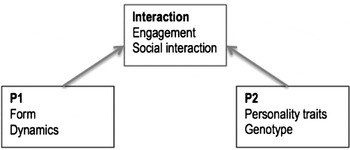
Figure 1. A schematic parameter space for SoCog paradigms. Schilbach et al. propose two key parameters for quantifying social interaction (middle box). These are situated within a broader framework that includes the characteristics of the two interactors (P1 and P2). In cases where one of the interactors (e.g., P1) is a virtual character or an “avatar,” then characteristics such as form and dynamics are crucial in determining the nature of any interaction. In cases where both P1 and P2 are humans, the interaction parameters need to account for the variation explained by individual characteristics of P1 and P2. Individual characteristics of P1 and P2 could be explained at a psychological (e.g., psychological traits) or a genetic level.
Social interaction is more than the sum of its parts. The clarion call for a second person approach in neuroscience by Schilbach et al. provides an opportunity to define a parameter space for ecological validity in studies of social cognition (SoCog). The operative definition of SoCog studies for this commentary includes all such studies that use any stimuli that can reasonably be identified as belonging to a conspecific. This commentary then considers a fundamental question about the integration of individual differences within this framework of studying social interaction.
Stimuli generally used in SoCog experiments range from minimal/schematic representations (Bayliss & Tipper Reference Bayliss and Tipper2005; Fox Reference Fox2000) to real-world social interactions (Chartrand & Bargh Reference Chartrand and Bargh1999). Paradigms that involve observing static stimuli without interacting (e.g., watching static photographs of facial expressions of emotion) have played pioneering roles in social cognitive neuroscience (Blair et al. Reference Blair, Morris, Frith, Perrett and Dolan1999; Morris et al. Reference Morris, Frith, Perrett, Rowland, Young, Calder and Dolan1996; Whalen et al. Reference Whalen, Rauch, Etcoff, McInerney, Lee and Jenike1998). However, since ecologically valid signals of social interaction are dynamic in nature, a first parameter in this framework is that of stimulus dynamics. Accordingly, brain regions responding to static facial expressions show greater activity in response to dynamic expressions of emotion (LaBar et al Reference LaBar, Crupain, Voyvodic and McCarthy2003). However, the nature of stimulus motion critically influences whether people perceive it as a social/biological stimulus, and how they respond to it (Kilner et al. Reference Kilner, Hamilton and Blakemore2007).
Chaminade and colleagues tested two dimensions of stimulus variation, by systematically manipulating anthropomorphism and motion type (artificial vs. biological) in a range of stimuli characters (Chaminade et al.Reference Chaminade, Hodgins and Kawato2007). This demonstrated that the motion type was a strong predictor of whether participants found the stimuli to be “biological” or not, across all stimulus forms. In contrast, if the motion type was recognised as biological, there was little difference in biological/artificial ratings across a range of stimuli forms. This provides an important insight for designing dynamic stimuli for experiments suggested in the target article, since the nature of interaction changes considerably if the stimuli are perceived to be artificial/artificially controlled (Pfeiffer et al. Reference Pfeiffer, Timmermans, Bente, Vogeley and Schilbach2011).
Form and dynamics thus constitute important stimulus dimensions for ecological validity of SoCog paradigms (as illustrated in my Figure 1, specifically in cases where P1 is a virtual character/avatar). Once the stimuli are perceived to be social/biological (either explicitly, or implicitly, e.g., by believing that a given dynamic stimulus is being controlled by another agent; Weibel et al. Reference Weibel, Wissmath, Habegger, Steiner and Groner2008), the stage is set for an ecologically valid social interaction – whose parameter space (comprising engagement and interaction) has been laid out in Figures 1 and 2 of the target article. Although social interactions have characteristics in addition to those of individual interactors, these are, nonetheless, influenced by individual differences. Interactions of a highly introverted person with a range of different strangers will have a certain common quality, which is possibly more due to individual differences than the interactions per se. It therefore is necessary to devise a set of experiments that parse out the influence of individual differences on the interactional parameters. Paradigms that use well-controlled (albeit, artificial) stimuli can address this to some extent. However, in more real-world social interactions (see my Fig. 1, where both P1 and P2 are humans), individual differences of both interactors can have a significant impact on social cognition (Zaki et al. Reference Zaki, Bolger and Ochsner2008). The quantification of interactional parameters therefore needs to be sensitive to individual differences. Possible questions for such analyses include the extent to which the individual characteristics of P1 and P2 (in Fig. 1) and their mutual relationship (quantified as their discrepancy, or correlation) determine the magnitude of the interactional parameters.
A schematic parameter space for SoCog paradigms. Schilbach et al. propose two key parameters for quantifying social interaction (middle box). These are situated within a broader framework that includes the characteristics of the two interactors (P1 and P2). In cases where one of the interactors (e.g., P1) is a virtual character or an “avatar,” then characteristics such as form and dynamics are crucial in determining the nature of any interaction. In cases where both P1 and P2 are humans, the interaction parameters need to account for the variation explained by individual characteristics of P1 and P2. Individual characteristics of P1 and P2 could be explained at a psychological (e.g., psychological traits) or a genetic level.
At the psychological level, one such dimension of individual differences is autistic traits. The level of these traits can determine how sensitive an individual is to rewarding social stimuli (albeit, across a spectatorial gap), and thus, how s/he responds to these (Kohls et al. Reference Kohls, Peltzer, Herpertz-Dahlmann and Konrad2009; Sims et al. Reference Sims, Van Reekum, Johnstone and Chakrabarti2012). By this account, individual differences in social motivation can have a considerable impact on at least one of the key interactional parameters (engagement). Similarly, at a genetic level, one such dimension of individual variability is sequence variants in genes involved in social-emotional behavior (Chakrabarti et al. Reference Chakrabarti, Dudbridge, Kent, Wheelwright, Hill Cawthorne, Allison, Banerjee Basu and Baron-Cohen2009). In separate studies, we demonstrated that individuals carrying specific variants in the cannabinoid receptor (CNR1) gene were likely to show a greater ventral striatal response to happy faces, and look longer at them (Chakrabarti & Baron-Cohen Reference Chakrabarti and Baron-Cohen2011; Chakrabarti et al. Reference Chakrabarti, Kent, Suckling, Bullmore and Baron-Cohen2006). The second person account raises key questions for the interpretation of these paradigms: Would these differences in social reward sensitivity be seen if the spectatorial gap is closed by making more ecologically valid, interactive paradigms? If yes, then it will be necessary to quantify how much of these observed differences are due to the interaction per se. If not, the utility of paradigms involving “inert stimuli” in SoCog studies will need to be systematically re-evaluated. The target paper raises these important testable possibilities.
In sum, this commentary situates the second-person account within a broader parameter space for evaluating SoCog paradigms (represented in Fig. 1), and raises the issue of integration of individual differences within the proposed framework.