




No CrossRef data available.
Article contents
Affect in social media: The role of audience and the presence of contempt in cyberbullying
Published online by Cambridge University Press: 30 October 2017
Abstract
Gervais & Fessler's Attitude–Scenario–Emotion (ASE) model is a useful tool for the detection of affect in social media. In this commentary, an addition to the model is proposed – the audience – and its role in the manifestation of affect is discussed using a cyberbullying scenario. The presence of contempt in cyberbullying is also discussed.
Information
- Type
- Open Peer Commentary
- Information
- Copyright
- Copyright © Cambridge University Press 2017
References
Altrabsheh, N., Cocea, M. & Fallahkhair, S. (2015) Detecting sarcasm from students' feedback in Twitter. In: Design for teaching and learning in a networked world: Proceedings of the 10th European Conference on Technology Enhanced Learning, EC-TEL 2015, Toledo, Spain, September 15-18, 2015, ed. Conole, G., Klobučar, T., Rensing, C., Konert, J., & Lavoué, E., pp. 551–55. Springer.Google Scholar
Balahur, A. (2013) Sentiment analysis in social media texts. In: Proceedings of the 4th Workshop on Computational Approaches to Subjectivity, Sentiment and Social Media Analysis, Atlanta, Georgia, 14 June, 2013, ed. Balahur, A., van der Goot, E., & Montoyo, A., pp. 120–28. Association for Computational Linguistics.Google Scholar
Bastiaensens, S., Vandebosch, H., Poels, K., Van Cleemput, K., DeSmet, A. & De Bourdeaudhuij, I. (2014) Cyberbullying on social network sites: An experimental study into bystanders' behavioural intentions to help the victim or reinforce the bully. Computers in Human Behavior
31:259–71.Google Scholar
Bernstein, M. S., Bakshy, E., Burke, M. & Karrer, B. (2013) Quantifying the invisible audience in social networks. In: Proceedings of the SIGCHI Conference on Human Factors in Computing Systems, Paris, France, April 27-May 2, 2013, ed. Mackay, W. E., Brewster, S. A., & Bødker, S., pp. 21–30. ACM Digital Library/Association for Computing Machinery.Google Scholar
Bertolotti, T. & Magnani, L. (2013) A philosophical and evolutionary approach to cyber-bullying: Social networks and the disruption of sub-moralities. Ethics and Information Technology
15(4):285–99.Google Scholar
Dinakar, K., Jones, B., Havasi, C., Lieberman, H. & Picard, R. (2012) Common sense reasoning for detection, prevention, and mitigation of cyberbullying. ACM Transactions on Interactive Intelligent Systems (TIIS)
2(3): article 18:1–30.CrossRefGoogle Scholar
Ekman, P. (1992b) Are there basic emotions?
Psychological Review
99(3):550–53.CrossRefGoogle ScholarPubMed
Jones, S. E., Manstead, A. S. R. & Livingstone, A. G. (2011) Ganging up or sticking together? Group processes and children's responses to text-message bullying. British Journal of Psychology
102:71–96.CrossRefGoogle ScholarPubMed
Justo, R., Corcoran, T., Lukin, S. M., Walker, M. & Torres, M. I. (2014) Extracting relevant knowledge for the detection of sarcasm and nastiness in the social web. Knowledge-Based Systems
69:124–33.Google Scholar
Litt, E. (2012) Knock, knock. Who's there? The imagined audience. Journal of Broadcasting & Electronic Media
56(3):330–45.CrossRefGoogle Scholar
Liu, B. & Zhang, L. (2012) A survey of opinion mining and sentiment analysis. In: Mining text data, ed. Aggarwal, C. C. & Zhai, C., pp. 415–63. Springer.Google Scholar
Marwick, A. E. (2011) I tweet honestly, I tweet passionately: Twitter users, context collapse, and the imagined audience. New Media and Society
13(1):114–33.CrossRefGoogle Scholar
Munezero, M., Montero, C. S., Kakkonen, T., Sutinen, E., Mozgovoy, M. & Klyuev, V. (2014a) Automatic detection of antisocial behaviour in texts. Informatica
38(1):3–10.Google Scholar
Munezero, M., Montero, C. S., Sutinen, E. & Pajunen, J. (2014b) Are they different? Affect, feeling, emotion, sentiment, and opinion detection in text. IEEE Transactions on Affective Computing
5(2):101–11.CrossRefGoogle Scholar
Paltoglou, G. & Thelwall, M. (2012) Twitter, MySpace, Digg: Unsupervised sentiment analysis in social media. ACM Transactions on Intelligent Systems and Technology (TIST)
3(4): article 66:1–19.Google Scholar
Paltoglou, G. & Thelwall, M. (2013) Seeing stars of valence and arousal in blog posts. IEEE Transactions on Affective Computing
4(1):116–23.CrossRefGoogle Scholar
Reyes, A., Rosso, P. & Buscaldi, D. (2012) From humor recognition to irony detection: The figurative language of social media. Data & Knowledge Engineering
74:1–12.CrossRefGoogle Scholar
Russell, J. A. & Mehrabian, A. (1977) Evidence for a three-factor theory of emotions. Journal of Research in Personality
11(3):273–94.CrossRefGoogle Scholar
Tokunaga, R. S. (2010) Following you home from school: A critical review and synthesis of research on cyberbullying victimization. Computers in Human Behavior
26(3):277–87.CrossRefGoogle Scholar
Tromp, E. & Pechenizkiy, M. (2015) Pattern-based emotion classification on social media. In: Advances in social media analysis, ed. Gaber, M. M., Cocea, M., Wiratunga, N. & Goker, A., pp. 1–20. Springer.Google Scholar
Zhao, R., Zhou, A. & Mao, K. (2016) Automatic detection of cyberbullying on social networks based on bullying features. In: Proceedings of the 17th International Conference on Distributed Computing and Networking, vol. 43, pp. 1–6. ACM (Association for Computing Machinery).Google Scholar
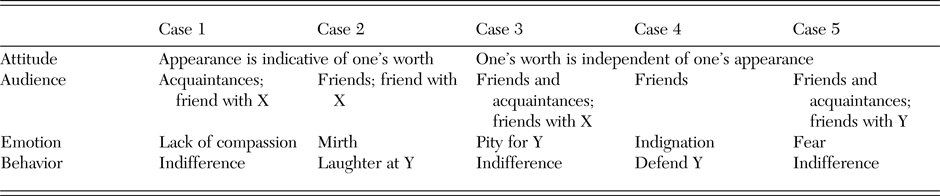
Table 1. Cases of the Attitude–Scenario–Emotion+Audience (ASE+A) model for a cyberbullying scenario
Social media is now a standard way of interacting with other people – friends, acquaintances, and a wider audience of unknown people. Given the wealth of online activity and its relevance to our “real” lives, analysis of social media has gained a lot of interest. In particular, affect detection from text has attracted many researchers (e.g., Altrabsheh et al. Reference Altrabsheh, Cocea, Fallahkhair, Conole, Klobučar, Rensing, Konert and Lavoué2015; Paltoglou & Thelwall Reference Paltoglou and Thelwall2012; Tromp & Pechenizkiy Reference Tromp, Pechenizkiy, Gaber, Cocea, Wiratunga and Goker2015), where affect is broadly understood as anything to do with human emotion and related phenomena. In this area, there is confusing terminology about what is expressed and what can be detected from social media text. A recent article (Munezero et al. Reference Munezero, Montero, Sutinen and Pajunen2014b) sought to clarify this terminology and it is largely aligned with Gervais & Fessler's (G&F's) article in the sense that emotions can be observed and that sentiments can be inferred from different emotion expressions.
Research in this area focuses on broad categories such as subjective versus objective text and positive/negative/neutral polarity (e.g., Gaber et al. 2015; Liu & Zhang Reference Liu, Zhang, Aggarwal and Zhai2012). Some attempts were made to detect specific emotions, mostly based on Ekman's basic emotions model (Ekman Reference Ekman1992b) or Russell's dimensions (Russell & Mehrabian Reference Russell and Mehrabian1977) (e.g., Balahur Reference Balahur, Balahur, van der Goot and Montoyo2013; Paltoglou & Thelwall Reference Paltoglou and Thelwall2013). In the last five years there has emerged detection of more complex affective phenomena, such as humour and irony (Reyes et al. Reference Reyes, Rosso and Buscaldi2012), nastiness (Justo et al. Reference Justo, Corcoran, Lukin, Walker and Torres2014), and sarcasm (Altrabsheh et al. Reference Altrabsheh, Cocea, Fallahkhair, Conole, Klobučar, Rensing, Konert and Lavoué2015; Justo et al. Reference Justo, Corcoran, Lukin, Walker and Torres2014). Moreover, there is a growing interest in the detection of online activity such as antisocial behaviour (Munezero et al. Reference Munezero, Montero, Kakkonen, Sutinen, Mozgovoy and Klyuev2014a) and cyberbullying (Dinakar et al. Reference Dinakar, Jones, Havasi, Lieberman and Picard2012; Zhao et al. Reference Zhao, Zhou and Mao2016) through the manifestation of affective text (e.g., insults).
In this context, the ASE model proposed by G&F would be a useful tool for sentiment detection. Given the characteristics of the medium of communication, that is, social media, I propose the addition of another dimension: the audience. The audience is implicit in social media; one may not be aware of the entire audience – in fact, there is a tendency to underestimate the size of the audience (Bernstein et al. Reference Bernstein, Bakshy, Burke, Karrer, Mackay, Brewster and Bødker2013), but one accepts that there is an audience and one's mental model of the audience influences one's online activity (Litt Reference Litt2012; Marwick Reference Marwick2011).
To illustrate the ASE model with the addition of the audience (ASE+A), a cyberbullying scenario is used, where cyberbullying is the repeated communication through digital media of hostile/aggressive messages intended to harm/discomfort others (Tokunaga Reference Tokunaga2010). The influence of attitudes, audience, and emotions on behaviour is discussed for several cases (Table 1). The cases and their explanations are not exhaustive; they are meant as an illustration of how the audience has an influence on one's emotions, and, consequently, on one's behaviour.
Cases of the Attitude–Scenario–Emotion+Audience (ASE+A) model for a cyberbullying scenario
Scenario: X is repeatedly making nasty comments about Y's appearance on a social network. The last comment is more hurtful and is accompanied by an unflattering picture.
Cases 1 and 2 illustrate the presence of contempt with “cold” and “hot” phenomenology respectively. In Case 1, the actor lacks compassion for Y, but the uncertainty over the audience (i.e., perceived risk of social negative evaluation/less social reward), prevents a reaction resulting in indifference. Case 2, on the other hand, with an audience of friends involved in the bullying (i.e., opportunity to gain social reward or fear of losing social approval if not joining) activates hostility in the form of laughter.
Case 3 illustrates a conflict between one's beliefs and a friends' behaviour, which could result in compassion for Y, but a reluctance to risk the friendship with X, leading to no reaction. In Case 4, defending Y is an opportunity to gain social rewards from an audience of friends (presumed to have similar beliefs). In Case 5, the actor is fearful that defending Y would lead to being targeted as well.
Thus, the audience has a major role in one's reactions on social media, with two main dimensions: (a) relationship to main actors (X and Y) and (b) the social group (friends/acquaintances/unknown). Social reward depending on the audience of friends versus acquaintances was explored in previous research on cyberbullying (Bastiaensens et al. Reference Bastiaensens, Vandebosch, Poels, Van Cleemput, DeSmet and De Bourdeaudhuij2014; Jones et al. Reference Jones, Manstead and Livingstone2011) – these cost-reward and power dynamic aspects are in line with the bookkeeping and commitment functions in social relationships, as discussed in G&F's article.
G&F define contempt as the lack of caring, but with the lack of intrinsic motivation to harm others. In cyberbullying, the intent to harm is present, without a clear distinction if this harm is the main goal or a means for other ends like social standing. In face-to-face bullying and, possibly even more so, in cyberbullying, the element of power or social standing may be the main goal. This may explain why some people join in the bullying when they do not know the victim or the initiating bully. Bertolotti and Magnani (Reference Bertolotti and Magnani2013) describe this behaviour as gratuitously humiliating another person in public and compare it to “sociopathy.” In this sense, it is similar to the “hate crimes” mentioned by G&F, and contempt rather than hate is more likely to justify such behaviour.
Using the ASE+A model for affect detection offers the potential to better understand affect in the context of social dynamics by integrating elements of the context (i.e., scenario), the audience (network of relations), and attitudes. Of these, perhaps the most challenging is the detection of attitudes; in the case of cyberbullying, stereotypes about one's appearance, intelligence, and other personal characteristics are often involved (Dinakar et al. Reference Dinakar, Jones, Havasi, Lieberman and Picard2012) and could be used as a proxy for attitudes.