We describe and understand our social (inter)-actions on the basis of a complex of folk-psychological notions, for example, “contempt” or “respect,” which also convey the criteria on the basis of which we attribute value to things and, above all, to people. We are generally aware which of these folk-psychological notions adequately describes our stance toward others – on any specific occasion we know whether we experience “contempt” or “respect” – and that such stances are characterized by specific affective tones. However, we do not know what causes these stances or whether the folk-psychological notions that we use to describe them are well grounded at a subpersonal level. Gervais & Fessler (G&F) develop a model called Attitude–Scenario–Emotion (ASE) that explains what these folk-psychological notions actually describe, that is, what computational and functional mechanisms realize our social relationships and actions. According to the ASE model, these stances and their characteristic affective tones are due to an underlying mechanism based on sentiments. Sentiments are viewed as functional networks: They are the basis of all social affects and constitute the deep structure that underlies and regulates emotions and attitudes (meant as affective valuations, which include cognitive elements such as beliefs, as well as representations concerning values).
The ASE model takes inspiration from early literature in social psychology, and its central idea can be traced back to 18th-century Sentimentalism, which claims that our social relationships are determined by the structure of our sentiments: these motivate all our morally relevant behaviors and allow us to become aware of our values as the criteria we use to assess our actions. In the ASE model, values are also a crucial operational parameter for sentiments that contributes to regulating our social emotions and selecting the appropriate (re-)actions. An important difference between these two perspectives is, however, the way in which they conceive of values. This difference points to an explanatory gap in the ASE model.
For Sentimentalism, sentiments have a prescriptive function; they operate independently of reasoning processes to determine social actions (Shaftesbury Reference Shaftesbury and Shaftesbury1711/2001). They are directly responsible for our grasp of moral values and do not derive from relational dispositions such as, for example, sympathy, because we can morally approve of the actions of our enemies (Hutcheson Reference Hutcheson1755). The values conveyed by our sentiments are the outcome of a moral intuition: Values are immediately perceived as such; they are produced by an innate faculty and are, therefore, “objective” and shared by all humans. This argument does not apply in the ASE model.
First, the authors never speak of moral values. Values are rather qualified as (social-) relational, even though they are hypothesized to be indirectly related to morality through the mediation of sentiments: In G&F's view, our view of another person's moral (in)efficacy depends on whether we are motivated, for example, by contempt or respect. The switch from moral to relational values remains unexplained in the target article, but is probably rooted in a relativistic view of morality according to which there are no situations that are universally considered as specifically moral, and moral rules are instead considered conventional, that is, social (Quintelier & Fessler Reference Quintelier and Fessler2012; Reference Quintelier and Fessler2015). To consider values as social-relational instead of moral might allow us to account for the cultural component of our judgments about what is right or wrong and for the fact that we often have variable degrees of moral consideration for people depending on our relation to them (e.g., friendship or hatred) (Dellantonio & Pastore Reference Dellantonio, Pastore and Magnani2013). However, it makes it difficult to explain why humans are also capable of neutral moral evaluations, which disregard relational values and even contradict the sentiments we have.
Second, and most importantly, the authors do not address the issue of how these values are formed. In the ASE model, values are a component of attitudes described as affective valuations, that is, as cognitions characterized by an affective component. This raises the question of how the relationship between values and valuations should be interpreted. Do values depend on valuations, that is, on the beliefs we have? Or are they rather the outcome of affects? If this remains undetermined, it is impossible to establish how people weight the relational value of others and how earlier weightings might be modified across time on the basis of what factors.
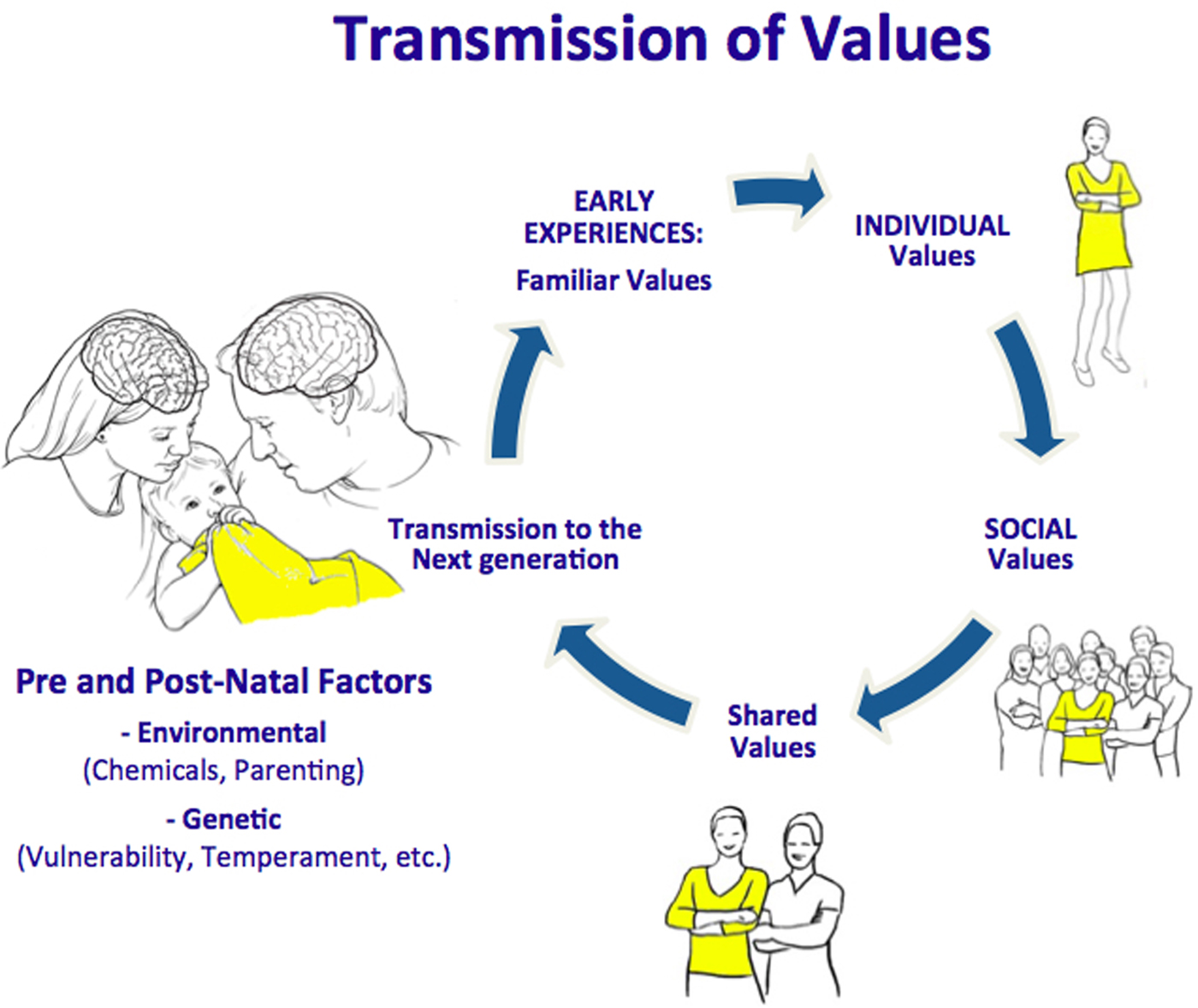
As for the ontogeny of values, we may gain some insight from recent literature in human genetics and physiology. Relational values, which may be represented by automatic patterns of relation in a given social scenario, start to develop at a very early stage, before children learn language and, thus, before they have cognitions in the form of beliefs. They start as subpersonal structures determined by our genetic background and environmental influences. Specifically, pre- and post-natal factors such as the genetic background of a person (genetic vulnerability and/or temperament) and environmental exposure (chemicals, parenting, etc.) interact in determining the transmission of relational values from one generation (parents) to the next (see our Fig. 1). Recent evidence has indicated, for instance, how people's automatic physiological reactivity to social stimuli (e.g., responses to a human cry [Esposito et al. Reference Esposito, Truzzi, Setoh, Putnick, Shinohara and Bornstein2017] or responses to socially appropriate/inappropriate contexts [Truzzi et al. Reference Truzzi, Senese, Setoh, Ripoli and Esposito2016]) is moderated by complex factors that depend on both genetic background (i.e., the oxytocin receptor gene) and environmental exposure (e.g., exposure to hormones during the fetal period or the subsequent level of bonding with parents; see Dalsant et al. Reference Dalsant, Truzzi, Setoh and Esposito2015). Of course, transmission from one generation to the next is not direct and linear; in addition, cognitive as well as social-relational mechanisms are involved in the further development of values. However, from a developmental perspective, values cannot be interpreted as the product of cognitive valuations; their early origin must be subpersonal, prelinguistic, and noncognitive. From this point of view, it does not seem appropriate to consider values as a component of attitudes, if attitudes are valuations. Alternatively, the notion of attitude should be further specified in terms of its affective components and its ontogenesis.
Figure 1.
Transgenerational Transmission of Values. Prenatal and postnatal factors influence early life experience, as family values are passed on. These family values merge later in life with individual and social values. The adult then passes on her/his values combined with her/his partner's values to the next generation.





 You have
Access
We describe and understand our social (inter)-actions on the basis of a complex of folk-psychological notions, for example, “contempt” or “respect,” which also convey the criteria on the basis of which we attribute value to things and, above all, to people. We are generally aware which of these folk-psychological notions adequately describes our stance toward others – on any specific occasion we know whether we experience “contempt” or “respect” – and that such stances are characterized by specific affective tones. However, we do not know what causes these stances or whether the folk-psychological notions that we use to describe them are well grounded at a subpersonal level. Gervais & Fessler (G&F) develop a model called Attitude–Scenario–Emotion (ASE) that explains what these folk-psychological notions actually describe, that is, what computational and functional mechanisms realize our social relationships and actions. According to the ASE model, these stances and their characteristic affective tones are due to an underlying mechanism based on sentiments. Sentiments are viewed as functional networks: They are the basis of all social affects and constitute the deep structure that underlies and regulates emotions and attitudes (meant as affective valuations, which include cognitive elements such as beliefs, as well as representations concerning values).
The ASE model takes inspiration from early literature in social psychology, and its central idea can be traced back to 18th-century Sentimentalism, which claims that our social relationships are determined by the structure of our sentiments: these motivate all our morally relevant behaviors and allow us to become aware of our values as the criteria we use to assess our actions. In the ASE model, values are also a crucial operational parameter for sentiments that contributes to regulating our social emotions and selecting the appropriate (re-)actions. An important difference between these two perspectives is, however, the way in which they conceive of values. This difference points to an explanatory gap in the ASE model.
For Sentimentalism, sentiments have a prescriptive function; they operate independently of reasoning processes to determine social actions (Shaftesbury Reference Shaftesbury and Shaftesbury1711/2001). They are directly responsible for our grasp of moral values and do not derive from relational dispositions such as, for example, sympathy, because we can morally approve of the actions of our enemies (Hutcheson Reference Hutcheson1755). The values conveyed by our sentiments are the outcome of a moral intuition: Values are immediately perceived as such; they are produced by an innate faculty and are, therefore, “objective” and shared by all humans. This argument does not apply in the ASE model.
First, the authors never speak of moral values. Values are rather qualified as (social-) relational, even though they are hypothesized to be indirectly related to morality through the mediation of sentiments: In G&F's view, our view of another person's moral (in)efficacy depends on whether we are motivated, for example, by contempt or respect. The switch from moral to relational values remains unexplained in the target article, but is probably rooted in a relativistic view of morality according to which there are no situations that are universally considered as specifically moral, and moral rules are instead considered conventional, that is, social (Quintelier & Fessler Reference Quintelier and Fessler2012; Reference Quintelier and Fessler2015). To consider values as social-relational instead of moral might allow us to account for the cultural component of our judgments about what is right or wrong and for the fact that we often have variable degrees of moral consideration for people depending on our relation to them (e.g., friendship or hatred) (Dellantonio & Pastore Reference Dellantonio, Pastore and Magnani2013). However, it makes it difficult to explain why humans are also capable of neutral moral evaluations, which disregard relational values and even contradict the sentiments we have.
Second, and most importantly, the authors do not address the issue of how these values are formed. In the ASE model, values are a component of attitudes described as affective valuations, that is, as cognitions characterized by an affective component. This raises the question of how the relationship between values and valuations should be interpreted. Do values depend on valuations, that is, on the beliefs we have? Or are they rather the outcome of affects? If this remains undetermined, it is impossible to establish how people weight the relational value of others and how earlier weightings might be modified across time on the basis of what factors.
As for the ontogeny of values, we may gain some insight from recent literature in human genetics and physiology. Relational values, which may be represented by automatic patterns of relation in a given social scenario, start to develop at a very early stage, before children learn language and, thus, before they have cognitions in the form of beliefs. They start as subpersonal structures determined by our genetic background and environmental influences. Specifically, pre- and post-natal factors such as the genetic background of a person (genetic vulnerability and/or temperament) and environmental exposure (chemicals, parenting, etc.) interact in determining the transmission of relational values from one generation (parents) to the next (see our Fig. 1). Recent evidence has indicated, for instance, how people's automatic physiological reactivity to social stimuli (e.g., responses to a human cry [Esposito et al. Reference Esposito, Truzzi, Setoh, Putnick, Shinohara and Bornstein2017] or responses to socially appropriate/inappropriate contexts [Truzzi et al. Reference Truzzi, Senese, Setoh, Ripoli and Esposito2016]) is moderated by complex factors that depend on both genetic background (i.e., the oxytocin receptor gene) and environmental exposure (e.g., exposure to hormones during the fetal period or the subsequent level of bonding with parents; see Dalsant et al. Reference Dalsant, Truzzi, Setoh and Esposito2015). Of course, transmission from one generation to the next is not direct and linear; in addition, cognitive as well as social-relational mechanisms are involved in the further development of values. However, from a developmental perspective, values cannot be interpreted as the product of cognitive valuations; their early origin must be subpersonal, prelinguistic, and noncognitive. From this point of view, it does not seem appropriate to consider values as a component of attitudes, if attitudes are valuations. Alternatively, the notion of attitude should be further specified in terms of its affective components and its ontogenesis.
Transgenerational Transmission of Values. Prenatal and postnatal factors influence early life experience, as family values are passed on. These family values merge later in life with individual and social values. The adult then passes on her/his values combined with her/his partner's values to the next generation.