Ellies et al. reference studies by Caudell and Quinlan (Reference Caudell and Quinlan2012) and Pelham (Reference Pelham2021), which provide evidence for how cues of resource scarcity and extrinsic mortality (EM) risks influence fertility through mediating factors like communicable diseases and reduced life expectancy. Although the two-tiered model is conceptually robust and supported by cross-sectional data, this reliance on single-point regional comparisons limits its scope. This approach does not capture the dynamic and evolving nature of environmental factors or their longitudinal impacts on life history (LH) strategies. Given the model’s emphasis on phenotypic plasticity, a more comprehensive analysis of how fluctuating energetic constraints and mortality cues influence LH development over time is essential. Moreover, while Ellis et al.’s model adeptly distinguishes between mortality cues and energetic constraints, it overlooks a foundational mechanism historically central to LH theory – density-dependent selection. Classical models suggest that under conditions of heightened competition and resource limitation, slower LH strategies may be favored, as individuals allocate energy toward somatic investment and competitive ability rather than maximizing immediate reproduction (Baldini, Reference Baldini2015). However, in contemporary formulations, the role of density-dependent selection has receded into the background, often treated as secondary to factors such as age-specific mortality risks and environmental unpredictability (Volk, 2025). Accounting for density-dependent pressures may elucidate why adverse conditions do not consistently select for fast LH strategy, but rather lead to varied outcomes depending on competition and resource availability.
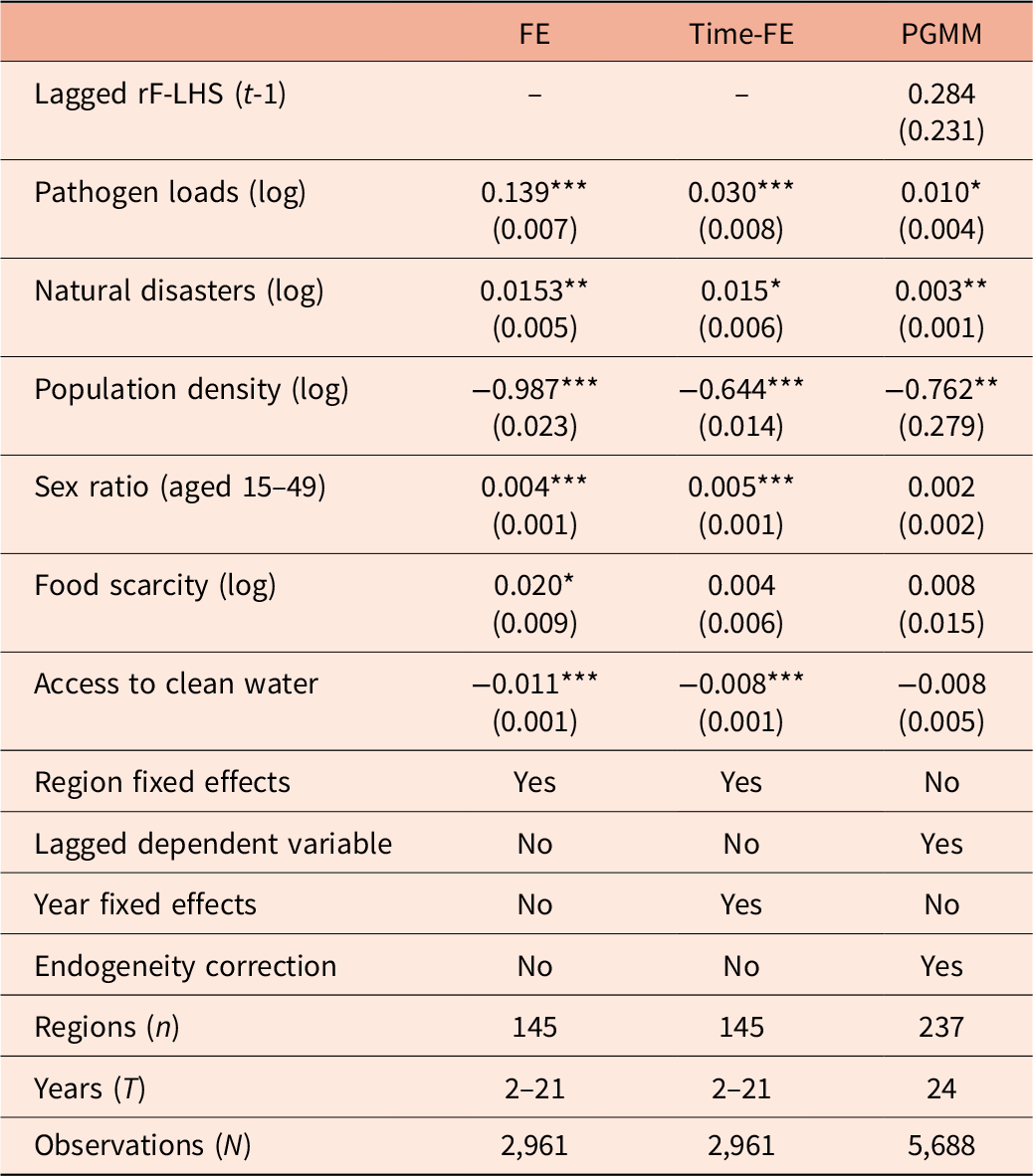
To address these gaps, we propose a cross-regional analysis to investigate the temporal effects of environmental harshness and unpredictability on LH strategies. Our study examined stressors such as pathogen loads, natural disasters, and food and water scarcity across a diverse sample of regions (145–237, depending on the analysis) over a period of up to 24 years. Using panel data and a relatively Faster Life History Strategy (rF-LHS) index – which incorporates total fertility rate, early reproduction, and early mortality – we aimed to clarify how these pressures influence critical LH trade-offs through the interplay of energetic constraints and mortality cues. Additionally, we incorporated population density into our analysis, highlighting its especially significant predictive role in shaping LH strategies over time. The analysis, available at https://osf.io/z5bcd/, is reported in Table 1.
Table 1.
Results for predictors of the relatively faster life history strategy across panel models
By leveraging comprehensive panel data, we provide critical insights into how fluctuating energetic constraints and mortality cues shape reproductive trade-offs within populations. Our results revealed that population density emerges as one of the most crucial factors that effectively decelerates the pace of LH strategies. Other research likewise underscores the fundamental role of population density in shaping LH strategies across populations (Sng et al., Reference Sng, Neuberg, Varnum and Kenrick2017). As population density increases, competition for limited resources intensifies, which under relatively stable conditions tends to favor slower developmental strategies and greater investment in fewer offspring. This suggests that high density often signals an environment that is, on average, predictable and resource-rich – enabling population growth in the first place – despite local competition. In such contexts, long-term investments in personal development become adaptive.
Moreover, density not only increases competition but can also foster cooperation and social support, both of which contribute to long-term planning and reduced impulsivity. At the group level, institutional structures in dense urban environments – such as reliable access to food, healthcare, and social safety nets – further reinforce delayed reproduction and prolonged development. These settings often cultivate cultural norms that emphasize future-oriented behaviors, including the value of education and strategic planning. Over time, these slow LH patterns may become entrenched through cultural transmission and individual self-selection, as people gravitate toward environments that align with their developmental goals and social preferences (Gallyamova & Grigoryev, Reference Gallyamova and Grigoryev2025). Overall, population density can function as a contextual factor that interacts with other ecological variables, shaping diverse LH strategies.
Then, ambient mortality cues (e.g., pathogen loads and natural disasters) are likely more important to the development of fast LH strategies than energetic constraints (e.g., food scarcity and access to clean water) within populations. This may be because mortality cues are more directly tied to actual causes of EM, while resource constraints, although challenging, are often more manageable or compensable. For example, scarcity of food or water can be mitigated through behavioral adaptation (e.g., more efficient foraging or agricultural innovations), physiological adjustments (e.g., reduced metabolism), or collective solutions (e.g., resource sharing). These constraints, therefore, do not always necessitate an immediate shift toward reproduction, as organisms can often afford to delay reproduction until conditions improve. In contrast, mortality cues (e.g., high rates of infection, violence, or unpredictable disasters) cannot be avoided through individual effort or adaptation (Low et al., Reference Low, Hazel, Parker and Welch2008).
It is this uncontrollability, rather than the mere harshness of conditions, that evolutionarily triggers a faster LH strategy. Importantly, in modern environments, there are few energetic constraints that reliably lead to high population-level mortality. Thus, resource scarcity may influence LH strategy indirectly, through its effects on mortality risk (Lawson et al., Reference Lawson, Alvergne and Gibson2012). For instance, a lack of clean water may lead to higher infant mortality via increased exposure to pathogens. When resource scarcity co-occurs with other ecological stressors like disease burden, individuals may perceive the environment as unpredictable and dangerous, with a high likelihood of early death. This perception activates mortality cues that directly calibrate LH strategies toward earlier reproduction and lower investment per offspring across populations (Caudell & Quinlan, Reference Caudell and Quinlan2012). Supporting this, another research across populations shows that as infant mortality rates decline due to improvements like clean water, vaccination, and medical care, countries undergo a demographic transition: fertility rates drop and maternal age at first birth increases (Pelham, Reference Pelham2021). These findings reinforce the idea that mortality and pathogen stress – rather than caloric deprivation alone – are the primary triggers of fast LH strategies.
Our results may help reconcile debates on the seemingly contradictory effects of harsh and unpredictable environments on LH development (Volk, Reference Volk2023), which inspired Ellis et al. This underscores the importance of examining both the combined and independent effects of diverse environmental factors and their dynamics over time to accurately assess their relative significance in shaping LH strategies.






 You have
Access
Ellies et al. reference studies by Caudell and Quinlan (Reference Caudell and Quinlan2012) and Pelham (Reference Pelham2021), which provide evidence for how cues of resource scarcity and extrinsic mortality (EM) risks influence fertility through mediating factors like communicable diseases and reduced life expectancy. Although the two-tiered model is conceptually robust and supported by cross-sectional data, this reliance on single-point regional comparisons limits its scope. This approach does not capture the dynamic and evolving nature of environmental factors or their longitudinal impacts on life history (LH) strategies. Given the model’s emphasis on phenotypic plasticity, a more comprehensive analysis of how fluctuating energetic constraints and mortality cues influence LH development over time is essential. Moreover, while Ellis et al.’s model adeptly distinguishes between mortality cues and energetic constraints, it overlooks a foundational mechanism historically central to LH theory – density-dependent selection. Classical models suggest that under conditions of heightened competition and resource limitation, slower LH strategies may be favored, as individuals allocate energy toward somatic investment and competitive ability rather than maximizing immediate reproduction (Baldini, Reference Baldini2015). However, in contemporary formulations, the role of density-dependent selection has receded into the background, often treated as secondary to factors such as age-specific mortality risks and environmental unpredictability (Volk, 2025). Accounting for density-dependent pressures may elucidate why adverse conditions do not consistently select for fast LH strategy, but rather lead to varied outcomes depending on competition and resource availability.
To address these gaps, we propose a cross-regional analysis to investigate the temporal effects of environmental harshness and unpredictability on LH strategies. Our study examined stressors such as pathogen loads, natural disasters, and food and water scarcity across a diverse sample of regions (145–237, depending on the analysis) over a period of up to 24 years. Using panel data and a relatively Faster Life History Strategy (rF-LHS) index – which incorporates total fertility rate, early reproduction, and early mortality – we aimed to clarify how these pressures influence critical LH trade-offs through the interplay of energetic constraints and mortality cues. Additionally, we incorporated population density into our analysis, highlighting its especially significant predictive role in shaping LH strategies over time. The analysis, available at https://osf.io/z5bcd/, is reported in Table 1.
Results for predictors of the relatively faster life history strategy across panel models
*** p < .001, ** p < .01, * p < .05. Standard errors are shown in parentheses. FE = Fixed Effects; Time-FE = Time Fixed Effects; PGMM = Panel Generalized Method of Moments (Arellano-Bond estimator) that uses lagged levels of endogenous variables as instruments to correct for autocorrelation and endogeneity in dynamic panel data.
By leveraging comprehensive panel data, we provide critical insights into how fluctuating energetic constraints and mortality cues shape reproductive trade-offs within populations. Our results revealed that population density emerges as one of the most crucial factors that effectively decelerates the pace of LH strategies. Other research likewise underscores the fundamental role of population density in shaping LH strategies across populations (Sng et al., Reference Sng, Neuberg, Varnum and Kenrick2017). As population density increases, competition for limited resources intensifies, which under relatively stable conditions tends to favor slower developmental strategies and greater investment in fewer offspring. This suggests that high density often signals an environment that is, on average, predictable and resource-rich – enabling population growth in the first place – despite local competition. In such contexts, long-term investments in personal development become adaptive.
Moreover, density not only increases competition but can also foster cooperation and social support, both of which contribute to long-term planning and reduced impulsivity. At the group level, institutional structures in dense urban environments – such as reliable access to food, healthcare, and social safety nets – further reinforce delayed reproduction and prolonged development. These settings often cultivate cultural norms that emphasize future-oriented behaviors, including the value of education and strategic planning. Over time, these slow LH patterns may become entrenched through cultural transmission and individual self-selection, as people gravitate toward environments that align with their developmental goals and social preferences (Gallyamova & Grigoryev, Reference Gallyamova and Grigoryev2025). Overall, population density can function as a contextual factor that interacts with other ecological variables, shaping diverse LH strategies.
Then, ambient mortality cues (e.g., pathogen loads and natural disasters) are likely more important to the development of fast LH strategies than energetic constraints (e.g., food scarcity and access to clean water) within populations. This may be because mortality cues are more directly tied to actual causes of EM, while resource constraints, although challenging, are often more manageable or compensable. For example, scarcity of food or water can be mitigated through behavioral adaptation (e.g., more efficient foraging or agricultural innovations), physiological adjustments (e.g., reduced metabolism), or collective solutions (e.g., resource sharing). These constraints, therefore, do not always necessitate an immediate shift toward reproduction, as organisms can often afford to delay reproduction until conditions improve. In contrast, mortality cues (e.g., high rates of infection, violence, or unpredictable disasters) cannot be avoided through individual effort or adaptation (Low et al., Reference Low, Hazel, Parker and Welch2008).
It is this uncontrollability, rather than the mere harshness of conditions, that evolutionarily triggers a faster LH strategy. Importantly, in modern environments, there are few energetic constraints that reliably lead to high population-level mortality. Thus, resource scarcity may influence LH strategy indirectly, through its effects on mortality risk (Lawson et al., Reference Lawson, Alvergne and Gibson2012). For instance, a lack of clean water may lead to higher infant mortality via increased exposure to pathogens. When resource scarcity co-occurs with other ecological stressors like disease burden, individuals may perceive the environment as unpredictable and dangerous, with a high likelihood of early death. This perception activates mortality cues that directly calibrate LH strategies toward earlier reproduction and lower investment per offspring across populations (Caudell & Quinlan, Reference Caudell and Quinlan2012). Supporting this, another research across populations shows that as infant mortality rates decline due to improvements like clean water, vaccination, and medical care, countries undergo a demographic transition: fertility rates drop and maternal age at first birth increases (Pelham, Reference Pelham2021). These findings reinforce the idea that mortality and pathogen stress – rather than caloric deprivation alone – are the primary triggers of fast LH strategies.
Our results may help reconcile debates on the seemingly contradictory effects of harsh and unpredictable environments on LH development (Volk, Reference Volk2023), which inspired Ellis et al. This underscores the importance of examining both the combined and independent effects of diverse environmental factors and their dynamics over time to accurately assess their relative significance in shaping LH strategies.
Acknowledgements
This work is an output of a research project implemented as part of the Basic Research Program at HSE University.
Competing interests
None.