Advances
As a sometime contributor to the literature on the relationship between mortality and fertility in human life history, I was excited to read the target article and will be recommending it to students and colleagues hereafter. The theoretical perspective the authors introduce represents a clear step forward, resolving debates and disentangling complexity in our understanding of human life history strategies.
The key advance is the demarcation of two tiers (types) of ecological signals of extrinsic mortality risk – one tier related to somatic experiences of energetic stress and the other related to “ambient” or environmental cues of mortality. These two types of cues affect reproduction in opposing directions, leading to the insight that the “timing of pubertal maturation and pace of reproduction/offspring number are dissociable components of life history strategies” (p. 16). The authors marshal multiple sets of evidence showing clear but countervailing relationships: nutritional stress slows menarche, yet proxies of mortality exposure increase both the pace of reproduction and the number of children born.
I find this perspective illuminating as it provides an explanation for patterns I have studied in rural Bangladesh. When comparing the effects of different types of father absence (Shenk et al., Reference Shenk, Towner, Kress and Alam2013
Reference Shenk, Towner, Kress and Alama), my colleagues and I found that nutritional stress (food insecurity in childhood) predicted delayed ages of marriage (closely linked to age at menarche in this context) and first birth, whereas cues of low socioeconomic status or risk were associated with earlier ages at marriage and first birth. In a separate analysis (Shenk et al., Reference Shenk, Starkweather, Kress and Alam2013
Reference Shenk, Starkweather, Kress and Alamb), we found that the number of child deaths in the local neighborhood was a strong predictor of women’s fertility. Life expectancy at birth and the infant mortality rate were weaker predictors, emphasizing the target article’s argument for the importance of local contextual factors as salient mortality cues.
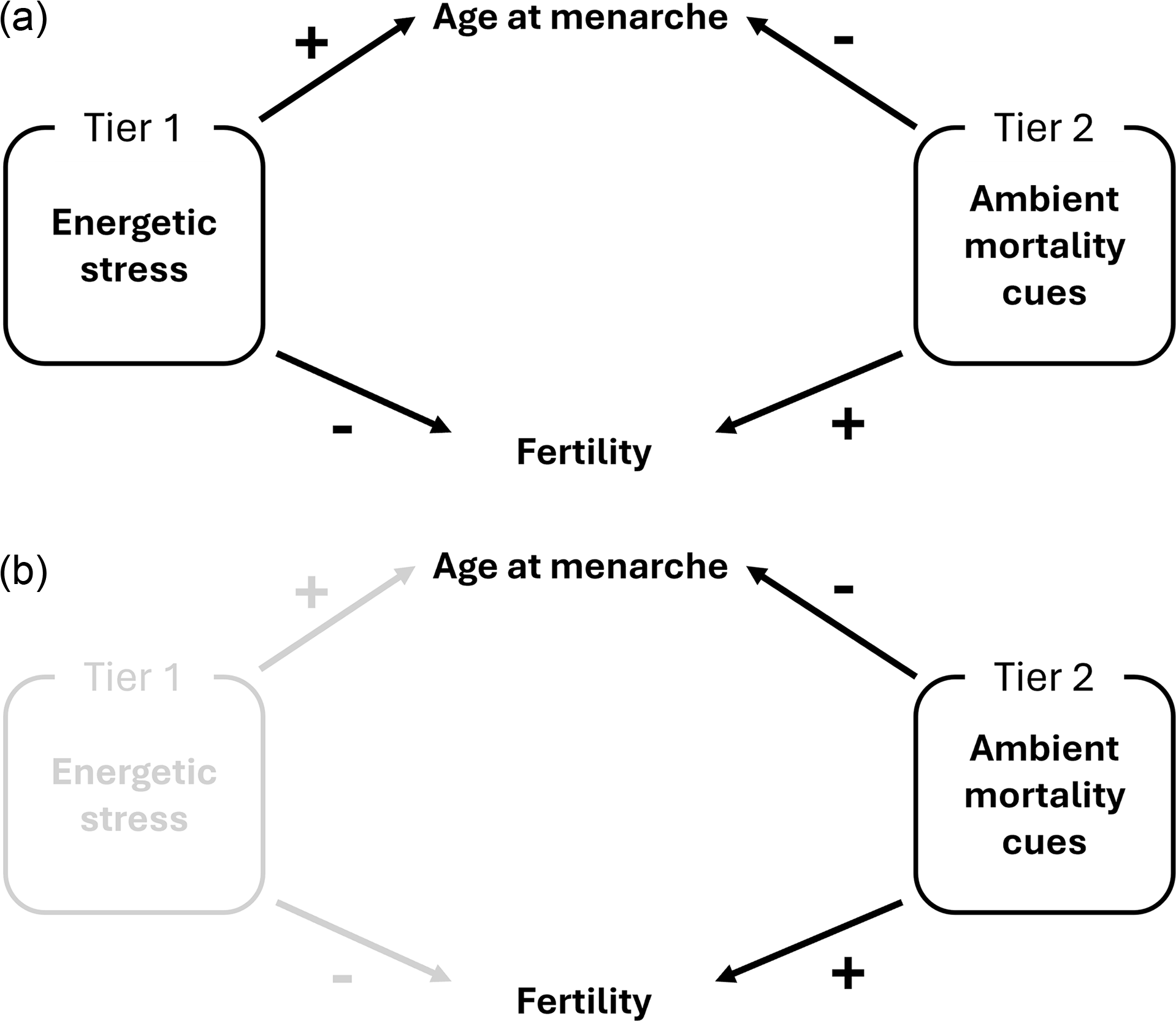
A key question is how we move from contexts in which energetic stress is a crucial regulator of development to the common pattern in industrialized contexts in which energetic stress is rare and we typically only see the effects of ambient mortality cues. The authors suggest that this change occurs when nutritional stress is replaced by types of poverty and food insecurity not clearly linked to caloric scarcity (from a to b in Figure 1). They then link this change to the concepts of socioeconomic development and the demographic transition, both of which are clearly relevant. Yet, I think it can be further illuminated by links to two other salient literatures: on embodied capital (e.g. Kaplan, Reference Kaplan1996) and market integration (e.g. Lu, Reference Lu2007), which have more precisely analyzed the ongoing transitions of human societies and life histories from foraging to subsistence farming to increasingly greater engagement with global markets, supply chains, formal education, and wage-labor.
Figure 1.
Links between environmental cues of extrinsic mortality and physiological and behavioral aspects of reproduction in (a) contexts with limited market integration and high salience of energetic stress, and (b) highly market integrated contexts with low levels of energetic stress. Figure credit: Joon Hwang.
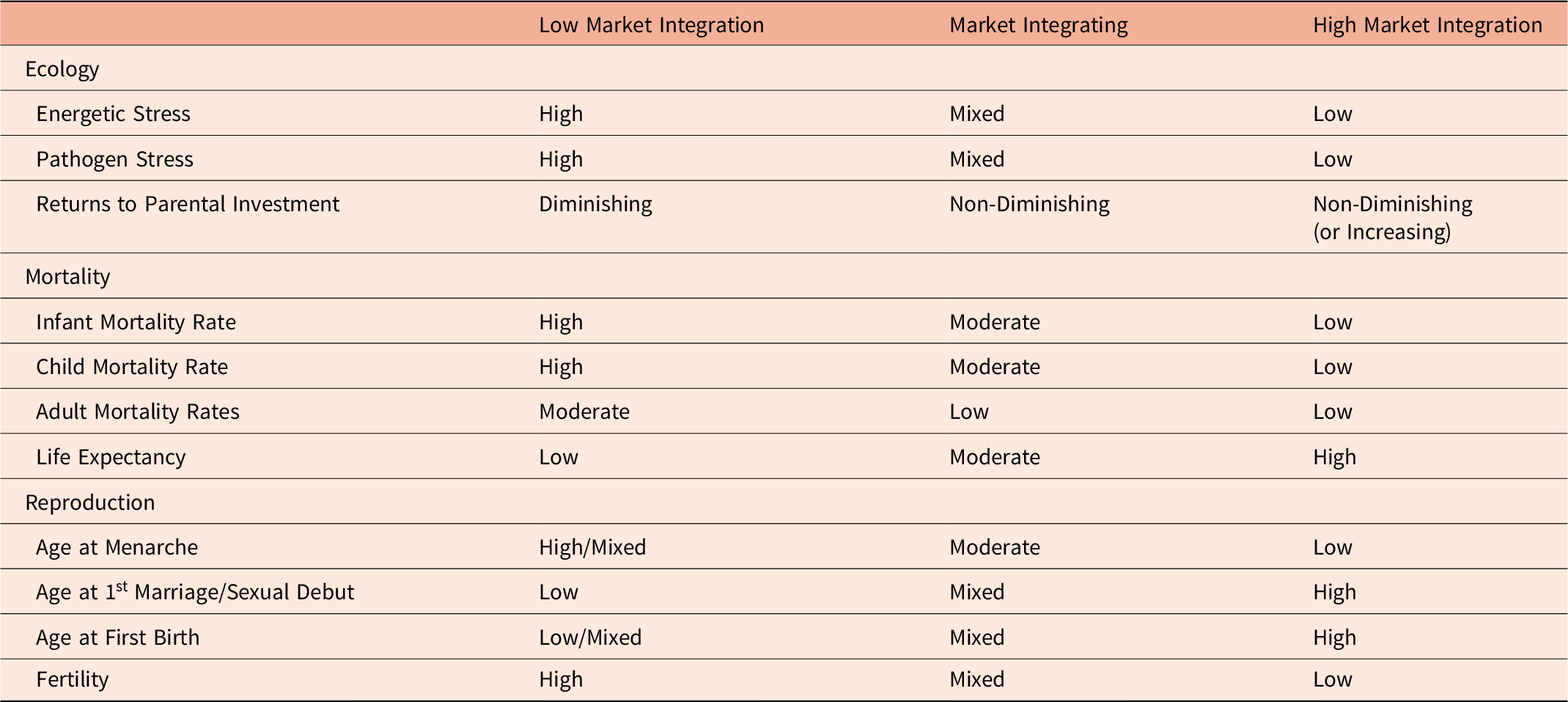
Increasing levels of market integration lead to a crucial life history transition. Lower infant and child mortality rates combined with wage labor mean that returns to parental investment diminish far less quickly, leading to higher per-child investment and lower fertility (e.g., Kaplan, Reference Kaplan1996). In these contexts, fertility behaviors are largely independent of energetic stress – though they are still affected by levels of “ambient” morality exposure (Figure 1b). A schematic for how levels of market integration are related to key ecological, mortality, and reproductive variables relevant to the two-tier model can be found in Table 1.
Table 1.
Predicted associations of levels of market integration with ecology, mortality risk, and reproduction
Remaining Questions
Despite its detail, the target article says relatively little about the timing of exposure to cues of extrinsic mortality and how this may affect their impact on reproduction. In a recent paper, we examine the timing of mortality exposure (Newmyer et al., Reference Newmyer, McAllister, Alam and Shenk2025) using a random sample of young married women from rural Bangladesh, exploring how exposure to family bereavements during the woman’s childhood, adolescence, and post-marriage adulthood were associated with fertility. Reminiscent of the central pattern described in the target article, we found that the number of kin deaths experienced was associated with delayed age at first birth but higher fertility. Yet, we found that this effect was only associated with mortality exposure after marriage, with no clear effect of mortality exposure in childhood or adolescence – contradicting predictions that early life mortality exposure might be especially influential. This begs the question of whether there are critical periods in terms of exposure to cues of extrinsic mortality – and whether early life (e.g., Chisholm et al., Reference Chisholm, Quinlivan, Petersen and Coall2005, Nettle, Coall, & Dickins, Reference Nettle, Coall and Dickins2009) or current exposures (e.g., Newmyer et al., Reference Newmyer, McAllister, Alam and Shenk2025, Shenk et al., Reference Shenk, Towner, Kress and Alam2013a) are more salient.
The two-tier model works to resolve this debate: “Childhood growth and pubertal development can only be shaped by childhood experiences. By contrast, the 2-tiered model assumes that, in addition to regulation by childhood experiences, adult reproductive parameters are calibrated by current conditions, which are informative regarding optimal resource allocations in people of reproductive age” (p. 12–13). The two-tier model thus gives us more precision regarding which reproductive parameters are likely to be influenced by cues at which ages – and the circumstances under which cues will be either competing or reinforcing.
We have also explored whether the age of the deceased influenced the effect of mortality exposure (Newmyer et al., Reference Newmyer, McAllister, Alam and Shenk2025). Given recent reductions in early life mortality in Bangladesh, we lacked enough infant or child deaths to power an analysis, but we looked for differences between exposures to the deaths of working-age or post-reproductive relatives (with greater salience of the former predicted in the literature). We found no difference, but instead deaths of both young adults and elderly relatives were similarly associated with delayed age at first birth, yet increased fertility.
In this instance, the two-tier model does not help us resolve questions about the potential differential effects of the age of the deceased. While the authors argue that “consistent with life history models, child mortality appears to be especially relevant to shifting allocation of resources toward offspring quantity over quality, whereas premature death among prime-age adults appears to play a prominent role in shifting toward current over future reproduction,” they also make it clear that “this distinction should be considered tentative” (p. 52) and call for further work, as do we.






 You have
Access
Advances
As a sometime contributor to the literature on the relationship between mortality and fertility in human life history, I was excited to read the target article and will be recommending it to students and colleagues hereafter. The theoretical perspective the authors introduce represents a clear step forward, resolving debates and disentangling complexity in our understanding of human life history strategies.
The key advance is the demarcation of two tiers (types) of ecological signals of extrinsic mortality risk – one tier related to somatic experiences of energetic stress and the other related to “ambient” or environmental cues of mortality. These two types of cues affect reproduction in opposing directions, leading to the insight that the “timing of pubertal maturation and pace of reproduction/offspring number are dissociable components of life history strategies” (p. 16). The authors marshal multiple sets of evidence showing clear but countervailing relationships: nutritional stress slows menarche, yet proxies of mortality exposure increase both the pace of reproduction and the number of children born.
I find this perspective illuminating as it provides an explanation for patterns I have studied in rural Bangladesh. When comparing the effects of different types of father absence (Shenk et al., Reference Shenk, Towner, Kress and Alam2013 Reference Shenk, Towner, Kress and Alama), my colleagues and I found that nutritional stress (food insecurity in childhood) predicted delayed ages of marriage (closely linked to age at menarche in this context) and first birth, whereas cues of low socioeconomic status or risk were associated with earlier ages at marriage and first birth. In a separate analysis (Shenk et al., Reference Shenk, Starkweather, Kress and Alam2013 Reference Shenk, Starkweather, Kress and Alamb), we found that the number of child deaths in the local neighborhood was a strong predictor of women’s fertility. Life expectancy at birth and the infant mortality rate were weaker predictors, emphasizing the target article’s argument for the importance of local contextual factors as salient mortality cues.
A key question is how we move from contexts in which energetic stress is a crucial regulator of development to the common pattern in industrialized contexts in which energetic stress is rare and we typically only see the effects of ambient mortality cues. The authors suggest that this change occurs when nutritional stress is replaced by types of poverty and food insecurity not clearly linked to caloric scarcity (from a to b in Figure 1). They then link this change to the concepts of socioeconomic development and the demographic transition, both of which are clearly relevant. Yet, I think it can be further illuminated by links to two other salient literatures: on embodied capital (e.g. Kaplan, Reference Kaplan1996) and market integration (e.g. Lu, Reference Lu2007), which have more precisely analyzed the ongoing transitions of human societies and life histories from foraging to subsistence farming to increasingly greater engagement with global markets, supply chains, formal education, and wage-labor.
Links between environmental cues of extrinsic mortality and physiological and behavioral aspects of reproduction in (a) contexts with limited market integration and high salience of energetic stress, and (b) highly market integrated contexts with low levels of energetic stress. Figure credit: Joon Hwang.
Increasing levels of market integration lead to a crucial life history transition. Lower infant and child mortality rates combined with wage labor mean that returns to parental investment diminish far less quickly, leading to higher per-child investment and lower fertility (e.g., Kaplan, Reference Kaplan1996). In these contexts, fertility behaviors are largely independent of energetic stress – though they are still affected by levels of “ambient” morality exposure (Figure 1b). A schematic for how levels of market integration are related to key ecological, mortality, and reproductive variables relevant to the two-tier model can be found in Table 1.
Predicted associations of levels of market integration with ecology, mortality risk, and reproduction
Remaining Questions
Despite its detail, the target article says relatively little about the timing of exposure to cues of extrinsic mortality and how this may affect their impact on reproduction. In a recent paper, we examine the timing of mortality exposure (Newmyer et al., Reference Newmyer, McAllister, Alam and Shenk2025) using a random sample of young married women from rural Bangladesh, exploring how exposure to family bereavements during the woman’s childhood, adolescence, and post-marriage adulthood were associated with fertility. Reminiscent of the central pattern described in the target article, we found that the number of kin deaths experienced was associated with delayed age at first birth but higher fertility. Yet, we found that this effect was only associated with mortality exposure after marriage, with no clear effect of mortality exposure in childhood or adolescence – contradicting predictions that early life mortality exposure might be especially influential. This begs the question of whether there are critical periods in terms of exposure to cues of extrinsic mortality – and whether early life (e.g., Chisholm et al., Reference Chisholm, Quinlivan, Petersen and Coall2005, Nettle, Coall, & Dickins, Reference Nettle, Coall and Dickins2009) or current exposures (e.g., Newmyer et al., Reference Newmyer, McAllister, Alam and Shenk2025, Shenk et al., Reference Shenk, Towner, Kress and Alam2013a) are more salient.
The two-tier model works to resolve this debate: “Childhood growth and pubertal development can only be shaped by childhood experiences. By contrast, the 2-tiered model assumes that, in addition to regulation by childhood experiences, adult reproductive parameters are calibrated by current conditions, which are informative regarding optimal resource allocations in people of reproductive age” (p. 12–13). The two-tier model thus gives us more precision regarding which reproductive parameters are likely to be influenced by cues at which ages – and the circumstances under which cues will be either competing or reinforcing.
We have also explored whether the age of the deceased influenced the effect of mortality exposure (Newmyer et al., Reference Newmyer, McAllister, Alam and Shenk2025). Given recent reductions in early life mortality in Bangladesh, we lacked enough infant or child deaths to power an analysis, but we looked for differences between exposures to the deaths of working-age or post-reproductive relatives (with greater salience of the former predicted in the literature). We found no difference, but instead deaths of both young adults and elderly relatives were similarly associated with delayed age at first birth, yet increased fertility.
In this instance, the two-tier model does not help us resolve questions about the potential differential effects of the age of the deceased. While the authors argue that “consistent with life history models, child mortality appears to be especially relevant to shifting allocation of resources toward offspring quantity over quality, whereas premature death among prime-age adults appears to play a prominent role in shifting toward current over future reproduction,” they also make it clear that “this distinction should be considered tentative” (p. 52) and call for further work, as do we.
Financial support
The author is currently supported by her faculty position at the Pennsylvania State University. Relevant research projects have been supported by the US National Science Foundation and the Pennsylvania State University.
Competing interests
None to declare.