



1. Background
Guided by concepts from life history (LH) theory, a large human research literature has examined how early experiences and environmental exposures calibrate the development of LH strategies. This developmentally focused approach was launched by foundational work in the 1990s (e.g., Belsky, Steinberg, & Draper, Reference Belsky, Steinberg and Draper1991; Chisholm, Reference Chisholm1993, Reference Chisholm1999) and has grown steadily in the decades since (see Nettle & Frankenhuis, Reference Nettle and Frankenhuis2019, for a bibliometric analysis). Despite some variation in theory and methods, this approach has been guided by a common assumption: Mortality risk from extrinsic sources – as signaled by observable environmental cues – promotes the development of faster LH strategies (e.g., earlier/faster reproduction, higher offspring number). This developmental hypothesis is inferred from LH theory but not mathematically derived from it (see Stearns & Rodrigues, Reference Stearns and Rodrigues2020).
The developmental hypothesis has recently been challenged (e.g., Dinh & Gangestad, Reference Dinh and Gangestad2024; Stearns & Rodrigues, Reference Stearns and Rodrigues2020; Volk, Reference Volk2023). The goal of the current paper is to address a potentially critical challenge – one that advances a directly opposing hypothesis based on energetic conditions. This opposing energetics hypothesis stipulates that, because harsh conditions characterized by high extrinsic mortality (EM) in the past were intimately linked to energetic constraints (i.e., limited or marginal nutrition), such conditions specifically led to the development of slower LH strategies (e.g., later puberty, slower reproduction, fewer offspring) (Volk, Reference Volk2023). By contrast, the developmental hypothesis posits that, independent of energetic conditions, EM promotes faster LH strategies.
The current paper advances a two-tiered LH model that attempts to integrate the energetics and developmental hypotheses. The model proposes that exposures to different sources of EM have both hierarchical and countervailing effects on the development of different LH traits. We first present the two-tiered model. Then we evaluate it by reviewing four lines of research investigating the effects of different sources of EM on variation in sexual development and adult reproductive parameters. These lines include: (1) LH variation among hunter-gatherers and subsistence-based horticulturalists under different environmental conditions (sect. 2.1); (2) between- and within-country correlations between ecological conditions, mortality, maturational timing, and fertility, including a new path analysis (sect. 2.2); (3) individual-level correlations (longitudinal and cross-sectional) between this same set of variables (sect. 2.3); and (4) natural experiments leveraging the impact of externally caused changes in mortality on LH traits (sect. 2.4). As various researchers have criticized using data from wealthy industrialized countries to test evolutionary hypotheses (e.g., Henrich, Heine, & Norenzayan, Reference Henrich, Heine and Norenzayan2010; Sear, Sheppard, & Coall, Reference Sear, Sheppard and Coall2019; Volk, Reference Volk2023), we focus on data from small-scale human societies and low- and middle-income countries (LMICs), wherein energetic and resource scarcity place meaningful constraints on growth and development.
Although the four lines of research reviewed herein are based in different scientific disciplines and employ diverse methods, perspectives, and populations, they converge on a shared conclusion: Harsh environmental conditions encompassing diverse sources of EM, including energetic stress and ambient cues to EM in the external environment, have countervailing effects on the development of LH strategies, both delaying pubertal maturation and promoting accelerated pace of reproduction and higher offspring number. We conclude that, although energetics are fundamental to many developmental processes, providing a first tier of environmental influence, this first tier alone cannot explain these countervailing effects. An important second tier of environmental influence is afforded by ambient cues to EM. The empirical record confirms this second tier as centrally involved in regulating the development of LH strategies, supporting the two-tiered model.
1.1. Applications of LH theory
LH theory (Roff, Reference Roff2002; Stearns, Reference Stearns1992) is a robust framework used to explain how natural selection shapes growth rates, timing of sexual maturation, investment in offspring, and age-specific rates of fertility and mortality to promote reproductive success under different environmental conditions. The main focus of the theory is on how selection shapes resource-allocation decisions, which determine how individuals allocate their limited time and energy to various activities that contribute to survival and reproduction across the life cycle: Physical and cognitive growth, maintenance of bodily tissues (survival), and mating and parental effort (reproduction). Because each of these activities influences fitness, devoting time and energy to one typically involves both benefits and costs, thereby engendering trade-offs between competing domains (such as between investing in current vs. future reproduction or quantity vs. quality of offspring). LH models delineate a limited set of environmental conditions that structure these tradeoffs (i.e., density-dependent competition, energetic availability, means and variances in mortality pressures imposed by extrinsic sources).
Theory and research on human development (e.g., Belsky et al., Reference Belsky, Steinberg and Draper1991, Reference Belsky, Schlomer and Ellis2012; Coall & Chisholm, Reference Coall and Chisholm2003; Del Giudice, Ellis, & Shirtcliff, Reference Del Giudice, Ellis and Shirtcliff2011; Ellis, Figueredo, Brumbach, & Schlomer, Reference Ellis, Figueredo, Brumbach and Schlomer2009; Gettler, McDade, Bragg, Feranil, & Kuzawa, Reference Gettler, McDade, Bragg, Feranil and Kuzawa2015; Kramer, Veile, & Otárola-Castillo, Reference Kramer, Veile and Otárola-Castillo2016; Lawson, Alvergne, & Gibson, Reference Lawson, Alvergne and Gibson2012; Quinlan, Reference Quinlan2010; Uggla & Mace, Reference Uggla and Mace2016) shift the focus of LH theory from between-species to within-species variation. Applications of LH theory to human development commonly focus on delineating how environmental conditions calibrate evolved LH adaptations. This approach has guided research toward two related questions. First, how do developmental experiences and environmental exposures shape resource-allocation tradeoffs, such as increased investment in immune function (survival) at a cost to physical size (growth) under conditions of high pathogen stress (e.g., McDade, Reference McDade2003; Urlacher et al., Reference Urlacher, Ellison, Sugiyama, Pontzer, Eick, Liebert and Snodgrass2018). Second, how are such tradeoffs instantiated in variation in demographic LH traits (i.e., traits related directly to rates of reproduction such as age at sexual maturation and offspring number) and their physiological and behavioral mediators (such as speed of biological aging, quality of parenting, and risky behavior indicative of future discounting). Mediators are important because they are hypothesized to govern the expression of LH traits (Braendle, Heyland, & Flatt, Reference Braendle, Heyland, Flatt, Flatt and Heyland2011; Del Giudice, Reference Del Giudice2020).
Covarying suites of LH traits and their mediators are referred to as LH strategies (e.g., Belsky et al., Reference Belsky, Steinberg and Draper1991; Del Giudice, Gangestad, & Kaplan, Reference Del Giudice, Gangestad, Kaplan and Buss2015; Ellis et al., Reference Ellis, Figueredo, Brumbach and Schlomer2009; Figueredo et al., Reference Figueredo, Vásquez, Brumbach, Schneider, Sefcek, Tal and Jacobs2006). Faster LH strategies are demographically indexed by earlier onset of sexual development and reproduction and/or higher offspring number/lower investment per child; slower LH strategies are demographically indexed by the opposite traits. As denoted by the and/or conjunction, however, these groupings do not imply that LH strategies vary along a single unitary dimension. Human life histories have different components and cannot simply be characterized as fast versus slow (Kramer & Ellison, Reference Kramer and Ellison2010; Van de Walle et al., Reference Van de Walle, Fay, Gaillard, Pelletier, Hamel, Gamelon and Jenouvrier2023). Suites of LH traits and mediators that instantiate earlier timing of development and reproduction (e.g., earlier ages at sexual maturation and first birth, as per the current–future tradeoff) may, in part, vary independently from suites of LH traits and mediators that instantiate higher offspring number/lower investment per child (e.g., shorter interbirth intervals, higher total fertility, as per the quantity–quality tradeoff) (sect. 1.4). In other words, an individual can mature late and then reproduce quickly.
1.2. Extrinsic mortality
EM refers to external causes of death that cannot generally be attenuated or prevented (Stearns, Reference Stearns1992). EM is relatively insensitive to the adaptive decisions and actions of the organism, such as parental care or defensive behaviors. In human populations, EM may result from factors such as warfare, natural disasters, community violence, family violence, infectious disease, and food shortages. As denoted by the phrase “relatively insensitive,” mortality is almost never purely extrinsic (Abrams, Reference Abrams1993); the adaptive decisions and actions of the organism almost always have at least some impact on mortality risks. The key feature of high EM, therefore, is that allocations of time and effort toward reducing mortality or increasing survival (e.g., long-term investments in growth and health) have low return on investment; that is, risks of disability and death “cannot be significantly reduced at a reasonable cost” (André & Rousset, Reference André and Rousset2020, p. 6). High EM discounts the value of future reproduction, resulting in tradeoffs favoring earlier onset of reproduction. These tradeoffs function to reduce the duration of mortality exposure prior to reproduction and increase the length of the reproductive span (e.g., Chisholm, Reference Chisholm1999; Migliano, Vinicius, & Lahr, Reference Migliano, Vinicius and Lahr2007; Quinlan, Reference Quinlan2010). In turn, high EM means that effort allocated toward increasing offspring quality only weakly mitigates offspring mortality, resulting in tradeoffs that favor offspring quantity over quality (e.g., Pennington & Harpending, Reference Pennington and Harpending1988). EM operates not only as a selection pressure on the evolution of LH strategies (Charnov, Reference Charnov1991; Promislow & Harvey, Reference Promislow and Harvey1990, Reference Promislow and Harvey1991), but also as an environmental influence on the development of LH strategies over the life course (e.g., Chisholm, Reference Chisholm1993, Reference Chisholm1999; Ellis et al., Reference Ellis, Figueredo, Brumbach and Schlomer2009; Quinlan, Reference Quinlan2010).Footnote 1
At the level of development, EM is communicated to the organism directly through biological pathways (e.g., energetic stress is signaled directly by gastrointestinal hormones; infectious diseases are signaled directly by immune responses) and indirectly through ambient cues in the external environment that are received and processed through sensory systems. When detected and encoded, ambient cues activate central nervous system processes (e.g., threat appraisal), which may in turn alter physiological mechanisms of energy allocation. Central nervous system processes, however, can influence reproductive behaviors (e.g., desired fertility, contraception choice, coital frequency) in ways that are not tightly constrained by such mechanisms. In other words, ambient cues to EM – defined here as developmental experiences and environmental exposures that signal premature death or heightened risk of death among individuals in one’s local environment – can calibrate reproduction in ways that are largely distinct from the effects of energetics. Ambient cues signaling heightened risk of child mortality, specifically, should guide resource-allocation decisions toward offspring quantity over quality.Footnote 2
In human research, ambient cues to EM have been operationalized in various ways. Some examples include: Frequency of funeral attendance (Smith-Greenaway, Yeatman, & Chilungo, Reference Smith-Greenaway, Yeatman and Chilungo2022); experiences of close bereavement (Pepper & Nettle, Reference Pepper and Nettle2013); own-child mortality (Kuate Defo, Reference Kuate Defo, Montgomery and Cohen1998); prevalence of infant or child death among immediate social network or community members (Sandberg, Reference Sandberg2006; Shenk, Towner, Kress, & Alam, Reference Shenk, Towner, Kress and Alam2013); experiencing the death of a sibling (Störmer & Lummaa, Reference Störmer and Lummaa2014) or parents (Kidman & Anglewicz, Reference Kidman and Anglewicz2014; Snopkowski & Ziker, Reference Snopkowski and Ziker2020) while growing up; assisting in military hospitals and with preparation of war dead (Lynch, Lummaa, Briga, Chapman, & Loehr, Reference Lynch, Lummaa, Briga, Chapman and Loehr2020); physical proximity to a homicide (Weitzman, Barber, Heinze, Kusunoki, & Zimmerman, Reference Weitzman, Barber, Heinze, Kusunoki and Zimmerman2023) or terrorist attack (Rotondi & Rocca, Reference Rotondi and Rocca2022); violent crime victimization (Gibbons et al., Reference Gibbons, Roberts, Gerrard, Li, Beach, Simons and Philibert2012) or community-level violent crime rates (Griskevicius, Delton, Robertson, & Tybur, Reference Griskevicius, Delton, Robertson and Tybur2011; Svallfors, Reference Svallfors2024); and mortality shocks caused by infectious disease (e.g., Chin & Wilson, Reference Chin and Wilson2018; McCord, Conley, & Sachs, Reference McCord, Conley and Sachs2017), natural disasters or warfare (sect. 2.4).
Consistent with these examples, the current review focuses on ambient cues to EM, and how these cues interact with energetic stress. Except as control variables or as exogenous predictors of mortality in multivariate models, we do not focus on other environmental factors, such as socioeconomic status, parental psychopathology, or father absence (even though past research has employed such variables as proxies for EM). This is a practical decision to limit the scope of the current review. In addition, although both levels of EM (“harshness”) and variation in EM (“unpredictability”) calibrate evolved LH adaptations (Ellis et al., Reference Ellis, Figueredo, Brumbach and Schlomer2009), we focus only on levels of EM, as there is not sufficient data on variation in EM to address the one-tiered versus two-tiered question.
1.3. The two-tiered LH model
The central question guiding the current review is: How do exposures to EM over development shape individual variation in human LH strategies? Building on past work (Belsky et al., Reference Belsky, Steinberg and Draper1991; Coall & Chisholm, Reference Coall and Chisholm2003; Ellis et al., Reference Ellis, Figueredo, Brumbach and Schlomer2009, Reference Ellis, Sheridan, Belsky and McLaughlin2022), we attempt to answer this question by proposing a two-tiered LH model (summarized in Table 1). Integrating the developmental and energetics hypotheses, the two-tiered model attempts to explain the effects – both hierarchical and countervailing – of different sources of EM (i.e., energetic stress vs. ambient cues to EM) on individual variation in different LH traits (i.e., timing of puberty vs. pace of reproduction and offspring number).
Comparison of one-tiered versus two-tiered models

Note: Hypotheses presented in this table are explained in the main text (sects. 1.3.1–1.3.2). Bolded rows show countervailing effects of different sources of extrinsic mortality on different life history outcomes (e.g., age at first reproduction vs. offspring number). Shaded rows show countervailing effects of different sources of extrinsic mortality on the same life history outcome (e.g., pace of reproduction). ↑ or ↓ denotes regardless of.
Effects of community-level child mortality on fertility outcomes in woen in low- and middle-income countries

DHS, Demographic and Health Surveys; HDI, Human Development Index at time of data collection.
Articles located through Google Scholar search (“community mortality” AND fertility), followed by backward and forward citation searches of identified articles and relevant literature reviews. Articles reporting only bivariate correlations without control variables were excluded. With the exception of mixed evidence from Kenya and Mozambique, all studies link higher community-level mortality to higher desired or achieved fertility, shorter interbirth intervals, earlier fertility timing, and/or lower contraception use.
aAnalyses controlled for socioeconomic factors.
bAnalyses controlled for own-child mortality.
1.3.1. Hierarchical effects: Timing of puberty
The first tier is energetics – caloric intake, energy expenditures, and related health conditions – which set the baseline for many developmental processes. Energetic stress (e.g., marginal nutritional conditions) and closely related conditions of pathogen stress (e.g., McDade, Reference McDade2003; Urlacher et al., Reference Urlacher, Ellison, Sugiyama, Pontzer, Eick, Liebert and Snodgrass2018) were major co-occurring causes of EM over evolutionary history. These first-tier conditions, which may be directly experienced by the organism through biological pathways (sect. 1.2),Footnote 3 induce tradeoffs that divert energy away from growth and reproduction (Table 1, rows 1–2). Such tradeoffs constrain physical growth and generally result in later pubertal maturation (Ellis, Reference Ellis2004; Ellison, Reference Ellison2003; Urlacher et al., Reference Urlacher, Ellison, Sugiyama, Pontzer, Eick, Liebert and Snodgrass2018).
The second tier becomes evident when bioenergetic resources are adequate to support growth and development (and when the person, even if well-nourished, is not in an “emergency LH stage” [Wingfield et al., Reference Wingfield, Maney, Breuner, Jacobs, Lynn, Ramenofsky and Richardson1998] caused by an acute threat to survival). In that context, ambient cues to EM (second tier) may accelerate pubertal development (as per Belsky et al., Reference Belsky, Steinberg and Draper1991).Footnote 4 The two-tiered model, therefore, proposes that environmentally mediated regulation of pubertal timing is hierarchically structured (Table 1, rows 3–4): Contingent firstly on energetics (and related first-tier conditions) and – when these are adequate – secondly on ambient cues to EM (Coall & Chisholm, Reference Coall and Chisholm2003; Ellis, Reference Ellis2004).
An inference of the two-tiered model is that psychosocial effects on pubertal development will be evident in high-resource settings in which the first tier is largely neutral.Footnote 5 That appears to be the case in high-income countries, wherein socioeconomically disadvantaged children do not experience slower or later puberty (sect. 2.3.1). In this high-income context, meta-analyses have established that childhood exposures to violence predict earlier pubertal development (d = −0.26) and its biological mediator, accelerated cellular aging (d = −0.43) (Colich, Rosen, Williams, & McLaughlin, Reference Colich, Rosen, Williams and McLaughlin2020; see also Ding, Xu, Kondracki, & Sun, Reference Ding, Xu, Kondracki and Sun2024). The two-tiered model implies that such effects would not be observed in low-resource settings because they would be swamped by energetics (see Kyweluk, Georgiev, Borja, Gettler, & Kuzawa, Reference Kyweluk, Georgiev, Borja, Gettler and Kuzawa2018). Although much research supports the primacy of energetics in regulating timing of puberty (sect. 2.3.1), some populations facing marginal nutritional conditions but high mortality pressures from other sources still display accelerated growth and pubertal development (sect. 2.1).
1.3.2. Countervailing effects: Timing of puberty versus pace of reproduction/offspring number
The two-tiered model proposes that relations between energetic stress, ambient cues to EM, and LH traits change after puberty, shifting from hierarchical regulation of growth and pubertal development (wherein energetics are the primary) to dualistic regulation of adult reproductive parameters (wherein energetics and ambient cues to EM distinctly, jointly, and independently influence the pace of reproduction and offspring number). In addition, the regulatory timeframe expands after puberty. Childhood growth and pubertal development can only be shaped by childhood experiences. By contrast, the two-tiered model assumes that, in addition to regulation by childhood experiences, adult reproductive parameters are calibrated by current conditions, which are informative regarding optimal resource allocations in people of reproductive age.
Most critically, the two-tiered model conceptualizes dualistic effects on adult reproductive parameters as countervailing (i.e., energetic stress and ambient cues to EM are hypothesized to have opposing effects on adult life histories). Responses to parasitic and infectious disease species illustrate such countervailing effects. The two-tiered model distinguishes between having a parasitic/infectious disease (first tier) and the presence of parasitic and infectious disease species in the ambient environment (second tier), as in the distinction between having malaria and inhabiting a malarial ecology. These first- and second-tier conditions have countervailing effects on current fertility: Having a parasitic/infectious disease generally constrains fertility (e.g., Lucas, Reference Lucas2013; Magadi & Agwanda, Reference Magadi and Agwanda2010), whereas living in a pathogenic environment increases community-level child mortality and, through it, supports behavioral and physiological changes in reproductive-age adults that increase fertility (see Boucekkine, Desbordes, & Latzer, Reference Boucekkine, Desbordes and Latzer2009; Bousmah, Reference Bousmah2017; McCord et al., Reference McCord, Conley and Sachs2017).
How does this occur? That is, how do exposures to ambient cues to EM promote faster pace of reproduction and higher offspring number? Mediated through central nervous system processes (sect. 1.2), second-tier conditions (ambient cues) alter key behavioral mediators of adult reproductive function. For example, in research conducted in LMICs, mortality exposures within family, community, and social networks predict higher levels of desired fertility (e.g., Broussard & Weitzman, Reference Broussard and Weitzman2020; Harman, Reference Harman1970; Owoo, Agyei-Mensah, & Onuoha, Reference Owoo, Agyei-Mensah and Onuoha2015; Smith-Greenaway & Lin, Reference Smith-Greenaway and Lin2023), which in turn strongly predicts higher achieved fertility (Cleland, Machiyama, & Casterline, Reference Cleland, Machiyama and Casterline2020; Pritchett, Reference Pritchett1994). Likewise, in LMICs, family- and community-level mortality exposures are associated with reduced likelihood of using contraception (Bhattacharya, Chakraborty, & Kim, Reference Bhattacharya, Chakraborty and Kim2023; Kuate Defo, Reference Kuate Defo, Montgomery and Cohen1998; Rosero-Bixby, Reference Rosero-Bixby, Montgomery and Cohen1998) and, through it, higher fertility (Bradshaw et al., Reference Bradshaw, Perry, Judge, Saraswati, Heyworth and Le Souëf2023). Mortality exposures also cause steeper future discounting (e.g., Cassar, Healy, & Von Kessler, Reference Cassar, Healy and Von Kessler2017; Li et al., Reference Li, Gui, Feng, Wang, Du, Gan and Luo2012; Pepper & Nettle, Reference Pepper and Nettle2013, Reference Pepper and Nettle2017; Ramos, Victor, Seidl-de-Moura, & Daly, Reference Ramos, Victor, Seidl-de-Moura and Daly2013), which in turn may promote faster reproduction (Bulley & Pepper, Reference Bulley and Pepper2017; Chesson et al., Reference Chesson, Leichliter, Zimet, Rosenthal, Bernstein and Fife2006; Pepper & Nettle, Reference Pepper and Nettle2013). Other potential behavioral mediators include: Heightened parental expectations of child mortality (e.g., Delavande, Kohler, & Vergili, Reference Delavande, Kohler and Vergili2024; Syamala, Reference Syamala2001); lowered parental care (Quinlan, Reference Quinlan2007); reduced parental investment in offspring quality (e.g., lower investment in children’s human capital; Becker, Cinnirella, & Woessmann, Reference Becker, Cinnirella and Woessmann2010; Fernihough, Reference Fernihough2017); and shortened breastfeeding duration, increased coital frequency, and decreased contraception use, as documented in women who have experienced own-child mortality (Hossain, Phillips, & LeGrand, Reference Hossain, Phillips and LeGrand2007; Kimani, Reference Kimani2001).
Although first-tier conditions, such as marginal nutrition, constrain adult female reproductive function (e.g., Bentley, Harrigan, & Ellison, Reference Bentley, Harrigan and Ellison1998; Ellison, Reference Ellison2003; Jasienska, Bribiescas, Furberg, Helle, & Núñez-de la Mora, Reference Jasienska, Bribiescas, Furberg, Helle and Núñez-de la Mora2017), the two-tiered model stipulates that natural selection shapes developmental systems to make the best of bad circumstances when faced with ambient cues to EM. Independent of energetics, making the best in this context may bias resource-allocation decisions toward faster pace of reproduction and higher offspring number (sect. 2), as implemented through behavioral mediators. Such resource-allocation decisions are predicted by LH models (sect. 1.2). In total, the two-tiered model proposes that diverse sources of EM – energetic stress and related first-tier conditions, on the one hand; ambient cues signaling premature death or heightened risk of death in one’s local environment, on the other – have dualistic yet countervailing effects on adult reproductive parameters.
Such countervailing effects occur when these different sources of EM (1) have opposing effects on the same LH outcome (as in the preceding example of parasitic and infectious disease species; represented by the two shaded rows in Table 1); and (2) have opposing effects on different LH outcomes (represented by the two bolded rows in Table 1). In this latter case, countervailing effects result in shifts toward both slower and faster LH traits, such as when harsh environmental conditions encompassing energetic stress and ambient cues to EM both constrain pubertal development and promote faster pace of reproduction/higher offspring number (sects. 2.2–2.4). That is why, in some contexts, girls who reach sexual maturity at older ages initiate reproduction sooner, have shorter interbirth intervals, and have similar or higher fertility rates than girls who mature at younger ages.
1.4. Timing of puberty and adult reproductive function are dissociable components of LH strategies, enabling countervailing effects
An important assumption of the two-tiered model is that different components of LH strategies are dissociable, given their links to different resource-allocation tradeoffs. That is why, in defining faster LH strategies (sect. 1.1), we distinguished between earlier timing of sexual development and reproduction (the current–future tradeoff) and higher offspring number/lower investment per child (the quality–quantity tradeoff).
A substantial body of research has established that timing of female pubertal maturation is distinguishable from functioning of the adult female reproductive axis. Girls who experience early age at menarche (relative to peers whose age at menarche is in the average range for their population) tend to experience earlier reproductive readiness (i.e., they experience more rapid onset of ovulatory menstrual cycles and earlier ages at first sex and first birth; reviewed in Ellis, Reference Ellis2004; see also Ibitoye, Choi, Tai, Lee, & Sommer, Reference Ibitoye, Choi, Tai, Lee and Sommer2017), but they do not have higher functioning mature reproductive systems beyond puberty. Specifically, girls who experience relatively earlier ages at menarche are not more successful at maintaining pregnancies that culminate in live birth, are not more successful at promoting fetal growth, and are not more fecund or reproductively successful in adulthood (reviewed in Ellis, Reference Ellis2004). These conclusions are not just based on data from large-scale Western societies. In a study of 22 small-scale, subsistence-based, natural-fertility societies (mostly tropical foragers and horticulturalists), age at menarche varied widely between societies, with an earlier age at menarche strongly predicting an earlier age at first reproduction (r = 0.76). However, age of menarche was not significantly associated with either total fertility or number of surviving offspring across the 22 societies (Hochberg, Gawlik, & Walker, Reference Hochberg, Gawlik and Walker2011).
In total, early pubertal development is a reliable indicator of early reproductive readiness, but not of high reproductive capacity or fertility after reproductive maturation is achieved. In other words, timing of pubertal maturation and pace of reproduction/ offspring number are dissociable components of LH strategies. This relative independence is theoretically important to the two-tiered model. It means that different sources of EM can influence these different LH traits in a countervailing manner – both delaying pubertal development under conditions of energetic stress (first tier) and increasing the pace of reproduction and offspring number in the presence of ambient cues to EM (second tier) – as established empirically in section 2.
1.5. Critique of the two-tiered LH model
Some researchers have promoted the explanatory utility of a one-tiered model (e.g., Hochberg et al., Reference Hochberg, Gawlik and Walker2011; Volk, Reference Volk2023). For example, Volk (Reference Volk2023) rejects a two-tiered model in favor of a one-tiered model of the role of the environment in regulating life histories (Table 1, rows 1–2). Although Volk acknowledges that in modernized (i.e., industrialized and developed) societies, harsh environmental conditions signaling EM may be associated with faster LH strategies, he contends that this is an artifact of modernity. Volk (Reference Volk2023) reviews data ostensibly showing that the opposite pattern occurs in historical and hunter-gatherer societies. He concludes that, before the demographic transition, the only environmental factor that regulated individuals toward faster LH strategies was good energetic conditions (first tier). Thus, according to Volk (Reference Volk2023), ambient cues to EM do not regulate people toward faster LH strategies (second tier); rather, to the extent that such cues are confounded with energetic deprivation, they regulate people toward slower LH strategies. In Volk’s words:
In both hunter-gatherer and historic populations, harsher and more unpredictable conditions led to a “slow” life history strategy where: (a) growth and menarche/spermarche were delayed, (b) reproduction was delayed due to energetic constraints and behavioral choices; and (c) overall fertility was reduced due to energetic constraints and behavioral choices. (Volk, Reference Volk2023, p. 99)
Long story short, energetics appeared to be the only thing that mattered. Psychosocial cues were irrelevant until modernity and thus it’s a 1-tiered theory, not a hierarchical 2 tiers. (Anthony Volk, personal communication, 2/14/2023)
This one-tiered model does not imply that behavioral choices are unimportant, but rather that such choices are driven by energetics.
The goal of the current paper is to evaluate the one-tiered versus two-tiered model. Although we reject the one-tiered model, showing that it does not sufficiently account for the empirical record on environmentally mediated regulation of LH strategies, that rejection does not imply that we downplay the importance of energetics in regulating human development. Our disagreement is with a one-tiered model that characterizes the effects of ambient cues to EM (second tier) as inseparable from – and subsumed by – energetics (first tier).
2. Empirical evidence for the two-tiered LH model
This section on empirical evidence reviews four lines of research. The first line examines variation in energetics, mortality, and reproductive development across small-scale societies inhabiting diverse ecological niches. These cross-cultural data afford a big-picture view of major variables and relations specified by the two-tiered model. The other three lines of research focus on large-scale societies. These lines do not so much address the overarching theory as specific hypotheses derived from it concerning mortality effects on LH traits. We leverage extensive empirical data from LMICs to evaluate these effects. Although each individual line of research is limited, the four lines together provide critical support for the two-tiered model.
2.1. Relations between energetics, mortality, and LH traits across small-scale societies are not explained by a one-tiered model
Subsistence-based societies, such as foragers and subsistence hor- ticulturalists, shed light on the adaptive range of maturational trajectories and reproductive processes that prevailed for much of human history. In these small-scale societies, the demographic, energetic, dietary, and epidemiological conditions under which children grow up were the human norm for millennia. Studies in small-scale societies consequently afford valuable insight into maturation and reproduction under natural fertility conditions, where mortality schedules are unabetted by medical intervention, and people inhabit ecological niches in which physical activity is habitual and over-consumption of food is limited.
Despite these commonalities, small-scale societies substantially vary in energetic and mortality conditions. As reviewed in this section, this variation correlates with age at menarche and age at first birth in complex ways that are not addressed by a one-tiered model. To demonstrate this complexity, we begin with an illustrative comparison of patterns of growth and development in a small-scale society versus Western reference groups. We then analyze patterns of variation across different small-scale societies.
2.1.1. Early pubertal maturation occurs across diverse energetic and mortality contexts
Across human populations, children mature early under contrasting conditions. Early sexual maturation has been documented not only in populations where food is abundant (regardless of levels of EM), but also in some populations with limited food availability and high EM. This paradox is not easily resolved by a one-tiered model, which predicts a singular, directional link between energy availability, the pace of growth, and sexual development.
Consider the average age at menarche, which has decreased in many developed nations over the last century (Garn, Reference Garn1987; Nichols et al., Reference Nichols, Trentham-Dietz, Hampton, Titus-Ernstoff, Egan, Willett and Newcomb2006; Parent et al., Reference Parent, Teilmann, Juul, Skakkebaek, Toppari and Bourguignon2003), as abundant nutrition and high sugar and fat energy foods have become more prevalent. For example, with some variation across cohorts, among UK-born women, menarcheal age declined from a mean age of 13.5 years in the early twentieth century to 12.3 years in the late twentieth century (Morris, Jones, Schoemaker, Ashworth, & Swerdlow, Reference Morris, Jones, Schoemaker, Ashworth and Swerdlow2011). This decline in menarcheal age has been attributed primarily to improved nutritional and health conditions (Parent et al., Reference Parent, Teilmann, Juul, Skakkebaek, Toppari and Bourguignon2003). Contemporaneously, Savanna Pumé girls (South American hunter-gatherers), who grow up with a high physical activity level in an ecology characterized by distinct seasonal and annual fluctuations in food supply and harsh epidemiological conditions, achieve maturation at similar ages. Pumé girls experience peak gains in weight at age 11.6, the same age as the National Health and Nutrition Examination Survey reference (Kramer, Campbell, Achenbach, & Hackman, Reference Kramer, Campbell, Achenbach and Hackman2022), and reach menarche on average at age 12.9 (SD ± 1.02; Kramer, Reference Kramer2008), an age that is within the normal range of variation relative to other Indigenous South Americans (Hill & Hurtado, Reference Hill and Hurtado1996; Walker et al., Reference Walker, Gurven, Hill, Migliano, Chagnon, De Souza and Yamauchi2006). How do we explain these similarities in the pace of maturation in contrasting energetic environments? One key variable to explain this paradox, unaccounted for in a one-tiered model, is the force of mortality.
2.1.2. Both energetics and juvenile mortality account for variation in ages at menarche and first birth across small-scale societies
A comparative study of energetic conditions, mortality rates, physical growth, and ages at menarche and first birth across 22 small-scale human societies (hunter-gatherers and subsistence horticulturalists; Walker et al., Reference Walker, Gurven, Hill, Migliano, Chagnon, De Souza and Yamauchi2006) clearly rejects a one-tiered model and underscores the necessity of a two-tiered explanatory framework. First, this comparative analysis demonstrated the importance of energetics (tier one): Societies that experienced better energetic conditions (as indicated by larger adult body size) displayed faster childhood growth rates and earlier ages at menarche and first birth in females (Walker et al., Reference Walker, Gurven, Hill, Migliano, Chagnon, De Souza and Yamauchi2006) and had a greater number of surviving offspring (Hochberg et al., Reference Hochberg, Gawlik and Walker2011).Footnote 6 Most striking, however, after controlling for adult body size, higher rates of childhood mortality further predicted faster growth and earlier reproductive development (tier two). In multivariate analyses, age at menarche and age at first birth each occurred about 1 year earlier for every 10% decline in survivorship to age 15 (Walker et al., Reference Walker, Gurven, Hill, Migliano, Chagnon, De Souza and Yamauchi2006), indicating a two-tiered model. In total, in many small-scale societies, marginal energetic conditions and high childhood mortality rates have countervailing effects on development, correlating respectively with both later and earlier ages at menarche and first birth. A one-tiered model alone cannot explain these countervailing effects.
Closer observation of the small-scale societies included in Walker et al.’s (Reference Walker, Gurven, Hill, Migliano, Chagnon, De Souza and Yamauchi2006) cross-cultural analysis reveals that not all sources of EM have the same effects on sexual maturation. Among hunter-gatherers and horticulturalists facing harsh energetic conditions, the empirical record on age at menarche can be explained reasonably well by a one-tiered model. For example, the Ju/’hoansi (Botswana/Namibia), the Gainj (Papua New Guinea), and Asai (New Guinea) live in high mortality environments in which malnutrition plays a significant role. Children in these populations grow slowly and girls mature late (ages at menarche: 16.6–18.4 years; Walker et al., Reference Walker, Gurven, Hill, Migliano, Chagnon, De Souza and Yamauchi2006), leading Walker et al. to conclude that when mortality is based in resource deficiency, as often occurs in higher-elevation or drier environments, the pace growth and sexual development are prolonged. This pattern may make the best of bad circumstances: Smaller individuals have more maintenance cost-effective phenotypes that downregulate energy needs (Gurven & Walker, Reference Gurven and Walker2006; Kuzawa, Reference Kuzawa2005), potentially lowering mortality risk in nutritionally poor environments (Stulp & Barrett, Reference Stulp and Barrett2016). The reproductive tradeoff incurred by smaller body size (lower adult body weight) is fewer surviving offspring (Hochberg et al., Reference Hochberg, Gawlik and Walker2011; Walker & Hamilton, Reference Walker and Hamilton2008). This pattern of slow growth, late sexual maturity, small body size, and low fertility in nutritionally restrictive environments underscores the importance of the first tier.
A second tier is needed, however, to account for patterns of growth and development among hunter-gatherers and horticul- turalists facing other mortality pressures (Kramer, Greaves, & Ellison, Reference Kramer, Greaves and Ellison2009). The Savanna Pumé (Venezuela), Hiwi (Venezuela), Yanomamo (Venezuela), Baka (Cameroon), and Negritos (Philippines) all live in high mortality environments. The heightened mortality in these societies is due largely to exposure to parasites and infectious diseases, and to violence in the case of the Hiwi (Hill, Hurtado, & Walker, Reference Hill, Hurtado and Walker2007) and Yanomamo (Macfarlan, Walker, Flinn, & Chagnon, Reference Macfarlan, Walker, Flinn and Chagnon2014). Child survivorship (up to age 15) in these five populations ranges from 33% to 55% (Hackman & Kramer, Reference Hackman and Kramer2023; Walker et al., Reference Walker, Gurven, Hill, Migliano, Chagnon, De Souza and Yamauchi2006). The Savanna Pumé, Hiwi, Baka, and Negritos all display accelerated patterns of childhood growth and maturation – faster and greater linear growth across ages 3–10 followed by earlier ages at menarche than expected for their adult body size (Kramer & Greaves, Reference Kramer and Greaves2010; Walker et al., Reference Walker, Gurven, Hill, Migliano, Chagnon, De Souza and Yamauchi2006) – despite poor environmental conditions. By age 10, Baka and Hiwi girls have reached 70% of their adult size (Walker et al., Reference Walker, Gurven, Hill, Migliano, Chagnon, De Souza and Yamauchi2006), and Savanna Pumé girls have attained 87% of their adult height (Kramer & Greaves, Reference Kramer and Greaves2010). In turn, Hiwi, Savanna Pumé, and Yanomamo girls attain early ages at menarche (12.4–12.9 years; Early & Peters, Reference Early and Peters1990; Kramer, Reference Kramer2008; Walker et al., Reference Walker, Gurven, Hill, Migliano, Chagnon, De Souza and Yamauchi2006) relative to girls in other small-scale societies. Contrary to a one-tiered model, accelerated sexual development in these societies occurs despite high rates of both juvenile and subadult or adult mortality (Kramer et al., Reference Kramer, Greaves and Ellison2009; Walker et al., Reference Walker, Gurven, Hill, Migliano, Chagnon, De Souza and Yamauchi2006). Age at menarche is comparable to that observed in populations in high-income countries with abundant energy availability (see Parent et al., Reference Parent, Teilmann, Juul, Skakkebaek, Toppari and Bourguignon2003).
In total, patterns of accelerated growth and sexual development in a number of hunter-gatherer and horticultural societies experiencing high levels of pathogen stress, and in some cases high levels of violence, are consistent with a two-tiered model. Walker et al. (Reference Walker, Gurven, Hill, Migliano, Chagnon, De Souza and Yamauchi2006) hypothesize that quickly obtaining a larger body size (rapid juvenile growth) is important for combating parasites and infectious diseases because larger body size confers protection via a more robust immune system, reducing the amount of time that individuals spend in the vulnerable juvenile stage. In addition, faster developmental trajectories in this context, including earlier sexual maturation, function to increase the probability of reproduction prior to disability or death while increasing the length of the reproductive span (sect. 1.2). Such acceleration could occur by increasing juvenile growth rates (Savanna Pumé, Hiwi, Baka, and Negritos), terminating growth at smaller adult body size (Hiwi, Baka, Yanomamo, and Negritos), and/or transitioning to reproductive maturity earlier-than-expected for adult body size (Savanna Pumé, Hiwi, Baka, and Negritos) or at an early absolute age relative to adolescents in other small-scale societies (Hiwi, Savanna Pumé, and Yanomamo).
2.1.3. Conclusion
Cross-cultural data from small-scale societies indicate that life histories advance under a variety of energetic and mortality conditions. Across human populations, children mature early under contrasting conditions, with early maturation occurring in some populations with limited energy availability and high EM. Among hunter-gatherers and subsistence-based horticulturalists, a two-tiered model is needed to understand such complex patterns of growth and sexual development. The two-tiered model proposes that energetic stress and ambient cues to EM (e.g., high rates of child mortality in one’s local community) operate simultaneously – often with countervailing effects. Although the biological mechanisms are unclear, different causes and levels of mortality interact with energy availability to regulate growth and development in complex ways that a one-tiered model is challenged to explain. Based on multivariate analyses, Walker et al. (Reference Walker, Gurven, Hill, Migliano, Chagnon, De Souza and Yamauchi2006) concluded that the effects of better energetic conditions and higher juvenile mortality on earlier ages at menarche and first birth were approximately equal, indicating a two-tiered model.
Although the data reviewed in this section are largely consistent with a two-tiered model, we note two important caveats. First, our review focused on a limited number of small-scale societies for which quantitative data were available, and among which populations and consequently sample sizes are often small. Although data from these societies afford a window into developmental and reproductive processes not otherwise documented in more economically developed societies, conclusions regarding multivariate effects of energetic stress and juvenile mortality on reproductive development should be considered tentative.
Second, the two-tiered model focuses on phenotypic plasticity (i.e., development of individual differences resulting from different environmental experiences and exposures within individual lifetimes). However, Walker et al. (Reference Walker, Gurven, Hill, Migliano, Chagnon, De Souza and Yamauchi2006) did not test for phenotypic plasticity. A plausible alternative explanation for their findings is that, when child mortality regimes are driven primarily by parasites/infectious diseases/violence rather than malnutrition, mortality-driven selection pressures favor earlier/faster childhood growth and sexual maturation. This concurs with data indicating (a) that Baka and Negritos LH patterns may be largely genetically determined (Becker et al., Reference Becker, Verdu, Froment, Le Bomin, Pagezy, Bahuchet and Heyer2011; Dávila et al., Reference Dávila, Shea, Omoto, Mercado, Misawa and Baumann2002); and (b) that Savanna Pumé and River Pumé women, who are genetically from the same population, have similar timing of onset of reproduction (and total fertility), despite River Pumé women being plumper and better nourished and sustaining lower levels of infant mortality (Kramer & Greaves, Reference Kramer and Greaves2007). In total, mortality-driven selection could explain why some small-scale societies experience accelerated childhood growth and sexual development despite marginal energetic conditions. As noted by Walker and Hamilton (Reference Walker and Hamilton2008), however, this acceleration contrasts with phenotypically plastic responses to energetic stress, which decelerate growth and sexual maturation (sect. 2.3.1). In total, although the cross-cultural data reviewed in this section reject a one-tiered model and underscore the necessity of a two-tiered framework that accounts for the effects of mortality, these data do not directly support the current two-tiered model because they are agnostic regarding phenotypic plasticity.
To address these limitations, and to advance the main goal of this paper – delineating relations between energetics, mortality exposures, and the development of LH strategies across multiple scales – a diversity of approaches and data sources are needed. Thus, to complement the patterns found among small-scale societies, we next consider larger-scale societies.
2.2. Macro-level correlations between ecological conditions, mortality, pubertal timing, and fertility support a two-tiered model
This section presents a path analysis and literature review that examine associations between ecological conditions (i.e., resource and caloric availability), mortality, pubertal timing, and fertility across diverse countries, regions, and communities in the developing world. The path analysis links low-resource, high-mortality environments to both later age at menarche and higher rates of fertility, demonstrating countervailing effects of EM on these different LH traits. The literature review then takes a deep dive into the pathway from mortality to fertility. We show that high-mortality environments – whether measured at the national, regional, or community level – upregulate fertility, and that this effect is robust against plausible alternative explanations.
2.2.1. Current path analysis
The path analysis was designed to test the hypothesis that low- resource, high-mortality environments have countervailing effects on LH traits, causing (a) later pubertal development and (b) faster pace of reproduction/higher offspring number. Although this hypothesis is causal, the path analysis employed cross-sectional data; causation cannot be inferred. Indicators of resource scarcity were treated as exogenous variables for predicting mortality (life expectancy) and, through it, puberty and fertility outcomes (see Fig. 1).
Path analytic results showing between-country relations between economic/energetic resources, body mass index (BMI), life expectancy at birth, mean age at menarche, and fertility rate. All path coefficients are standardized. R 2 values capture combined direct and indirect effects. *p < 0.05, ***p < 0.001.

We used Šaffa, Kubicka, Hromada, and Kramer’s (Reference Šaffa, Kubicka, Hromada and Kramer2019) publicly available cross-national dataset to test the hypothesis. All variables included in the path analysis are described in Šaffa et al. (Reference Šaffa, Kubicka, Hromada and Kramer2019), including descriptive statistics. The dataset includes 89 countries with mean menarcheal age data (the determining factor for inclusion in the original study). Resource scarcity was indexed by body mass index (BMI; kg/m2), which is commonly used as a measure of energetic condition (e.g., Black et al., Reference Black, McEwen, Smeeth, Popham, Karam and Pluess2023), and by two highly correlated indicators of resource availability: Energy consumption per capita (kcal/person/day) and gross domestic product (GDP) per capita. These two variables were standardized and averaged together (r = 0.71) to form the composite variable economic/energetic resources. We used life expectancy at birth as the index of mortality risk over the lifespan. Age at menarche (age at first menstruation) was employed as the indicator of pubertal timing. Measures of adolescent fertility (births per 1,000 women aged 15–19) and total fertility (births per woman) were standardizing and averaged together (r = 0.82) to form the composite fertility rate variable. Combining these two measures weighted fertility rate toward earlier/faster reproduction (relevant to testing LH models).
Hypotheses, data diagnostic procedures, variable construction methods, data transformations, missingness information, and data analytic methods and decisions were preregistered (https://osf.io/shgcx/). Results of the path analysis, showing standardized path coefficients, are presented in Figure 1. Estimation procedures, zero-order correlations, and maximum likelihood parameter estimates for the final model (including direct and indirect effects) are reported in the supplementary materials. As preregistered, the indirect pathways to age at menarche and fertility rate were added to the model first (to enable hypothesis testing), followed by the addition of the one statistically significant direct path (as indicated by modification indices). No additional paths were statistically significant. Fit statistics indicated an acceptable model fit (CFI = 1.00, RMSEA = 0.00, SRMR = 0.018, TLI = 1.00, chi-square with 3 df = 2.281, p = 0.516). As predicted, there were statistically significant indirect paths (a) from higher economic/energetic resources, through longer life expectancy, to both earlier age at menarche (β = −0.448, z = −7.25, p < 0.001) and lower fertility rate (β = −0.311, z = −6.94, p < 0.001); and (b) from higher BMI, through longer life expectancy, to both earlier age at menarche (β = −0.073, z = −3.53, p < 0.001) and lower fertility rate (β = −0.051, z = −0.051, p < 0.001). These effects (shown in Fig. 1) support the hypothesis that low-resource, high-mortality environments have opposing effects on LH traits.
On the one hand, the results of the path analysis demonstrate clear ecological constraints on sexual development (as per the one-tiered model). Greater resource scarcity (i.e., lower energy consumption per capita, lower GDP per capita, lower BMI) predicted lower life expectancy and, through it, later age at menarche. This between-country correlation converges with a large body of research on individual variation in pubertal timing within LMICs (sect. 2.3.1). On the other hand, the same challenging ecological and mortality conditions that predicted later age at menarche also predicted earlier and higher fertility (i.e., more children at younger ages, as per the two-tiered model). This between-country correlation likewise converges with other research examining this phenomenon at the level of individual differences in fertility within LMICs (sects. 2.3–2.4). In total, as proposed by the two-tiered model, low-resource, high-mortality conditions were associated with countervailing shifts toward both slower and faster LH traits.
2.2.2. Previous path-analytic studies link low-resource, high-mortality conditions to high fertility
To our knowledge, two previous between-country analyses have used path analytic methods to examine mortality as an intervening mechanism in the relation between ecological conditions/resource availability and fertility outcomes (though not pubertal timing). In an analysis of 191 countries, Caudell and Quinlan (Reference Caudell and Quinlan2012) specifically examined pathways leading from lower resource availability (e.g., fewer calories per capita, lower access to clean water and sanitation) to higher rates of adolescent and total fertility. Tests of indirect effects showed that these pathways operated mainly through higher rates of communicable diseases (e.g., HIV/AIDS, malaria) and, in turn, lower life expectancy. Similarly, in an analysis of 150 countries, Pelham (Reference Pelham2021) investigated pathways leading from higher pathogen loads to higher rates of adolescent and total fertility. Tests of indirect effects showed that these pathways operated mainly through higher infant mortality. These indirect paths controlled for past fertility rates and per capita GDP (Pelham, Reference Pelham2021). Taken together, these two previous path analyses – indicating that harsh conditions largely regulate fertility through their effects on morbidity and mortality – converge with the current path analysis (Fig. 1), but are each based on much larger samples of countries.
2.2.3. Changes in mortality regulate changes in fertility over time
Although higher mortality rates are strongly and reliably associated with higher fertility rates at the national level (e.g., Caudell & Quinlan, Reference Caudell and Quinlan2012; Lorentzen, McMillan, & Wacziarg, Reference Lorentzen, McMillan and Wacziarg2008; Low, Hazel, Parker, & Welch, Reference Low, Hazel, Parker and Welch2008; Murray et al., Reference Murray, Callender, Kulikoff, Srinivasan, Abate, Abate and Bililign2018) – an association that is robust even when restricted to LMICs (Bradshaw et al., Reference Bradshaw, Perry, Judge, Saraswati, Heyworth and Le Souëf2023) – correlation does not equal causation. Thus, it is important to examine mortality–fertility relations longitudinally. Herzer, Strulik, and Vollmer (Reference Herzer, Strulik and Vollmer2012) applied panel cointegration techniques to examine the extent to which changes in fertility respond to preceding changes in mortality; over the course of a century (1900–1999), reductions in mortality led to reductions in fertility (as did increases in per capita income) within the 20 countries around the world for which data were available. Other analyses, conducted in a wider range of countries, which also employed panel cointegration methods to study relations between mortality and fertility over long periods of time, reached the same conclusion (Angeles, Reference Angeles2010; Murtin, Reference Murtin2013; Sánchez-Barricarte & García-Espinal, Reference Sánchez-Barricarte and García-Espinal2017), strongly indicating that declines in mortality contribute to declines in fertility.Footnote 7 This pattern converges with data from sub-Saharan Africa on changes in fertility over the late twentieth to early twenty-first century: Controlling for variation in women’s educational attainment, reductions in under-5 mortality accounted for 30% (urban) and 35% (rural) of fertility declines across 30 countries (Shapiro & Tenikue, Reference Shapiro and Tenikue2017). Finally, at the individual level, micro-longitudinal data on reproductive change over the demographic transition in the Netherlands, Sweden, and Spain indicate that familial experiences of own-child survival (low mortality) played a central role in shifting reproduction toward longer interbirth intervals and lower total fertility, whereas experiences of own-child mortality had the opposite effect (Reher & Sanz-Gimeno, Reference Reher and Sanz-Gimeno2007; Reher, Sandström, Sanz-Gimeno, & van Poppel, Reference Reher, Sandström, Sanz-Gimeno and van Poppel2017; Van Poppel, Reher, Sanz-Gimeno, Sanchez-Dominguez, & Beekink, Reference Van Poppel, Reher, Sanz-Gimeno, Sanchez-Dominguez and Beekink2012).
2.2.4. Mortality–fertility relations are not confounded by country-specific factors
Of course there are country-specific factors that influence fertility, such as culture and religion, that could affect between-country correlations between mortality and fertility. One way to address this issue is to examine within-country changes in mortality and fertility over time (sect. 2.2.3). Another is to compare different states, districts, or local communities within the same country that vary in mortality rates. Such within-country analyses have been conducted in numerous LMICs and generate the same pattern of results as between-country comparisons (Table 2). Although some effects of child mortality on fertility could be directly explained by changes in reproductive physiology (e.g., reduced lactational amenorrhea), the effects of community-level mortality on fertility exceed replacement effects (sect. 2.4.1) and occur independently of variation between women in socioeconomic conditions and own-child mortality history (Table 2).
2.2.5. Mortality–fertility relations are not confounded by economic development or stage in the demographic transition
Relations between mortality and fertility rates could also be confounded by economic development. Rising per capita income and associated technological changes and demand for human capital could lead specific regions or countries to experience lower levels of both mortality and fertility (e.g., Becker, Reference Becker1992). To address this potential confound, various studies have calculated between- country correlations between mortality (e.g., under-age-5 mortality, life expectancy) and either adolescent or total fertility while controlling for GDP per capita (Angeles, Reference Angeles2010; Bulled & Sosis, Reference Bulled and Sosis2010; Pelham, Reference Pelham2021). Inclusion of this control variable did not reduce the strength of relations between mortality and fertility in any of these analyses. Further, all studies reported in Table 2, which show consistent relations between higher community-level mortality and higher levels of desired and achieved fertility within LMICs, controlled for socioeconomic variation between respondents. These mortality–fertility relations occurred across diverse levels of development, as indicated by the Human Development Index (column 1 of Table 2) and child mortality rates (column 3 of Table 2), indicating that these relations were not an artifact of economic development or stage in the mortality transition.
To evaluate the artifact explanation (i.e., potential confounding by stage in the demographic transition), Canning, Günther, Linnemayr, and Bloom (Reference Canning, Günther, Linnemayr and Bloom2013) analyzed the effects of community level mortality on fertility in sub-Saharan Africa (N = 12,151 communities in 1199 regions). Of the 46 countries included in this analysis, about half were early in the mortality transition (under-5 mortality > 20%) and half were later in the mortality transition (under-5 mortality < 20%). Controlling for education and income, the positive effects of higher community-level (and regional-level) child mortality on total fertility were large and robust within countries in each child mortality category, though effects were somewhat stronger within countries early in the mortality transition. In total, even though higher per capita income contributes to lower fertility (Herzer et al., Reference Herzer, Strulik and Vollmer2012), the link between higher mortality exposure and higher fertility cannot be explained by differences between people in socioeconomic conditions – at either the between-country or within-country level of analysis – or by a country’s stage in the demographic transition.
2.2.6. Mortality–fertility relations are not explained by reverse causation
Relations between mortality and fertility could also reflect reverse causation: Higher fertility potentially reduces child survival (reviewed in Lawson & Borgerhoff Mulder, Reference Lawson and Borgerhoff Mulder2016; McCord et al., Reference McCord, Conley and Sachs2017). To address this issue, McCord et al. (Reference McCord, Conley and Sachs2017) collected timevarying data on parasite transmission and found that pathogen-mediated increases in child mortality contributed to higher fertility. Specifically, in an analysis of 133 countries over a 50-year period (1960–2010), greater temporal variation in malaria ecology (a spatial index of country-level stability of malaria transmission) strongly predicted higher rates of malaria-related deaths and under-age-5 mortality and, in turn, higher total fertility (McCord et al., Reference McCord, Conley and Sachs2017). These analyses controlled for between-country variation in women’s educational attainment and GDP per capita. This same pattern also emerged in a longitudinal analysis of a rural Senegalese community, which showed that increases over time in community-level malaria incidence/case fatality rates predicted increases in current fertility (probability of giving birth) among women aged 15–25, controlling for own-child mortality history and socioeconomic factors (Bousmah, Reference Bousmah2017). This concurs with a larger literature showing that the effects of community-level mortality on fertility operate independently of own-child mortality (Table 2) and, therefore, cannot be explained by reverse causation.
2.2.7. Mortality–fertility relations are robust across countries with the shortest life expectancies
Finally, because of ecological/energetic constraints on reproduction (as per the one-tiered model), higher mortality might only lead to accelerated pace of reproduction and higher offspring number in countries or communities in which living conditions exceed a certain ecological/life expectancy threshold (Low et al., Reference Low, Hazel, Parker and Welch2008). For example, when comparing countries with the shortest life expectancies (<60 years; n = 32), the relation between life expectancy and age at first birth was not statistically significant (Low et al., Reference Low, Hazel, Parker and Welch2008). However, Low et al. did not incorporate relevant control variables into their analysis, such as per capita GDP and mortality rates from HIV/AIDS (during the HIV/AIDS epidemic, HIV-infected women in developing countries experienced both dramatically increased mortality and reduced fertility; e.g., Magadi & Agwanda, Reference Magadi and Agwanda2010). When these variables were controlled for, shorter life expectancy strongly and significantly predicted higher total fertility rates in countries with the lowest life expectancies (<60 years; n = 44) (Bulled & Sosis, Reference Bulled and Sosis2010). Further, a recent analysis divided 195 countries into 5 quintiles based on the Socio-Demographic Index (SDI, which is similar to the United Nations’ Human Development Index but is more sensitive to women’s status in society). Across countries and territories in the lowest SDI quintile (i.e., lowest developmental status), the under-age-5 mortality rate correlated 0.66 with the total female fertility rate and 0.68 with the under-age-25 female fertility rate (Murray et al., Reference Murray, Callender, Kulikoff, Srinivasan, Abate, Abate and Bililign2018: Appendix Table 11). The size of these correlations was very similar across all five SDI quintiles, demonstrating the ecological robustness of the association between higher child mortality and higher female fertility (see also Table 2, which supports this robustness at the community level).
2.2.8. Conclusion
Based on the one-tiered model, a straightforward prediction is that better ecological conditions lead to higher fertility because more energetic resources are available to allocate toward reproduction (Volk, Reference Volk2023). However, this prediction is not supported by between- or within-country comparisons. In fact, the opposite occurs: Resource-poor ecologies and associated reductions in life expectancy correlate with higher fertility (despite later ages at menarche). In the path analysis (Fig. 1), challenging ecological conditions (i.e., lower energy consumption per capita, lower GDP per capita) and lower life expectancy afforded valid indicators of harsh environments, as evidenced by their strong effects on later age at menarche. However, even against this backdrop of slower sexual development, the positive effects of mortality on fertility were robust, clearly demonstrating the countervailing effects of EM on different LH traits.
An extensive research literature in demography has established the effects of higher mortality on higher fertility. Across multiple path analyses (including previously published research), lower resource availability or higher pathogen loads were associated with higher fertility rates, and these effects largely operated through heightened morbidity and mortality (e.g., lower life expectancy, higher infant mortality, higher rates of communicable diseases). Most critically, the effects of mortality on fertility have proven robust against plausible alternative explanations. These effects: (a) were not confounded by country-specific factors; (b) were not reduced by controlling for per capita GDP or other indicators of economic development; (c) were not an artifact of a country’s stage in the demographic transition; (d) clearly emerged when analyzing within-country change in fertility rates over the twentieth century; (e) clearly emerged in within-country analyses comparing different states, regions, or local communities that vary in mortality rates (even after controlling for respondents’ socioeconomic status and own-child mortality history; Table 2); (f) were supported by time varying data on parasite transmission, indicating that pathogen-mediated increases and decreases in child mortality contribute to higher and lower fertility, respectively; and (g) were even present in comparisons between countries with the shortest life expectancies (<60 years), wherein harsh ecological conditions are pervasive.
2.3. Micro-level correlations between ecological conditions, mortality exposures, pubertal timing, and fertility support a two-tiered model
This section shifts the focus from group-level relations between countries, regions, or communities (macro-level) to individual-level relations between people (micro-level). Reviewing historical, longitudinal, and cross-sectional data, we examine the effects of energetic stress and ambient cues to EM on individual differences in LH traits. We begin by reviewing historical data in which childhood mortality exposures and subsequent reproductive events were recorded in archives (e.g., civil registers, tax rolls). Then we review longitudinal cohort studies in LMICs in which complex adversity exposures were assessed in childhood and linked to LH traits in adolescence and adulthood. Both sources of data indicate that mortality exposures and related experiences in childhood (e.g., resource scarcity) predict earlier timing of reproduction. The longitudinal cohort studies concomitantly show countervailing effects on (later) timing of puberty. Finally, we review research in LMICs on the effects of mortality exposures on fertility preferences, timing, and outcomes. We conclude that mortality exposures in family, community, and social networks reliably predict higher levels of desired fertility, faster pace of reproduction, and greater achieved fertility. Each line of research supports the two-tiered model.
2.3.1. When do harsh conditions cause later puberty? A methodological note
Before reviewing these lines of research, we present a methodological note. The between-country correlation between harsh ecological conditions and later pubertal development (Fig. 1) replicates in research on adolescent development conducted in lower-resource settings (where many children in poverty face significant energetic constraints) but not in high-resource settings. Accordingly, lower socioeconomic status predicts later timing of puberty in LMICs (e.g., Ethiopia: Belachew et al., Reference Belachew, Hadley, Lindstrom, Getachew, Duchateau and Kolsteren2011; Tanzania: Rebacz, Reference Rebacz2009; Ghana: Adadevoh, Agble, Hobbs, & Elkins, Reference Adadevoh, Agble, Hobbs and Elkins1989; Sudan: Elshiekh & Mohammed, Reference Elshiekh and Mohammed2011; Mozambique: Padez, Reference Padez2003; Nigeria: Abioye-Kuteyi et al., Reference Abioye-Kuteyi, Ojofeitimi, Aina, Kio, Aluko and Mosuro1997; South Africa: Jones, Reference Jones2008; Egypt: Attallah, Reference Attallah1978; Morocco: Montero, Bernis, Loukid, Hilali, & Baali, Reference Montero, Bernis, Loukid, Hilali and Baali1999; Chile (indigenous adolescents): Amigo, Vásquez, Bustos, Ortiz, & Lara, Reference Amigo, Vásquez, Bustos, Ortiz and Lara2012; Colombia: Jansen, Herrán, & Villamor, Reference Jansen, Herrán and Villamor2015; Peru: Aurino, Schott, Penny, & Behrman, Reference Aurino, Schott, Penny and Behrman2018; Mexico: Torres-Mejía et al., Reference Torres-Mejía, Cupul-Uicab, Allen, Galal, Salazar-Martínez and Lazcano-Ponce2005; Haiti: Allman, Reference Allman1982; Brazil: Linhares, Round, & Jones, Reference Linhares, Round and Jones1986; Venezuela: Lopez Contreras, Tovar Escobar, Farid Coupal, Landaeta Jimenez, & Mendez Castellano, Reference Lopez Contreras, Tovar Escobar, Farid Coupal, Landaeta Jimenez and Mendez Castellano1981; Pakistan: Karim, Qaisar, & Hussain, Reference Karim, Qaisar and Hussain2021; Iran: Nasiri et al., Reference Nasiri, Dolatian, Ramezani Tehrani, Alavi Majd, Bagheri and Malekifar2020; India: Aurino et al., Reference Aurino, Schott, Penny and Behrman2018; Tibet: Singh, Singh, & Kshatriya, Reference Singh, Singh and Kshatriya2020; Bangladesh: Foster, Menken, Chowdhury, & Trussell, Reference Foster, Menken, Chowdhury and Trussell1986; Indonesia: Artaria & Henneberg, Reference Artaria and Henneberg2000; Vietnam: Aurino et al., Reference Aurino, Schott, Penny and Behrman2018; Philippines: Adair, Reference Adair2001).Footnote 8 This finding converges with a large nutrition literature demonstrating that girls in developing countries who are either malnourished (as determined by height and weight measurements) or have limited access to food (as determined by dietary studies) have later ages at menarche than peers with high or ad libitum access to food (Costa et al., Reference Costa, Darling, Shinde, Tadesse, Sherfi, Mwanyika-Sando and Fawzi2025; Ellis, Reference Ellis2004; Glass, Geerkens, & Martin, Reference Glass, Geerkens and Martin2022).
A contrasting pattern occurs in high-resource settings. In a recent meta-analysis of data from high-income countries, lower socioeconomic status predicted significantly earlier, not later, pubertal timing (Colich et al., Reference Colich, Rosen, Williams and McLaughlin2020).Footnote 9 This finding suggests that individuals growing up in poverty (as a group) in high-income countries do not experience enough energetic deprivation to systematically constrain sexual development. For example, in the National Health and Nutrition Examination Survey (United States), food insecurity was not associated with lower caloric intake but did correlate with diets that were energy-dense but of poor quality (Leung, Epel, Ritchie, Crawford, & Laraia, Reference Leung, Epel, Ritchie, Crawford and Laraia2014). This is likely a novel phenomenon from a historical and evolutionary perspective (see Volk, Reference Volk2023) and could confound evaluation of one-tiered versus two-tiered models. To circumvent this issue, the following discussion of environmentally mediated variation in pubertal development and reproductive scheduling is restricted to lower-resource settings – societies in which substantial numbers of children face significant energetic constraints that compromise growth. Excluded from our analysis is research conducted in modern countries in the high-middle or high quintiles of the SDI (Murray et al., Reference Murray, Callender, Kulikoff, Srinivasan, Abate, Abate and Bililign2018).
2.3.2. Historical data link childhood exposures to sibling mortality to earlier ages at marriage and first birth
Störmer and Lummaa (Reference Störmer and Lummaa2014) used seventeenth to nineteenth century data from Germany, Canada and Finland to analyze the effects of sibling death during childhood on timing of reproduction. The Finnish and Canadian populations had high juvenile mortality rates (approximately 40%), though the infant mortality rate in the German population was comparatively low (12%). Across all three populations, children who experienced the death of a sibling while growing up had earlier ages of marriage and first birth (comparable effects also occur in contemporary LMICs; e.g., Broussard & Weitzman, Reference Broussard and Weitzman2020; Gettler et al., Reference Gettler, McDade, Bragg, Feranil and Kuzawa2015; Pebley, Delgado, & Brinemann, Reference Pebley, Delgado and Brinemann1979; Ueyama & Yamauchi, Reference Ueyama and Yamauchi2009). This accelerated onset of reproduction occurred in both males and females (Störmer & Lummaa, Reference Störmer and Lummaa2014). In addition, in the German population, women who experienced the death of a sibling in early childhood (0–5 years) had more out-of-wedlock offspring (Pink, Willführ, Voland, & Puschmann, Reference Pink, Willführ, Voland and Puschmann2020), presumably because they were more likely to begin having sex before marriage ties were formalized.Footnote 10 Consistent with LH models, accelerated reproduction in the context of ambient cues to EM in early life may be adaptive, as suggested by historical longitudinal data indicating that exposures during childhood to community mortality and sibling death provide reliable cues to premature adult mortality (Van Dijk, Janssens, & Smith, Reference Van Dijk, Janssens and Smith2019).
Historical data from Dominica, however, suggest limits on accelerated reproduction under very harsh conditions. Based on longitudinal data from a rural community in Dominica (1925–2000), periods of moderately high EM (as defined by localpopulation infant mortality rates) predicted earlier age at first birth and higher fertility, relative to periods of either low or very high EM (Quinlan, Reference Quinlan2010). Periods of very high EM (e.g., 72% infant mortality rate in 1950) were, apparently, characterized by levels of energetic deprivation and somatic depletion that were severe enough to suppress adult reproductive function (Quinlan, Reference Quinlan2010). The resulting quadratic effects – linking increasing levels of EM to both accelerated and decelerated reproduction (in an inverted U-shaped curve) – demonstrate the importance of both the first and second tiers: Although women apparently made the best of bad circumstances by accelerating reproduction under relatively high levels of EM (as per the two-tiered model), this occurred within constraints imposed by the first tier.
2.3.3. Longitudinal cohort studies show countervailing effects of energetic stress and mortality-related developmental experiences on LH traits
Both timing of pubertal development and reproductive scheduling were examined in longitudinal cohort studies in South Africa (Cape Area Panel Study), the Philippines (Cebu Longitudinal Health and Nutrition Survey), Brazil (Pelotas Birth Cohort Study), and Peru (Young Lives Study). Across these studies, complex adversity exposures involving marginal childhood nutrition together with other forms of environmental harshness (e.g., poverty, sibling death, exposure to violence) predicted both later pubertal development and earlier ages at first pregnancy or reproduction (South Africa: Anderson, Reference Anderson2015; Brazil: Wells et al., Reference Wells, Cole, Cortina-Borja, Sear, Leon, Marphatia and Menezes2019; Philippines: Gettler et al., Reference Gettler, McDade, Bragg, Feranil and Kuzawa2015; Peru: Aurino et al., Reference Aurino, Schott, Penny and Behrman2018; Favara, Lavado, & Sánchez, Reference Favara, Lavado and Sánchez2020). In total, the complex adversity exposures documented across these different studies had countervailing effects on life histories: Later puberty followed by earlier reproductive scheduling.
The most detailed analysis was conducted in the Philippines cohort. Males who experienced worse nutritional conditions in childhood tended to experience later pubertal development and later onset of sexual activity (Gettler et al., Reference Gettler, McDade, Bragg, Feranil and Kuzawa2015), as predicted by a one-tiered model. In the same sample, however, males who experienced paternal instability or the death of a sibling in childhood become fathers at a younger age (Gettler et al., Reference Gettler, McDade, Bragg, Feranil and Kuzawa2015), consistent with a two-tiered model. Likewise, across waves of the Philippines National Demographic and Health Survey, women living in poverty reported later ages at menarche (presumably because of unfavorable childhood nutrition; see Kyweluk et al., Reference Kyweluk, Georgiev, Borja, Gettler and Kuzawa2018) but earlier ages at sexual debut and much higher fertility rates on average (Lai & Tey, Reference Lai and Tey2014; Tey, Lai, & Ng, Reference Tey, Lai and Ng2019). Taken together, these findings concur with the results of the between- country path analysis (Fig. 1), which showed that resource scarcity and associated increases in mortality were associated with both later ages of menarche and earlier/higher fertility.
2.3.4. Ordinary, day-to-day mortality exposures predict higher levels of desired and achieved fertility: Family, social network, and community-level data
Other research has specifically examined the effects of mortality exposures on variation in fertility preferences, timing, and outcomes. Such exposures have been studied at multiple levels. First, childhood experiences of sibling mortality, which in LMICs strongly predict subsequent own-child mortality (Smith-Greenaway, Weitzman, Lin, & Huss, Reference Smith-Greenaway, Weitzman, Lin and Huss2023), forecast earlier onset of reproduction (sect. 2.3.2). Second, in LMICs, parents tend to respond to the death of an infant or child by having more children (e.g., Gyimah & Fernando, Reference Gyimah and Fernando2004; Kuate Defo, Reference Kuate Defo, Montgomery and Cohen1998; Lindstrom & Kiros, Reference Lindstrom and Kiros2007). Third, beyond family-level effects, community-level mortality appears to regulate fertility in LMICs. Empirical investigations of this phenomenon are summarized in Table 2. Those investigations show that, independent of own-child mortality and socioeconomic factors, residing in an area where other residents experience elevated levels of child mortality uniquely predicts lower contraception use, shorter interbirth intervals, and higher levels of desired and achieved fertility.Footnote 11 Further, independent of socioeconomic conditions, living in a community where others experience elevated levels of lethal violence or premature death correlates with earlier ages at first reproduction, as documented among people in (a) Latin America living in areas with high homicide rates (Braverman-Bronstein et al., Reference Braverman-Bronstein, Vidaña-Pérez, Ortigoza, Baldovino-Chiquillo, Diez-Canseco, Maslowsky and Roux2022; Svallfors, Reference Svallfors2024) and (b) high-income countries residing in areas with short local life expectancies (Copping, Campbell, & Muncer, Reference Copping, Campbell and Muncer2013; Uggla & Mace, Reference Uggla and Mace2016; Wilson & Daly, Reference Wilson and Daly1997). In Colombia, for example, girls who experience consistent community violence (they live in an area with high exposure to armed conflict/violence and then move to another area with high exposure) have more than twice the odds of becoming adolescent mothers than girls who experience decreasing community violence (they live in an area with high armed conflict/violence but then move to a peaceful area) (Sanchez-Cespedes, Reference Sanchez-Cespedes2018).
Such community-level effects, which emerge reliably across diverse settings, underscore the importance of ambient cues to EM in regulating reproduction. Taken together, mortality exposures across different phases of development, from childhood to reproductive age, and in different contexts, from intimate losses in the family to deaths of children in the community to local homicides, predict fertility preferences, timing, and outcomes, as per the two-tiered model.
To better understand these effects in the context of specific exposures to EM, two studies collected nuanced individual-level data on “variation in exposures to ordinary, day-to-day mortality in one’s community and social network” (Smith-Greenaway et al., Reference Smith-Greenaway, Yeatman and Chilungo2022, p. 565). This approach affords a sensitive, personal indicator of EM risk. Both studies were conducted in countries (Malawi and Nepal) experiencing high mortality.
Over a 2-year period, the Malawi study repeatedly assessed indicators of recent mortality exposure in terms of women’s funeral attendance in the prior month (Smith-Greenaway et al., Reference Smith-Greenaway, Yeatman and Chilungo2022). Malawi has one of the lowest life expectancies in the world, and women in this study attended an average of one funeral per month, though with wide variation across participants. The number of funerals attended by individual women prospectively predicted higher rates of pregnancy (confirmed through urine hCG tests), and especially unintended pregnancy, even after controlling for socioeconomic factors.
The Nepal study directly measured rates of infant mortality (child loss) among individuals belonging to women’s social networks (i.e., sociometric network alters) (Sandberg, Reference Sandberg2006). Consistent with the 33% under-5 mortality rate in Nepal at the time of the study (Sandberg, Reference Sandberg2006), the average infant mortality rate among network alters was about 23% (based on 10-year retrospective fertility histories), with wide variation. Higher and more consistent experiences of infant mortality among network alters corresponded to a higher probability of women giving birth within the year, even after controlling for women’s own-child mortality history.
2.3.5. Conclusion
The literature on energetic stress in the context of ambient cues to EM provides a textbook case of the complex – and often countervailing – nature of developmental responses to harsh environments. Despite the negative effects of energetic deprivation on growth and pubertal development, broader phenotypic responses may still make the best of bad circumstances, particularly in response to strong mortality cues experienced in one’s family, community, or social network.
Such responses – in historical studies of childhood mortality exposures in Germany, Canada, and Finland; in longitudinal cohort studies in South Africa, the Philippines, Brazil, and Peru; in research on social network mortality in Malawi and Nepal; and in analyses of community-level mortality in LMICs around the world – involve allocation of resources toward earlier/faster reproduction and higher offspring number, as per the two-tiered model. In the literature reviewed in this section, these allocations involved shifts toward faster demographic LH traits (i.e., earlier ages at first pregnancy and first reproduction, shorter interbirth intervals, higher total fertility) and presumed mediators of these traits (i.e., earlier onset of sexual activity, higher desired fertility, reduced contraception use).
More broadly, these reproductive responses are consistent with a well-documented phenomenon in LMICs: Women who experience low-income and economic marginalization – and thus elevated levels of morbidity and mortality (Banks, Kuper, & Polack, Reference Banks, Kuper and Polack2017; Ellis et al., Reference Ellis, Figueredo, Brumbach and Schlomer2009) – marry at younger ages, use contraception less, and have more children (e.g., Hackman & Hruschka, Reference Hackman and Hruschka2020; Hruschka, Sear, Hackman, & Drake, Reference Hruschka, Sear, Hackman and Drake2019; Schoumaker, Reference Schoumaker2004), despite later pubertal development (sect. 2.3.1). Likewise, the longitudinal cohort studies showed countervailing effects of harsh conditions involving energetic stress and other mortality-related exposures on the development of LH strategies: Later puberty followed by earlier onset of pregnancy or reproduction. Such countervailing effects support the two-tiered model. In total, the diversity of research reviewed in this section clearly contradicts the one-tiered model – even if the first tier ultimately constrains the observed shifts toward earlier/faster reproduction (as apparently occurred in Dominica).
2.4. Natural experiments leveraging the impact of externally caused mortality shocks on LH traits support a two-tiered model
A common limitation of human LH research is the correlational nature of the data, which makes it difficult to determine environmentally mediated regulation of LH traits. One way to address this issue is through natural experiments, whereby an environmental factor is altered (introduced or removed) by circumstances outside of the control of the affected people/communities. The impact of the altered environmental factor can then be evaluated. Natural experiments enable testing of the effects of externally caused changes in mortality on LH traits. Here we review two kinds of natural experiments – natural disasters and warfare – which, in LMICs, often cause sharp increases in both energetic stress and ambient cues to EM. As reviewed below, these increases have countervailing effects on LH strategies: Childhood growth and pubertal development are constrained, but the pace of reproduction and offspring number increase, as per the two-tiered model.
Given the limitations of using data from wealthy, industrialized societies to test evolutionary hypotheses (e.g., Sear et al., Reference Sear, Sheppard and Coall2019; Volk, Reference Volk2023), we review natural experiments occurring in lower-resource settings – ecological contexts characterized by significant energetic constraints – within countries or territories that (at least at the time of the event) had limited capacity to buffer the exogenous mortality shock. Individuals and communities in this more resource-limited context may be more sensitive to altered environmental conditions (e.g., Davis, Reference Davis2017). Excluded from our analysis are natural experiments that occurred in high-resource settings (i.e., countries in the high-middle or high quintiles of the SDI; Murray et al., Reference Murray, Callender, Kulikoff, Srinivasan, Abate, Abate and Bililign2018).
2.4.1. In LMICs, exposures to natural disasters lead to higher fertility, despite reductions in childhood growth
Natural disasters can have myriad negative effects on the lives of people exposed to them (e.g., displacement, economic disruption, loss of social services, food scarcity, disease, and death). When examining the aggregate effects of all kinds of disasters on populations as a whole, including short-term impacts, the overall change in live birth rates may actually be negative (Lee, Batyra, Castro, & Wilde, Reference Lee, Batyra, Castro and Wilde2023). The one-tiered model implies that such negative outcomes result from deteriorating energetic conditions (e.g., prolonged disruption of food supplies). Decreases in fertility following poor harvests in eighteenth-century Finland (Rickard et al., Reference Rickard, Holopainen, Helama, Helle, Russell and Lummaa2010), crop failures in Ireland in the 1840s (Boyle & Gráda, Reference Boyle and Gráda1986), and various droughts in Africa over the last 50 years (Norling, Reference Norling2022) concur with this assumption.
Here we focus on a particular kind of natural experiment that is most causally informative for evaluating the two-tiered model. It involves three criteria. First, a spatially and temporally localized natural disaster results in a major mortality shock (extensive community-level death and destruction). This first criterion excludes long-lasting disasters, such as drought, that unfold gradually over time and space. Second, demographic data on fertility were collected prior to the shock and then again after the shock. Third, fertility outcomes of people living in communities that directly experienced the shock are compared with fertility outcomes of people in neighboring communities that did not experience the shock (or experienced it to lesser degrees). By specifying comparisons between local communities, this third criterion minimizes sociocultural and geographic confounds. Taken together, these criteria implement a difference-in-differences design, which is a widely used method for testing the effects of a policy or event.
The effects of five major natural disasters on fertility (in countries or territories in the lower three quintiles of the SDI) have been examined using this difference-in-differences design. These studies examined responses to the 2004 Indian Ocean tsunami (Nobles, Frankenberg, & Thomas, Reference Nobles, Frankenberg and Thomas2015; see also Jung, Reference Jung2024), the 2001 Gujarat earthquake in India (Nandi, Mazumdar, & Behrman, Reference Nandi, Mazumdar and Behrman2018), the 2010 Haiti earthquake (Behrman & Weitzman, Reference Behrman and Weitzman2016; Harville & Do, Reference Harville and Do2016), the 2005 North-West Frontier earthquake in Pakistan (Finlay, Reference Finlay2009), and Hurricane Mitch in Nicaragua in 1998 (Davis, Reference Davis2017). Each of these natural disasters caused widespread morbidity and mortality. Across all five populations, women living in areas that directly experienced the natural disaster showed significantly greater increases in fertility (e.g., childbirth rates, pregnancy rates) from pre-disaster to post-disaster than did women living in neighboring communities that did not experience the disaster (or experienced it to lesser degrees). These increases in fertility occurred despite deterioration of living conditions (higher energetic stress), as indexed by well-documented reductions in childhood growth that occurred in the wake of each of these five natural disasters (Aceh, Indonesia: Frankenberg, Friedman, Ingwersen, & Thomas, Reference Frankenberg, Friedman, Ingwersen and Thomas2017; Gujarat: Dhamija & Sen, Reference Dhamija and Sen2023; Haiti: Dodlova, Escobar, & Grimm, Reference Dodlova, Escobar and Grimm2023; Pakistan: Andrabi, Daniels, & Das, Reference Andrabi, Daniels and Das2023; Nicaragua: Omitsu & Yamano, Reference Omitsu and Yamano2006). In total, the significant increases in fertility that occurred across all five disaster sites – despite harsh energetic conditions that constrained childhood growth – support the two-tiered model.
Two of the five studies (Finlay, Reference Finlay2009; Nobles et al., Reference Nobles, Frankenberg and Thomas2015) distinguished between replacement effects (when parents who directly lose a child seek to have another child to compensate for their loss) and insurance effects (consistent with LH models, when parents who perceive high risk of extrinsic child mortality increase their family size to hedge their bets against child death). Analysis of fertility responses to both the 2004 Indian Ocean tsunami and the 2005 North-West Frontier earthquake in Pakistan showed evidence of both replacement and insurance effects (Finlay, Reference Finlay2009; Nobles et al., Reference Nobles, Frankenberg and Thomas2015), indicating the people who experienced these natural disasters not only attempted to replace the children they lost, but also shifted toward higher overall fertility. Such insurance effects converge with the literature reviewed above on the links between higher mortality rates in family, community, and social networks and earlier/faster reproduction (sect. 2.3.4; Table 2).
2.4.2. Prolonged exposure to high-intensity armed conflicts promotes higher fertility in low-resource settings
A substantial literature has examined the impact of violent conflicts on fertility outcomes. Localized exposure to armed conflict is generally associated with an initial decline in fertility followed by an increase in fertility in the early postwar period (e.g., Caldwell, Reference Caldwell2004; Heuveline & Poch, Reference Heuveline and Poch2007; Kraehnert, Brück, Di Maio, & Nisticò, Reference Kraehnert, Brück, Di Maio and Nisticò2019; Thiede, Hancock, Kodouda, & Piazza, Reference Thiede, Hancock, Kodouda and Piazza2020). In addition, children exposed to armed conflicts tend to experience reductions in growth (stunting, wasting, underweight) and later ages at menarche in girls (Clarkin, Reference Clarkin2019; Le & Nguyen, Reference Le and Nguyen2023). As reviewed by Black et al. (Reference Black, McEwen, Smeeth, Popham, Karam and Pluess2023), these effects are likely mediated by energetic stress, as per a one-tiered model.
Although outbreaks of armed conflict generally have negative short-term effects on fertility, long-lasting and high-intensity conflicts are associated with higher fertility rates, and this link is specific to low-income countries (Urdal & Che, Reference Urdal and Che2013). Specifically, Urdal and Che (Reference Urdal and Che2013) used timeseries data over 1970–2005 to examine country-level correlations between conflict intensity and fertility. During that time period, there was a strong general decline in fertility rates, but the fertility transition was interrupted in low-income countries exposed to protracted armed conflict. Conflict intensity (measured as number of battle-related deaths) was associated with higher female fertility rates in low-income countries, even after controlling for infant mortality rates (Urdal & Che, Reference Urdal and Che2013). Further, across sub-Saharan Africa, girls who were exposed to warfare during the first decade of life achieved higher fertility later in life (+0.26 children) than peers who were not exposed (controlling for socioeconomic factors; Madsen & Finlay, Reference Madsen and Finlay2019). In total, contrary to a one-tiered model, both childhood and adult exposures to warfare-related mortality predict higher female fertility rates in low-resource settings.
A small body of research has examined the effects of protracted armed conflicts on both childhood growth (e.g., height-for-age, age at menarche) and female fertility within individual countries. In an analysis of spatial and temporal variation in exposure to the Nepalese civil war (1996–2006), Nepal, Halla, and Stillman (Reference Nepal, Halla and Stillman2023) found that children in villages affected by the conflict experienced reductions in growth (lower height-for-age), but that women in those villages experienced higher fertility, relative to children and women in villages not affected by the conflict. This increase in fertility apparently resulted in a quantity–quality tradeoff, as mothers exposed to the Nepalese conflict had more children but at lower weight-for-height (Phadera, Reference Phadera2021). Similar growth and fertility responses (e.g., lower weight-for-age, later ages at menarche, but higher overall fertility rates) have also been documented among people exposed to the decades-long civil conflict in Colombia (Castro Torres & Urdinola, Reference Castro Torres and Urdinola2019; Villamor, Chavarro, & Caro, Reference Villamor, Chavarro and Caro2009), the prolonged civil war in Mali (Torrisi, Reference Torrisi2024; Tranchant et al., Reference Tranchant, Gelli, Bliznashka, Diallo, Sacko, Assima and Masset2019), the protracted Boko Haram insurgency in Nigeria (Ekhator-Mobayode & Asfaw, Reference Ekhator-Mobayode and Asfaw2019; Rotondi & Rocca, Reference Rotondi and Rocca2022), and recurring terrorist activity in Pakistan (Grossman, Khalil, & Ray, Reference Grossman, Khalil and Ray2019; Javeid, Pratt, Li, & Zhao, Reference Javeid, Pratt, Li and Zhao2023). In total, protracted armed conflicts in low-resource settings appear to have countervailing effects on LH traits, as evidenced by slower growth and later puberty but faster pace of reproduction and higher offspring number.
Despite such countervailing effects, the causal link from warfare- and disaster-related mortality to LH outcomes could be confounded by third variables (e.g., population displacements, loss of access to health care and contraceptive services). One research project largely obviated such confounds by using within-family comparisons. Specifically, Lynch et al. (Reference Lynch, Lummaa, Briga, Chapman and Loehr2020) examined a population of evacuees from a region of Finland during World War II. Young women evacuees were split into two groups: Those who volunteered for a woman’s paramilitary organization versus peers and sisters who did not volunteer. Volunteers and non-volunteers were differentially exposed to mortality cues and stress during the war, and were then integrated back into the same population after the war. Comparisons between sisters in the same family who did and did not volunteer showed that volunteers had earlier ages at first birth, shorter interbirth intervals, and more children after the war (Lynch et al., Reference Lynch, Lummaa, Briga, Chapman and Loehr2020). These within-family comparisons controlled for family-wide confounds such as socioeconomic status, father absence, family violence, race, and ethnicity. These results suggest that heightened exposure to wartime mortality and related stressors (e.g., assisting in military hospitals and with preparation of war dead) accelerated reproductive timetables and increased total fertility in volunteers – not just during wartime but prospectively over time.
2.4.3. Conclusion
The natural experiments reviewed in this section both converge with and diverge from the one-tiered model, which posits that limited energetic conditions (at least prior to the demographic transition) induced slower LH strategies (Volk, Reference Volk2023). Significant exposures to both natural disasters and warfare constrain physical growth, delay pubertal development, and, at least in the short term, reduce fertility. That is the first tier. At the same time, however, women in developing countries who are exposed to high levels of community mortality as a result of natural disasters, or to long-lasting and high-intensity armed conflicts (either in childhood or as adults), show accelerated reproduction and higher offspring number. That is the second tier. Such countervailing effects have been documented across a variety of natural experiments, all of which examined fertility responses to mortality shocks that were generally outside of the control of the affected people/communities. This increased fertility involved both replacement and insurance effects, occurred despite deteriorating conditions that constrained growth and delayed puberty among children in the affected communities, and was documented in comparisons between sisters with fully traced reproductive histories who, as young women, were differentially exposed to war. These results converge with the two-tiered model.
3. General discussion
A core assumption of LH theory is that resource-allocation decisions are shaped by natural selection to maximize fitness under different environmental conditions. Herein we focused on the two conditions – energetic stress (first tier) and ambient cues to EM (second tier) – that form the basis of the two-tiered LH model. Based on the current literature review, we conclude that, independent of energetic stress, ambient cues to EM are central to regulating LH strategies, particularly in relation to adult reproductive parameters. Further, the particular source of an ambient cue to EM may not be critical (as long as the cue is detected and encoded). Whether a cue derives from own-child mortality, experiencing the death of siblings or parents while growing up, child mortality events among immediate social network or community members, premature adult mortality among neighborhood members, the frequency of funeral attendance, physical proximity to a homicide or terrorist attack, or mortality shocks caused by natural disasters or warfare, the outcome is largely the same: Increased allocation of resources toward faster pace of reproduction and higher offspring number (within energetic constraints). What matters in this context are developmental experiences and environmental exposures signaling premature death or heightened risk of death among people – especially children – in one’s local environment.
Consistent with LH models, child mortality appears to be especially relevant to shifting allocation of resources toward offspring quantity over quality, whereas premature death among prime-age adults appears to play a prominent role in shifting toward current over future reproduction. This distinction should be considered tentative, however, given inconsistencies in the data (sects. 2.3 and 3.1). Further work is needed to more precisely delineate the evolved decision rules that guide different LH responses to ambient cues to EM in relation to child versus adult mortality risks.
We examined energetic stress and ambient cues to EM in small-scale human societies (hunter-gatherers and subsistence horticulturalists) and populations in LMICs, wherein energetic and resource scarcity place meaningful constraints on growth and development. Based on the current review, we conclude that (1) energetics are fundamental to many developmental processes, providing a first tier of environmental influence, and (2) ambient cues to EM constitute a second tier of environmental influence. The first and second tier appear to regulate timing of puberty in a primarily hierarchical manner, with energetics exerting a foundational influence, and to regulate pace of reproduction/offspring number in a primarily dualistic – yet countervailing – manner: Energetic stress and ambient cues to EM have opposing effects that uniquely and jointly regulate adult reproductive functioning. Multiple converging lines of research support this two-tiered model (sects. 2 and 3.2). Countervailing effects were evident in between-country analyses linking resource scarcity and lower life expectancy to both later age at menarche and earlier/higher fertility (sect. 2.2.1); in individual-level analyses documenting this same phenomenon in longitudinal cohorts in South Africa, the Philippines, Brazil, and Peru (sect. 2.3.3); in difference-in-differences analyses of the impact of natural disasters, which documented reduced childhood growth but higher rates of fertility (sect. 2.4.1); and in demographic studies of the effects of exposure to protracted armed conflicts in Nepal, Colombia, Mali, Nigeria, and Pakistan, which documented this same pattern of diminished growth and heightened fertility (sect. 2.4.2). These countervailing effects – which cannot be explained by a one-tiered model – underscore the necessity of a two-tiered approach.
Strong support for the two-tiered model also comes from extensive research demonstrating that high-mortality environments – whether measured at the national, regional, or community level – upregulate fertility, and that this effect is robust against plausible alternative explanations (sect. 2.2). Mortality–fertility relations are supported by panel cointegration techniques showing that reductions in mortality reliably led to reductions in fertility over the course of the twentieth century. Micro-longitudinal analyses of reproductive change over the demographic transition in Sweden, Spain, and the Netherlands support this same conclusion. Conversely, increases in mortality lead to increases in fertility, as demonstrated by the effects of malaria-mediated increases in child mortality (sect. 2.2.6), reversals of the fertility transition in countries experiencing severe HIV epidemics (Gori, Lupi, Manfredi, & Sodini, Reference Gori, Lupi, Manfredi and Sodini2020), and the impact of mortality shocks caused by natural disasters (sect. 2.4.1). Most critically, mortality–fertility relations are not confounded by economic development or stage in the demographic transition (sect. 2.2.5). Within LMICs, community-level mortality reliably predicts faster pace of reproduction and higher offspring number, and these effects occur independently of (1) women’s own-child mortality history, (2) variation between women in socioeconomic factors, and (3) variation between LMICs in developmental status (Table 2).
Drilling down to the individual level, exposure to mortality cues in one’s family, community, or social network shifts resource-allocation decisions toward accelerated pace of reproduction and higher offspring number (sect. 2.3). Such shifts have been documented in historical data in which childhood mortality exposures and subsequent reproductive events were recorded in archives (sect. 2.3.2); in longitudinal cohort studies in LMICs in which complex adversity exposures were assessed in childhood and linked to LH traits in adolescence and adulthood (sect. 2.3.3); and in research on the effects of mortality exposures on fertility preferences, timing, and outcomes in LMICs around the world (sect. 2.3.4). In total, mortality exposures across different phases of development, from childhood to reproductive age, and in different social contexts, from intimate losses in the family to deaths of children in the community, and at different levels of chronicity and severity, from everyday events such as funeral attendance to major mortality shocks, predict fertility preferences, timing, and outcomes, as per the two-tiered model.
3.1. Challenges to the current–future versus quantity–quality distinction
At the same time, the effects of mortality exposures on reproductive processes do not cleanly correspond to the current–future versus quantity–quality distinction. This is because, in longitudinal cohort studies (sect. 2.3.3), harsh environmental conditions involving energetic stress and other mortality-related experiences generally predicted both later pubertal development and earlier ages at first pregnancy or reproduction – a phenomenon also observed among women experiencing low-income and economic marginalization in LMICs (sect. 2.3.5). In other words, complex adversity exposures involving both energetic stress and ambient cues to EM are linked to resource-allocation tradeoffs favoring both later and earlier reproductive milestones, as instantiated in the discordant timing of different LH events (later puberty vs. earlier ages at marriage and onset of reproduction). Such discordant processes may occur among people of reproductive age because, independent of energetic constraints, ambient cues to EM upregulate behavioral mediators of faster LH strategies (e.g., accelerated onset of sexual activity, higher desired fertility, increased risky behavior indicative of future discounting; sect. 1.3.2; see also Chang & Lu, Reference Chang and Lu2018; Pepper & Nettle, Reference Pepper and Nettle2017; Richardson et al., Reference Richardson, Placek, Srinivas, Jayakrishna, Quinlan and Madhivanan2020; Wells et al., Reference Wells, Cole, Cortina-Borja, Sear, Leon, Marphatia and Menezes2019). This logic does not extend to pubertal timing, however, because puberty is primarily regulated by energetics and related first-tier conditions. Second-tier conditions alter behavioral mediators and, through it, may regulate reproduction toward faster LH strategies overall – earlier onset of reproduction, faster pace of reproduction, higher offspring number – after the pubertal transition. Thus, beyond puberty, LH strategies may be generally coherent (as per the very high correlation between adolescent and total fertility; sect. 2.2.1), encompassing both current–future and quantity–quality tradeoffs.
3.2. Data from high-resource settings support the two-tiered model
Finally, in the current review, we accepted the criticism that data from wealthy, industrialized societies have limited value for testing evolutionary hypotheses (e.g., Sear et al., Reference Sear, Sheppard and Coall2019; Volk, Reference Volk2023); thus, we focused on small-scale societies and populations in LMICs. This allowed us to examine reproductive responses to EM in lower-resource setting, wherein populations face meaningful energetic constraints. An alternative approach is to examine such responses in high-resource settings, where relevant variation in energetic conditions is largely neutral, as is apparently the case in high-income countries (sect. 2.3.1). This approach is potentially valuable because it enables researchers to examine second-tier factors (e.g., mortality-related psychosocial experiences and exposures) without the imposing influence of the first tier. Much relevant work has been conducted in high-resource settings. In high-income countries, for example, a well-developed literature documents shifts toward earlier/faster reproduction (or higher desired fertility) in response to ambient cues to EM, such as physical proximity to a homicide (Weitzman et al., Reference Weitzman, Barber, Heinze, Kusunoki and Zimmerman2023), experiences of close bereavement (Pepper & Nettle, Reference Pepper and Nettle2013), early disability or death of primary caregivers or other close kin (Berg, Lawson, & Rotkirch, Reference Berg, Lawson and Rotkirch2020; Snopkowski & Ziker, Reference Snopkowski and Ziker2020), low neighborhood life expectancy (Uggla & Mace, Reference Uggla and Mace2016; Wilson & Daly, Reference Wilson and Daly1997), and even experimentally manipulated mortality cues (Mathews & Sear, Reference Mathews and Sear2008; Wisman & Goldenberg, Reference Wisman and Goldenberg2005). In our view, the extensive body of research conducted in high-resource settings complements – and cross-validates – the research in lower-resource settings reviewed in this paper.
3.3. Conclusion
In conclusion, many diverse sources of data support the two-tiered model, which assumes that natural selection shaped developmental systems to make the best of bad circumstances in the face of EM. Despite energetic constraints, ambient cues to EM shift individuals toward accelerated pace of reproduction and higher offspring number. Although energetic deprivation generally constrains pubertal development, accelerated sexual maturation still occurs in some populations that experience limited food availability in the context of high EM from other sources. These paradoxes are not easily resolved by a one-tiered model, which predicts a singular, directional link between energy availability, the pace of growth, sexual development, and reproduction. The one-tiered model gets it half right – energetics are indeed important – but energetics alone cannot account for the complex empirical record on environmentally mediated regulation of LH strategies.
Supplementary material
The supplementary material for this article can be found at https://doi.org/10.1017/S0140525X24001316.
Financial support
Development of this paper was supported by the Consortium for Families and Health Research (CFAHR) at the University of Utah; by the US National Institutes of Health (NIH) and Eunice Kennedy Shriver National Institute of Child Health and Human Development (NICHD), grant K99HD109373 to B. M. R.; by the Canadian Institute for Advanced Research (CIFAR) program in Child and Brain Development (to B. M. R.); and by the National Science Foundation, grant BCS-0349963 (to K. L. K.). The listed authors are solely responsible for this paper’s content; the conclusions do not reflect the official view of the CFAHR, NIH, CIFAR, or NSF.
Competing interests
None.
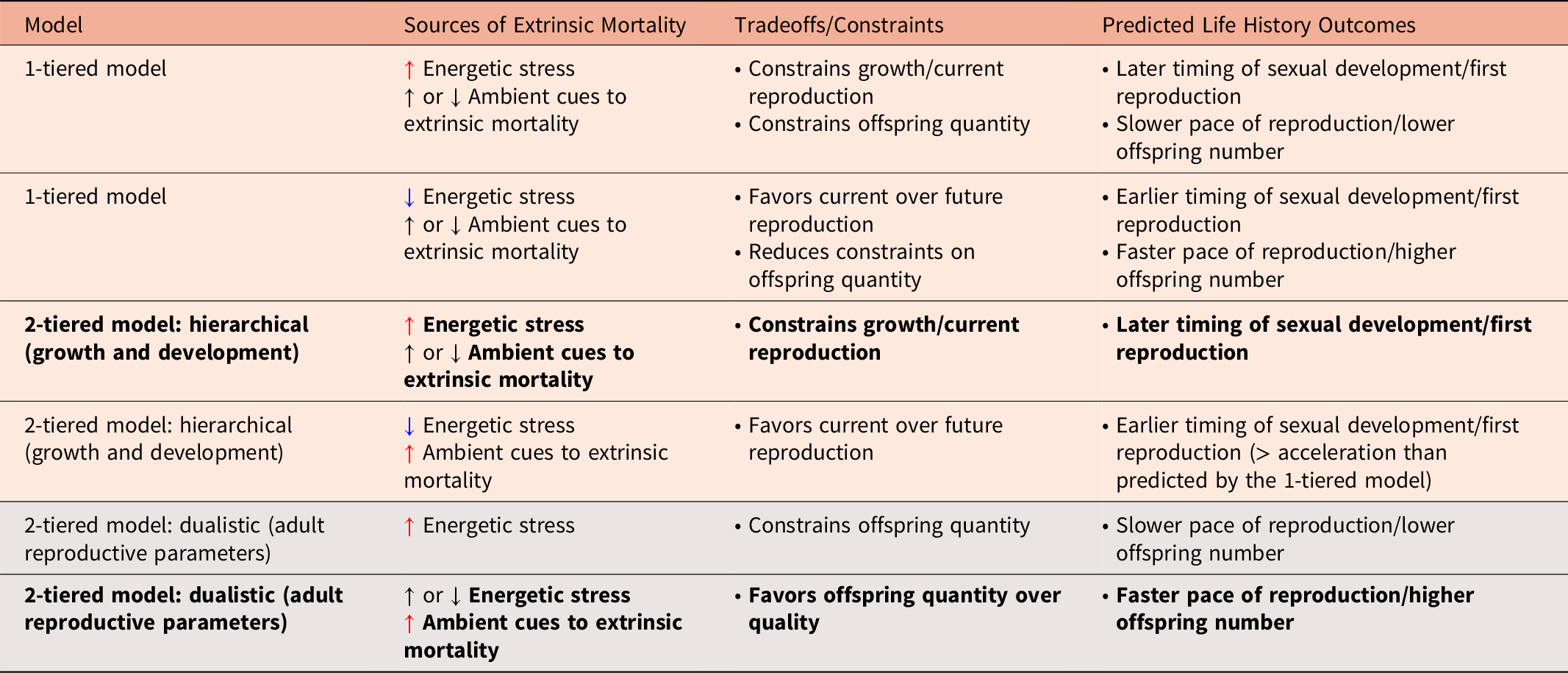




Target article
Two tiers, not one: Different sources of extrinsic mortality have opposing effects on life history traits
Related commentaries (29)
Applying Life-History Theory to Development: A Two-Tiered Model All Along?
Child versus adult probabilities of death and their effects on under-25 and total fertility: a test using over 30 years of panel data from 204 countries and territories
Cognitive and affective processes mediate the effects of environmental factors on life history outcomes
Competitive stress and life-history mismatch
Density slows, while pathogens and disasters accelerate life history within populations
Extrinsic mortality and life histories: strategic response or accidental association?
Extrinsic mortality is not the same as diminishing marginal returns on mortality reduction
Food environments shape the way mortality influences life-history trajectories
From shyness to attachment: social behaviors as adaptive responses to environmental stress
Hierarchical relationship? Only development will tell
Hierarchical response models: new perspectives on development
Implication of two-tiered life-history model for contemporary fertility trends in modern societies
Is feminism capable of slowing down life history strategies?
Life-history theory, multilevel selection, and the mereological fallacy
Mortality cues in a high-resource context: Minority stress, suicide exposure, and pubertal development
No need for tiers to explain the ecological predictors of human life history strategies
Nuanced in theory, tricky in practice: falsifiability, timing, and curvilinearity of Tier 1 and 2 effects
Operational and conceptual confusion in life history research necessitates the two-tiered model
Predicting, advancing, and rescuing human life-history strategies and sustainability from extrinsic mortality in extreme-Earth and extra-Earth niches
Revisiting demography in order to develop more complex life history models
Social context links energetic and developmental accounts of life history
Social inequalities as sources of extrinsic mortality: implications of the two-tiered model
The challenge of incorporating unpredictability into a two-tiered model
The interaction between social factors and biological factors: supplementary reflections on the two-tiered life history model
The mortality-fertility relationship from the economic demography perspective
The two-tier model: an unbalanced view
The two-tiered model resolves key questions on extrinsic mortality and fertility
Two-tiers of life history: straw men, polar bears, and confusing causation
What is essential for life and life history research?
Author response
The two-tiered life history model: from interrogating assumptions to refining concepts and hypotheses