Refine search
Actions for selected content:
42 results
On the effective non-vanishing of Hecke–Maass L-functions at special points
- Part of
-
- Journal:
- Canadian Journal of Mathematics , First View
- Published online by Cambridge University Press:
- 23 September 2026, pp. 1-41
-
- Article
-
- You have access
- HTML
- Export citation
-
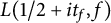
In this article, we consider the non-vanishing problem for the family of special Hecke–Maass L-values $ L (1/2+it_f, f) $
 with $f (z)$
 in an orthonormal basis of (even or odd) Hecke–Maass cusp forms of Laplace eigenvalue $1/4 + t_f^2$
 ($t_f> 0$
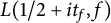
 ). We prove that 20% of $L (1/2+it_f, f)$
 for $ t_f \leqslant T$
 do not vanish as $T \rightarrow \infty $
 . For comparison, it is known that the non-vanishing proportion is at least 25% for the central L-values $L (1/2, f)$
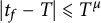
 . Further, 20% may be raised to 50% conditionally on the generalized Riemann hypothesis. Moreover, we prove non-vanishing results on the short interval $|t_f-T| \leqslant T^{\mu }$
 for any $0 < \mu < 1$
 .


PRODUCT OF RANKIN-SELBERG CONVOLUTIONS AND A NEW PROOF OF JACQUET’S LOCAL CONVERSE CONJECTURE
- Part of
-
- Journal:
- Journal of the Institute of Mathematics of Jussieu / Volume 25 / Issue 6 / November 2026
- Published online by Cambridge University Press:
- 10 August 2026, pp. 3287-3361
- Print publication:
- November 2026
-
- Article
-
- You have access
- HTML
- Export citation
-
This article constructs a family of integrals representing the product of Rankin–Selberg L-functions for ${\mathrm {GL}}_l \times {\mathrm {GL}}_m$
 and ${\mathrm {GL}}_l \times {\mathrm {GL}}_n$
 in the regime $m+n<l$
 . When $n=0$
 , these integrals reduce (up to a shift) to the classical Rankin-Selberg convolution integrals of Jacquet–Piatetski-Shapiro–Shalika (JPSS), thereby generalizing the JPSS integrals. We establish their basic properties and use them to define local gamma factors. As an application, we provide a new proof of Jacquet’s local converse conjecture.


The shifted fourth moment of modular form L-functions in the weight aspect
- Part of
-
- Journal:
- Canadian Journal of Mathematics , First View
- Published online by Cambridge University Press:
- 05 January 2026, pp. 1-54
-
- Article
-
- You have access
- HTML
- Export citation
Hybrid subconvexity for Maass form symmetric-square L-functions
- Part of
-
- Journal:
- Proceedings of the Royal Society of Edinburgh. Section A: Mathematics , First View
- Published online by Cambridge University Press:
- 29 December 2025, pp. 1-51
-
- Article
-
- You have access
- HTML
- Export citation
-
Recently R. Khan and M. Young proved a mean Lindelöf estimate for the second moment of Maass form symmetric-square
 $L$-functions
 $L(\operatorname{sym}^2 u_{j},1/2+it)$ on the short interval of length
 $G\gg |t_j|^{1+\epsilon}/t^{2/3}$, where
 $t_j$ is a spectral parameter of the corresponding Maass form. Their estimate yields a subconvexity estimate for
 $L(\operatorname{sym}^2 u_{j},1/2+it)$ as long as
 $|t_j|^{6/7+\delta}\ll t \lt (2-\delta)|t_j|$. We obtain a mean Lindelöf estimate for the same moment in shorter intervals, namely for
 $G\gg |t_j|^{1+\epsilon}/t$. As a corollary, we prove a subconvexity estimate for
 $L(\operatorname{sym}^2 u_{j},1/2+it)$ on the interval
 $|t_j|^{2/3+\delta}\ll t\ll |t_j|^{6/7-\delta}$.


Conditional lower bounds on the distribution of central values: The case of modular forms
- Part of
-
- Journal:
- Canadian Journal of Mathematics , First View
- Published online by Cambridge University Press:
- 01 December 2025, pp. 1-30
-
- Article
-
- You have access
- HTML
- Export citation
-
Radziwiłł and Soundararajan unveiled a connection between low-lying zeros and central values of L-functions, which they instantiated in the case of quadratic twists of an elliptic curve. This article addresses the case of the family of modular forms in the level aspect, and proves that the logarithms of central values of associated L-functions approximately distribute along a normal law with mean
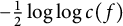 $-\tfrac 12 \log \log c(f)$ and variance
 $\log \log {c(f)}$, where
 $c(f)$ is the analytic conductor of f, as predicted by the Keating–Snaith conjecture.


8 - A Primer on Zeta Functions and Decomposition Spaces
-
-
- Book:
- Moduli, Motives and Bundles
- Published online:
- 31 October 2025
- Print publication:
- 20 November 2025, pp 233-264
-
- Chapter
- Export citation
Equivalence between the functional equation and Voronoï-type summation identities for a class of L-functions
- Part of
-
- Journal:
- Proceedings of the Royal Society of Edinburgh. Section A: Mathematics / Volume 156 / Issue 4 / August 2026
- Published online by Cambridge University Press:
- 25 November 2024, pp. 1480-1520
- Print publication:
- August 2026
-
- Article
-
- You have access
- HTML
- Export citation
-
To date, the bestmethodsfor estimating the growth of mean values of arithmetic functions rely on the Voronoï summation formula. By noticing a general pattern in the proof of his summation formula, Voronoï postulated that analogous summation formulas for
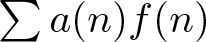 $\sum a(n)f(n)$ can be obtained with ‘nice’ test functions f(n), provided a(n) is an ‘arithmetic function’. These arithmetic functions a(n) are called so because they are expected to appear as coefficients of some L-functions satisfying certain properties. It has been well-known that the functional equation for a general L-function can be used to derive a Voronoï-type summation identity for that L-function. In this article, we show that such a Voronoï-typesummation identity in fact endows the L-function with some structural properties, yielding in particular the functional equation. We do this by considering Dirichlet series satisfying functional equations involving multiple Gamma factors and show that a given arithmetic function appears as a coefficient of such a Dirichlet series if and only if it satisfies the aforementioned summation formulas.
Results on the non-vanishing of derivatives of L-functions of vector-valued modular forms
- Part of
-
- Journal:
- Proceedings of the Edinburgh Mathematical Society / Volume 68 / Issue 1 / February 2025
- Published online by Cambridge University Press:
- 21 November 2024, pp. 63-79
-
- Article
-
- You have access
- Open access
- HTML
- Export citation
On the root of unity ambiguity in a formula for the Brumer–Stark units
- Part of
-
- Journal:
- Canadian Mathematical Bulletin / Volume 67 / Issue 3 / September 2024
- Published online by Cambridge University Press:
- 27 December 2023, pp. 611-623
- Print publication:
- September 2024
-
- Article
-
- You have access
- HTML
- Export citation
An approximation formula for the shifted cubic moment of automorphic L-functions in the weight aspect
- Part of
-
- Journal:
- Canadian Journal of Mathematics / Volume 77 / Issue 3 / June 2025
- Published online by Cambridge University Press:
- 06 September 2023, pp. 715-738
- Print publication:
- June 2025
-
- Article
-
- You have access
- HTML
- Export citation
MOMENTS AND HYBRID SUBCONVEXITY FOR SYMMETRIC-SQUARE L-FUNCTIONS
- Part of
-
- Journal:
- Journal of the Institute of Mathematics of Jussieu / Volume 22 / Issue 5 / September 2023
- Published online by Cambridge University Press:
- 06 December 2021, pp. 2029-2073
- Print publication:
- September 2023
-
- Article
-
- You have access
- HTML
- Export citation
-
We establish sharp bounds for the second moment of symmetric-square L-functions attached to Hecke Maass cusp forms
 $u_j$ with spectral parameter
 $t_j$, where the second moment is a sum over
 $t_j$ in a short interval. At the central point
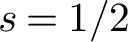 $s=1/2$ of the L-function, our interval is smaller than previous known results. More specifically, for
 $\left \lvert t_j\right \rvert $ of size T, our interval is of size
 $T^{1/5}$, whereas the previous best was
 $T^{1/3}$, from work of Lam. A little higher up on the critical line, our second moment yields a subconvexity bound for the symmetric-square L-function. More specifically, we get subconvexity at
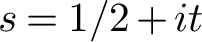 $s=1/2+it$ provided
 $\left \lvert t_j\right \rvert ^{6/7+\delta }\le \lvert t\rvert \le (2-\delta )\left \lvert t_j\right \rvert $ for any fixed
 $\delta>0$. Since
 $\lvert t\rvert $ can be taken significantly smaller than
 $\left \lvert t_j\right \rvert $, this may be viewed as an approximation to the notorious subconvexity problem for the symmetric-square L-function in the spectral aspect at
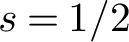 $s=1/2$.


EXTREME VALUES OF GEODESIC PERIODS ON ARITHMETIC HYPERBOLIC SURFACES
- Part of
-
- Journal:
- Journal of the Institute of Mathematics of Jussieu / Volume 21 / Issue 5 / September 2022
- Published online by Cambridge University Press:
- 22 December 2020, pp. 1507-1542
- Print publication:
- September 2022
-
- Article
-
- You have access
- Export citation
Bounds for twisted symmetric square L-functions via half-integral weight periods
- Part of
-
- Journal:
- Forum of Mathematics, Sigma / Volume 8 / 2020
- Published online by Cambridge University Press:
- 09 November 2020, e44
-
- Article
-
- You have access
- Open access
- Export citation
-
We establish the first moment bound
$$\begin{align*}\sum_{\varphi} L(\varphi \otimes \varphi \otimes \Psi, \tfrac{1}{2}) \ll_\varepsilon p^{5/4+\varepsilon} \end{align*}$$for triple product L-functions, where
 $\Psi $ is a fixed Hecke–Maass form on
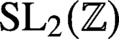 $\operatorname {\mathrm {SL}}_2(\mathbb {Z})$ and
 $\varphi $ runs over the Hecke–Maass newforms on
 $\Gamma _0(p)$ of bounded eigenvalue. The proof is via the theta correspondence and analysis of periods of half-integral weight modular forms. This estimate is not expected to be optimal, but the exponent
 $5/4$ is the strongest obtained to date for a moment problem of this shape. We show that the expected upper bound follows if one assumes the Ramanujan conjecture in both the integral and half-integral weight cases.
Under the triple product formula, our result may be understood as a strong level aspect form of quantum ergodicity: for a large prime p, all but very few Hecke–Maass newforms on
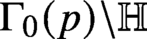 $\Gamma _0(p) \backslash \mathbb {H}$ of bounded eigenvalue have very uniformly distributed mass after pushforward to
 $\operatorname {\mathrm {SL}}_2(\mathbb {Z}) \backslash \mathbb {H}$.
Our main result turns out to be closely related to estimates such as
$$\begin{align*}\sum_{|n| < p} L(\Psi \otimes \chi_{n p},\tfrac{1}{2}) \ll p, \end{align*}$$where the sum is over those n for which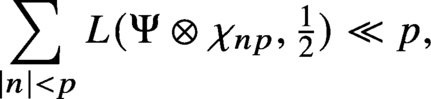
 $n p$ is a fundamental discriminant and
 $\chi _{n p}$ denotes the corresponding quadratic character. Such estimates improve upon bounds of Duke–Iwaniec.


Branching laws for classical groups: the non-tempered case
- Part of
-
- Journal:
- Compositio Mathematica / Volume 156 / Issue 11 / November 2020
- Published online by Cambridge University Press:
- 17 December 2020, pp. 2298-2367
- Print publication:
- November 2020
-
- Article
-
- You have access
- HTML
- Export citation
-
This paper generalizes the Gan–Gross–Prasad (GGP) conjectures that were earlier formulated for tempered or more generally generic L-packets to Arthur packets, especially for the non-generic L-packets arising from Arthur parameters. The paper introduces the key notion of a relevant pair of Arthur parameters that governs the branching laws for
 ${{\rm GL}}_n$ and all classical groups over both local fields and global fields. It plays a role for all the branching problems studied in Gan et al. [Symplectic local root numbers, central critical L-values and restriction problems in the representation theory of classical groups. Sur les conjectures de Gross et Prasad. I, Astérisque 346 (2012), 1–109] including Bessel models and Fourier–Jacobi models.

Large values of Dirichlet L-functions at zeros of a class of L-functions
- Part of
-
- Journal:
- Canadian Journal of Mathematics / Volume 73 / Issue 6 / December 2021
- Published online by Cambridge University Press:
- 01 July 2020, pp. 1459-1505
- Print publication:
- December 2021
-
- Article
-
- You have access
- Export citation
-
In this paper, we are interested in obtaining large values of Dirichlet L-functions evaluated at zeros of a class of L-functions, that is,
$$ \begin{align*}\max_{\substack{F(\rho)=0\\ T\leq \Im \rho \leq 2T}}L(\rho,\chi), \end{align*} $$where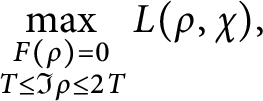
 $\chi $ is a primitive Dirichlet character and F belongs to a class of L-functions. The class we consider includes L-functions associated with automorphic representations of
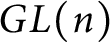 $GL(n)$ over
 ${\mathbb {Q}}$.


Corrigendum: Around
 $\boldsymbol{\ell }$-independence
- Part of
-
- Journal:
- Compositio Mathematica / Volume 156 / Issue 6 / June 2020
- Published online by Cambridge University Press:
- 29 May 2020, pp. 1262-1274
- Print publication:
- June 2020
-
- Article
-
- You have access
- HTML
- Export citation
-
We correct the proof of the main
 $\ell$-independence result of the above-mentioned paper by showing that for any smooth and proper variety over an equicharacteristic local field, there exists a globally defined such variety with the same (
 $p$-adic and
 $\ell$-adic) cohomology.


Simple zeros of automorphic
 $L$-functions
- Part of
-
- Journal:
- Compositio Mathematica / Volume 155 / Issue 6 / June 2019
- Published online by Cambridge University Press:
- 30 May 2019, pp. 1224-1243
- Print publication:
- June 2019
-
- Article
-
- You have access
- HTML
- Export citation
-
We prove that the complete
 $L$-function associated to any cuspidal automorphic representation of
 $\operatorname{GL}_{2}(\mathbb{A}_{\mathbb{Q}})$ has infinitely many simple zeros.


Around
 $\ell$ -independence
- Part of
-
- Journal:
- Compositio Mathematica / Volume 154 / Issue 1 / January 2018
- Published online by Cambridge University Press:
- 17 October 2017, pp. 223-248
- Print publication:
- January 2018
-
- Article
-
- You have access
- HTML
- Export citation
-
In this article we study various forms of
 $\ell$ -independence (including the case
 $\ell =p$ ) for the cohomology and fundamental groups of varieties over finite fields and equicharacteristic local fields. Our first result is a strong form of
 $\ell$ -independence for the unipotent fundamental group of smooth and projective varieties over finite fields. By then proving a certain ‘spreading out’ result we are able to deduce a much weaker form of
 $\ell$ -independence for unipotent fundamental groups over equicharacteristic local fields, at least in the semistable case. In a similar vein, we can also use this to deduce
 $\ell$ -independence results for the cohomology of smooth and proper varieties over equicharacteristic local fields from the well-known results on
 $\ell$ -independence for smooth and proper varieties over finite fields. As another consequence of this ‘spreading out’ result we are able to deduce the existence of a Clemens–Schmid exact sequence for formal semistable families. Finally, by deforming to characteristic
 $p$ , we show a similar weak version of
 $\ell$ -independence for the unipotent fundamental group of a semistable curve in mixed characteristic.


On the fourth moment of Hecke–Maass forms and the random wave conjecture
- Part of
-
- Journal:
- Compositio Mathematica / Volume 153 / Issue 7 / July 2017
- Published online by Cambridge University Press:
- 02 May 2017, pp. 1479-1511
- Print publication:
- July 2017
-
- Article
-
- You have access
- HTML
- Export citation
BEYOND ENDOSCOPY FOR THE RELATIVE TRACE FORMULA II: GLOBAL THEORY
- Part of
-
- Journal:
- Journal of the Institute of Mathematics of Jussieu / Volume 18 / Issue 2 / March 2019
- Published online by Cambridge University Press:
- 24 April 2017, pp. 347-447
- Print publication:
- March 2019
-
- Article
-
- You have access
- Export citation
-
For the group
 $G=\operatorname{PGL}_{2}$ we perform a comparison between two relative trace formulas: on the one hand, the relative trace formula of Jacquet for the quotient
 $T\backslash G/T$, where
 $T$ is a nontrivial torus, and on the other the Kuznetsov trace formula (involving Whittaker periods), applied to nonstandard test functions. This gives a new proof of the celebrated result of Waldspurger on toric periods, and suggests a new way of comparing trace formulas, with some analogies to Langlands’ ‘Beyond Endoscopy’ program.


