To save content items to your account,
please confirm that you agree to abide by our usage policies.
If this is the first time you use this feature, you will be asked to authorise Cambridge Core to connect with your account.
Find out more about saving content to .
To save content items to your Kindle, first ensure no-reply@cambridge.org
is added to your Approved Personal Document E-mail List under your Personal Document Settings
on the Manage Your Content and Devices page of your Amazon account. Then enter the ‘name’ part
of your Kindle email address below.
Find out more about saving to your Kindle.
Note you can select to save to either the @free.kindle.com or @kindle.com variations.
‘@free.kindle.com’ emails are free but can only be saved to your device when it is connected to wi-fi.
‘@kindle.com’ emails can be delivered even when you are not connected to wi-fi, but note that service fees apply.
This is a concluding chapter that summarizes previous findings. The importance of greater cultural competence on the part of elites is a particular emphasis.
This paper examines how senior executives at the UK’s largest publicly listed companies financially benefited from the Coronavirus Job Retention Scheme (CJRS), and seeks to explain this phenomenon with the concept of elite welfare. Using a difference-in-differences research design, we analyse the impact of participation in the CJRS on executive remuneration between 2019 and 2023. Drawing on a sample of Financial Times Stock Exchange (FTSE) 350 firms (n = 246), we find that receipt of furlough support in 2020 was associated with significant increases in chief executive officer (CEO) performance pay and total remuneration in the immediate post-pandemic year. We interpret these results through a new analytical approach that understands elite income derived from rent-extraction facilitated by public policy or expenditure as a form of welfare. Unlike conventional welfare, which typically comprises relatively modest payments and concessions to broad sections of the population, elite welfare accrues to a small minority in privileged positions, taking the form of extractions of rent arising through opportunities created by government policy. We argue that recognising elite welfare as a parallel welfare system – largely insulated from competitive constraint and market discipline – provides a valuable new perspective on the interdependencies between inequality, public policy and the redistributive logics of the modern state.
This article provides a multi-dimensional perspective on parliamentary composition in an era of political turbulence. It extends existing turnover models by proposing a three-dimensional framework to understand persistence which includes the structure of the ballot, electoral volatility and institutional career opportunities. Using novel comparative data from 14 European democracies (1965–2021), where we distinguish between newcomers, seniors (3+ terms) and super-seniors (5+ terms), we find that persistence is most likely in politico-institutional contexts characterised by candidate control over ballot access, low electoral volatility and unicameral legislatures. Super-seniors seem to occupy an advantaged position, as prior seniority levels strongly shape subsequent ones, and they are also less vulnerable to electoral shocks. At the same time, we descriptively show that none of the countries in our sample provide the full configuration conducive to persistence, suggesting that contemporary democracies contain institutional arrangements that promote circulation within the legislative elite and limit concentration.
Upper-class people have long described near-total turnover from “old” to “new” money during major socioeconomic shifts, but quantitative measures of elite persistence often contradict their claims. Oil boom Dallas is one such case. Midcentury Dallas socialites consistently alleged that “new money” oil families replaced “old money” cotton families during the 1930s oil boom, but a dataset of the full upper class (n = 12,353) and most wealthy oilmen (n = 325) demonstrates that cotton families generally remained upper class, oilmen were mostly born upper class, and most upper-class people had both cotton men and oilmen somewhere in their family networks. What explains the disparity between upper-class perceptions and demographic reality? I argue that upper-class social worlds are often perceived and narrativized in terms of “prototypical elites,” who are especially wealthy and tied to regionally specific industries. Elite perceptions of total turnover reflect real churn among prototypical tycoons rather than churn among the upper class as a whole. Approaches to the study of elites and inequality that focus on ultra-rich individuals divorced from their relational contexts similarly overemphasize change and underemphasize persistence.
Russia’s superwealthy and politically influential elites – or oligarchs – were created during the privatization of the 1990s. After Putin came to power in 2000, he subordinated the oligarchs to the state: The oligarchs could keep their fortunes as long as they supported the Kremlin’s priorities. Multiple oligarchs have underwritten Putin’s ongoing war against Ukraine. Three types of oligarchs can be distinguished today: Putin’s friends, the silovarchs, and the outsiders. As a whole, the oligarchs seek more predictability from the Kremlin and more security for their assets – but they do not necessarily desire democracy or the rule of law proper. The oligarchs cannot force the Kremlin to guarantee their property rights due to the internal divisions among themselves, as well as the Kremlin’s complete control of coercion.
Violent upheavals in landownership following conquest often change not only the concentration of land across individuals, but also the inequality of its distribution between groups. We argue that variation in landowners’ group identity has important implications for the provision of local public goods. We test this claim by studying the aftermath of the Cromwellian Settlement in seventeenth-century Ireland. Leveraging the lottery-based allocation of expropriated Catholic land to distinct groups of English Protestants, we find significant local variation in the extent of Protestant landownership. Drawing on rich original data, we find fewer local public goods in the long run in areas with more Protestant elites, with the largest reductions in goods that were either directly elite-funded or disproportionately benefited the Catholic majority. The results illustrate how conquest reshapes not just institutions but also long-run local inequalities, and highlight the distinct consequences of between-group inequality for the provision of public goods.
This article explores the strategies of politicians from the pastoralist Samburu of northern Kenya since the country’s 2013 devolution – a reform ostensibly designed to remedy Kenya’s corrosive and often violent elite politics. Drawing on ethnographic data gathered between 2021 and 2025, I argue that devolution has rendered the political arena in north-central Kenya more diffuse, convoluted and contested. Ahead of elections, shifting coalitions of actors – cutting across the political structures and scales created by devolution – deploy the material rewards of government to intervene in Samburu beliefs around cattle prestige, gerontocratic norms and spiritual life. They do so to assert political influence, mobilise violence against rival groups, and win local elections. Rather than resolving Kenya’s elite problems, devolution has thus refracted them through new structures, producing distinctive patterns of power and violence across the northern pastoralist landscape.
Large corporations increasingly shape economic and political life, often beyond public oversight. This chapter examines how market concentration, lobbying, and financialization distort competition and policymaking. It traces the emergence of a global economic elite whose influence undermines democratic accountability and inclusive growth. The chapter proposes antitrust reforms, corporate transparency, and institutional checks to limit excess power. Ensuring capitalism serves the public interest requires rebalancing the relationship between business and the state.
This article explores how people imagine a 21st-century persona-indexing register as emanating from a 19th-century person-indexing register. The persona in question is the Philippine conyo, regarded as spoiled, empty-headed, rich kids who speak a distinct style of “Taglish” (Tagalog-English). The person in question is José Rizal, one of the most celebrated Filipino historical figures. Drawing on ethnographic and media data, I trace how Rizal is regarded as “the original conyo,” as its first author or animator. Examining how this type-token interdiscursive link between persona and person plays on the inversion of a chronotopic frame, I consider what conceptualizing elite historical continuity accomplishes socially and economically. I argue that citing Rizal creates a channel to move value.
Under the usual rules of US political parties, candidates are vetted by party insiders, and people who lose a presidential race don’t get a second shot. Trump defied this and many other historical traditions. Understanding this means understanding election narratives and beliefs about electability, and how those in the GOP today are different from what they were in the past and what the Democratic Party has. The chapter provides a book outline.
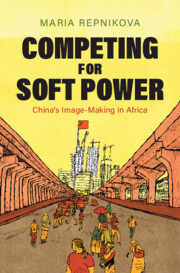
Through the critical case study of Ethiopia, Maria Repnikova examines the ambitious but disjointed display of Chinese diplomatic influence in Africa. In doing so, she develops a new theoretical approach to understanding China's practice of soft power, identifying the core mechanisms as tangible enticement with material and experiential offerings, ideational promotion of values, visions, and governance practices, and censorial power over the production and dissemination of China narratives. Through in-depth field work, including interviews and focus groups, Repnikova builds a clear picture of the uneven implementation and reception of this image-making, in which Chinese messengers can improvise official agendas, and Ethiopian recipients can strategically appropriate and negotiate Chinese power. Contrary to popular claims about China replacing the West in the Global South, this innovative research reveals the successes, but also the inconsistencies and limitations of Chinese influence, as well as the ever-present shadow of the West in mediating soft-power encounters.
Durable social connections are priceless resources for support, companionship, and opportunity. They make life worth living. However, not everyone has equal access to these seemingly free social resources. Like many other valuable things in life, 'social capital' is both a source and a consequence of inequality throughout the population – something that reinforces the status quo and existing social hierarchies. In Friends and Fortunes, the authors painstakingly document that the distribution of social connections in American society is as stark as income inequality. Through detailed analyses and colorful real-life illustrations, they reveal how rich elites hoard both the most prized and the most deceptively frivolous social ties. Drawing on over one hundred measures of social capital from dozens of datasets and over one million people, they explain how social networks create a remarkable and omnipresent web of connections that subtly feed hidden systems of power, prestige, wealth and, ultimately, life chances.
Chapter 4 surveys the ways in which imperial officials were represented in various forms of late ancient Christian literature. In so doing, it acts as an introduction to Part II, which explores how contemporaries conceived of distinctly Christian forms of political service in this period. There is not a straightforward ‘archive’ of sources for this problem. Texts on government by current or former administrators do not tend to discuss the implications of their religious identities. As a result, it is rare that we can reconstruct an officeholder’s own perspective. At the same time—and in sharp contrast to other Christian authority figures (emperors, bishops, ascetics)—there is no single genre of Christian literature which focuses consistently on the careers of imperial or royal officials. This chapter thus considers how the purposes, audiences and generic expectations of letters, sermons, church histories, and saints’ lives shaped (and sometimes demanded) positive portrayals of officials, their religious identities, and their interactions with Christian communities and authority figures.
Part III of this book reconstructs expectations of official churchgoing and entanglements with churchmen and Christian institutions in select political environments across the fifth and sixth centuries. Ch. 6 pursues this problem in the best attested of these: the Eastern imperial capital of Constantinople. It begins by charting norms of imperial religious observance. Eastern emperors seem to have attended public churches at major festivals and special occasions. Various reports suggest that when the emperor went to church, those who served them (and the senatorial aristocracy as a collective) were supposed to go too. Within these politics of church attendance, the bishop of Constantinople represents a surprisingly peripheral figure. Although some courtiers and bureaucrats were regular attendees at Hagia Sophia, they seem to have kept themselves at a critical distance from the bishop’s pastoral authority. As with other members of the Constantinopolitan elite, many imperial officials focused their Christian identities on activities within their own households, whether these were dynastic commemorations, building projects, patronage arrangements for clerics, monastic start-ups, or their own ascetic practices. This chapter shows how the religious practices and affiliations of these ‘over-mighty congregants’ were also shaped by the corporate Christianity of the imperial palace, consistory, and Senate.
This chapter investigates Pindar’s construction of the relationships by which communities are constituted: relationships between families, individuals, and the polis; between the inhabitants of the polis and their past; and between different polis communities. It surveys civic values, as well as the passages where Pindar discusses specific constitutional forms. Because Pindar’s lyric expresses political issues through the lens of poetic concerns, assimilating civic and military conflict to vicissitude, it maps some of the strategies by which Pindar subsumes the political into the poetic. A final focus is the nature of Pindar’s Panhellenism and the connection of Panhellenism to elite mobility. Pindar’s Panhellenism projects competitively local claims for eminence into a broad Greek arena and characterises the mythico-historical past of Greek cities as one of migration and elite movement. The interaction of local identity with the Panhellenic arena is thus driven by the mobility of heroic and then athletic elites.
This article highlights the role of a Parisian primary public school serving elite demographics in shaping children’s class identities by teaching privilege management. Based on a year of ethnographic observations in 4th and 5th grade classrooms, this study examines the daily practices of a privileged school and its philanthropy program, Giving is Good. Drawing on critical scholarship on the education of elites, exposure and intervention are the two mechanisms through which the class transforms children’s immediate social environment into a resource for philanthropic engagement. The results indicate that privilege management generates a disposition to talk about and navigate inequality with ease while maintaining face and privilege. Results also show a profound gendered discrepancy in how children “learn to give.” In light of recent evolutions in citizenship education, the article discusses the implications of teaching philanthropy in public schools for political culture and how privileged children learn to think about other children who do not belong to the same social class.
This chapter turns to the elite reaction to broader provincial claims about legality. Rather than putting the courtroom at the center of their legal imaginary, Greek elites reimagined themselves as transcending normal administrative processes. Through their physical self-presentation, through their beautiful speech, and through their ability to create particular affective states in their interlocutors, they sought to achieve thauma: a state of amazement that obviated the need for legal judgment. The Greek rhetoric of the "Second Sophistic" is, on this reading, a sort of anti-legalism: by replacing legal judgment with aesthetic evaluation, elites attempted to preserve their positions - and their physical bodies - from degradation and punishment.
This paper critically examines the concept of populism, challenging the predominant ideological definition by highlighting the importance of political relations between populist actors and elites. It argues that populism should be conceptualized as a political phenomenon characterized by conflict with dominant elites, rather than solely as a set of ideas centered on ‘the people’ and ‘elites’. Through a comparative analysis of four politicians – Tony Blair, Emmanuel Macron, Jeremy Corbyn, and Jean-Luc Mélenchon – the study demonstrates that although some actors utilize populist rhetoric, their tendency to generate conflict with elites distinguishes populist actors from other uses of populist ideas. The cases empirically demonstrate that ‘softer’ cases of populism indeed do not contain conflict and, thus, according to my approach, are not really populist. Thus, I demonstrate the inclination of ideational definitions to overstretch the concept of populism.
Part III of the book looks at the beginnings and purposes of local history-writing. Chapter 7 makes a case for what made local history-writing a popular alternative to other forms of history-writing, particularly universal history but also some other forms as well. It briefly presents the rare occasions on which local histories from the early Islamic centuries say something specific about why they were inspired to compile their work. It then considers some arguments made by other modern historians, for example seeing local history-writing against the context of political fragmentation and ideas about local pride. The chapter then argues that the beginnings of local history-writing have to be understood against the context of emerging ideas about scholarly authority in the Islamic world, particularly the ideas pushed by scholars from Medina, most prominently Mālik b. Anas and his students, offering a historiographical justification for the distinctive authority of the scholars from that town.
Part I of the book provides the framework and contexts for appreciating the significance of local history-writing. Chapter 1 deals with the different professional and elite groups who were the principal producers of history in the early Islamic world. Many works were produced by those loosely known as religious scholars (ʿulamāʾ, sing. ʿālim), but other professional groups such as government chancery officials and administrators (kuttāb, sing. kātib) are considered as well, as are those who can be very loosely labelled litterateurs (udabāʾ, sing. adīb). The chapter investigates how these groups thought about themselves as communities and how they derived social authority as elites. It is frequently assumed that these groups used history-writing as one way of underpinning their authority, but it is less frequently examined explicitly how such authority operated. Since this book absolutely agrees with the now well-established principal that history-writing supported the position and authority of relevant groups, it is important to establish in what precise ways this worked and what the opportunities to exercise authority were to those groups whose members produced local histories.